Accounting for Educational Institutions in the UAE: A Complete Guide
The education sector in the UAE has experienced remarkable growth over the past decade. From private schools and universities to vocational training…
Read article
Are your business invoicing processes ready to meet the UAE’s electronic invoicing requirements? Non-compliance with the Electronic Invoicing System can result in administrative fines, making it important for businesses to understand their responsibilities before implementation deadlines and ongoing reporting obligations.
The UAE Cabinet has issued Cabinet Decision No. 173 of 2026, establishing administrative penalties for violations of the legislation regulating the Electronic Invoicing System. Understanding the UAE Electronic Invoicing Penalties can help businesses identify potential compliance gaps, review their invoicing arrangements and maintain accurate electronic transaction records.
This guide explains the key provisions of the decision, the applicable fines and the steps businesses should consider to support compliance.
Cabinet Decision No. 173 of 2026 establishes administrative penalties for violations of the legislation regulating the UAE Electronic Invoicing System.
The decision operates under Federal Decree-Law No. 28 of 2022 on Tax Procedures and refers to the relevant ministerial decisions governing electronic invoicing.
It defines two important parties:
The decision applies to violations of the legislation regulating electronic invoicing. However, it excludes persons who issue, transmit, share, exchange or report electronic invoices and electronic credit notes voluntarily under the relevant decisions.
This distinction is important for businesses that have adopted electronic invoicing before becoming subject to mandatory implementation.
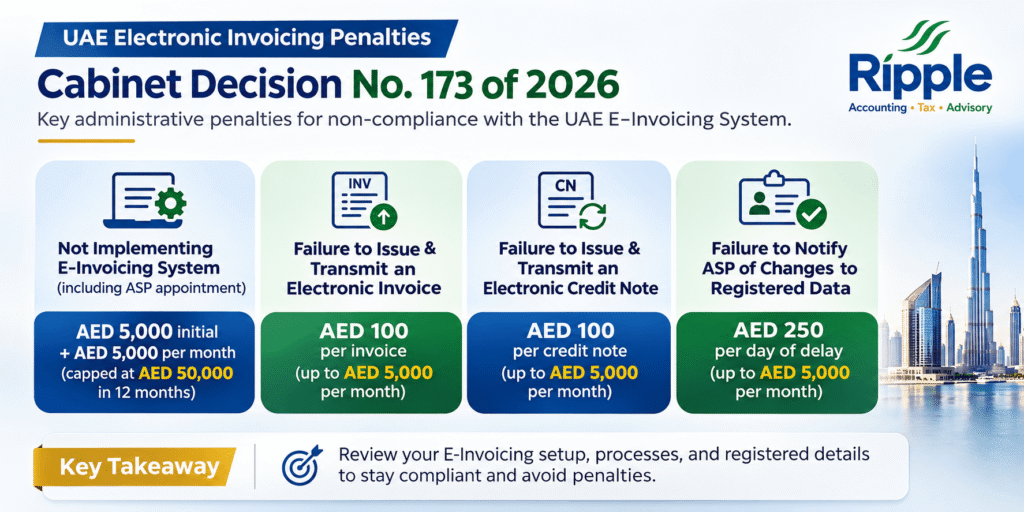
The decision establishes four categories of violations, each with a specific administrative penalty. Businesses should understand these amounts because the financial consequences vary depending on the nature and duration of non-compliance.
The following table summarises the UAE Electronic Invoicing Penalties listed in the decision.
| Violation | Administrative penalty |
| Failure to implement the Electronic Invoicing System, including failure to appoint an Accredited Service Provider | AED 5,000 for the first instance, plus AED 5,000 for each month or part thereof that non-compliance continues, subject to a maximum of AED 50,000 within 12 consecutive months |
| Failure to issue and transmit an electronic invoice | AED 100 per invoice, up to AED 5,000 per calendar month |
| Failure to issue and transmit an electronic credit note | AED 100 per credit note, up to AED 5,000 per calendar month |
| Failure to notify the appointed Accredited Service Provider of changes to information registered with the Authority | AED 250 for each day of delay or part thereof, up to AED 5,000 per calendar month |
These penalties are specified in the table annexed to Cabinet Decision No. 173 of 2026.
One of the main compliance risks concerns businesses that fail to implement the Electronic Invoicing System according to the applicable requirements.
Under the decision, an issuer or recipient may face a penalty if they fail to implement the system in accordance with Ministerial Decision No. 244 of 2025, its amendments or any decision replacing it.
The violation also includes failure to appoint an Accredited Service Provider (ASP).
The penalty structure is:
For example, a business that fails to implement the required system may face the initial AED 5,000 penalty and further monthly penalties if the non-compliance continues. However, the total penalty under this category cannot exceed AED 50,000 within a 12-month consecutive period.
The revised provision also expressly addresses both issuers and recipients, making it important for businesses to review their responsibilities on both sides of an electronic transaction.
Businesses required to use the Electronic Invoicing System must issue and transmit electronic invoices to recipients through the prescribed system.
Failure to complete this process can result in an administrative penalty of AED 100 for each electronic invoice that is not properly issued and transmitted. The total penalty cannot exceed AED 5,000 per calendar month.
For businesses processing a high volume of transactions, missing invoices can create additional compliance risks. Maintaining organised sales records, reviewing invoice generation processes and monitoring successful transmission can help reduce these issues.
Businesses should also ensure that their invoicing arrangements support the required electronic exchange rather than relying only on manually prepared documents.
The decision also addresses non-compliance involving electronic credit notes. An electronic credit note is a document issued, transmitted and received in a structured electronic format that enables automatic and electronic processing through the Electronic Invoicing System.
If an issuer fails to issue and transmit an electronic credit note to the recipient through the system, the applicable penalty is AED 100 per electronic credit note.
The maximum penalty is AED 5,000 per calendar month.
Businesses that regularly process sales returns, invoice adjustments or other transactions requiring credit notes should review their procedures to ensure these documents are generated and transmitted through the required system.
A consistent process for issuing electronic invoices and credit notes can help businesses maintain more reliable transaction records and reduce the possibility of missed reporting obligations.
Businesses must also pay attention to the accuracy of information registered with the Authority. Under Cabinet Decision No. 173 of 2026, an issuer or recipient may face a penalty if they fail to notify their appointed Accredited Service Provider about changes to data registered with the Authority.
The applicable penalty is AED 250 for each day of delay or part thereof, subject to a maximum of AED 5,000 per calendar month.
This requirement makes it important for businesses to establish an internal process for communicating relevant changes to their service provider.
For example, when registered business information changes, the responsible finance or administration team should identify the update, review the relevant records and notify the appointed ASP as required.
Businesses should avoid relying on informal communication or assuming that registered information will automatically update when company details change.
Cabinet Decision No. 173 of 2026 repeals Cabinet Decision No. 106 of 2025 and replaces the previous administrative penalty framework.
The revised decision introduces several important changes that businesses should understand.
| Compliance area | Revised position under Decision No. 173 of 2026 |
| Failure to implement the system | Initial AED 5,000 penalty followed by AED 5,000 for each continuing month or part thereof, subject to an AED 50,000 cap within 12 consecutive months |
| Recipient obligations | Expressly includes failure by a recipient to implement the system and failure to maintain recipient compliance |
| Failure to issue electronic invoices | AED 100 per invoice, with a maximum of AED 5,000 per calendar month |
| Failure to issue electronic credit notes | AED 100 per credit note, with a maximum of AED 5,000 per calendar month |
| Failure to notify the ASP of registered data changes | AED 250 per day or part thereof, capped at AED 5,000 per calendar month |
| Failure to notify the Authority of a system failure | The previous specific administrative penalty is removed from the revised penalty framework |
The Ministry of Finance explained that the updated framework responds to stakeholder feedback and aims to make the penalty structure clearer and more proportionate.
One particularly important development is the revised approach to implementation penalties. The new framework introduces an express maximum of AED 50,000 within 12 consecutive months. It also reduces the daily penalty for failing to notify the appointed ASP of changes to registered data.
Businesses should distinguish between the removal of a particular penalty and the removal of an underlying compliance obligation. The absence of a specific penalty in this decision does not automatically mean that every related operational requirement has been removed.
Some businesses may perform both roles within the Electronic Invoicing System. They issue invoices to customers while also receiving electronic invoices from suppliers.
Article 3(2) of Cabinet Decision No. 173 of 2026 clarifies how administrative penalties apply in these circumstances.
If the same person acts as an issuer, a recipient or both in relation to the same violation, only one administrative penalty will be imposed for that violation under this decision.
This provision helps prevent the duplication of penalties for the same non-compliance.
However, businesses should not interpret this as an exemption from their separate obligations as issuers and recipients. They must still maintain appropriate processes to meet the requirements applicable to each role.
Article 5 states that Cabinet Decision No. 173 of 2026 will be published in the Official Gazette and will come into force on the day following its publication.
Therefore, businesses should refer to the official publication when confirming the applicable commencement date rather than assuming that the announcement date and effective date are necessarily the same.
The decision also repeals Cabinet Decision No. 106 of 2025, together with any provisions that contradict or conflict with the new decision.
Understanding the penalty structure is only one part of electronic invoicing compliance. Businesses also need appropriate software, reliable accounting records and internal procedures to meet the applicable requirements.
The following steps can help finance teams identify potential compliance gaps and prepare for the transition.
Businesses should assess whether their existing accounting software can support the UAE Electronic Invoicing System or requires additional integration. The selected solution should handle structured invoice data, connect with an appropriate Accredited Service Provider (ASP) and support the required electronic exchange process.
Before purchasing or upgrading software, consider its compatibility with UAE requirements, integration capabilities, reporting features and ability to handle electronic credit notes.
If you are evaluating different solutions, read our guide on choosing the right e-invoicing software in the UAE to understand the important features and capabilities to consider before selecting an accounting system.
Where required, appoint an appropriate Accredited Service Provider and coordinate the implementation process. Businesses should verify their provider’s accreditation status and confirm that the selected solution supports the necessary electronic invoice and credit note exchange.
Finance teams should also establish a process for communicating relevant changes to registered business information to their appointed ASP within the applicable requirements.
Examine how your business generates, approves and transmits invoices and credit notes. Identify manual processes that may lead to missing documents, incomplete information or transmission issues.
Businesses should ensure that electronic invoices and credit notes are issued and transmitted through the required system rather than relying only on manually prepared documents or PDF attachments.
Electronic invoicing should form part of your wider accounting and tax recordkeeping process. Businesses need to ensure that invoice information is accurately reflected in their accounting records and supported by relevant transaction documentation.
Regularly review sales invoices, purchase records, credit notes, general ledger entries and supporting documents. Reconcile electronic invoice data with accounting records to identify discrepancies and maintain a clear audit trail.
For a closer look at how electronic invoicing affects financial documentation and tax compliance, read our guide on UAE e-invoicing and Corporate Tax records.
Review your electronic invoicing processes regularly instead of waiting until an implementation or reporting deadline approaches. Periodic checks can help identify weaknesses in invoice transmission, data accuracy, recordkeeping and communication with your service provider.
Maintaining documented procedures and assigning clear responsibilities to finance teams can also help businesses address compliance issues before they result in administrative penalties.
Preparing for electronic invoicing involves more than selecting an invoicing platform. Businesses also need accurate financial records, organised transaction information and internal procedures that support ongoing compliance.
Ripple Accounting, Tax & Advisory can support UAE businesses with accounting, bookkeeping and compliance review services to help strengthen their financial processes.
Our support can include:
Whether your business is preparing for electronic invoicing implementation or reviewing its existing invoicing arrangements, having reliable financial records and appropriate accounting procedures can make the transition easier.
Contact Ripple Accounting, Tax & Advisory to discuss your accounting and compliance support requirements.
Cabinet Decision No. 173 of 2026 establishes administrative penalties for violations of the UAE legislation regulating the Electronic Invoicing System. It replaces Cabinet Decision No. 106 of 2025 and specifies penalties for implementation failures, missing electronic invoices, missing electronic credit notes and delays in notifying an Accredited Service Provider about registered data changes.
The penalty is AED 5,000 for the first instance and an additional AED 5,000 for each month or part thereof during which non-compliance continues. The total penalty cannot exceed AED 50,000 within any 12 consecutive months.
The penalty is AED 100 for each electronic invoice that an issuer fails to issue and transmit through the Electronic Invoicing System. The maximum penalty is AED 5,000 per calendar month.
No. Article 2(2) excludes persons who issue, transmit, share, exchange or report electronic invoices and electronic credit notes voluntarily under the relevant decisions from the provisions of Cabinet Decision No. 173 of 2026.
Yes. Article 4 repeals Cabinet Decision No. 106 of 2025 and any provisions that contradict or conflict with the new decision.
Cabinet Decision No. 173 of 2026 introduces a revised administrative penalty framework for the UAE Electronic Invoicing System. It establishes clearer consequences for implementation failures, missing electronic invoices and credit notes, and delays in communicating registered data changes to an Accredited Service Provider. For businesses preparing for mandatory electronic invoicing, understanding these requirements is important for avoiding unnecessary financial exposure. Reviewing invoicing procedures, maintaining accurate accounting records and conducting regular compliance checks can help businesses prepare for their responsibilities.
Disclaimer: This article is intended for general informational purposes and does not constitute legal, tax or professional advice. Businesses should consult the applicable legislation and seek professional guidance regarding their specific compliance obligations.
Tell us a little about your business and our UAE tax experts will get back to you with clear, practical answers — no obligation.
 Bookkeeping
The education sector in the UAE has experienced remarkable growth over the past decade. From private schools and universities to vocational training…
Read article Bookkeeping
Running a successful business requires more than tracking company revenue and expenses. As a business owner, your personal financial position also plays…
Read article Audit
Financial fraud can happen in businesses of any size, from startups to multinational corporations. As the UAE continues to strengthen its regulatory…
Read articlePage 66 of 67
Book a free consultation and get clear answers for your business.
0 Comments