VAT Registration for UAE Freelancers and Consultants: Requirements and Process
Are you working independently as a freelancer or consultant in the UAE and wondering whether you need to register for VAT? Operating…
Read article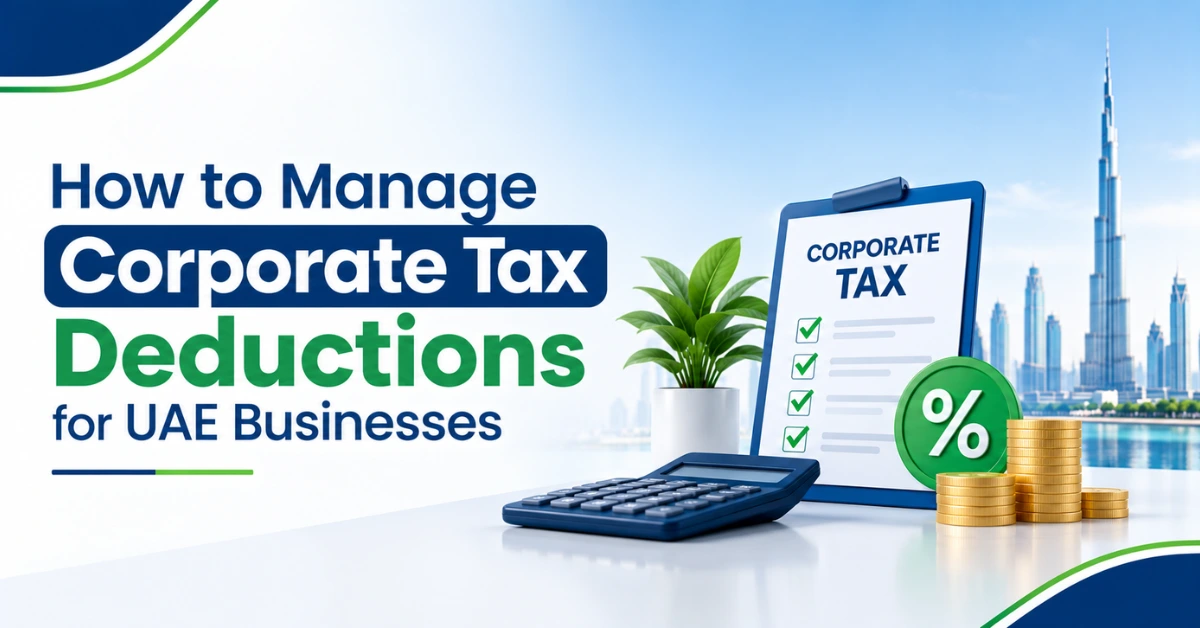
Managing Corporate Tax Deductions correctly is important for UAE businesses that want to calculate taxable income accurately, control tax expenses and maintain compliance with Federal Tax Authority (FTA) requirements. Although the UAE Corporate Tax system allows businesses to deduct qualifying expenses, not every expense recorded in financial statements automatically qualifies for tax purposes. Businesses must understand which expenses they can claim, which costs face deduction restrictions and how to maintain supporting financial records. Incorrect expense classification can increase taxable income calculations, create compliance risks and lead to unnecessary tax liabilities.
Under the UAE Corporate Tax Law (Federal Decree-Law No. 47 of 2022), businesses can generally deduct qualifying expenditure incurred wholly and exclusively for their business, subject to specific conditions and limitations.
Whether you operate a mainland company, consultancy, trading business or Free Zone entity, a structured expense management process can make Corporate Tax compliance easier.
Corporate Tax Deductions are qualifying business expenses that companies can subtract when calculating their taxable income. These deductions help determine how much profit remains subject to UAE Corporate Tax. Under Article 28 of the UAE Corporate Tax Law, businesses can generally deduct expenditure that is not capital in nature and is incurred wholly and exclusively for their business. However, specific restrictions apply to certain expenses.
For example, a Dubai-based consultancy may incur expenses for office rent, employee salaries, internet services, marketing and professional advice. These costs may qualify for deductions when they relate to the company’s business activities and satisfy the applicable tax rules.
It is important to distinguish between accounting expenses and tax-deductible expenses. An expense appearing in a company’s profit and loss statement does not automatically qualify for a Corporate Tax deduction.
Businesses must review their financial transactions and make the necessary tax adjustments before calculating taxable income.
The UAE introduced its federal Corporate Tax regime for financial years beginning on or after 1 June 2023. The Federal Tax Authority administers the system and oversees Corporate Tax registration, returns, payments and compliance.
The standard UAE Corporate Tax rates are:
The standard rates apply subject to the relevant legal provisions and eligibility conditions.
Businesses generally calculate Corporate Tax using their accounting income, adjusted according to applicable tax rules.
For example, a company may report accounting profit of AED 500,000. However, if some expenses are not deductible, its taxable income may be higher than its accounting profit.
Businesses should therefore maintain accurate financial statements, review expenses and complete the relevant tax adjustments before filing their Corporate Tax returns.
UAE businesses can generally deduct qualifying expenses incurred for their taxable business activities. The treatment depends on the nature of each expense, its business purpose and any specific restrictions under the Corporate Tax Law.
The following are common expense categories that businesses should review.
Employee-related expenses generally qualify for Corporate Tax deductions when they relate to genuine business activities.
These may include:
Businesses should maintain employment contracts, payroll records, salary statements and supporting payment documents.
Office-related expenses generally qualify when businesses incur them to operate their commercial activities.
Common examples include:
For example, a UAE marketing agency paying AED 8,000 monthly for office rent may generally claim the qualifying rental expense, provided the premises support its business activities.
Businesses often spend money to attract customers, promote products and increase sales. Qualifying marketing and advertising expenses may include:
Companies should retain invoices, contracts and campaign records to support these expenses.
Businesses may require external professionals to manage financial, legal and operational responsibilities.
Potentially deductible costs include:
These expenses should relate to the company’s taxable business activities and satisfy the applicable deduction requirements.
Genuine business travel expenses may qualify for deductions when businesses incur them for taxable business purposes.
Examples include:
Companies should document the business purpose of each trip and retain receipts and supporting records.
Businesses may use equipment, machinery, furniture, vehicles and software over several years. Instead of treating every capital purchase as an immediate operating expense, companies generally recognise depreciation or amortisation according to applicable accounting standards and Corporate Tax rules.
For example, a company purchasing office equipment for AED 50,000 may recognise depreciation over its useful life rather than deducting the entire purchase price as an ordinary operating expense in the year of purchase.
Routine repairs and maintenance expenses may qualify when they relate to business assets and maintain their existing operating condition. Examples include equipment servicing, office repairs and routine maintenance. However, substantial improvements that create or enhance an asset may need capital treatment rather than an immediate expense deduction.
Businesses should calculate taxable income by starting with their accounting profit and applying the adjustments required under UAE Corporate Tax legislation.
A practical calculation process includes:
Consider a UAE trading company with the following annual financial results:
| Description | Amount |
|---|---|
| Annual revenue | AED 1,000,000 |
| Eligible business expenses | AED 600,000 |
| Accounting profit | AED 400,000 |
| Non-deductible expenses | AED 10,000 |
| Taxable income | AED 410,000 |
The company must add back the AED 10,000 non-deductible expenses when calculating taxable income.
Its illustrative Corporate Tax liability would be:
Total illustrative Corporate Tax: AED 3,150.
This example assumes no other tax adjustments, reliefs, exemptions or carried-forward losses. Actual calculations depend on the company’s circumstances and applicable legislation.
Yes. However, qualifying entertainment, amusement and recreation expenses are generally subject to a 50% deduction restriction under Article 32 of the UAE Corporate Tax Law.
This restriction applies to qualifying expenditure incurred for customers, shareholders, suppliers and other business partners.
Examples may include:
Suppose a UAE company spends AED 20,000 on qualifying customer entertainment during a tax period.
Its deduction would be:
Businesses should maintain invoices, attendee information and records explaining the business purpose of entertainment activities.
Importantly, the 50% restriction does not automatically apply to every employee meal or ordinary business expense. Companies should assess the nature and purpose of each cost before applying the restriction.
Not every expense recorded in a company’s accounts qualifies for a Corporate Tax deduction. Article 33 of the UAE Corporate Tax Law identifies several expenses that businesses cannot deduct when calculating taxable income.
Common examples include:
Businesses should identify these costs separately in their accounting records and make the necessary adjustments before filing their tax returns.
A common accounting mistake occurs when business owners use company funds for personal purchases. For example, a business owner may purchase personal clothing, family travel tickets or household equipment using a company bank account. These costs do not become deductible business expenses simply because the company paid for them.
Some expenses may serve both business and personal purposes. In such cases, businesses should identify the portion attributable to taxable business activities and apply a fair and reasonable allocation method where permitted.
Businesses that borrow money to finance operations may incur significant interest expenses. Although qualifying interest expenditure can generally be deductible, the UAE Corporate Tax Law introduces restrictions to prevent excessive deductions.
Under Article 30, the General Interest Deduction Limitation Rule generally applies when a business’s net interest expenditure exceeds AED 12 million in a tax period.
The deductible amount is generally the higher of:
Net interest expenditure means the relevant interest expenditure after deducting interest income, subject to the applicable rules.
Suppose a UAE company has:
The company can generally deduct AED 12 million because this is higher than 30% of its adjusted EBITDA.
The remaining AED 3 million may be carried forward for deduction in the subsequent 10 tax periods, subject to the applicable conditions.
Certain businesses, including banks and insurance providers, have specific exclusions from the general rule. Separate restrictions may also apply to certain related-party financing arrangements.
Businesses should therefore review loan agreements, interest income, financing arrangements and related-party transactions before claiming interest deductions.
Free Zone companies must also understand UAE Corporate Tax requirements. Establishing a company in a UAE Free Zone does not automatically exempt it from Corporate Tax.
A Free Zone Person that meets all relevant conditions may qualify as a Qualifying Free Zone Person (QFZP). Such businesses can benefit from a 0% Corporate Tax rate on qualifying income, while taxable income that does not meet the qualifying income requirements is generally subject to 9%.
Free Zone companies should pay particular attention to expense allocation, accounting records and the treatment of different income streams.
Practical steps include:
For example, a DMCC company providing consultancy services may need to assess whether its income qualifies under the Free Zone Corporate Tax rules. It should also maintain records showing how operating expenses relate to its business activities.
The same principle applies to companies operating in ADGM, Meydan and other UAE Free Zones. Each business must assess its eligibility based on the applicable legislation rather than assuming that its Free Zone licence guarantees a 0% rate.
Businesses can manage their tax liabilities more effectively by applying eligible deductions and maintaining accurate financial records. Legal tax planning involves using available deductions, exemptions and reliefs correctly rather than claiming expenses without proper justification.
Consider the following practical steps:
These practices help businesses calculate taxable income correctly and reduce the risk of incorrect deduction claims.
Accurate accounting records are essential for managing Corporate Tax Deductions. Businesses need sufficient documentation to support their income, expenditure and tax adjustments.
Under the UAE Corporate Tax framework, taxable persons generally need to retain relevant records and documents for at least seven years following the end of the relevant tax period.
Important records include:
Businesses should also prepare financial statements using the applicable accounting standards, including IFRS where required.
Incomplete accounting records can make it difficult to demonstrate that an expense qualifies for a tax deduction.
For example, a company may record AED 30,000 in marketing expenses but fail to retain supplier invoices or evidence of the services received. Without adequate supporting documentation, the business may face difficulties substantiating its deduction during an FTA review.
Regular bookkeeping, bank reconciliations and expense reviews help businesses identify these gaps before filing their Corporate Tax returns.
Maintaining organised records also makes financial reporting, auditing and tax planning more straightforward.
Even businesses with accounting departments can make mistakes when managing deductible expenses. These errors may result in incorrect taxable income calculations and additional compliance risks.
Common mistakes include:
Businesses can reduce these risks by reviewing expenses regularly, maintaining reliable accounting records and checking applicable tax rules before submitting returns.
Managing Corporate Tax Deductions requires more than recording expenses in accounting software. Businesses must understand the applicable tax rules, identify eligible expenditure and maintain reliable documentation to support their tax calculations.
Ripple Accountants supports UAE businesses with practical accounting, tax and compliance services. Our team helps businesses organise financial information, review expenses and understand their Corporate Tax responsibilities.
Our support includes:
Businesses can also explore our Corporate Tax Return Filing Services and Tax Advisory Services for additional guidance.
Whether you operate a mainland company, a Free Zone business or an SME, professional accounting support can help you maintain accurate records and manage your tax obligations.
Contact our team:
UAE businesses can generally deduct qualifying expenses incurred for their taxable business activities. These may include employee salaries, office rent, utilities, marketing, professional fees, business travel and qualifying depreciation expenses, subject to applicable tax restrictions.
No. Businesses cannot automatically deduct every expense recorded in their accounting statements. Personal expenses, dividends, Corporate Tax payments, certain fines and penalties, and other restricted costs generally cannot reduce taxable income.
Yes. Genuine employee salaries, eligible staff benefits and commercial rental expenses are generally deductible when incurred for taxable business activities and supported by appropriate documentation.
No. Qualifying entertainment, amusement and recreation expenses incurred for customers, shareholders, suppliers and other business partners are generally 50% deductible under Article 32 of the UAE Corporate Tax Law.
Common non-deductible expenses include dividends, bribes, Corporate Tax payments, personal expenses, certain fines and penalties, and expenses attributable to exempt income. Businesses should review the specific provisions of the Corporate Tax Law before claiming deductions.
Businesses generally start with accounting profit and adjust it for non-deductible expenses, exempt income, applicable deductions, tax losses and other adjustments required under UAE Corporate Tax legislation. The resulting amount represents taxable income.
Yes. Free Zone businesses must follow applicable Corporate Tax deduction rules. Qualifying Free Zone Persons may benefit from a 0% rate on qualifying income, subject to the relevant conditions. Their other taxable income may be subject to the standard 9% rate.
The general interest deduction limitation rule generally applies when net interest expenditure exceeds AED 12 million. The deductible amount is the higher of AED 12 million or 30% of tax-adjusted EBITDA, subject to applicable conditions and exceptions.
Businesses generally need to retain relevant Corporate Tax records and supporting documents for at least seven years following the end of the relevant tax period, subject to specific legal requirements.
Professional accountants and tax advisers can help businesses classify expenses, review supporting documents, calculate taxable income and prepare Corporate Tax returns. Ripple Accountants provides accounting, bookkeeping and Corporate Tax advisory support for UAE businesses.
Managing Corporate Tax Deductions correctly helps UAE businesses calculate taxable income accurately and maintain compliance with Federal Tax Authority requirements. Understanding eligible expenses, applying deduction restrictions and keeping proper financial records are essential parts of effective tax management. Businesses should regularly review their accounting records, separate personal and business expenses and check applicable tax adjustments before filing their Corporate Tax returns.
With the right accounting processes and professional guidance, companies can avoid common deduction mistakes and manage their tax responsibilities more effectively.
Ripple Accountants can help your business review expenses, organise financial records and manage UAE Corporate Tax requirements with confidence. Contact our team for practical accounting and tax support.
Disclaimer: This article provides general information about UAE Corporate Tax Deductions and should not be treated as legal, tax or accounting advice. Tax rules and administrative requirements may change, so businesses should consult the latest Federal Tax Authority guidance or a qualified UAE tax professional before making tax decisions.
Tell us a little about your business and our UAE tax experts will get back to you with clear, practical answers — no obligation.
 VAT
Are you working independently as a freelancer or consultant in the UAE and wondering whether you need to register for VAT? Operating…
Read article VAT
Does operating from a UAE free zone mean your company is automatically exempt from VAT registration? Not necessarily. Although free zones offer…
Read article Compliance
Are your business invoicing processes ready to meet the UAE’s electronic invoicing requirements? Non-compliance with the Electronic Invoicing System can result in…
Read articlePage 1 of 67
Book a free consultation and get clear answers for your business.
0 Comments