VAT Registration for UAE Freelancers and Consultants: Requirements and Process
Are you working independently as a freelancer or consultant in the UAE and wondering whether you need to register for VAT? Operating…
Read article
Has your company been established in the UAE, but you have not generated any sales yet? Does that mean you must wait before registering for VAT?
Not necessarily. UAE VAT legislation allows eligible businesses to apply for voluntary registration based on qualifying taxable expenses, even when they have not started generating revenue. This provides a route for new companies that are investing in business operations before making their first sale.
Understanding VAT Registration for New UAE Companies With No Sales is particularly important for startups that have already invested in office facilities, equipment, professional services or other business activities but have not yet secured customers.
This guide explains how VAT registration for new UAE companies with no sales works, including eligibility, 30-day forecasts, application requirements, and important compliance considerations.
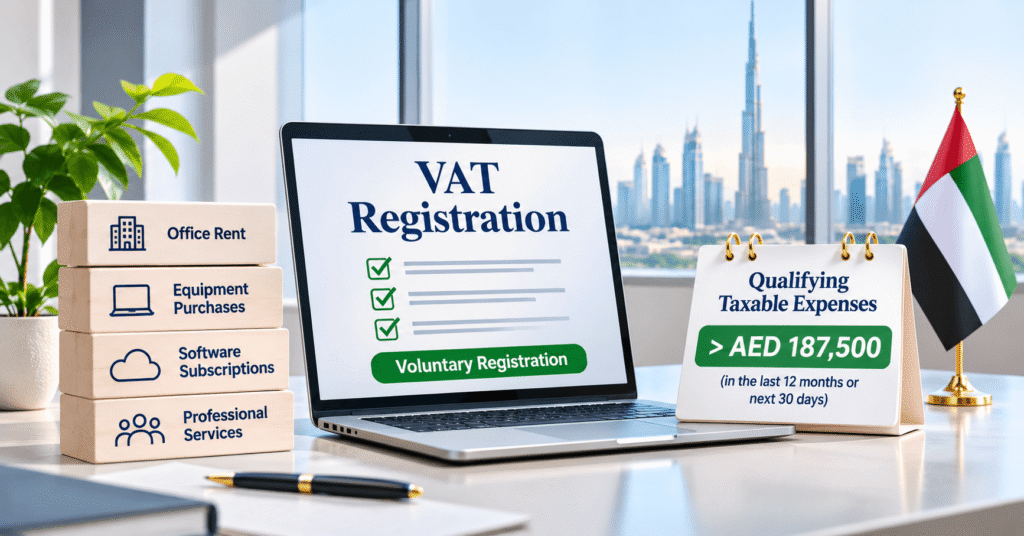
Yes. A newly established UAE company may qualify for voluntary VAT registration even if it has not generated any sales.
The UAE VAT system recognises that startups often incur significant business expenses before beginning commercial operations. These expenses may include office rent, equipment purchases, software subscriptions, professional services and other business-related costs.
Under the voluntary registration rules, a UAE-resident business may apply if its qualifying taxable expenses exceed AED 187,500 during the previous 12 months or are expected to exceed this amount within the next 30 days.
However, meeting the financial threshold alone does not automatically guarantee approval.
The company must also satisfy the applicable eligibility conditions and provide supporting evidence demonstrating its business activities and intention to make taxable supplies.
For example, a newly established consulting company may have signed an office lease, purchased computers and engaged professional service providers before acquiring its first customer. If its qualifying taxable expenses meet the voluntary registration threshold, it may be eligible to apply.
The Federal Tax Authority (FTA) reviews the application and supporting information before making a registration decision.
Before applying, a new business should understand the difference between mandatory and voluntary VAT registration. These thresholds determine whether registration is required or whether a company can choose to register.
For businesses considering VAT Registration for New UAE Companies With No Sales, the voluntary threshold is particularly important because qualifying taxable expenses can provide an alternative basis for registration.
A UAE-resident business must register for VAT when the total value of its taxable supplies and imports:
The mandatory threshold is generally based on taxable supplies and imports, not startup expenses.
Therefore, a company that has not generated sales and has no relevant taxable supplies will not ordinarily meet the mandatory threshold through its purchases alone.
However, businesses should monitor expected taxable supplies rather than relying only on completed sales.
The voluntary registration threshold is AED 187,500.
A UAE-resident business that does not meet the mandatory registration criteria may apply voluntarily when the total value of its:
exceeds AED 187,500 during the previous 12 months or is expected to exceed that amount within the next 30 days.
This expense-based option is particularly relevant to newly established businesses with no sales.
| Criteria | Mandatory Registration | Voluntary Registration |
| Threshold | AED 375,000 | AED 187,500 |
| Basis | Taxable supplies and imports | Taxable supplies, imports or qualifying taxable expenses |
| Previous 12 months | Applicable | Applicable |
| Next 30 days | Applicable | Applicable |
| Requirement | Compulsory when conditions are met | Optional when conditions are met |
| Relevance to companies with no sales | Usually limited unless expected taxable supplies meet the threshold | May qualify through eligible taxable expenses |
Businesses should refer to the FTA’s official VAT registration guidance to review the applicable conditions.
For a new company, taxable expenses can provide an alternative basis for voluntary VAT registration. These are business-related purchases on which VAT has been correctly charged and which satisfy the applicable requirements.
When assessing VAT Registration for New UAE Companies With No Sales, businesses should identify which startup purchases qualify as taxable expenses under the FTA requirements.
For example, a startup may purchase office furniture, computer equipment and professional services before generating any revenue.
If the qualifying expenses exceed AED 187,500, the company may be able to apply for voluntary VAT registration.
Common examples include:
The VAT treatment depends on the nature of each expense and the relevant tax documentation.
Not every amount paid by a company qualifies towards the voluntary registration threshold.
Businesses should distinguish between qualifying taxable expenses and other financial commitments.
For example:
Companies should retain valid tax invoices and supporting records to demonstrate the nature and value of their expenditure.
A new company should calculate its qualifying taxable expenses before submitting an application. The calculation should be based on the relevant 12-month historical period or the expected qualifying expenses within the next 30 days.
A practical expense calculation can help determine whether VAT Registration for New UAE Companies With No Sales is an option for a newly established business.
A practical expense calculation can help determine whether VAT Registration for New UAE Companies With No Sales is an option for a newly established business. Suppose a newly established UAE company has not generated any revenue but has incurred the following expenses:
| Business expense | Amount (AED) |
| Office equipment and furniture | 65,000 |
| Professional and consultancy services | 35,000 |
| Marketing and advertising | 40,000 |
| Software and IT services | 25,000 |
| Other qualifying business purchases | 30,000 |
| Total qualifying expenses | 195,000 |
In this example, the company’s qualifying taxable expenses amount to AED 195,000.
Since this exceeds the voluntary registration threshold of AED 187,500, the company may be eligible to apply for voluntary VAT registration, provided it satisfies the other applicable conditions and can substantiate its eligibility.
The company should not assume that the entire amount qualifies simply because it appears in its accounting records. Each expense must be checked against its VAT treatment and supporting documentation.
If the company’s qualifying taxable expenses remain below AED 187,500, it will not qualify through the expense-based voluntary registration route on those figures alone.
It should continue monitoring its expenditure and expected taxable supplies.
Once the relevant threshold is exceeded or is expected to be exceeded within the next 30 days, the company can reassess its eligibility.
The 30-day forecast is an important part of the UAE VAT registration process.
Businesses do not always need to wait until they have completed 12 months of operations. The FTA also considers whether the relevant threshold is expected to be exceeded within the next 30 days.
For a new company, this is particularly useful because its operations may be in the preparation or investment stage.
Suppose a newly established company has already incurred AED 120,000 in qualifying taxable expenses.
It has also entered into agreements for additional business purchases worth AED 80,000, expected to be incurred within the next 30 days.
If the additional purchases are qualifying taxable expenses and the company can provide valid supporting evidence, its expected qualifying expenses may reach AED 200,000.
This exceeds the AED 187,500 voluntary registration threshold.
The company may therefore have grounds to apply under the anticipated-expenses route, subject to the FTA’s eligibility and evidence requirements.
A forecast should be supported by genuine business documents rather than unsupported estimates.
Relevant evidence may include:
The FTA may assess whether the expected expenditure is genuine, business-related and supported by appropriate evidence.
Companies should also ensure that forecast figures are realistic and consistent with their operational plans.
Documentation is particularly important when a company applies for VAT registration without having generated sales.
Since there may be no sales invoices or historical revenue records, the FTA may rely more heavily on expense documentation and evidence of intended business activities.
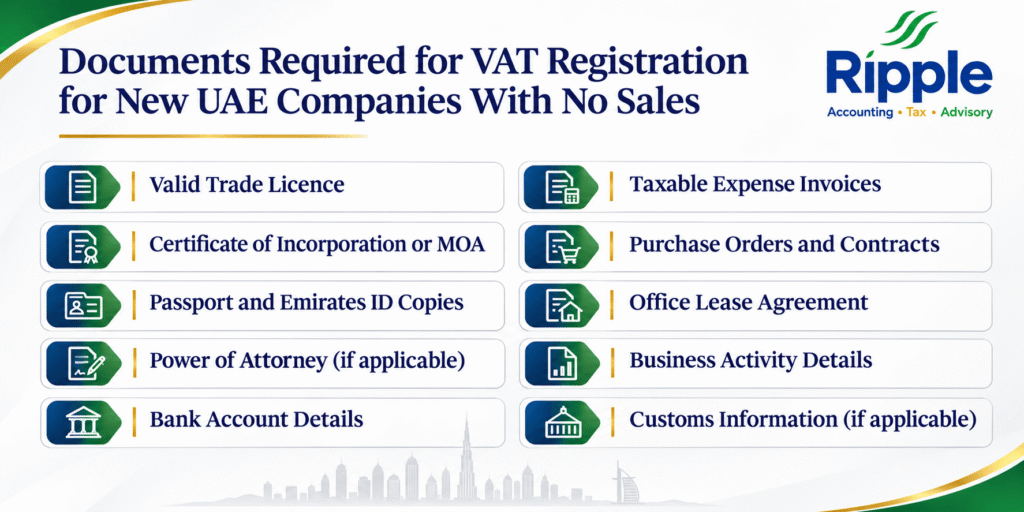
The following documents may be required depending on the company’s legal structure and application basis.
| Document | Why It Is Required |
| Valid trade licence | Confirms the company’s legal business activities. |
| Certificate of incorporation or MOA | Establishes the company’s legal structure and ownership details. |
| Passport and Emirates ID copies | Identifies owners and authorised signatories, as applicable. |
| Power of Attorney (if applicable) | Establishes the authority of the person submitting the application. |
| Bank account details | Provides company banking information where required or relevant. |
| Taxable expense invoices | Supports the voluntary registration application based on expenses. |
| Purchase orders and contracts | Demonstrates expected business expenditure or future taxable activities. |
| Office lease agreement | Supports the company’s business establishment and operating arrangements. |
| Business activity details | Explains the nature and intended operations of the company. |
| Customs information (if applicable) | Supports applications involving imports and customs-related activities. |
For applications based on taxable expenses, the FTA’s VAT registration service specifies at least five VAT invoices supporting expenses exceeding the registration threshold.
Companies should ensure that these invoices:
Simply submitting a list of expenses without appropriate supporting invoices may not be sufficient.
A company with no sales should also be prepared to explain how it intends to operate.
For example, a new trading business may provide supplier agreements, purchase orders and information about its expected trading activities.
A professional services company may provide client agreements, service proposals or other relevant commercial documents.
These records help demonstrate that the company is preparing to conduct genuine economic activities rather than applying for registration without an identifiable business purpose.
For a more detailed breakdown, read our guide to VAT Registration in UAE: Required Documents and Checklist.
Eligible companies can submit their VAT registration applications electronically through the FTA’s EmaraTax platform.
The process generally involves the following steps.
Once approved, the company can access its VAT registration certificate and Tax Registration Number (TRN) through its account.
According to the FTA’s published VAT registration service information, the estimated processing time is 20 business days from receipt of a completed application. Actual processing may depend on the application and any additional information requested.
Obtaining a TRN is not the end of a company’s VAT responsibilities.
Once registered, the business must follow the applicable VAT rules even if its sales remain low or it has not yet started generating revenue.
Important responsibilities include:
Businesses should regularly review their taxable supplies, expenses and registration status to determine whether they continue to meet the relevant requirements.
New businesses sometimes make registration decisions based on incomplete information or assumptions.
The following mistakes can create unnecessary delays and compliance risks.
For further guidance, businesses can also read our article on How to Prepare for an FTA Compliance Review in UAE.
Registering a newly established company for VAT without sales requires more than completing an online application. Businesses need to determine whether their expenses qualify, calculate the relevant threshold and prepare supporting evidence that reflects their actual business activities.
Ripple Accounting, Tax & Advisory helps new UAE companies assess their VAT registration position and prepare the information required for an application.
Our support includes:
Whether your company is preparing to launch, has already invested in business operations or is planning its first commercial transactions, understanding its VAT position early can help prevent avoidable compliance issues.
If your new UAE company has not generated sales but has already incurred substantial business expenses, contact Ripple Accountants to discuss your VAT registration eligibility and the appropriate next steps.
Explore our VAT Registration and Filing Services or speak with our team about your company’s requirements.
Yes. A UAE-resident business may qualify for voluntary VAT registration based on qualifying taxable expenses exceeding AED 187,500 during the previous 12 months or expected within the next 30 days, subject to the applicable eligibility and documentation requirements.
The voluntary VAT registration threshold is AED 187,500. A qualifying UAE-resident business may apply based on taxable supplies, imports or qualifying taxable expenses, depending on its circumstances.
Yes. A company may rely on qualifying expenses expected within the next 30 days if it can provide appropriate supporting evidence, such as valid contracts, purchase orders and other relevant commercial documents.
The FTA’s published VAT registration service requirements specify at least five VAT invoices for applications supported by taxable expenses exceeding the registration threshold. Businesses should check the latest FTA requirements and ensure that the invoices substantiate their declared expenses.
Yes. VAT-registered businesses must meet their assigned filing obligations even if they have not generated sales. Depending on the transactions during the relevant tax period, the company may need to submit a nil VAT return.
A newly established UAE company does not always need to wait until it starts generating sales before considering VAT registration. The voluntary registration framework provides an opportunity for eligible businesses to apply based on qualifying taxable expenses. However, companies should carefully assess the AED 187,500 threshold, review their 30-day expenditure forecasts and prepare the required supporting documents before applying. With proper planning and professional assistance, new businesses can establish their VAT position early and prepare for their ongoing tax responsibilities.
Disclaimer: This article provides general information about UAE VAT registration and should not be treated as individual tax or legal advice. Eligibility and registration decisions depend on the company’s circumstances and applicable UAE VAT legislation and FTA requirements.
Tell us a little about your business and our UAE tax experts will get back to you with clear, practical answers — no obligation.
 VAT
Are you working independently as a freelancer or consultant in the UAE and wondering whether you need to register for VAT? Operating…
Read article VAT
Does operating from a UAE free zone mean your company is automatically exempt from VAT registration? Not necessarily. Although free zones offer…
Read article Compliance
Are your business invoicing processes ready to meet the UAE’s electronic invoicing requirements? Non-compliance with the Electronic Invoicing System can result in…
Read articlePage 1 of 67
Book a free consultation and get clear answers for your business.
0 Comments