VAT Registration for UAE Freelancers and Consultants: Requirements and Process
Are you working independently as a freelancer or consultant in the UAE and wondering whether you need to register for VAT? Operating…
Read article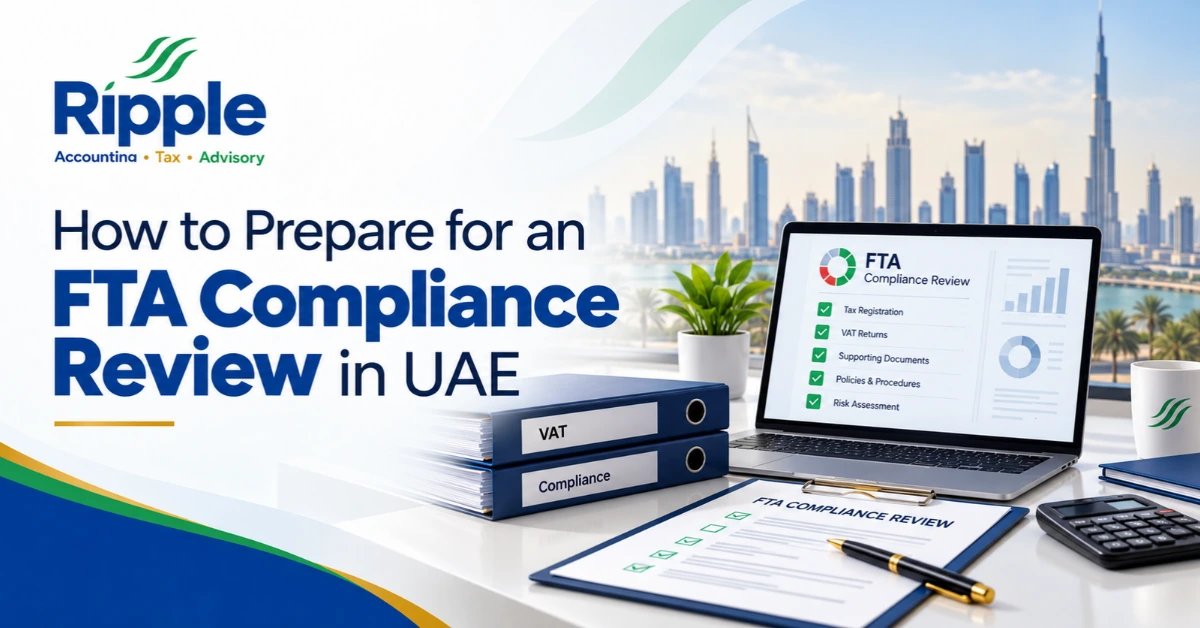
An FTA Compliance Review is an important part of maintaining tax compliance for businesses operating in the United Arab Emirates (UAE). The Federal Tax Authority (FTA) checks business records, tax returns, financial information, and supporting documents to determine whether companies meet their tax obligations. Businesses that maintain accurate accounting records and submit correct tax returns can respond to these reviews more confidently. Preparing for an FTA compliance review involves more than checking previously submitted VAT returns. Companies should also review their Corporate Tax records, reconcile financial statements, verify tax calculations, and organise supporting documents. Any differences between accounting records and tax submissions should receive attention before they create further compliance issues.
Whether you operate a mainland company, free zone business, trading firm, or service-based organisation, a structured preparation process can help reduce compliance risks. With professional accounting support from Ripple Accountants, businesses can strengthen their tax reporting processes and maintain organised financial records.
An FTA Compliance Review is an examination of a business’s tax-related information to check whether it follows applicable UAE tax laws and regulations. The Federal Tax Authority may examine commercial records, accounting information, tax returns, invoices, and other supporting documents to verify a taxpayer’s obligations.
A compliance review may relate to Value Added Tax (VAT), Corporate Tax, or other applicable federal tax requirements. Businesses should understand that a compliance review and a formal tax audit are not necessarily the same. A formal tax audit is a defined procedure through which the FTA examines relevant records and information to verify compliance with tax legislation.
The FTA may examine different areas depending on the business’s activities, tax registrations, transactions, and the purpose of its review.
Common areas include:
The FTA may also request additional information when it needs to verify a particular transaction or tax position. Businesses should therefore maintain complete and accessible records rather than relying only on submitted tax returns.
UAE businesses must follow the tax requirements that apply to their activities and legal status. Accurate tax reporting helps companies meet their obligations, maintain reliable financial information, and respond to regulatory requests.
Poor tax compliance can create financial and operational problems. For example, a business that claims input VAT without sufficient supporting invoices may face questions about the eligibility of those claims. Similarly, a company that reports incorrect taxable income may need to correct its Corporate Tax position.
Regular compliance reviews help businesses identify these problems before they become more difficult to resolve.
Businesses that fail to meet applicable tax obligations may face:
The applicable penalty depends on the specific violation and the legislation in force. Businesses should consult current FTA guidance rather than rely on outdated penalty figures.
Preparing for an FTA tax audit requires businesses to review their tax filings, accounting records, and supporting documents. A structured preparation process helps identify errors, resolve discrepancies, and provide accurate information when the authority requests it.
The following steps can help businesses improve their FTA audit preparation.
Start by checking previously submitted VAT and Corporate Tax returns. Compare the reported figures with your accounting records and financial statements to identify inconsistencies.
Pay attention to:
For example, if your sales ledger shows higher revenue than your VAT return, investigate the difference and establish whether it relates to exempt supplies, out-of-scope transactions, timing differences, or an incorrect reporting entry.
Accurate bookkeeping provides the foundation for effective tax compliance. Businesses should maintain organised accounting records that allow them to trace reported figures back to original transactions.
Prepare the following documents:
Keep digital and physical records organised by financial year and tax period. Make sure authorised employees can retrieve documents without unnecessary delays.
Review your business’s tax registration details to confirm that the information submitted to the FTA remains accurate.
Check:
Businesses should also check whether changes in their operations affect their tax registration or reporting responsibilities.
Financial reconciliation helps identify differences between accounting figures and tax information. Compare your sales, expenses, purchases, assets, and liabilities with the corresponding figures in submitted tax returns. For VAT, check whether the input and output tax figures agree with the sales and purchase ledgers. For Corporate Tax, review accounting profit and the adjustments used to calculate taxable income.
A proper reconciliation should explain every material difference and include supporting evidence.
If you identify an error, investigate its cause and assess its tax impact before deciding how to correct it. Some discrepancies may result from bookkeeping mistakes, duplicate invoices, incorrect tax classifications, or incomplete transaction records.
Depending on the circumstances, the business may need to correct its accounting records, amend information, or submit a voluntary disclosure through the appropriate FTA procedure.
Do not ignore identified errors or assume that a small difference cannot create a compliance issue.
A practical FTA tax audit preparation checklist helps business owners and finance teams review important compliance areas before an FTA request.
Use this checklist as part of your internal tax compliance process.
Tax registration and filing
Accounting and financial records
VAT documentation
Corporate Tax documentation
Final preparation
Completing this checklist regularly can help businesses maintain better tax audit readiness rather than preparing everything at the last minute.
Many tax compliance problems develop because businesses do not review their accounting records regularly. Even companies that submit returns on time can experience problems when their supporting documents contain errors or incomplete information.
Businesses should pay particular attention to:
Corporate Tax compliance also requires accurate financial information and supporting documentation.
Common problems include:
UAE business example: Consider a Dubai-based trading company that records sales of AED 1 million in its accounting system but reports AED 900,000 in its VAT return. During an internal review, the finance team identifies the AED 100,000 difference.
Instead of ignoring the discrepancy, the company investigates the transactions, checks the relevant invoices, and determines whether the difference reflects an incorrect entry or a valid tax treatment. This process helps the company establish the correct position and take appropriate corrective action.
Voluntary disclosure is a formal process through which a taxpayer notifies the FTA about certain errors or omissions in a previously submitted tax return, tax assessment, or tax refund application. Businesses may need to consider this process when they identify an incorrect tax position that meets the legal conditions for disclosure.
The relevant procedure is associated with FTA Form 211.
Before submitting a voluntary disclosure, businesses should:
The UAE Tax Procedures framework was amended in 2026, including changes to voluntary disclosure procedures. Businesses should therefore check the latest legislation and FTA guidance before submitting a disclosure.
A voluntary disclosure is not automatically required for every accounting discrepancy. Businesses should assess the nature of the error and obtain appropriate tax advice before proceeding.
Businesses should maintain complete and accessible tax records to support their reported financial information.
The following documents are particularly useful during an FTA compliance review.
1. Accounting documents
2. VAT documents
3. Corporate Tax documents
4. Business documents
UAE businesses should also pay attention to record retention requirements. For Corporate Tax, taxable persons generally need to retain relevant records and documents for at least seven years following the end of the relevant tax period. Other tax records may follow different requirements.
The FTA issued Decision No. 4 of 2026 concerning requirements for maintaining information in accounting records and commercial books. Businesses should review their record-management processes against the applicable requirements.
For additional guidance, see Ripple Accountants’ article on UAE Accounting Record Keeping Requirements.
Receiving an FTA audit notification does not automatically mean that a business has committed a tax violation. The authority may conduct an audit to verify whether the business has fulfilled its tax obligations.
Businesses should respond carefully and follow the instructions in the official notification.
If the business cannot locate a requested document or identify a discrepancy, it should investigate the issue and seek appropriate professional advice rather than provide unsupported explanations.
Professional accounting support can help UAE businesses maintain accurate financial records and meet their tax obligations.
Experienced accountants review financial information, identify reporting differences, and help companies organise supporting documentation.
Professional support may include:
Ripple Accountants supports UAE businesses with accounting, bookkeeping, VAT, Corporate Tax, and compliance-related services.
Our approach focuses on maintaining accurate financial information and helping businesses identify potential compliance issues before they become more difficult to resolve.
Our support includes:
Businesses can also explore our VAT Registration and Filing Services for support with VAT returns, reconciliations, and FTA-related requirements.
For a broader review of your business’s tax obligations, visit our UAE Compliance Review service.
Businesses should review their tax records regularly instead of waiting until they receive an FTA notification. The appropriate review frequency depends on business size, transaction volume, accounting complexity, and tax obligations.
A practical internal review schedule may include:
Businesses with high transaction volumes or complex tax arrangements may benefit from more frequent reviews.
Regular checks help finance teams identify errors early and maintain reliable records throughout the financial year.
An FTA Compliance Review is an examination of a business’s tax records, returns, and supporting documents to verify whether it meets applicable UAE tax requirements. It may cover VAT, Corporate Tax, and other relevant tax obligations.
The FTA conducts reviews and audits to verify tax compliance, examine reported transactions, check supporting documents, and determine whether taxpayers have fulfilled their legal obligations.
Review your tax returns, reconcile financial statements, organise invoices, verify tax calculations, and prepare supporting documents. Investigate discrepancies and follow the instructions in any official FTA notification.
The FTA may request VAT returns, Corporate Tax returns, invoices, bank statements, financial statements, general ledgers, contracts, and other documents relevant to the audit.
Yes. The FTA may examine records relating to different federal tax obligations, depending on the purpose and scope of its review.
Corporate Tax records generally require retention for at least seven years following the end of the relevant tax period. Other tax records may have different retention periods, so businesses should check the applicable legislation.
The FTA may take action under applicable tax legislation, which can include issuing a tax assessment or imposing administrative penalties. The appropriate response depends on the nature of the error and the relevant legal provisions.
Yes. Professional accountants can review financial records, reconcile tax returns, organise supporting documents, identify discrepancies, and assist businesses with audit preparation and compliance-related work.
Preparing for an FTA Compliance Review requires accurate accounting records, properly filed tax returns, and organised supporting documents. UAE businesses should regularly review their VAT and Corporate Tax obligations, reconcile financial information, and address discrepancies before they create larger compliance problems. A proactive approach helps companies improve tax audit readiness and respond to FTA requests with greater confidence.
Ripple Accountants helps UAE businesses strengthen their accounting processes and manage tax compliance requirements through professional accounting, bookkeeping, VAT, Corporate Tax, and compliance review support.
If your business needs assistance reviewing its financial records or preparing for an FTA compliance review, our team can help assess your requirements and identify the areas that need attention.
Contact Ripple Accountants:
Disclaimer: This article provides general information about UAE tax compliance and FTA review procedures. Tax laws, administrative penalties, and filing requirements may change, so businesses should consult current FTA guidance or a qualified tax professional before making tax-related decisions.
Tell us a little about your business and our UAE tax experts will get back to you with clear, practical answers — no obligation.
 VAT
Are you working independently as a freelancer or consultant in the UAE and wondering whether you need to register for VAT? Operating…
Read article VAT
Does operating from a UAE free zone mean your company is automatically exempt from VAT registration? Not necessarily. Although free zones offer…
Read article Compliance
Are your business invoicing processes ready to meet the UAE’s electronic invoicing requirements? Non-compliance with the Electronic Invoicing System can result in…
Read articlePage 1 of 67
Book a free consultation and get clear answers for your business.
0 Comments