UAE VAT Return Filing Documents Checklist: A Practical Guide
Does your business have all the necessary documents ready before submitting its VAT return to the Federal Tax Authority (FTA)? This UAE…
Read article
Does your business know which sales and transactions should be included when calculating taxable turnover for VAT registration in the UAE?
A business may generate substantial revenue without necessarily reaching the VAT registration threshold. This is because the Federal Tax Authority (FTA) considers specific taxable supplies and imports rather than simply looking at total accounting revenue or net profit.
Understanding how to calculate taxable turnover for UAE VAT registration helps businesses determine whether they must register, qualify for voluntary registration or need to monitor their upcoming transactions.
This guide explains the calculation process, relevant supply categories, supporting records and the practical checks businesses should complete before submitting a VAT registration application.
Taxable turnover refers to the total value of qualifying taxable supplies and relevant imports made by a business for VAT registration purposes.
It is important to distinguish taxable turnover from accounting revenue. A company’s financial statements may include different income categories, but not every amount automatically forms part of the VAT registration calculation.
For example, a business may generate income from:
These transactions may receive different VAT treatments. Therefore, businesses must classify their activities before calculating the relevant turnover.
According to the FTA, taxable supplies include supplies subject to either the standard VAT rate of 5% or the zero rate of 0%. Certain imports must also be considered where they would have been taxable if supplied within the UAE.
Businesses should therefore calculate taxable turnover using the appropriate VAT treatment rather than simply adding every amount received during the year.
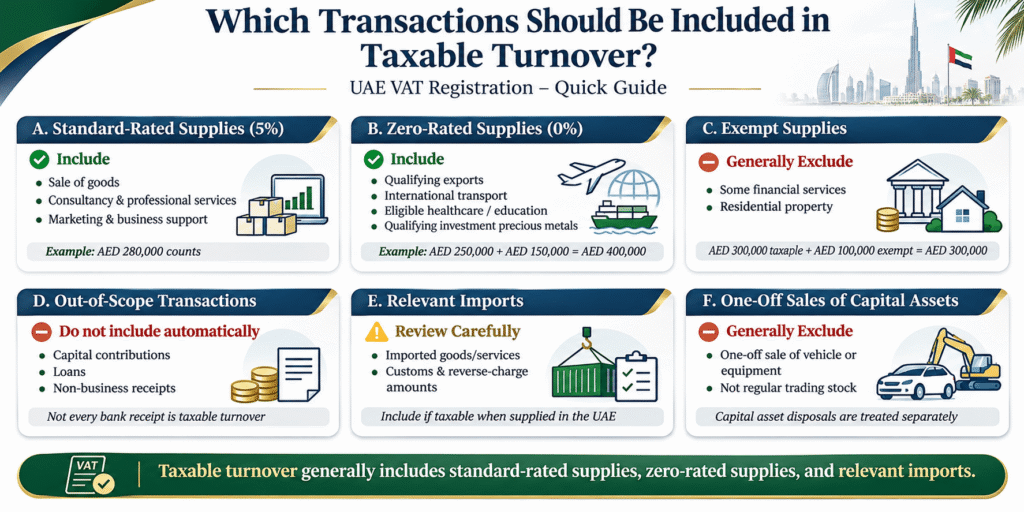
Identifying the correct transactions is one of the most important parts of calculating taxable turnover for UAE VAT registration. The calculation generally includes qualifying standard-rated and zero-rated supplies, together with relevant imports.
Standard-rated supplies are goods and services subject to the UAE’s standard VAT rate of 5%.
Examples include:
The value of qualifying standard-rated supplies must be included in the registration calculation.
For example, if a consultancy business generates AED 280,000 from standard-rated services during the relevant 12-month period, that amount forms part of its taxable turnover.
Zero-rated supplies are also taxable supplies, even though VAT is charged at 0%.
Examples may include:
Businesses sometimes exclude zero-rated sales because they do not charge customers VAT on these transactions. However, this is incorrect for registration threshold purposes.
Zero-rated supplies must generally be included when calculating taxable turnover.
For example, an exporter generating AED 250,000 from qualifying zero-rated exports and AED 150,000 from standard-rated domestic sales has AED 400,000 in relevant supplies, subject to the applicable rules.
Exempt supplies are generally excluded from the taxable turnover calculation.
Certain financial services and residential property transactions may qualify for exemption, depending on their precise nature and the applicable VAT provisions.
For example, a business generating AED 300,000 from standard-rated services and AED 100,000 from exempt supplies would generally calculate its taxable supplies as AED 300,000 rather than AED 400,000.
Businesses should review the legal VAT classification of each transaction before excluding it.
Out-of-scope transactions are not automatically treated as taxable supplies.
Their treatment depends on the nature and circumstances of the transaction. Businesses should not include every bank receipt, capital contribution, loan or other financial movement as taxable turnover.
For example, receiving a genuine shareholder capital contribution is different from generating revenue through a taxable business supply.
The accounting description alone is not sufficient to determine the VAT treatment.
Certain imported goods and services must also be considered when assessing VAT registration eligibility.
The relevant test includes imports that would have been subject to VAT if the same goods or services had been supplied within the UAE.
Businesses should review customs declarations, import VAT records and reverse-charge transactions to determine which amounts are relevant.
The FTA’s Taxable Person Guide explains that a one-off supply of a capital asset is excluded from the calculation of taxable supplies for registration threshold purposes.
For example, selling a business vehicle or an item of equipment as a one-off capital asset disposal should not automatically be treated as ordinary taxable turnover.
However, businesses should distinguish genuine capital asset disposals from regular commercial trading activities involving the purchase and resale of goods. The nature and frequency of the transactions matter.
Businesses should follow a consistent process when calculating taxable turnover for UAE VAT registration. The calculation should be based on the relevant transactions rather than the company’s annual accounting period alone.
Start by reviewing the previous 12 months of business activity. The FTA’s registration test uses a rolling 12-month period, not necessarily the calendar year or financial year.
For example, if a business is assessing its position on 30 November 2026, it should review the relevant preceding 12-month period rather than relying only on January-to-December sales.
Businesses should update this calculation regularly because each new month changes the assessment period.
Gather the financial information required to identify qualifying supplies and imports.
Relevant records include:
Reconcile the records against the accounting system to avoid duplicate transactions or missing sales.
Separate the transactions into appropriate categories.
| Transaction category | Treatment in turnover calculation |
| Standard-rated supplies (5%) | Include |
| Zero-rated supplies (0%) | Include |
| Exempt supplies | Exclude |
| Out-of-scope transactions | Generally exclude, subject to specific rules |
| Relevant taxable imports | Include |
| One-off capital asset disposals | Exclude where the FTA exclusion applies |
This classification is essential because including exempt income or overlooking zero-rated sales can produce an inaccurate result.
After classification, add the values of the relevant taxable supplies and imports.
Illustrative calculation:
Consider a UAE trading company with the following transactions during its relevant 12-month period:
| Transaction | Amount (AED) | Treatment |
| Standard-rated domestic sales | 230,000 | Include |
| Qualifying zero-rated exports | 95,000 | Include |
| Exempt income | 60,000 | Exclude |
| One-off capital asset sale | 25,000 | Exclude |
| Relevant taxable imports | 35,000 | Include |
| Total qualifying amount | 360,000 |
The company’s relevant total is AED 360,000.
It has not exceeded the AED 375,000 mandatory registration threshold based on this calculation.
However, the business should continue monitoring its turnover and assess whether its next 30-day forecast changes its registration position.
Note: This is an illustrative example. Actual calculations depend on the nature of supplies, applicable import rules and the business’s circumstances.
Once the calculation is complete, compare the relevant amount against the applicable registration criteria. For UAE-resident businesses, the mandatory registration threshold is AED 375,000.
The voluntary registration threshold is AED 187,500, subject to the applicable eligibility conditions.
The business should assess both its previous 12-month position and any relevant expected transactions within the next 30 days.
Calculating historical taxable turnover is not the only requirement businesses should monitor. The FTA also considers whether a business expects its taxable supplies and imports to exceed the mandatory threshold within the next 30 days. This means a business cannot always wait until the relevant sales have been completed before assessing its registration obligation.
For example, suppose a UAE company has already generated AED 300,000 in qualifying taxable supplies during the relevant period.
It then signs a binding contract for AED 100,000 of additional taxable services expected to be supplied within the next 30 days. If the business reasonably expects the relevant total to exceed AED 375,000 within that period, it may have a mandatory registration obligation. The company should not wait until it receives the customer’s payment to assess its position.
Businesses should maintain appropriate evidence supporting expected revenue, such as:
The FTA’s VAT registration service specifically identifies purchase orders and contracts as examples of documents supporting expected revenues.
Forecasts should be realistic and supported by genuine commercial evidence rather than unsupported estimates.
Yes. Eligible UAE-resident businesses may apply for voluntary VAT registration if they meet the relevant requirements.
A business that does not meet the mandatory registration criteria may qualify where the value of its taxable supplies and imports, or its qualifying taxable expenses, exceeds AED 187,500 during the previous 12 months or is expected to exceed that amount within the next 30 days.
This can be particularly useful for:
For example, a new consultancy business may have generated AED 120,000 in taxable supplies but incurred AED 200,000 in qualifying VAT-bearing business expenses.
It may be eligible to apply for voluntary registration, provided the relevant conditions and evidence requirements are satisfied.
Voluntary registration also creates ongoing compliance responsibilities.
A registered business must maintain appropriate tax records, issue tax invoices where required, submit VAT returns and account for VAT according to the applicable rules.
Therefore, businesses should consider both the potential benefits of recovering eligible input VAT and the administrative responsibilities associated with registration.
A reliable turnover calculation should be supported by financial and commercial records.
The FTA’s VAT registration service requires an official declaration of total taxable supplies and monthly sales from the establishment date until the application date. The declaration must be signed and stamped by the authorised signatory.
The following records can help businesses prepare an accurate calculation:
| Supporting record | Purpose |
| Sales invoices | Verify taxable sales and transaction values |
| Credit and debit notes | Identify adjustments to recorded sales |
| Monthly sales reports | Prepare the monthly turnover breakdown |
| Customer contracts | Support agreed and expected revenue |
| Purchase orders | Substantiate upcoming taxable transactions |
| Customs documents | Review relevant imports |
| Accounting ledger | Reconcile reported figures with recorded transactions |
| Export documentation | Support qualifying zero-rated supplies |
| Tax invoices for expenses | Support voluntary registration based on qualifying expenses |
Businesses should ensure that the information in their turnover declaration agrees with the underlying financial records.
For a more detailed document checklist, read VAT Registration in UAE: Required Documents and Checklist.
Even businesses with organised accounting systems can make errors when determining their VAT registration position.
Some common mistakes include:
Once a UAE-resident business becomes required to register for VAT, it must submit its application to the FTA within 30 days of becoming required to register.
Applications are submitted through the FTA’s EmaraTax platform.
The registration process generally involves:
The FTA may review the submitted turnover declaration, supporting invoices, contracts and other relevant information.
Businesses should ensure that their application reflects the correct registration basis and that the financial information is consistent with their records.
The FTA may also request clarification or additional documents where necessary.
For businesses that need help preparing their VAT registration application, the FTA’s official VAT Registration Service provides the application requirements and submission process.
Calculating taxable turnover requires more than adding monthly sales figures. Businesses must identify the correct VAT treatment, review relevant imports, distinguish exempt income from taxable supplies and assess whether upcoming transactions could create a registration obligation.
Ripple Accounting, Tax & Advisory supports UAE businesses with VAT registration and filing services, including reviewing turnover information, organising supporting records and preparing registration applications.
The team can assist businesses with:
If your business is approaching the VAT registration threshold or you are unsure which transactions should be included in your calculation, professional support can help you establish a more reliable registration position.
Explore Ripple’s VAT Registration & Filing Services to get assistance with your VAT registration requirements. Contact Ripple Accountants to discuss your requirements.
Add the value of qualifying standard-rated and zero-rated supplies, together with relevant taxable imports, during the applicable assessment period. Exclude exempt supplies and qualifying excluded transactions, such as one-off capital asset disposals, where the relevant FTA rules apply.
Yes. Zero-rated supplies are taxable supplies and are generally included when calculating turnover for VAT registration. Although VAT is charged at 0%, these transactions still count towards the relevant registration threshold.
No. Exempt supplies are generally excluded from the VAT registration turnover calculation. Businesses should classify their transactions correctly because the VAT treatment depends on the nature of each supply.
Yes. A UAE-resident business may become required to register if it expects its taxable supplies and imports to exceed AED 375,000 within the next 30 days. Eligible businesses may also qualify for voluntary registration based on expected qualifying supplies, imports or taxable expenses exceeding AED 187,500.
Relevant records include sales invoices, monthly sales reports, accounting ledgers, customer contracts, purchase orders, customs documents and export evidence. The FTA also requires an appropriate turnover declaration signed and stamped by the authorised signatory as part of its registration documentation requirements.
Calculating taxable turnover correctly is an important step in determining whether a UAE business must register for VAT or qualifies for voluntary registration. Businesses should review their rolling 12-month supplies, classify transactions according to their VAT treatment, consider relevant imports and monitor expected transactions over the next 30 days. Maintaining accurate financial records and reviewing turnover regularly can help businesses identify registration obligations early and prepare more reliable applications.
For assistance with turnover reviews, supporting documentation and VAT registration, contact Ripple Accounting, Tax & Advisory.
Disclaimer: This article provides general information about UAE VAT registration and should not be treated as individual tax advice. The VAT treatment of specific transactions depends on the applicable legislation, FTA guidance and the facts of each business.
Tell us a little about your business and our UAE tax experts will get back to you with clear, practical answers — no obligation.
 VAT
Does your business have all the necessary documents ready before submitting its VAT return to the Federal Tax Authority (FTA)? This UAE…
Read article VAT
A business may already have a VAT registration number, but can it provide official proof of registration when a bank, supplier, customer…
Read article VAT
Selling products through an online store or marketplace can help a UAE business reach more customers, but have you considered when those…
Read articlePage 4 of 68
Book a free consultation and get clear answers for your business.
0 Comments