VAT Registration for UAE Freelancers and Consultants: Requirements and Process
Are you working independently as a freelancer or consultant in the UAE and wondering whether you need to register for VAT? Operating…
Read article
Selling products through an online store or marketplace can help a UAE business reach more customers, but have you considered when those sales create a VAT registration obligation?
For e-commerce sellers, VAT compliance involves more than checking annual revenue. Businesses must understand taxable sales, monitor rolling turnover, maintain platform and payment records, and prepare for the Federal Tax Authority (FTA) registration process. Understanding these requirements early can help online businesses avoid registration delays and manage their tax responsibilities as sales grow.
This guide explains the practical steps involved in VAT registration for UAE e-commerce sellers, from threshold calculations to supporting documents and ongoing compliance.
Yes. UAE VAT can apply to businesses selling goods and services through websites, mobile applications, social media platforms and online marketplaces.
The method of selling does not automatically determine whether a transaction is subject to VAT. Instead, the VAT treatment depends on factors such as:
The standard VAT rate in the UAE is 5%, although certain supplies receive different VAT treatment.
For example, an online retailer selling taxable products to UAE customers may need to charge VAT once registered. However, an international seller supplying goods to UAE customers may have different registration and tax responsibilities depending on the transaction and supply arrangements.
The FTA’s E-Commerce VAT Guide explains how VAT applies to supplies made through electronic means.
The VAT registration threshold is an important consideration for online businesses. However, e-commerce sellers should calculate their taxable turnover rather than relying only on total money received through their online platforms.
The UAE has two main registration thresholds.
| Registration Type | Threshold | Eligibility |
| Mandatory VAT registration | AED 375,000 | Required when applicable taxable supplies and imports exceed the threshold. |
| Voluntary VAT registration | AED 187,500 | Available to eligible businesses meeting the relevant taxable supplies, imports or taxable expenses criteria. |
These thresholds apply to UAE-resident businesses under the relevant registration rules.
An e-commerce business must register when its taxable supplies and imports:
For example, suppose an online electronics store records AED 390,000 in taxable supplies over a rolling 12-month period. The business has crossed the mandatory registration threshold and must take the required registration steps.
An online seller may qualify for voluntary registration if it does not meet the mandatory criteria but its taxable supplies, imports or eligible taxable expenses exceed AED 187,500 over the previous 12 months or are expected to exceed this amount during the next 30 days.
This option may benefit growing online stores that regularly incur VAT on inventory, packaging, advertising, technology subscriptions and other business expenses.
However, voluntary registration should be considered alongside the administrative responsibilities of filing VAT returns and maintaining tax records.
Important: The thresholds are based on the relevant VAT legislation, not simply the number of orders or gross deposits received into a bank account.
One common mistake among e-commerce sellers is using total marketplace payouts or bank deposits as their taxable turnover. These figures may not accurately represent the value of taxable supplies. A proper calculation should consider the nature of sales and relevant VAT adjustments.
When reviewing turnover, consider:
Sellers should also review cancelled orders, refunds, discounts and returned products to ensure their turnover calculations reflect the relevant VAT treatment.
Consider a UAE-based online clothing store with the following figures over a rolling 12-month period:
| Sales Category | Amount (AED) |
| Taxable website sales | 180,000 |
| Taxable marketplace sales | 145,000 |
| Taxable social media sales | 65,000 |
| Eligible adjustments | (15,000) |
| Illustrative taxable turnover | 375,000 |
This example shows why businesses should combine relevant sales channels rather than monitor each platform separately.
The treatment of adjustments must be supported by appropriate records and the applicable VAT rules. The calculation should also distinguish taxable supplies from exempt and out-of-scope transactions.
VAT registration is not based exclusively on what an online business has already earned. The FTA also considers expected taxable supplies during the next 30 days.
This makes sales forecasting particularly important for e-commerce businesses experiencing rapid growth.
For example, an online store may currently have AED 340,000 in relevant taxable supplies over the previous 12 months. However, it expects to receive a large wholesale order worth AED 60,000 within the next 30 days.
If the expected taxable supplies exceed the mandatory threshold, the business must assess its registration obligation without waiting for the order to be completed.
E-commerce sellers can use the following approach:
For better accuracy, businesses should update their forecasts regularly rather than relying on a single annual revenue estimate.
Practical tip: Maintain a monthly VAT threshold tracker showing previous 12-month taxable supplies, expected supplies for the next 30 days and the remaining distance from the mandatory threshold.
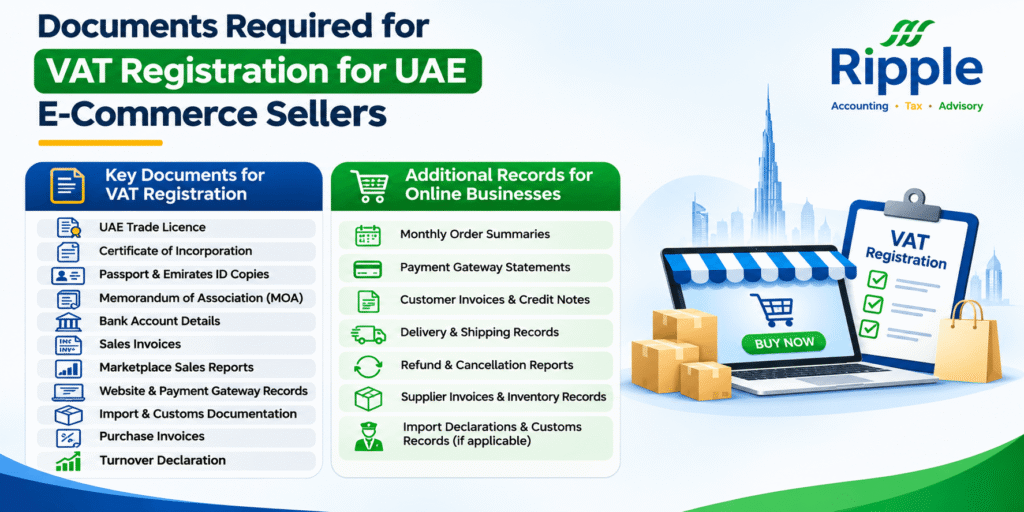
Preparing the correct documents can make the FTA application process easier. Online businesses should organise their legal, financial and transaction records before submitting their registration application.
The documents required may vary depending on the business structure, activities and information requested by the FTA.
| Required Document | Why It Is Needed |
| Valid UAE trade licence | Confirms the registered business activity and legal details. |
| Certificate of incorporation | Provides information about the company’s legal establishment, where applicable. |
| Passport and Emirates ID copies | Identifies owners and authorised signatories, where required. |
| Memorandum of Association (MOA) | Supports information about the company’s ownership and structure. |
| Bank account details | Helps establish the business’s financial information. |
| Sales invoices | Provides evidence of completed transactions and taxable supplies. |
| Marketplace sales reports | Supports turnover calculations for platform-based sales. |
| Website and payment gateway records | Helps reconcile direct online sales and customer payments. |
| Import and customs documentation | Supports the treatment of imported goods and related VAT. |
| Purchase invoices | Provides evidence of business expenses and potential input tax recovery. |
| Turnover declaration | Supports the declared taxable turnover and registration eligibility. |
In addition to standard company documents, e-commerce sellers should organise:
These records help demonstrate how the business calculated its taxable turnover and whether the information submitted to the FTA is consistent with its actual operations.
Eligible businesses can apply for VAT registration through the FTA’s EmaraTax platform.
The application process generally involves the following steps:
Visit the FTA website and access EmaraTax to create and activate the required account.
Enter the relevant business information and establish the taxable person’s profile.
Open the taxable person’s account and select the VAT registration option.
Provide the requested details, including business activities, legal structure, contact information and financial information.
Attach the required company documents, turnover declaration and relevant financial records.
Check that the information is accurate and consistent with the supporting documents before submitting the application.
Check the EmaraTax dashboard for updates or requests for additional information.
Once approved, the business can access its VAT registration certificate and Tax Registration Number (TRN).
According to the FTA’s VAT registration service information, the estimated time for completing an application is 20 business days from receipt of a completed application. This is an estimated processing period, not a guarantee of approval within that timeframe.
Not every online selling arrangement has the same VAT treatment. E-commerce businesses should understand their actual supply chain before deciding who is responsible for accounting for VAT.
Receiving a TRN is only the beginning of VAT compliance. E-commerce sellers must establish processes to manage VAT on their sales, purchases and business transactions.
The following responsibilities should be included in their regular accounting procedures.
E-commerce sellers should reconcile platform sales, refunds, purchase invoices and VAT collected before each filing deadline.
Online businesses can face registration and compliance difficulties when their sales records are incomplete or their VAT obligations are misunderstood.
Some common mistakes include:
The FTA assesses VAT registration applications using the information and supporting documents submitted by applicants. It may request clarification or additional evidence where necessary.
Businesses should therefore ensure that their turnover declarations, financial records and explanations of business activities are accurate and consistent.
If the FTA requests further information, responding with properly organised documents can help avoid unnecessary application delays.
Managing VAT registration while running an online business can become challenging as orders increase and sales expand across multiple platforms.
Ripple Accounting, Tax & Advisory supports UAE businesses with VAT registration and filing services, helping e-commerce sellers organise their financial information and prepare for VAT compliance.
Our support can include:
Whether you operate an independent online store, sell through marketplaces or manage multiple digital sales channels, having organized financial records can make VAT compliance easier to manage.
Need help with VAT registration for your online business? Contact Ripple Accounting, Tax & Advisory to discuss your VAT registration requirements and receive professional support with the application process.
UAE-based e-commerce sellers must register when their taxable supplies and imports exceed AED 375,000 over the previous 12 months or are expected to exceed this amount within the next 30 days. Eligible businesses may also register voluntarily when they meet the AED 187,500 threshold criteria.
VAT may apply to taxable sales made through online marketplaces. However, the responsibility for accounting for VAT depends on the contractual arrangement and whether the marketplace acts as an agent or participates in the supply differently.
Yes. A UAE-resident online business may qualify for voluntary VAT registration if its taxable supplies and imports or eligible taxable expenses exceed AED 187,500 during the previous 12 months or are expected to exceed this amount within the next 30 days.
Common documents include a trade licence, incorporation documents, identification of relevant owners and authorised signatories, sales invoices, marketplace reports, bank statements, purchase invoices and a turnover declaration. The FTA may request additional supporting documents depending on the application.
The business must apply for VAT registration within 30 days of becoming required to register. Failure to submit the application within the specified period can result in administrative penalties. Sellers should monitor their turnover regularly to avoid missing their registration obligations.
VAT registration for UAE e-commerce sellers requires more than monitoring online sales revenue. Businesses must understand their taxable supplies, assess previous 12-month turnover, prepare 30-day forecasts and maintain accurate supporting records. By organizing these processes early, online sellers can identify their registration obligations, prepare stronger FTA applications and manage their ongoing VAT responsibilities more effectively. If your online business is approaching the registration threshold or needs assistance preparing an application, professional VAT registration and accounting support can help you manage the process with greater confidence.
Disclaimer: This article provides general information about UAE VAT requirements and is not a substitute for professional tax advice. VAT treatment depends on the nature of transactions, contractual arrangements and applicable legislation. Businesses should consult the latest FTA guidance when assessing their individual circumstances.
Tell us a little about your business and our UAE tax experts will get back to you with clear, practical answers — no obligation.
 VAT
Are you working independently as a freelancer or consultant in the UAE and wondering whether you need to register for VAT? Operating…
Read article VAT
Does operating from a UAE free zone mean your company is automatically exempt from VAT registration? Not necessarily. Although free zones offer…
Read article Compliance
Are your business invoicing processes ready to meet the UAE’s electronic invoicing requirements? Non-compliance with the Electronic Invoicing System can result in…
Read articlePage 1 of 67
Book a free consultation and get clear answers for your business.
0 Comments