How to Apply UAE Tax Rules to Intercompany Charges
Intercompany charges are common among businesses operating through parent companies, subsidiaries, branches and other related entities in the UAE. These charges may…
Read article
Does your business have all the necessary documents ready before submitting its VAT return to the Federal Tax Authority (FTA)?
This UAE VAT Return Filing Documents Checklist helps VAT-registered businesses understand the records they need to prepare before submitting a return. It involves reporting taxable sales, purchases, output VAT and recoverable input VAT for a specific tax period through the FTA’s EmaraTax platform.
To complete this process accurately, businesses need organised tax invoices, purchase records, payment evidence and accounting reports. Missing documents or incorrect calculations can lead to filing errors, unpaid tax liabilities and potential penalties.
This guide explains what VAT return filing involves, which documents to prepare, how to organise your records and how to submit your return on time.
UAE VAT return filing is the process through which a VAT-registered business reports its VAT-related transactions to the Federal Tax Authority for an assigned tax period. The return summarises the VAT charged on sales and other taxable supplies, as well as the VAT paid on eligible business purchases and expenses.
Businesses generally report this information using the VAT Return form in the FTA’s EmaraTax portal. The return helps determine whether the business owes VAT to the FTA or is in a position to claim a VAT refund.
During a tax period, a business collects VAT on taxable supplies and may pay VAT on eligible purchases and expenses. When preparing its return, it calculates the difference between:
If output VAT is higher than recoverable input VAT, the business generally has VAT to pay. If recoverable input VAT exceeds output VAT, it may have a refundable VAT position, subject to the applicable rules and procedures.
A VAT return generally includes information about:
The figures reported must be supported by appropriate invoices, transaction records and accounting documents.
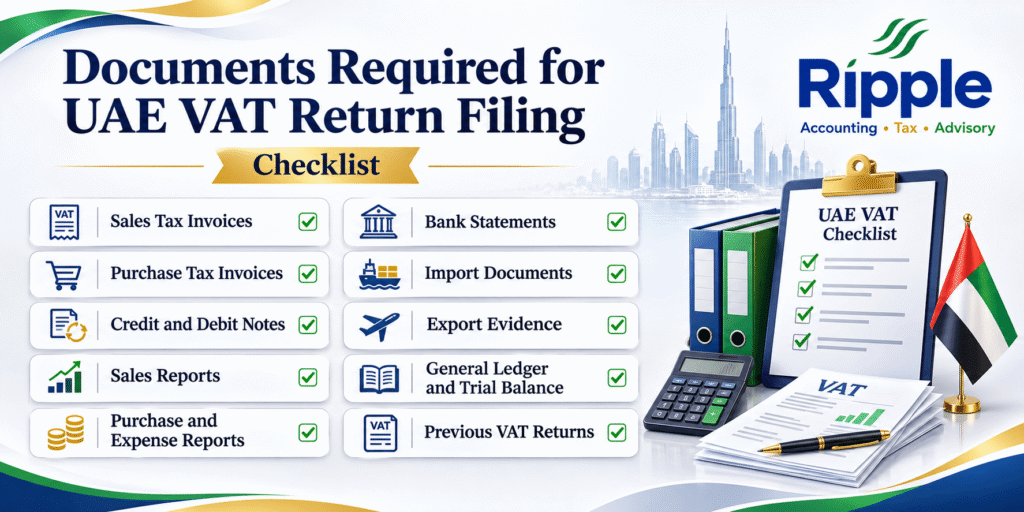
The exact documents a business needs depend on its activities, transaction types and VAT position. However, most VAT-registered businesses should prepare the following records before starting their return.
| Document | Why it is required |
| Sales tax invoices | To verify taxable sales and output VAT charged |
| Purchase tax invoices | To support eligible input VAT recovery |
| Credit and debit notes | To support adjustments to previously recorded transactions |
| Sales reports | To reconcile revenue and taxable supplies |
| Purchase and expense reports | To review business expenses and input VAT |
| Bank statements | To compare recorded transactions with payments received and made |
| Import documents | To support import VAT and customs-related transactions |
| Export evidence | To support the VAT treatment of qualifying exports |
| General ledger and trial balance | To check VAT-related balances and accounting entries |
| Previous VAT returns | To review earlier declarations and identify relevant adjustments |
These documents should be collected for the correct tax period. Businesses should also check whether transactions recorded in their accounting system agree with the supporting documents.
Sales records help establish the value of taxable supplies and the output VAT a business must report. Before filing, businesses should review all sales made during the tax period, including transactions that may have different VAT treatments.
Tax invoices are among the most important documents for VAT reporting. They provide evidence of sales and the VAT charged to customers.
A business should check that its invoices contain the required information, such as:
Businesses should also review simplified tax invoices where applicable and ensure they meet the relevant FTA requirements.
Sales reports provide a consolidated view of transactions during the tax period. These reports can be generated from accounting software, point-of-sale systems or other business platforms.
They help businesses:
Credit notes are required when a business makes adjustments to a previously issued tax invoice, such as after a return, cancellation, discount or reduction in the value of a supply.
Businesses should retain the original invoice, relevant credit note and supporting evidence for the adjustment. This helps ensure that changes to output VAT are reported correctly.
Businesses selling through websites, online marketplaces or digital platforms should also collect relevant sales reports. These records may include order details, customer invoices, refunds, platform fees and settlement statements.
This is particularly important when marketplace transactions, refunds and platform deductions are recorded separately in the accounting system.
Purchase records help businesses identify the VAT paid on goods and services acquired for business purposes. However, not all VAT incurred can automatically be recovered. Input VAT recovery depends on the applicable conditions and restrictions.
Businesses should collect tax invoices issued by suppliers for purchases and expenses. These invoices help verify the amount of VAT paid and provide supporting evidence for input VAT recovery.
Before including an amount in the VAT return, check that:
Some business expenses may be supported by receipts, payment records or other documents, depending on the nature of the transaction and applicable VAT requirements.
Common examples include office expenses, business travel, utilities, professional services and equipment purchases.
Keep the supporting records together so that each expense can be traced to its accounting entry and VAT treatment.
An input VAT reconciliation compares the VAT recorded in the accounting system with the amounts supported by supplier invoices and other relevant documents.
This review can help identify:
A proper reconciliation helps reduce the risk of claiming more input VAT than the business is entitled to recover.
Businesses involved in international trade need additional records to support the VAT treatment of imports and exports.
Import-related documents may include:
Businesses should reconcile import information with their accounting records and VAT reporting. They should also check whether import VAT is accounted for through the applicable procedure, including the reverse charge mechanism where relevant.
Qualifying exports may be subject to zero-rating when the relevant legal conditions are met. Businesses should retain evidence demonstrating that the goods were exported or that the services meet the applicable zero-rating requirements.
For goods, supporting evidence may include:
For services, businesses should retain contracts, invoices and relevant correspondence or other evidence supporting the VAT treatment.
The correct VAT treatment depends on the nature of the supply and the applicable conditions. A transaction should not be treated as zero-rated simply because the customer is located outside the UAE.
In addition to invoices and transaction documents, businesses should review their accounting records to make sure the VAT return reflects their financial activity accurately.
The general ledger contains detailed accounting entries for sales, purchases, expenses, VAT accounts and other financial transactions. Reviewing relevant ledger accounts can help identify incorrect postings and transactions that have not been included in the VAT return.
A trial balance provides an overview of account balances at a particular date. It can help identify differences between VAT control accounts and the figures prepared for the return.
Bank statements help businesses compare recorded receipts and payments with actual bank transactions. They can also help identify missing entries, customer refunds and supplier payments.
However, bank statements alone are not a substitute for valid tax invoices or other documents required to support VAT treatment and input VAT recovery.
Businesses dealing in goods should review inventory movements, purchase records and sales records. This is useful for checking whether recorded transactions agree with stock movements and identifying potential errors in the accounting system.
Previous VAT returns should be reviewed to identify outstanding adjustments, corrections and differences that may affect the current reporting period.
If an error is discovered in an earlier return, the business should follow the FTA’s applicable correction procedures rather than making an unsupported adjustment in the current return.
VAT-registered businesses are assigned tax periods by the FTA. A tax period is the period for which a business must calculate and report its VAT transactions.
Businesses commonly receive either monthly or quarterly tax periods. The FTA determines the applicable period, so businesses should check their assigned tax period in EmaraTax rather than assume that every business follows the same schedule.
For example, a business with a quarterly tax period may report transactions for January to March in one return, while another business may be required to file monthly.
In general, a VAT return must be submitted within 28 days after the end of the relevant tax period. Any VAT payable must also be settled by the applicable deadline.
For example, if a business has a quarterly tax period ending on 31 March, its return and payment will generally be due by 28 April.
Businesses should check their actual tax period and deadline in EmaraTax, as assigned dates and any specific FTA instructions should take precedence over general examples.
For official guidance, refer to the FTA’s VAT return filing and payment information.
Collecting documents is only one part of VAT preparation. Businesses also need a structured process to check and reconcile the information before submitting a return.
The following workflow can help finance teams organise their records.
VAT returns are submitted electronically through the FTA’s EmaraTax platform. Businesses should complete the return using figures that have already been checked against their supporting records.
The general process is as follows:
The exact screens and steps may change as the FTA updates its platform. Businesses should follow the instructions displayed in EmaraTax and the latest FTA user guidance.
For further instructions, consult the FTA’s VAT Returns User Guide.
VAT-registered businesses must maintain records that allow the FTA to verify their tax position and reported transactions.
In general, VAT records must be retained for at least five years after the end of the relevant tax period. Different retention requirements may apply in particular circumstances, including certain real estate-related records or cases involving tax audits and disputes.
Records may include:
Businesses should check the applicable retention rules for their circumstances and keep records accessible in a format that can be provided to the FTA when required.
Incomplete records, late submissions and incorrect VAT reporting can expose businesses to administrative penalties under UAE tax legislation.
The applicable penalty depends on the nature of the violation, when it occurred and the rules in force at the relevant time.
Important: Administrative penalty rules have been amended, and the applicable amounts may depend on the date and type of violation. Before publication, verify the current penalty schedule against the latest FTA announcement and legislation rather than relying on older penalty figures.
Official reference: FTA announcement on amended administrative penalties.
Even businesses with accounting systems can make mistakes when preparing VAT returns. Some common issues include:
A consistent monthly or quarterly review process can help businesses identify these issues before the return is submitted.
Preparing a VAT return involves more than entering figures into EmaraTax. Businesses must ensure that sales, purchases, input VAT claims and supporting documents are accurate and properly reconciled.
Ripple Accounting, Tax & Advisory supports UAE businesses with VAT registration and filing services, including assistance with reviewing VAT records, organising supporting documents, checking transaction classifications and preparing for VAT return submission.
The team can also support businesses with accounting and bookkeeping to maintain organised financial records and compliance reviews to identify gaps before they become filing problems.
If your business needs help reviewing its VAT documents or preparing its next return, contact Ripple Accounting, Tax & Advisory for VAT filing support.
Common documents include sales and purchase tax invoices, credit notes, sales and expense reports, bank statements, import and export records, general ledger reports and previous VAT returns. The exact documents depend on the business’s activities and transactions.
No. A bank statement can help verify that a payment was made, but it does not generally replace the tax invoice and other evidence required to support input VAT recovery. Businesses must meet the applicable FTA conditions before claiming input VAT.
Generally, a VAT return must be submitted within 28 days after the end of the assigned tax period. Businesses should check their tax period and deadline in EmaraTax.
Businesses should ensure that they have the required supporting records before submitting their return. Missing invoices can affect the accuracy of reported sales and purchases and may prevent the business from substantiating input VAT claims. The appropriate action depends on the transaction and applicable VAT requirements.
In general, VAT records must be retained for at least five years after the end of the relevant tax period. Specific circumstances may require a longer retention period, so businesses should check the applicable rules.
Preparing the right documents before filing a VAT return helps UAE businesses report transactions accurately, support input VAT claims and meet FTA deadlines. By maintaining organised invoices, accounting records and supporting evidence, businesses can reduce filing errors and avoid unnecessary compliance issues. If you need assistance preparing or reviewing your VAT records, Ripple Accounting, Tax & Advisory can help you manage your VAT filing responsibilities.
Disclaimer: This article is for general informational purposes only and should not be considered tax, legal or financial advice. UAE VAT laws, procedures and administrative penalties may change. Businesses should refer to the latest FTA guidance or consult a qualified tax professional regarding their specific circumstances.
Tell us a little about your business and our UAE tax experts will get back to you with clear, practical answers — no obligation.
 Corporate Tax
Intercompany charges are common among businesses operating through parent companies, subsidiaries, branches and other related entities in the UAE. These charges may…
Read article Compliance
Choosing between a tax consultant and a tax agent in the UAE can affect how your business manages tax compliance, handles Federal…
Read article VAT
Does your business have all the necessary documents ready before submitting its VAT return to the Federal Tax Authority (FTA)? This UAE…
Read articlePage 3 of 67
Book a free consultation and get clear answers for your business.
0 Comments