The Benefits of Real-Time Accounting for Decision Making
Businesses no longer have the luxury of waiting until the end of the month to understand their financial performance. Markets change quickly,…
Read article
Why might a UAE Tax Residency Certificate application be rejected even when an applicant lives or operates a business in the country? Missing evidence, incorrect application details or failure to meet the relevant eligibility criteria can complicate the process.
A UAE Tax Residency Certificate (TRC) is issued by the Federal Tax Authority (FTA) to eligible applicants for domestic purposes or to support claims under applicable double taxation agreements. Understanding the requirements before applying can help individuals and businesses reduce avoidable errors and prepare stronger applications. You can contact Ripple Accountants to get professional support to avoid these mistakes.
Let’s get started!
A UAE TRC application may not be approved if the FTA is not satisfied that the applicant meets the relevant tax residency criteria or has provided sufficient supporting evidence.
The Authority assesses applications according to the applicant’s circumstances, the purpose of the certificate and the period covered by the request. Requirements can differ for natural persons and legal entities, as well as between domestic-purpose and treaty-purpose applications.
It is important to distinguish between a formal rejection and an application that is returned for corrections, requires additional information or remains pending. These situations may require different responses.
The FTA does not publish one universal list of reasons for every rejected application. However, its official tax residency guidance identifies eligibility and documentary requirements that applicants should review carefully before submission.
For the official requirements, consult the FTA Tax Resident and Tax Residency Certificate Guide.
One of the most important checks is whether the applicant qualifies for the specific certificate being requested.
For individuals, eligibility may depend on physical presence in the UAE, the relevant 12-month period, a permanent place of residence, or the location of their financial and personal interests, depending on the circumstances and applicable rules.
For treaty-purpose applications, the relevant treaty conditions must also be considered. The FTA’s published guidance, for example, identifies a 183-day residence requirement for natural persons applying for a treaty-purpose certificate and a minimum one-year establishment requirement for legal persons.
These requirements should not be treated as a universal checklist for every domestic-purpose application. The correct eligibility test depends on the applicant’s category and the purpose of the certificate.
How to avoid this mistake: Establish which eligibility criteria apply before paying the application fee. Review your physical presence, residence evidence, business establishment and the period for which you are applying.
An application may require further review if the submitted documents do not adequately support the information provided.
For example, an individual may need a passport, Emirates ID, residence visa or official entry and exit report, depending on the relevant category. Applicants who have spent between 90 and 182 days in the UAE may also need evidence of employment, business activity or a permanent place of residence, as applicable.
A legal entity may need corporate records or other evidence relevant to its establishment and activities.
Submitting only identification documents may not be sufficient when the application requires evidence of residence or business activity.
How to avoid this mistake: Use the FTA’s TRC applicant user manual to identify the documents required for your applicant category. Check that every required attachment is legible, complete and relevant to the application period.
Differences between application details and supporting records can create verification problems.
Examples include a name that does not match the passport, an incorrect Emirates ID number, an expired identification document or company details that differ from official registration records.
The FTA’s applicant manual specifically instructs users to ensure that the Emirates ID name, expiry date and identification number match the information on the card.
For businesses, inconsistencies in the legal name, registration information or authorised signatory details can also require clarification.
How to avoid this mistake: Compare the completed application against the original documents before submission. Check spelling, identification numbers, dates and corporate details rather than relying on previously saved information.
A TRC for domestic purposes is not automatically interchangeable with one requested to obtain benefits under a double taxation agreement.
Applicants sometimes focus on obtaining a certificate without first confirming what the receiving authority actually requires. A foreign tax authority may need evidence for a particular tax year, a specified period or a treaty-related claim.
An incorrect financial year or selected application category can also create problems. The FTA’s FAQ notes that certain application details cannot be amended at some later stages, and an approved application may require a new application if changes are needed.
How to avoid this mistake: Confirm the intended use of the certificate with the requesting authority. Select the appropriate purpose, jurisdiction and period before submitting the application. If you are unsure, review the FTA’s guidance on domestic versus treaty-purpose TRCs.
Living in the UAE or holding a residence visa does not, by itself, establish that every applicant meets the tax residency requirements for every type of certificate.
Depending on the case, the FTA may need evidence of physical presence, a permanent place of residence, employment, business activity or the location of the applicant’s financial and personal interests.
For example, an individual who spends less than 183 days in the UAE may need to provide additional evidence under the applicable eligibility category. A company may need documents establishing its legal presence and satisfying the relevant requirements for the certificate’s purpose.
How to avoid this mistake: Build your application around the relevant eligibility criteria. Use supporting evidence that directly demonstrates the facts on which your application relies, and ensure that the evidence relates to the correct period.
Even when the necessary documents are available, inconsistencies between them can complicate an application.
An address on a tenancy document may differ from the address in another record. A supporting document may relate to an earlier period, or a company document may no longer reflect its current legal details.
These discrepancies do not automatically mean that an application will be rejected. However, they may prompt questions about the accuracy or relevance of the evidence.
How to avoid this mistake: Review the dates and details across your documents. Where records legitimately differ, prepare an explanation and provide additional supporting evidence where appropriate. Do not alter original documents to make them appear consistent.
A careful pre-submission review can help reduce avoidable mistakes. Use the following checklist before applying.
Applicants should also monitor their application status and respond promptly to any requests for additional information. The FTA’s official TRC portal provides access to the application service.
If your application is rejected, begin by reviewing the notification and identifying the reason given by the FTA. Avoid submitting another application immediately without first understanding whether the problem concerns eligibility, documentation, application details or the period requested.
A reconsideration request is not a guarantee of approval. Review the applicable procedure and deadline carefully, and consider obtaining professional advice if the issue involves complex residency or treaty requirements.
A UAE Tax Residency Certificate (TRC) application can become complicated when supporting documents are incomplete, personal or company details do not match, or the evidence does not adequately support the applicant’s eligibility. Reviewing these details before submission can help reduce avoidable errors and delays.
Ripple Accounting, Tax & Advisory can help businesses organize relevant financial records, review supporting documentation and identify inconsistencies that may need attention before a tax-related application. Professional assistance can be particularly useful when an application involves business records, cross-border transactions or documentation for a foreign tax authority.
Want to avoid common UAE TRC application mistakes? Contact Ripple Accounting, Tax & Advisory to discuss your documentation requirements and explore how professional accounting and tax advisory support can help you prepare for the application process.
Please note that the Federal Tax Authority makes the final decision on TRC eligibility and issuance, and professional assistance cannot guarantee approval.
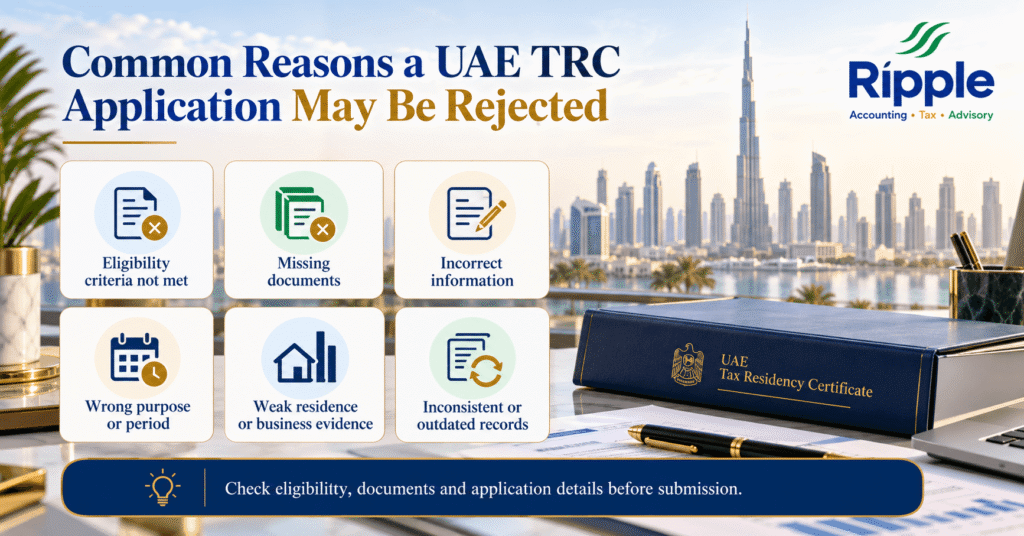
Potential issues include failure to meet the applicable eligibility criteria, missing documents, incorrect application details, insufficient residence evidence or selecting the wrong certificate purpose or period. The actual reason depends on the applicant’s circumstances and the FTA’s decision.
A new application may be appropriate in some circumstances, but first review the reason for the decision and the status of the original application. Correct any underlying issues and check the FTA’s current instructions before resubmitting.
No. A residence visa alone does not establish eligibility for every type of TRC. The applicable requirements may also involve physical presence, residence evidence, business activity or other relevant circumstances.
Where the FTA has issued a formal decision eligible for reconsideration, you may be able to submit a request through its official service. The FTA generally requires reconsideration requests within 40 business days of the original decision. Check the official procedure and applicable deadline.
Confirm the correct certificate purpose and eligibility requirements, prepare the necessary supporting documents, verify all application details and ensure that the evidence covers the relevant period. Consult the FTA’s current guidance before submission.
A UAE TRC application requires more than completing an online form. Applicants must select the appropriate certificate purpose, satisfy the relevant eligibility requirements and provide supporting evidence that matches the application details and period. Reviewing these points before submission can help reduce avoidable errors and delays. If the FTA issues an unfavorable decision, identify the reason and check the available options before deciding whether to reapply or seek reconsideration.
If you want to learn more about TRC, you can check these guides:
Disclaimer: This article is for general informational purposes only and does not constitute legal or tax advice. Eligibility and documentation requirements depend on the applicant’s circumstances and applicable rules. Always consult the latest Federal Tax Authority guidance for current requirements and procedures.
Tell us a little about your business and our UAE tax experts will get back to you with clear, practical answers — no obligation.
 Bookkeeping
Businesses no longer have the luxury of waiting until the end of the month to understand their financial performance. Markets change quickly,…
Read article Bookkeeping
The education sector in the UAE has experienced remarkable growth over the past decade. From private schools and universities to vocational training…
Read article Bookkeeping
Running a successful business requires more than tracking company revenue and expenses. As a business owner, your personal financial position also plays…
Read articlePage 57 of 59
Book a free consultation and get clear answers for your business.
0 Comments