The Cost of Poor Bookkeeping: Hidden Expenses for SMEs
Bookkeeping is one of the most important functions in any business, yet it is often overlooked by small and medium-sized enterprises (SMEs).…
Read article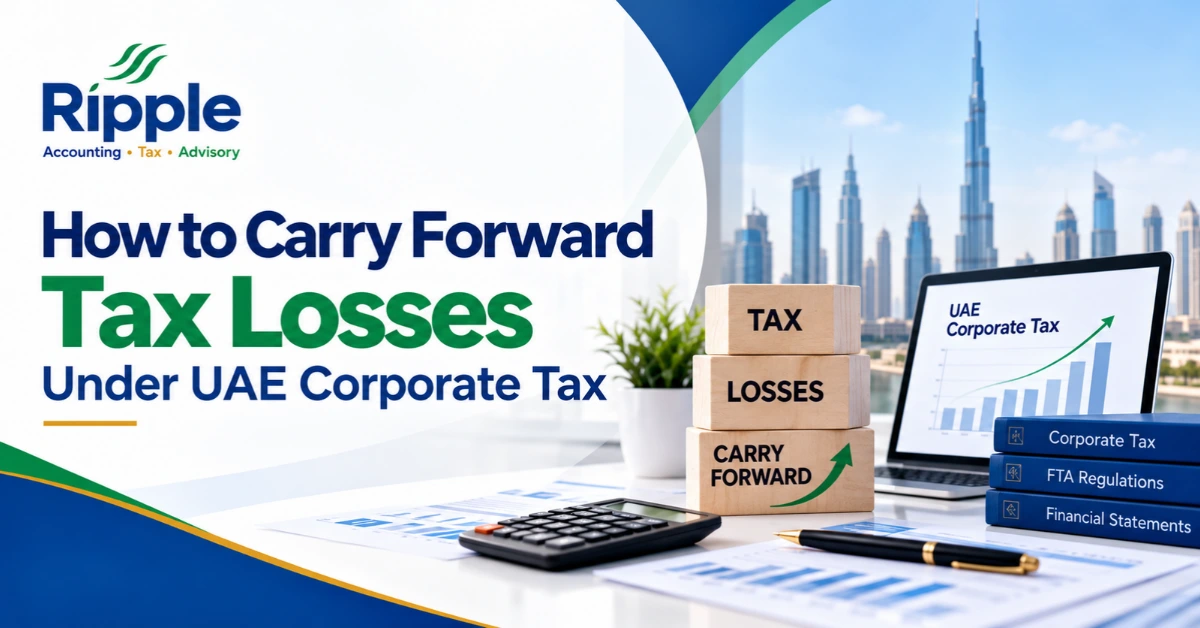
Businesses operating in the UAE may experience financial losses during certain tax periods due to high operating costs, lower sales, market changes or unexpected expenses. However, a tax loss does not always mean a business loses the opportunity to reduce its future tax liability. Under the UAE Corporate Tax regime, eligible businesses can carry forward qualifying tax losses and use them to offset taxable income in future tax periods. This relief helps businesses manage their tax position while maintaining compliance with the applicable regulations.
Understanding the UAE corporate tax loss carry forward rules is important for business owners, finance managers and accountants. Companies must know how to calculate eligible tax losses, apply the 75% limitation, meet ownership conditions and maintain proper supporting records.
A tax loss occurs when a business’s allowable tax deductions exceed its taxable income for a particular tax period. Under UAE Corporate Tax, eligible businesses can carry these losses forward to reduce taxable income in subsequent tax periods, subject to specific legal conditions.
However, businesses must distinguish between accounting losses and tax losses.
An accounting loss appears in a company’s financial statements when its expenses exceed its revenue. A tax loss, on the other hand, results from calculations under UAE Corporate Tax legislation. The two amounts may differ because certain accounting expenses are not deductible for tax purposes, while specific tax adjustments can affect the final result.
For example, a Dubai trading company may report an accounting loss of 200,000. However, after adjusting non-deductible expenses and other tax items, its actual tax loss may be lower.
Businesses should calculate their taxable income under the applicable rules before recording an eligible tax loss for future use.
Tax loss carryforward allows an eligible taxable person to use an unused tax loss against taxable income in a future tax period.
For example, if a UAE company records a qualifying tax loss of 300,000 in one year and earns taxable income in the next year, it may use the earlier loss to reduce its taxable income, subject to the 75% limitation and other conditions.
Businesses should follow a structured process to carry forward tax losses correctly under UAE Corporate Tax.
The following steps explain how the process generally works:
For example, a UAE consultancy company may incur a tax loss of 250,000 during its first tax period. If the company generates taxable income in the following year, it may use the eligible carried-forward loss to reduce its taxable income.
The company must still apply the relevant tax loss utilization rules when preparing its Corporate Tax return.
The UAE Corporate Tax Law sets specific requirements for carrying forward tax losses. Businesses cannot automatically transfer every accounting loss into future tax periods.
Under Article 37 of Federal Decree-Law No. 47 of 2022, eligible tax losses can be carried forward and used against taxable income in subsequent tax periods, provided the relevant conditions are satisfied.
Businesses should consider the following requirements:
These conditions help ensure that businesses claim only eligible tax losses.
Ownership changes can affect a company’s ability to use carried-forward tax losses.
Under the general continuity rule, the same persons must continue to own at least 50% of the taxable person from the beginning of the tax period in which the loss arose until the end of the tax period in which the business uses that loss. However, the law provides an exception where ownership changes by more than 50%. In this situation, the company may still qualify if it continues conducting the same or a similar business after the ownership change.
For example, if a UAE company experiences a major shareholder change but continues operating the same consultancy business, it may satisfy the relevant exception, subject to the applicable requirements.
Businesses should review ownership changes carefully before using historical tax losses.
Under Article 37(2) of the UAE Corporate Tax Law, carried-forward tax losses can generally offset a maximum of 75% of taxable income for the relevant tax period.
This means a company cannot normally use its entire carried-forward tax loss to eliminate all its taxable income.
Consider the following example:
A UAE company has taxable income of 1,000,000 before applying carried-forward tax losses. It also has eligible unused tax losses of 900,000 from previous periods.
The calculation works as follows:
| Particulars | Amount |
|---|---|
| Taxable income before losses | 1,000,000 |
| Available carried-forward losses | 900,000 |
| Maximum offset (75%) | 750,000 |
| Remaining taxable income | 250,000 |
The company can use 750,000 of its available tax losses and carry forward the remaining 150,000 for future eligible tax periods.
The remaining taxable income of 250,000 is subject to the applicable UAE Corporate Tax rates.
This limitation ensures that a portion of taxable income remains subject to Corporate Tax when the restriction applies.
UAE Corporate Tax legislation does not prescribe a fixed general expiry period for eligible carried-forward tax losses. Businesses can generally carry unused qualifying losses into subsequent tax periods, provided they continue to meet the applicable conditions.
However, companies should not assume that every historical loss will remain available indefinitely in every situation. Ownership changes, business continuity requirements and other legal restrictions can affect the use of tax losses.
Businesses should maintain an accurate record of losses generated, utilized and remaining at the end of each tax period.
Tax losses also cannot generally be carried back to reduce taxable income from previous tax periods.
Yes. UAE Corporate Tax legislation allows certain companies to transfer eligible tax losses to other qualifying group companies under Article 38.
However, the companies must satisfy specific ownership, residency and accounting requirements before transferring losses.
A company may transfer all or part of its eligible tax loss to another qualifying UAE company when the following conditions are satisfied:
The receiving company can use the transferred loss against its taxable income, subject to the applicable 75% limitation and other requirements.
Tax loss transfers between qualifying group companies are different from the treatment of companies that form a UAE Corporate Tax Group.
A Tax Group is treated as a single taxable person for Corporate Tax purposes, subject to the applicable requirements. Its taxable income is generally calculated using the financial results of its members and relevant tax adjustments.
Businesses should assess whether a tax loss transfer or Tax Group arrangement better suits their corporate structure.
Free Zone companies are also subject to UAE Corporate Tax rules, although Qualifying Free Zone Persons may benefit from a 0% Corporate Tax rate on qualifying income if they meet the relevant conditions.
A Free Zone company should assess its tax loss position based on its taxable status, income categories and applicable Corporate Tax provisions.
Businesses should pay particular attention to the following:
Importantly, a Qualifying Free Zone Person cannot participate in the tax loss transfer arrangements under Article 38 as a transferor or recipient. However, its own tax loss position requires a separate assessment under the applicable provisions.
Free Zone businesses should review their tax calculations before claiming or transferring losses.
Accurate tax loss calculations help businesses avoid incorrect claims and maintain compliance with Federal Tax Authority requirements. Companies should calculate their taxable income using accounting records and relevant tax adjustments before determining the amount of eligible tax losses.
Businesses should maintain the following documents to support their tax loss calculations:
These records help businesses demonstrate how they calculated their tax losses and applied them in subsequent tax periods.
Businesses should accurately report their taxable income and relevant tax adjustments when filing Corporate Tax returns through EmaraTax.
They should also maintain a separate tax loss schedule to track:
Taxable persons generally need to submit their Corporate Tax returns within nine months after the end of the relevant tax period.
For more information, read our guide on UAE Corporate Tax Return Filing.
Businesses should also review their UAE accounting record-keeping requirements to ensure that their financial information and supporting documents remain complete and accessible.
Businesses can face compliance problems when they misunderstand UAE Corporate Tax loss relief provisions.
Here are some common mistakes to avoid:
Avoiding these mistakes helps businesses maintain accurate tax records and use eligible tax losses correctly.
Managing tax losses requires accurate accounting records, proper tax calculations and a clear understanding of UAE Corporate Tax legislation. At Ripple Accountants, we support UAE businesses with practical accounting and tax compliance services. Our team can help review taxable income, identify eligible tax losses, prepare tax loss carryforward schedules and support Corporate Tax return preparation.
We also help businesses maintain financial records and understand relevant tax compliance requirements.
Whether you operate a Mainland company, a Free Zone business or a group of UAE companies, professional guidance can help you manage your tax position more effectively.
Contact Ripple Accountants to discuss your Corporate Tax requirements.
UAE Corporate Tax legislation does not prescribe a fixed general expiry period for eligible tax losses. Businesses can carry unused qualifying losses forward, subject to applicable ownership, continuity and utilization conditions.
Eligible carried-forward tax losses can generally offset up to 75% of taxable income for a tax period. The remaining taxable income is subject to applicable Corporate Tax rates.
Yes. A UAE company can transfer eligible tax losses to another qualifying resident juridical taxable person if both companies meet the ownership, residency, financial year and accounting standards requirements under Article 38.
A Free Zone company may qualify for tax loss relief subject to the applicable Corporate Tax provisions. However, Qualifying Free Zone Persons cannot participate in tax loss transfers under Article 38.
Not automatically. Businesses must calculate taxable income under UAE Corporate Tax rules and make the required adjustments before determining whether an accounting loss qualifies as a tax loss.
Yes, in certain circumstances. The company must generally satisfy the 50% ownership continuity condition or qualify for the exception where it continues the same or a similar business after a change exceeding 50%.
Understanding the UAE corporate tax loss carry forward rules helps businesses manage their taxable income and plan for future tax periods. However, companies must meet the eligibility requirements, follow the 75% limitation and maintain accurate financial records before using tax losses. From calculating eligible losses to preparing Corporate Tax returns, proper tax management helps businesses avoid unnecessary compliance issues.
Ripple Accountants can support your business with Corporate Tax calculations, tax loss assessments, accounting and ongoing compliance. Contact our team for guidance on managing your UAE Corporate Tax responsibilities.
Disclaimer: This article is for general informational purposes only and does not constitute tax or legal advice. UAE Corporate Tax rules and tax loss relief conditions may vary depending on individual business circumstances and applicable legislation. Consult a qualified tax professional before making tax-related decisions.
Tell us a little about your business and our UAE tax experts will get back to you with clear, practical answers — no obligation.
 Bookkeeping
 is one of the most important functions in any business, yet it is often overlooked by small and medium-sized enterprises (SMEs).…
Read article Compliance
Businesses today generate more financial and operational data than ever before. Every invoice, payment, approval, and customer transaction creates valuable information that…
Read article Compliance
Lease accounting has become one of the most important areas of financial reporting for businesses that rent offices, warehouses, vehicles, machinery, or…
Read articlePage 67 of 67
Book a free consultation and get clear answers for your business.
0 Comments