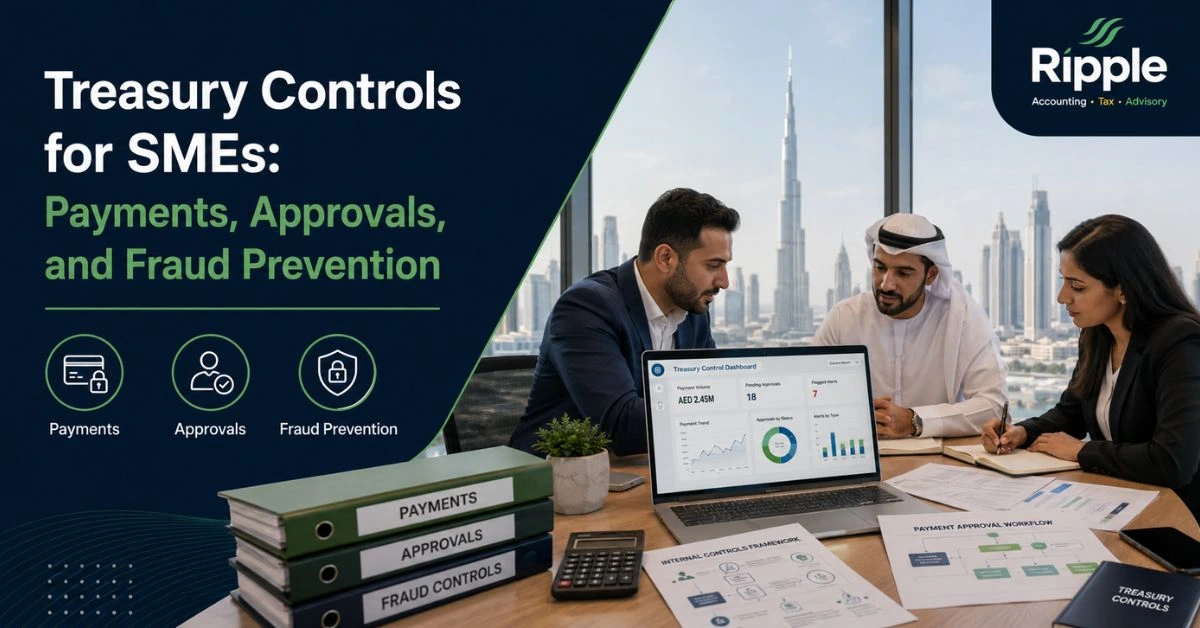
Treasury Controls for SMEs: Payments, Approvals, and Fraud Prevention
M Maria August 19, 2026 12 min read
Could an employee create a supplier, approve a payment, and transfer company money without anyone independently reviewing the transaction?
For many small and medium-sized businesses, treasury processes develop as the company grows. Payments that were once handled directly by the owner may eventually be managed by accountants, finance managers, procurement teams, and online banking users.
Without appropriate controls, this growth can create opportunities for unauthorized payments, duplicate transactions, vendor fraud, and misuse of bank access.
What Are Treasury Controls for SMEs?
Treasury controls are policies, procedures, and checks used to manage a company’s cash, bank accounts, payments, financing, and other financial resources safely.
For an SME, treasury controls may include:
Who can access online banking
Who can create beneficiaries
Who can prepare payments
Who can approve payments
Payment limits
Dual authorization
Bank reconciliations
Cash-flow monitoring
Vendor verification
Credit-card controls
Review of unusual transactions
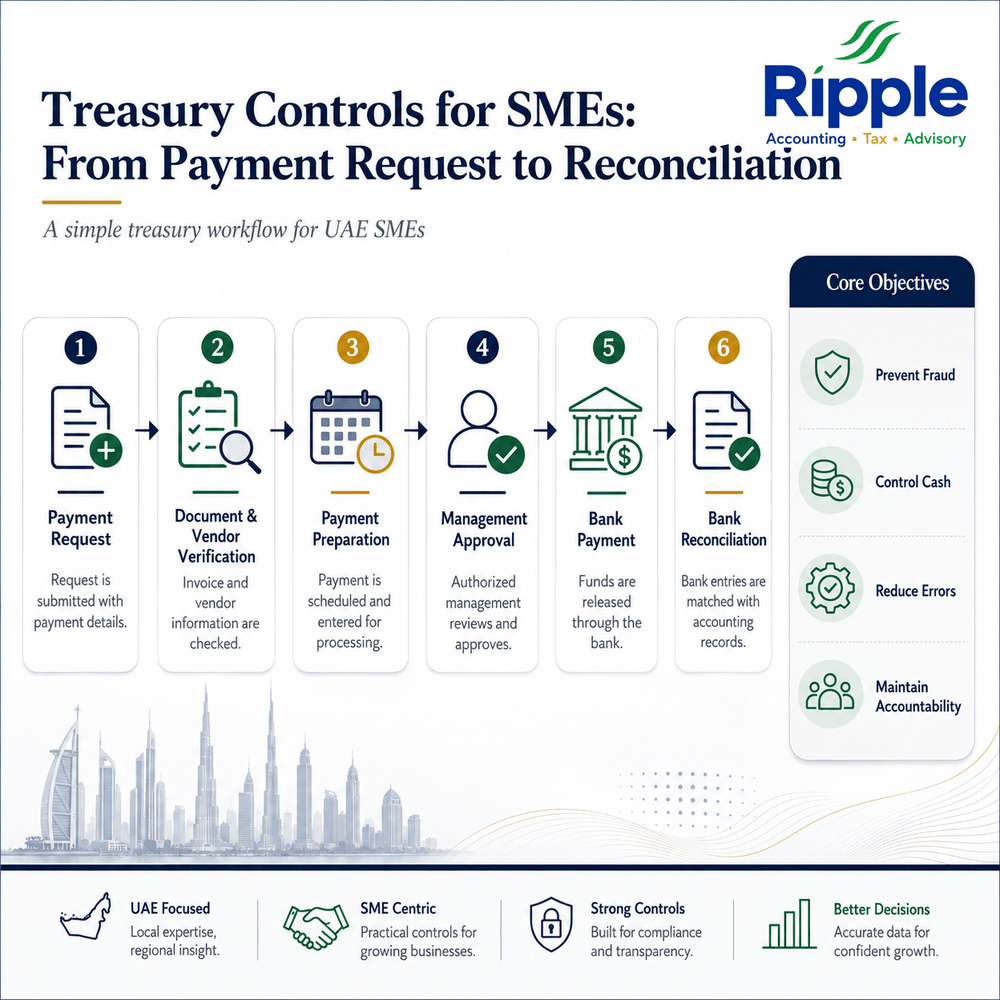
The purpose is to create a controlled process from the moment a payment is requested until it appears correctly in the company’s accounting records.
For example, an employee may receive an invoice for AED 25,000. Instead of allowing that employee to create the vendor, enter the payment, and approve the bank transfer, the process can require independent review.
This creates multiple opportunities to identify an error or fraudulent transaction before money leaves the company’s account.
Treasury Controls for SMEs
Why Treasury Controls Matter for UAE SMEs
SMEs may assume that fraud prevention is mainly an issue for large corporations. In reality, smaller businesses can face significant risks because they often have fewer employees and less separation between responsibilities.
A finance employee may simultaneously have access to accounting software, supplier records, and online banking. While this may be convenient, excessive access can create a significant control weakness.
The UAE Central Bank’s regulatory framework for banks places strong emphasis on governance, risk management, internal controls, and monitoring. Although those prudential requirements apply to regulated financial institutions rather than automatically to ordinary SMEs, they demonstrate the importance of structured financial controls within the wider UAE financial environment.
For SMEs, the practical lesson is simple: access to company money should be controlled according to responsibility, authority,, and risk.
Key Treasury Risks Without Effective Controls
Weak treasury processes can expose an SME to several types of financial loss.
Unauthorized Payments: An employee may initiate a payment without appropriate management approval. For example, an accountant receives an email requesting an urgent AED 40,000 transfer. If there is no independent approval requirement, the payment could leave the company’s account before anyone verifies the request.
Vendor Fraud: A fraudulent employee or compromised account may attempt to replace a legitimate supplier’s bank details. Suppose a company’s regular supplier is paid AED 15,000 every month. Someone changes the beneficiary account to an account controlled by a fraudster. Without independent verification, the payment may appear completely normal.
Duplicate Payments: Duplicate invoices can result from:
Repeated invoice submission
Manual data entry
Multiple employees processing the same invoice
Weak accounts-payable systems
Payroll Fraud: Weak controls can also allow payments to inactive or fictitious employees. Payroll should therefore have its own approval and reconciliation process, with employee master-data changes independently reviewed.
Core Treasury Controls Every UAE SME Should Have
A practical SME Treasury Controls UAE framework should cover five areas:
Access: Only authorised employees should have access to banking platforms and financial systems.
Approval: Payments should be approved according to defined limits.
Verification: Beneficiary details and payment instructions should be independently checked.
Segregation: Different people should perform key stages of the payment process where staffing allows.
Reconciliation: Bank activity should be compared regularly with accounting records.
These controls do not need to be complicated. Even a small business can establish a basic approval matrix and review process.
Payment Approval Controls
A strong payment process should clearly define who can request, prepare, approve, and release payments.
For example:
Payment Amount
Preparation
Approval
Up to AED 5,000
Finance Officer
Finance Manager
AED 5,001–25,000
Finance Officer
Finance Manager + Director
Above AED 25,000
Finance Manager
Director/Owner
The exact limits should reflect the company’s size, risk profile, and management structure. The important principle is that payment authority should be predefined rather than decided informally for each transaction. Payment approval should also be based on supporting documentation such as an invoice, purchase order, contract, or approved expense claim.
Segregation of Duties in Finance
Segregation of duties in finance means dividing important responsibilities between different people. Ideally, one person should not control the entire payment cycle. For example:
Activity
Responsible Person
Create supplier
Procurement
Verify supplier
Finance
Prepare payment
Accounts Payable
Approve payment
Manager/Director
Release bank payment
Authorized signatory
Reconcile bank
Accountant
For a very small SME, having six different employees may not be practical. In that situation, management can introduce compensating controls.
For example, if one accountant must prepare and upload payments, the business owner can independently review the payment batch, supporting invoices, and bank beneficiaries before authorization.
The principle is not “one person per task at all costs.” It is to prevent one individual from having unchecked control over company funds.
Bank Account and Online Banking Controls
Online banking is now central to business payments, making bank account controls particularly important. An SME should maintain a current list of:
Active bank accounts
Authorized signatories
Online banking users
Payment limits
Approval rights
Token or authentication holders
Account administrators
Access should be removed promptly when an employee leaves the company or changes roles. Businesses should also regularly review whether users still need their existing access.
For example, an employee who was originally authorized to approve payments up to AED 100,000 may have moved to a different role. Keeping the old authorization active creates unnecessary risk.
Dual Authorization for Payments
One of the most effective Payment Authorization UAE controls is dual approval. Under this arrangement, one employee prepares the payment while another authorized person approves it. For high-value transactions, the company may require two independent approvers.
For example: Finance Officer prepares an AED 75,000 supplier payment → Finance Manager reviews the invoice → Managing Director provides final authorization.
This means an employee cannot independently move AED 75,000 simply by entering the transaction into the banking system. Dual authorization can be particularly useful for:
High-value transfers
New beneficiaries
International payments
Related-party transfers
Urgent payments
Changes to bank details
Vendor and Beneficiary Controls
Vendor master data should be treated as sensitive financial information. A change in a supplier’s bank account should not automatically trigger a payment. Instead, the change should be independently verified using trusted contact information already held by the company. For example, if an email says:
“Please update our bank account before today’s payment.”
The finance employee should not simply rely on the email. The business could independently contact the supplier using a previously verified telephone number or email address and confirm the change. The verification should then be documented.
This is especially important because business email compromise and impersonation attacks often attempt to manipulate payment instructions
Cash Management and Daily Bank Reconciliation
Cash management UAE should include regular visibility over:
Bank balances
Expected receipts
Upcoming payments
Payroll obligations
Tax liabilities
Loan repayments
Supplier payments
Bank reconciliation is another essential control. The accountant should compare the bank statement with the company’s accounting records and investigate unexplained differences.
For example, if the accounting system shows AED 250,000 but the bank shows AED 220,000, the difference should be explained rather than simply carried forward. Reconciliation can identify:
Unauthorized transactions
Duplicate entries
Bank charges
Missing receipts
Incorrect postings
Unrecorded payments
Treasury Fraud Prevention
Effective treasury fraud prevention requires more than checking invoices. Businesses should also monitor unusual behavior. Warning signs can include:
Unusually large payments
Payments outside normal working patterns
New beneficiaries
Sudden changes in supplier bank details
Repeated urgent payments
Transfers to unrelated accounts
Unusual international payments
Payments just below approval thresholds
Multiple transactions split into smaller amounts
For example, if company policy requires director approval for payments above AED 50,000, an employee might attempt to split AED 100,000 into two AED 50,000 payments.
A control should therefore consider connected transactions, not just individual payment amounts.
Controls for Cheques, Cards, and Petty Cash
Treasury controls should cover physical payment methods as well as online transfers.
Corporate Cards
Businesses should define:
Spending limits
Permitted categories
Receipt requirements
Approval procedures
Monthly reconciliation
Petty Cash
Petty cash should have:
A fixed limit
A designated custodian
Supporting receipts
Regular cash counts
Independent review
Cheques
Checkbooks should be securely stored, and unused checks should be controlled. Signature authority should also be reviewed regularly.
Emergency and Urgent Payment Controls
Fraudsters often create a sense of urgency. An email might claim:
“The CEO is travelling and needs AED 30,000 transferred within the next 30 minutes.”
The payment should still follow the company’s approval process. If an emergency exception is genuinely necessary, the company should have a predefined procedure requiring independent verification.
An “urgent” payment should not automatically mean an uncontrolled payment.
How Technology Can Strengthen Treasury Controls
Technology can improve treasury controls when configured correctly.
Accounting and banking systems can support:
Approval workflows
User permissions
Payment limits
Audit trails
Automated reconciliations
Duplicate-payment detection
Cash-flow reporting
Exception alerts
However, technology does not replace governance. If every employee has administrator access, even an advanced system may provide little protection. The objective should be least-privilege access, meaning users receive only the permissions necessary for their responsibilities.
Treasury Control Matrix for UAE SMEs
A simple control matrix can help management identify gaps.
Risk
Control
Frequency
Owner
Unauthorized payment
Dual approval
Every payment
Finance
Fake beneficiary
Independent verification
Every change
Finance
Excessive bank access
Access review
Quarterly
Management
Duplicate payment
Invoice/system check
Every payment
AP
Bank fraud
Bank reconciliation
Daily/weekly
Accountant
Payroll fraud
Payroll review
Monthly
HR + Finance
Unusual transaction
Transaction monitoring
Ongoing
Finance
Former employee access
User removal
Immediately
Admin/Finance
The matrix should be tailored to the company’s size and risk profile.
Practical Example: How Payment Fraud Can Happen
Consider a UAE SME with five finance employees. The company’s accountant has access to:
Supplier master data
Accounting software
Online banking
Payment preparation
Bank reconciliation
A fraudster sends a fake email requesting a supplier bank account change. The accountant updates the supplier details, prepares the payment, and uploads the transaction to online banking.
Because the accountant also has authority to approve the payment, the AED 60,000 transfer is released without independent review. The fraud was discovered two weeks later during a management review. Now consider the same scenario with stronger controls.
The accountant can update the supplier details, but an independent finance manager must verify the change. A second authorized person approves the payment, and the bank reconciliation is reviewed the next day. The fraudulent transaction has multiple opportunities to be detected before or shortly after payment.
How to Implement Treasury Controls Step by Step
Step 1: Map the Current Payment Process
Document how money currently moves from invoice receipt to final bank payment.
Step 2: Identify High-Risk Activities
Focus on activities such as beneficiary changes, large payments, international transfers and bank access.
Step 3: Establish an Approval Matrix
Define payment limits and authorized approvers.
Step 4: Review User Access
Remove unnecessary banking and accounting permissions.
Step 5: Introduce Segregation
Separate payment preparation, approval, and reconciliation where possible.
Step 6: Strengthen Beneficiary Verification
Create a formal process for adding and changing supplier bank details.
Step 7: Reconcile Regularly
Compare bank transactions against accounting records and investigate exceptions.
Step 8: Test the Controls
Management should periodically test whether controls are actually operating as designed.
Common Treasury Control Mistakes SMEs Should Avoid
Giving Too Much Access: Employees should not retain unnecessary access simply because they had it in the past.
Relying Only on Email Approval: Email approval can be useful, but important payments should ideally pass through a controlled workflow with an audit trail.
Ignoring Small Payments: Fraud is not always large. Repeated small transactions can accumulate into substantial losses.
Failing to Review Bank Users: Bank access should be reviewed regularly, particularly after employee departures or role changes.
Treating Urgent Payments Differently: Emergency payments still require independent verification.
Not Reconciling Frequently: A business may not discover unauthorized transactions promptly if bank reconciliations are delayed.
How Ripple Accountant Can Help
Ripple Accountant can support UAE SMEs in developing a more structured financial control and reporting environment. Our support can help businesses improve the organization of payment records, bank reconciliations, financial reporting and transaction reviews. We can also help management establish clearer processes for monitoring cash movements and identifying discrepancies.
Want to strengthen your SME’s treasury controls? Contact the Ripple Accountant support team today to discuss your payment, reconciliation, and financial control requirements.
Phone: +971 52 356 5409
WhatsApp: +971 4 250 0833
Email: info@uaetaxcompliance.ae
FAQs
1. What are treasury controls for SMEs?
Treasury controls are procedures that help businesses protect and manage cash, bank accounts, payments, financing, and other financial resources. They include payment approvals, access controls, segregation of duties, and bank reconciliation.
2. What is segregation of duties in finance?
Segregation of duties means separating important financial responsibilities among different people. For example, one employee prepares a payment while another approves it.
3. What is the most important payment control for an SME?
There is no single control that works for every business, but independent payment approval and appropriate segregation of duties are fundamental controls.
4. How often should an SME reconcile its bank accounts?
The appropriate frequency depends on transaction volume and risk. Businesses with frequent payments may benefit from daily or near-daily monitoring, while lower-volume businesses may use a regular weekly process supplemented by monthly formal reconciliation.
5. Should SMEs use dual approval for every payment?
Not necessarily. SMEs can establish approval thresholds based on transaction value and risk. Higher-risk or higher-value payments can require multiple approvals.
6. How can SMEs prevent supplier bank-detail fraud?
Businesses should independently verify bank-detail changes using trusted contact information and require appropriate approval before updating beneficiary records.
7. Can accounting software prevent treasury fraud?
Accounting software can strengthen controls through permissions, workflows, audit trails and reconciliation features, but technology cannot replace appropriate governance and independent review.
Conclusion
Effective treasury controls for SMEs do not require a complicated treasury department or an expensive system. They require clear responsibilities, appropriate approval limits, and consistent monitoring. For UAE SMEs, a strong framework should connect payment approvals, segregation of duties, bank account controls, beneficiary verification, reconciliation, and fraud monitoring.
Disclaimer: This article provides general information about treasury controls, payment approvals, fraud prevention, and financial processes for UAE businesses. Control requirements and appropriate procedures may vary depending on the company’s size, activities, banking arrangements, and internal governance structure. Businesses should assess their specific circumstances and obtain professional accounting, legal, or financial advice where appropriate.
Share
Free Consultation
Have a tax or accounting question?
Tell us a little about your business and our UAE tax experts will get back to you with clear, practical answers — no obligation.
0 Comments
No comments yet. Be the first to start the conversation.
Non-profit organizations play a vital role in supporting communities, advancing education, promoting healthcare, protecting the environment, and delivering humanitarian aid across the…
Businesses have traditionally relied on financial reports such as revenue, profit, cash flow, and expenses to evaluate performance. While these metrics remain…
Auditing different types of businesses is essential because every industry operates with unique financial processes, regulations, and risks. A manufacturing company manages…


0 Comments