Why UAE Tax Residency Certificate Applications Get Rejected: Common Mistakes to Avoid
Why might a UAE Tax Residency Certificate application be rejected even when an applicant lives or operates a business in the country?…
Read article
Could an employee create a supplier, approve a payment, and transfer company money without anyone independently reviewing the transaction?
For many small and medium-sized businesses, treasury processes develop as the company grows. Payments that were once handled directly by the owner may eventually be managed by accountants, finance managers, procurement teams, and online banking users.
Without appropriate controls, this growth can create opportunities for unauthorized payments, duplicate transactions, vendor fraud, and misuse of bank access.
Treasury controls are policies, procedures, and checks used to manage a company’s cash, bank accounts, payments, financing, and other financial resources safely.
For an SME, treasury controls may include:
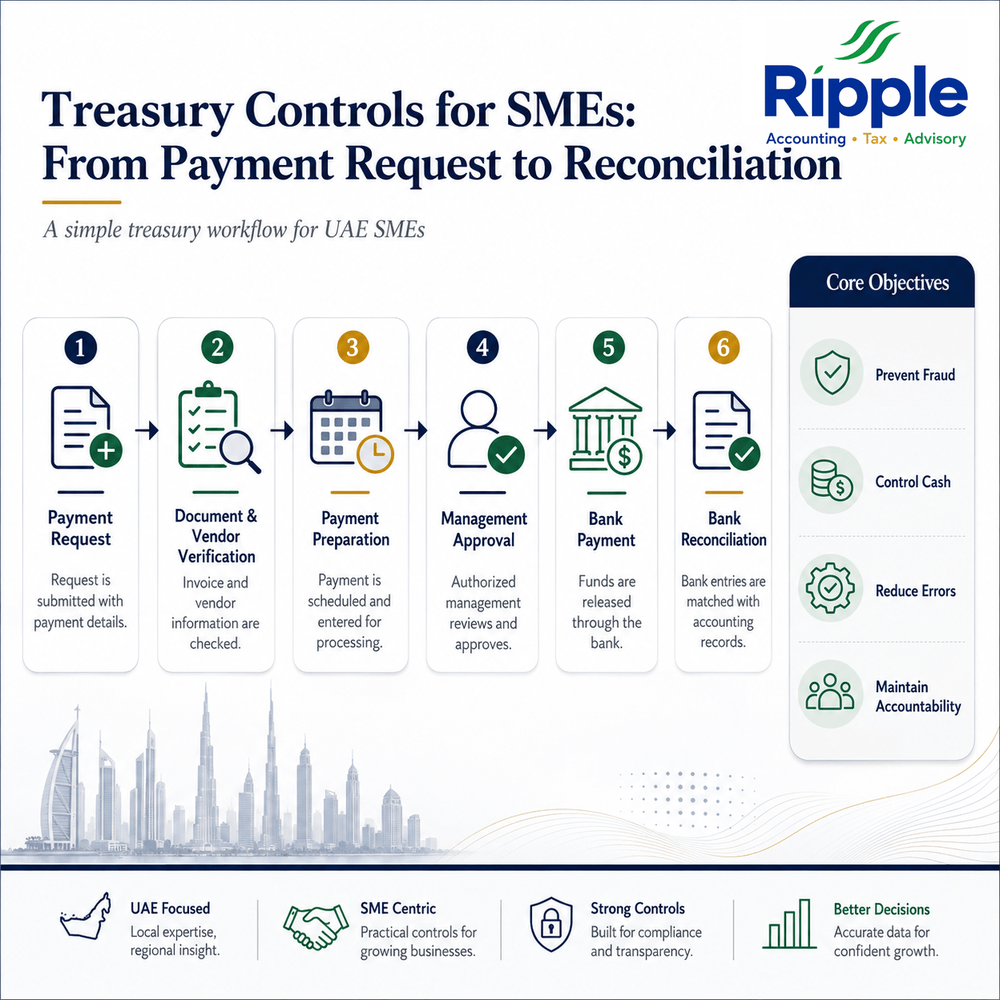
The purpose is to create a controlled process from the moment a payment is requested until it appears correctly in the company’s accounting records.
For example, an employee may receive an invoice for AED 25,000. Instead of allowing that employee to create the vendor, enter the payment, and approve the bank transfer, the process can require independent review.
Request → Verification → Preparation → Approval → Payment → Reconciliation
This creates multiple opportunities to identify an error or fraudulent transaction before money leaves the company’s account.
SMEs may assume that fraud prevention is mainly an issue for large corporations. In reality, smaller businesses can face significant risks because they often have fewer employees and less separation between responsibilities.
A finance employee may simultaneously have access to accounting software, supplier records, and online banking. While this may be convenient, excessive access can create a significant control weakness.
The UAE Central Bank’s regulatory framework for banks places strong emphasis on governance, risk management, internal controls, and monitoring. Although those prudential requirements apply to regulated financial institutions rather than automatically to ordinary SMEs, they demonstrate the importance of structured financial controls within the wider UAE financial environment.
For SMEs, the practical lesson is simple: access to company money should be controlled according to responsibility, authority,, and risk.
Weak treasury processes can expose an SME to several types of financial loss.
A practical SME Treasury Controls UAE framework should cover five areas:
These controls do not need to be complicated. Even a small business can establish a basic approval matrix and review process.
A strong payment process should clearly define who can request, prepare, approve, and release payments.
For example:
| Payment Amount | Preparation | Approval |
| Up to AED 5,000 | Finance Officer | Finance Manager |
| AED 5,001–25,000 | Finance Officer | Finance Manager + Director |
| Above AED 25,000 | Finance Manager | Director/Owner |
The exact limits should reflect the company’s size, risk profile, and management structure. The important principle is that payment authority should be predefined rather than decided informally for each transaction. Payment approval should also be based on supporting documentation such as an invoice, purchase order, contract, or approved expense claim.
Segregation of duties in finance means dividing important responsibilities between different people. Ideally, one person should not control the entire payment cycle. For example:
| Activity | Responsible Person |
| Create supplier | Procurement |
| Verify supplier | Finance |
| Prepare payment | Accounts Payable |
| Approve payment | Manager/Director |
| Release bank payment | Authorized signatory |
| Reconcile bank | Accountant |
For a very small SME, having six different employees may not be practical. In that situation, management can introduce compensating controls.
For example, if one accountant must prepare and upload payments, the business owner can independently review the payment batch, supporting invoices, and bank beneficiaries before authorization.
The principle is not “one person per task at all costs.” It is to prevent one individual from having unchecked control over company funds.
Online banking is now central to business payments, making bank account controls particularly important. An SME should maintain a current list of:
Access should be removed promptly when an employee leaves the company or changes roles. Businesses should also regularly review whether users still need their existing access.
For example, an employee who was originally authorized to approve payments up to AED 100,000 may have moved to a different role. Keeping the old authorization active creates unnecessary risk.
One of the most effective Payment Authorization UAE controls is dual approval. Under this arrangement, one employee prepares the payment while another authorized person approves it. For high-value transactions, the company may require two independent approvers.
For example: Finance Officer prepares an AED 75,000 supplier payment → Finance Manager reviews the invoice → Managing Director provides final authorization.
This means an employee cannot independently move AED 75,000 simply by entering the transaction into the banking system. Dual authorization can be particularly useful for:
Vendor master data should be treated as sensitive financial information. A change in a supplier’s bank account should not automatically trigger a payment. Instead, the change should be independently verified using trusted contact information already held by the company. For example, if an email says:
“Please update our bank account before today’s payment.”
The finance employee should not simply rely on the email. The business could independently contact the supplier using a previously verified telephone number or email address and confirm the change. The verification should then be documented.
This is especially important because business email compromise and impersonation attacks often attempt to manipulate payment instructions
Cash management UAE should include regular visibility over:
Bank reconciliation is another essential control. The accountant should compare the bank statement with the company’s accounting records and investigate unexplained differences.
For example, if the accounting system shows AED 250,000 but the bank shows AED 220,000, the difference should be explained rather than simply carried forward. Reconciliation can identify:
Effective treasury fraud prevention requires more than checking invoices. Businesses should also monitor unusual behavior. Warning signs can include:
For example, if company policy requires director approval for payments above AED 50,000, an employee might attempt to split AED 100,000 into two AED 50,000 payments.
A control should therefore consider connected transactions, not just individual payment amounts.
Treasury controls should cover physical payment methods as well as online transfers.
Businesses should define:
Petty cash should have:
Checkbooks should be securely stored, and unused checks should be controlled. Signature authority should also be reviewed regularly.
Fraudsters often create a sense of urgency. An email might claim:
“The CEO is travelling and needs AED 30,000 transferred within the next 30 minutes.”
The payment should still follow the company’s approval process. If an emergency exception is genuinely necessary, the company should have a predefined procedure requiring independent verification.
An “urgent” payment should not automatically mean an uncontrolled payment.
Technology can improve treasury controls when configured correctly.
Accounting and banking systems can support:
However, technology does not replace governance. If every employee has administrator access, even an advanced system may provide little protection. The objective should be least-privilege access, meaning users receive only the permissions necessary for their responsibilities.
A simple control matrix can help management identify gaps.
| Risk | Control | Frequency | Owner |
| Unauthorized payment | Dual approval | Every payment | Finance |
| Fake beneficiary | Independent verification | Every change | Finance |
| Excessive bank access | Access review | Quarterly | Management |
| Duplicate payment | Invoice/system check | Every payment | AP |
| Bank fraud | Bank reconciliation | Daily/weekly | Accountant |
| Payroll fraud | Payroll review | Monthly | HR + Finance |
| Unusual transaction | Transaction monitoring | Ongoing | Finance |
| Former employee access | User removal | Immediately | Admin/Finance |
The matrix should be tailored to the company’s size and risk profile.
Consider a UAE SME with five finance employees. The company’s accountant has access to:
A fraudster sends a fake email requesting a supplier bank account change. The accountant updates the supplier details, prepares the payment, and uploads the transaction to online banking.
Because the accountant also has authority to approve the payment, the AED 60,000 transfer is released without independent review. The fraud was discovered two weeks later during a management review. Now consider the same scenario with stronger controls.
The accountant can update the supplier details, but an independent finance manager must verify the change. A second authorized person approves the payment, and the bank reconciliation is reviewed the next day. The fraudulent transaction has multiple opportunities to be detected before or shortly after payment.
Document how money currently moves from invoice receipt to final bank payment.
Focus on activities such as beneficiary changes, large payments, international transfers and bank access.
Define payment limits and authorized approvers.
Remove unnecessary banking and accounting permissions.
Separate payment preparation, approval, and reconciliation where possible.
Create a formal process for adding and changing supplier bank details.
Compare bank transactions against accounting records and investigate exceptions.
Management should periodically test whether controls are actually operating as designed.
Ripple Accountant can support UAE SMEs in developing a more structured financial control and reporting environment. Our support can help businesses improve the organization of payment records, bank reconciliations, financial reporting and transaction reviews. We can also help management establish clearer processes for monitoring cash movements and identifying discrepancies.
Want to strengthen your SME’s treasury controls? Contact the Ripple Accountant support team today to discuss your payment, reconciliation, and financial control requirements.
Treasury controls are procedures that help businesses protect and manage cash, bank accounts, payments, financing, and other financial resources. They include payment approvals, access controls, segregation of duties, and bank reconciliation.
Segregation of duties means separating important financial responsibilities among different people. For example, one employee prepares a payment while another approves it.
There is no single control that works for every business, but independent payment approval and appropriate segregation of duties are fundamental controls.
The appropriate frequency depends on transaction volume and risk. Businesses with frequent payments may benefit from daily or near-daily monitoring, while lower-volume businesses may use a regular weekly process supplemented by monthly formal reconciliation.
Not necessarily. SMEs can establish approval thresholds based on transaction value and risk. Higher-risk or higher-value payments can require multiple approvals.
Businesses should independently verify bank-detail changes using trusted contact information and require appropriate approval before updating beneficiary records.
Accounting software can strengthen controls through permissions, workflows, audit trails and reconciliation features, but technology cannot replace appropriate governance and independent review.
Effective treasury controls for SMEs do not require a complicated treasury department or an expensive system. They require clear responsibilities, appropriate approval limits, and consistent monitoring. For UAE SMEs, a strong framework should connect payment approvals, segregation of duties, bank account controls, beneficiary verification, reconciliation, and fraud monitoring.
Disclaimer: This article provides general information about treasury controls, payment approvals, fraud prevention, and financial processes for UAE businesses. Control requirements and appropriate procedures may vary depending on the company’s size, activities, banking arrangements, and internal governance structure. Businesses should assess their specific circumstances and obtain professional accounting, legal, or financial advice where appropriate.
Tell us a little about your business and our UAE tax experts will get back to you with clear, practical answers — no obligation.
 Corporate Tax
Why might a UAE Tax Residency Certificate application be rejected even when an applicant lives or operates a business in the country?…
Read article Corporate Tax
How much does a UAE Tax Residency Certificate cost, how long does it take to obtain, and when does it expire? Understanding…
Read article Corporate Tax
Are you planning to apply for a UAE Tax Residency Certificate but unsure which documents you need or whether you qualify? Understanding…
Read articlePage 1 of 58
Book a free consultation and get clear answers for your business.
0 Comments