The Cost of Poor Bookkeeping: Hidden Expenses for SMEs
Bookkeeping is one of the most important functions in any business, yet it is often overlooked by small and medium-sized enterprises (SMEs).…
Read article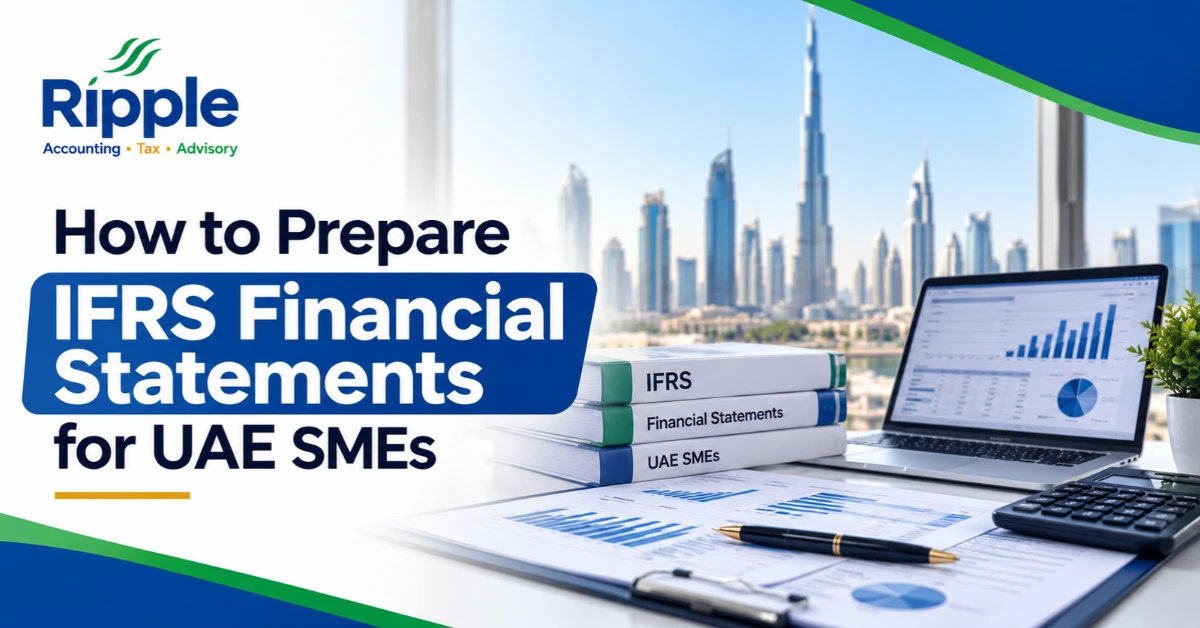
Preparing an IFRS Financial Statement is an important responsibility for small and medium-sized enterprises (SMEs) operating in the UAE. Accurate financial reporting helps business owners understand their financial position, measure profitability, manage cash flow and meet applicable regulatory requirements. It also provides reliable financial information for banks, investors, auditors and tax authorities. The UAE Corporate Tax framework recognises International Financial Reporting Standards (IFRS) and IFRS for SMEs as accepted accounting standards for determining taxable income. Eligible businesses with revenue not exceeding AED 50 million may apply IFRS for SMEs for Corporate Tax purposes, subject to the applicable requirements.
However, preparing financial statements involves more than recording sales and expenses. Businesses must reconcile accounts, review outstanding balances, calculate depreciation, assess liabilities and prepare the required financial disclosures.
International Financial Reporting Standards (IFRS) are accounting standards developed by the International Accounting Standards Board (IASB). They establish consistent principles for recording, measuring and presenting financial information.
An IFRS Financial Statement provides a structured view of a company’s assets, liabilities, income, expenses and cash movements. It helps users understand how a business performs and whether it can meet its financial obligations.
For UAE SMEs, accurate financial reporting supports several business activities:
Businesses should also distinguish between management accounts and formal financial statements. Management accounts help owners monitor performance throughout the year, while formal financial statements follow an applicable accounting framework and include the required disclosures.
A complete set of financial statements generally includes five main components:
Together, these statements provide a complete picture of a company’s financial health.
UAE businesses must consider the accounting requirements that apply to their legal structure, regulatory authority and tax position. For UAE Corporate Tax purposes, Ministerial Decision No. 114 of 2023 identifies IFRS as the applicable accounting standard. It also allows a taxable person with revenue not exceeding AED 50 million to apply IFRS for SMEs.
This option helps eligible businesses use a simplified reporting framework without automatically applying every requirement of full IFRS.
However, businesses should check whether their regulatory authority, licensing conditions or other statutory obligations require a particular accounting framework or additional financial reporting.
Both frameworks support transparent financial reporting, but IFRS for SMEs simplifies several accounting requirements.
The main differences include:
An SME should not select an accounting framework based only on its employee count or business size. It must consider the applicable UAE requirements and eligibility conditions.
UAE Corporate Tax rules establish important thresholds for accounting methods and financial reporting.
Businesses should understand these three requirements:
The AED 3 million threshold relates to the permitted accounting method. It does not mean that the business automatically qualifies to use IFRS for SMEs or that it has no financial reporting responsibilities.
The Federal Tax Authority (FTA) also explains that financial statements form the starting point for calculating taxable income. Businesses must therefore maintain accounting records that support their tax calculations.
Companies should review Ministerial Decision No. 114 of 2023 and the FTA’s Accounting Standards Guide when determining their applicable requirements.
Preparing financial statements requires a systematic process. UAE SMEs should follow these steps to organise their accounting records and produce reliable financial reports.
Start by gathering all documents related to the company’s financial activities during the reporting period.
Important records include:
Organise these documents by accounting period and transaction type. Complete records make it easier to verify transactions and identify missing information.
Account reconciliation ensures that recorded balances agree with supporting documents and external records. Accountants should review bank statements, customer balances, supplier accounts, inventory and cash transactions.
For example, a Dubai trading company may record a supplier invoice in December but discover during reconciliation that the invoice was not included in its accounting system. The accountant should assess the transaction and record the expense and liability in the correct reporting period.
Regular reconciliation helps businesses avoid overstated profits, missing liabilities and inaccurate financial statements.
After recording transactions and completing reconciliations, prepare a trial balance.
A trial balance lists the balances of the company’s ledger accounts, including:
Check whether total debit balances equal total credit balances.
However, a balanced trial balance does not guarantee that every transaction is correct. Accountants must also review account classifications, missing entries and unusual balances before preparing the financial statements.
Before preparing the final statements, review the accounting adjustments required under the applicable IFRS framework.
Common year-end adjustments include:
For example, if a UAE SME purchases office equipment for AED 30,000, it should assess whether the equipment qualifies as a fixed asset and calculate depreciation using its accounting policy and applicable standard.
These adjustments help ensure that the financial statements reflect the company’s actual financial position.
Once the trial balance and adjustments are complete, prepare the five components of the financial statements.
Consider a UAE trading company with annual revenue of AED 1,200,000, cost of sales of AED 720,000 and operating expenses of AED 300,000.
Its simplified operating result would be:
This example excludes finance costs, tax adjustments and other possible items. It illustrates how accounting records flow into the income statement.
Review the statements before finalising them.
Check that:
The going concern assessment deserves particular attention. Management should consider whether the company can continue operating and meet its financial obligations for the foreseeable future.
After completing the review, management should examine the financial statements and supporting schedules.
The final process may include:
A structured approval process improves accountability and helps businesses maintain reliable financial records.
Preparing an IFRS Financial Statement becomes easier when businesses maintain a complete document checklist.
Before starting year-end reporting, collect:
Keep these documents organised and accessible. Missing invoices, incomplete bank records and unsupported balances can delay financial statement preparation and create difficulties during an audit.
Financial reporting plays an important role in UAE Corporate Tax compliance. Under the Corporate Tax framework, accounting profit or loss from the financial statements forms the starting point for calculating taxable income. Businesses then make the tax adjustments required under the law.
For example, certain expenses recorded in the income statement may not qualify for a Corporate Tax deduction. Similarly, specific exemptions, reliefs and other adjustments may affect taxable income.
Therefore, accounting profit and taxable income are not necessarily the same.
Businesses should maintain:
For additional guidance, businesses can visit UAE Tax Compliance, which provides accounting, financial reporting and Corporate Tax support through the Ripple team.
Not every UAE SME has the same audit obligations. Requirements depend on the applicable Corporate Tax rules, company legislation, licensing authority and regulatory framework. Under the UAE Corporate Tax rules, taxable persons with revenue exceeding AED 50 million during a relevant tax period are required to maintain audited financial statements. Certain tax groups must also meet applicable audit requirements.
Additionally, some free zone authorities, mainland regulatory requirements and specific business structures may impose separate audit obligations.
Businesses should therefore confirm their requirements with the relevant authority rather than assume that all UAE companies follow identical rules.
UAE businesses operate under different licensing and regulatory frameworks. Their financial reporting responsibilities may therefore vary.
The key point is that IFRS compliance, Corporate Tax reporting and statutory audit requirements are connected but separate responsibilities. Meeting one requirement does not automatically satisfy every other obligation.
The International Accounting Standards Board issued the third edition of the IFRS for SMEs Accounting Standard in February 2025.
The revised standard applies to annual reporting periods beginning on or after 1 January 2027, with early application permitted.
The update includes changes to several areas, including:
UAE SMEs that use IFRS for SMEs should review the changes and assess their impact on accounting policies, financial reporting procedures and disclosures.
Businesses should also confirm the applicable adoption requirements before implementing the revised edition.
The IFRS Foundation’s official IFRS for SMEs guidance provides further information about the standard and its implementation.
Even businesses with accounting software can make errors when they do not review their financial records regularly.
Common mistakes include:
Regular bookkeeping and periodic financial reviews help SMEs identify these issues before year-end.
Preparing accurate financial statements requires organised records, appropriate accounting knowledge and a clear understanding of UAE reporting requirements. Ripple Accountants supports UAE businesses with accounting and financial reporting services designed to improve financial accuracy and simplify ongoing compliance.
Our support can include:
You can explore our accounting and bookkeeping services or visit UAE Tax Compliance for information about Ripple’s accounting and tax support.
For UAE Corporate Tax purposes, taxable persons generally apply IFRS. Those with revenue not exceeding AED 50 million may apply IFRS for SMEs, subject to the applicable conditions. Other statutory and regulatory requirements may also affect the accounting framework.
A complete set of financial statements generally includes a statement of financial position, statement of profit or loss, statement of cash flows, statement of changes in equity and explanatory notes. The exact requirements depend on the applicable accounting framework and regulatory obligations.
Full IFRS includes more extensive accounting and disclosure requirements. IFRS for SMEs simplifies selected recognition, measurement and disclosure requirements for eligible entities without public accountability.
Some free zone authorities require annual audited financial statements, while others may have different requirements depending on the licence and legal structure. Companies should confirm their obligations with their specific free zone authority.
Start by collecting financial records, reconciling accounts and preparing an adjusted trial balance. Then classify assets, liabilities and equity correctly and check that total assets equal total liabilities plus equity.
Eligible taxable persons with revenue not exceeding AED 3 million during a tax period may use the cash basis of accounting, subject to the applicable conditions. The FTA may also approve its use in exceptional circumstances.
Businesses should maintain accounting records continuously and review financial performance monthly or quarterly. They should also prepare annual financial statements according to their applicable reporting, tax and regulatory requirements.
Yes. UAE Corporate Tax rules require taxable persons to prepare financial statements using IFRS or, where eligible, IFRS for SMEs. The accounting profit or loss provides the starting point for determining taxable income.
Preparing IFRS financial statements is an essential part of managing a financially organised UAE business. Accurate reporting helps SMEs understand their financial performance, maintain reliable records and meet applicable accounting and Corporate Tax requirements.
From collecting invoices and reconciling accounts to preparing financial statements and reviewing disclosures, every stage contributes to the accuracy of the final reports.
Business owners should maintain their accounting records throughout the year rather than wait until the financial year ends. They should also review applicable IFRS requirements, Corporate Tax rules and audit obligations as their businesses grow.
Disclaimer: This article provides general information about IFRS financial reporting and UAE accounting requirements. Specific obligations may vary depending on business structure, revenue, applicable accounting standards and regulatory authority. Consult a qualified accounting professional for advice on your circumstances.
Tell us a little about your business and our UAE tax experts will get back to you with clear, practical answers — no obligation.
 Bookkeeping
 is one of the most important functions in any business, yet it is often overlooked by small and medium-sized enterprises (SMEs).…
Read article Compliance
Businesses today generate more financial and operational data than ever before. Every invoice, payment, approval, and customer transaction creates valuable information that…
Read article Compliance
Lease accounting has become one of the most important areas of financial reporting for businesses that rent offices, warehouses, vehicles, machinery, or…
Read articlePage 67 of 67
Book a free consultation and get clear answers for your business.
0 Comments