Product Returns & Refunds UAE: Credit Notes, VAT & Inventory
Product returns and customer refunds are common for UAE retailers, wholesalers, distributors, and e-commerce businesses. However, a returned product is not simply…
Read article
Are your UAE SME’s financial statements complete enough to give management, investors, lenders, and auditors a clear picture of the business?
For many UAE SMEs, preparing IFRS financial statements UAE businesses can rely on involves more than producing a profit and loss report at year-end. Businesses need reliable accounting records and financial information that can support reporting, tax compliance, management decisions, and, where applicable, an audit. The UAE Commercial Companies Law requires companies to prepare annual financial accounts and apply international accounting standards and principles when preparing periodic and annual accounts.
So, what should an SME actually prepare, and where does IFRS fit into the process? Let’s break it down.

IFRS stands for International Financial Reporting Standards. These standards provide a framework for preparing financial statements so that financial information is presented consistently and can be understood and compared more easily.
For UAE businesses, IFRS is particularly relevant because the UAE Corporate Tax framework uses financial statements as the starting point for determining taxable income. The Ministry of Finance has also issued guidance on accounting standards and methods for Corporate Tax purposes.
Financial statements prepared using an appropriate IFRS framework can help show:
However, IFRS reporting and statutory audit are not the same thing. A business may need financial statements without every situation involving the same audit requirements. SMEs should therefore consider their legal structure, applicable UAE laws, regulatory requirements, financing arrangements, and tax position separately.
The answer depends on the business and the applicable requirements. The UAE Commercial Companies Law states that companies must prepare annual financial accounts, including a balance sheet and profit and loss account, and apply international accounting standards and principles when preparing their periodic and annual accounts.
For Corporate Tax purposes, the Ministry of Finance has clarified the accounting standards and methods businesses may use. Its guidance states that IFRS is applicable to businesses with revenue exceeding AED 50 million, while businesses with revenue not exceeding AED 50 million can opt to apply IFRS for SMEs. Businesses with revenue below AED 3 million may, subject to the applicable conditions, use the cash basis of accounting for Corporate Tax purposes.
This distinction is important because the accounting framework used for Corporate Tax purposes should not be confused with every company’s broader financial reporting or legal obligations. Businesses should therefore assess their specific circumstances rather than assuming that one accounting treatment applies to every UAE SME.
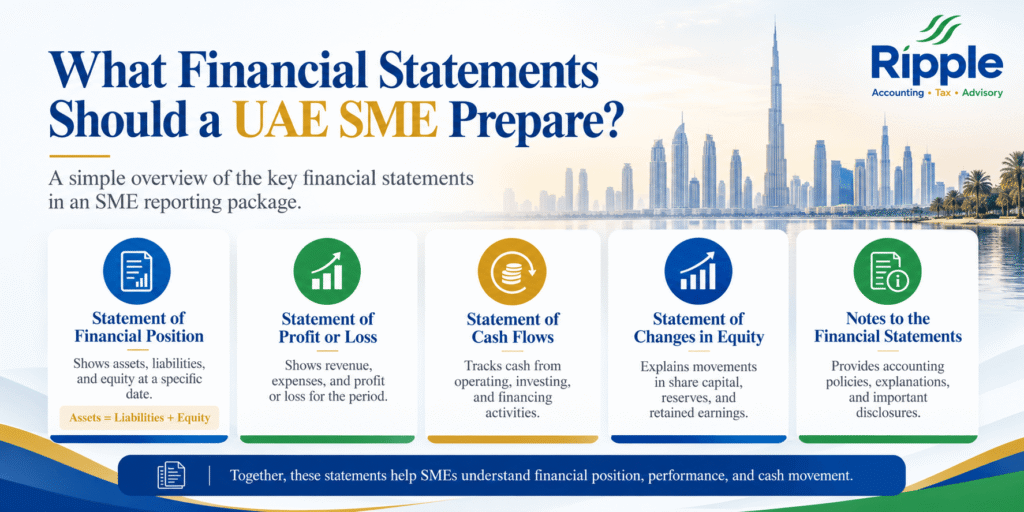
A complete financial reporting package will generally contain several important statements and supporting information. The exact presentation can vary depending on the applicable reporting framework and the nature of the business.
Often referred to as the balance sheet, this statement presents the company’s financial position at a specific date. It generally includes three major categories:
What the company owns or controls, such as:
What the company owes, such as:
The owners’ interest in the business, which can include:
A basic accounting relationship is:
Assets = Liabilities + Equity
The statement should provide a clear picture of the company’s financial position at the reporting date.
The profit and loss statement shows the company’s financial performance over a particular period.
It normally includes:
For SME owners, this statement is particularly useful because it shows whether revenue is translating into sustainable profitability.
A business can have strong sales but still experience weak profitability if operating costs, financing expenses, or other costs are too high.
Profit does not necessarily equal cash available to the business. The statement of cash flows explains how cash and cash equivalents changed during the reporting period.
Cash flows are generally presented through:
For example, operating cash flows may include customer collections and supplier payments. Investing activities may include purchasing or selling equipment, while financing activities may include loans, repayments, or owner financing.
For SMEs, this statement can provide valuable insight into whether the business is generating sufficient cash from its core operations.
This statement explains movements in the company’s equity during the reporting period.
Depending on the business, changes may result from:
This helps shareholders understand why the closing equity balance differs from the opening balance.
The financial statements should not be viewed as numbers alone. Notes provide additional explanations and accounting information needed to understand the figures.
Depending on the business, notes may cover:
The notes can be particularly important during an audit because they provide context behind the amounts presented in the primary statements.
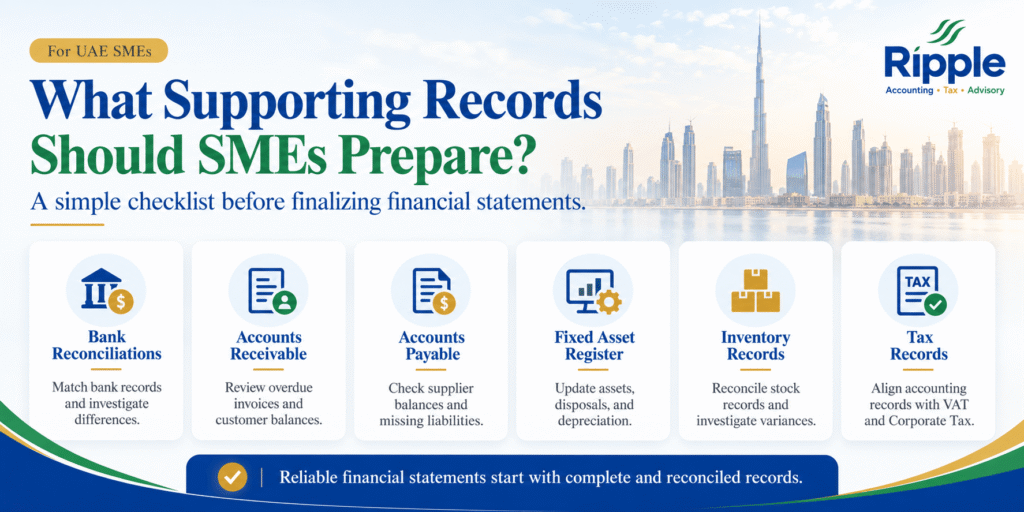
Financial statements are only as reliable as the accounting records behind them. Before preparing year-end statements, an SME should ensure its accounting records are complete and properly reconciled.
Each bank account should be reconciled against the accounting records.
Investigate:
Review customer balances and identify:
Supplier balances should also be reviewed for:
If the company owns equipment, vehicles, computers, machinery or other fixed assets, its asset register should be updated.
Check:
Businesses holding inventory should reconcile accounting records with appropriate inventory records and investigate material differences.
Where applicable, businesses should reconcile their accounting information with VAT and Corporate Tax records.
The UAE Tax Procedures framework also includes requirements concerning accounting records and commercial books. The Ministry of Finance explains that Cabinet Decision No. 74 of 2023 sets out accounting record and commercial book requirements, including retention requirements.
These two types of reporting are sometimes confused. Management accounts are generally prepared to help business owners and managers monitor performance. They may include customized KPIs, budgets, forecasts, department-level reports, or other internal information.
IFRS-based financial statements, on the other hand, follow an established accounting framework and are designed to provide structured financial information about the business.
For example, management may request a monthly report showing:
These can be extremely useful internally but are not necessarily a substitute for formal financial statements.
If financial statements will be audited, preparation should ideally begin well before the auditor starts fieldwork. An SME can use the following checklist:
This preparation can reduce avoidable questions and delays during the audit process.
Proper financial reporting is not only about satisfying a compliance requirement.
It can help an SME:
Professional support can be useful when:
A professional review can help identify issues before financial statements are finalised.
Preparing IFRS financial statements UAE businesses can rely on requires more than simply exporting figures from accounting software. The underlying records need to be complete, reconciled and properly reviewed.
Ripple Accounting, Tax & Advisory can support UAE businesses with accounting and audit & assurance requirements, including financial reporting preparation and review.
If your SME needs help preparing financial statements, organizing accounting records or getting ready for an audit, contact Ripple Accounting, Tax & Advisory to discuss your requirements.
Ripple can help businesses establish a more structured financial reporting process so that management has clearer financial information and records are better prepared for relevant reporting, tax and audit requirements.
A typical complete set can include a statement of financial position, statement of profit or loss, statement of cash flows, statement of changes in equity and accompanying notes. The exact requirements depend on the applicable accounting framework and the company’s circumstances.
Not necessarily in exactly the same form for every business and purpose. The UAE Commercial Companies Law requires companies to apply international accounting standards and principles in preparing their accounts, while the Corporate Tax framework provides specific accounting standards and methods depending on revenue and other conditions.
IFRS is the broader set of International Financial Reporting Standards. IFRS for SMEs is a simplified financial reporting framework designed for eligible small and medium-sized entities. UAE businesses should determine which framework is appropriate based on the applicable UAE requirements and their circumstances.
Audit requirements can depend on the company’s legal structure and applicable UAE legislation, as well as other circumstances such as regulatory or contractual requirements. For example, the UAE Commercial Companies Law states that every joint stock company and limited liability company shall have one or more auditors to carry out an annual audit of its accounts.
Financial statements provide the accounting information from which taxable income is generally determined, subject to the adjustments required under the UAE Corporate Tax rules. The Ministry of Finance has specifically addressed accounting standards and methods used for Corporate Tax purposes.
Preparing IFRS financial statements for a UAE SME involves more than producing a year-end profit and loss report. A complete reporting process should consider the statement of financial position, profit or loss, cash flows, changes in equity and relevant notes, supported by accurate accounting records. The UAE Commercial Companies Law requires companies to prepare annual financial accounts and apply international accounting standards and principles.
At the same time, Corporate Tax rules provide specific accounting options and requirements that businesses need to consider based on their circumstances.For SMEs, the best approach is to keep accounting records accurate throughout the year rather than trying to reconstruct financial information immediately before an audit, financing application or tax deadline.
Disclaimer: This article provides general information about IFRS financial statements for UAE SMEs and should not be considered legal, accounting, audit or tax advice. Accounting and reporting requirements can vary according to a company’s legal structure, size, revenue, activities, regulatory status and other circumstances. UAE legislation, accounting requirements and tax guidance may change. Businesses should consult the latest official UAE legislation and guidance, or obtain advice from a qualified professional, before making accounting, tax or reporting decisions.
Tell us a little about your business and our UAE tax experts will get back to you with clear, practical answers — no obligation.
Product returns and customer refunds are common for UAE retailers, wholesalers, distributors, and e-commerce businesses. However, a returned product is not simply…
Read article VAT
The UAE’s VAT registration rules require businesses to monitor their taxable turnover continuously rather than waiting until the end of the financial…
Read article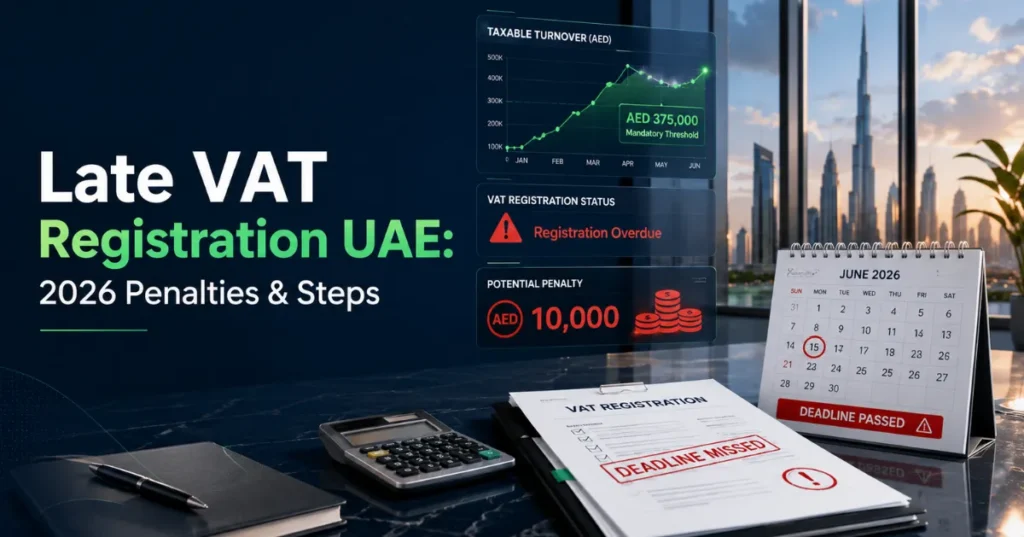 VAT
Late VAT registration is a common compliance issue for businesses that experience rapid growth or fail to monitor their taxable turnover regularly.…
Read articlePage 45 of 59
Book a free consultation and get clear answers for your business.
0 Comments