UAE Tax Residency Certificate Requirements: Documents and Eligibility
Are you planning to apply for a UAE Tax Residency Certificate but unsure which documents you need or whether you qualify? Understanding…
Read article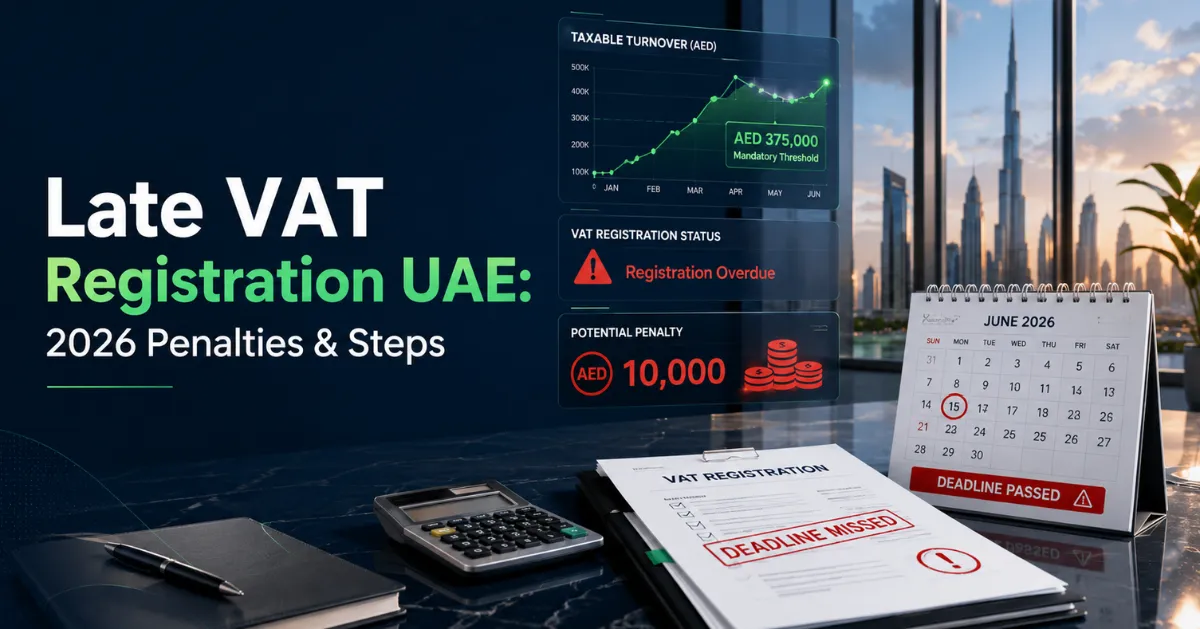
Late VAT registration is a common compliance issue for businesses that experience rapid growth or fail to monitor their taxable turnover regularly. Under the UAE VAT framework, businesses are responsible for tracking their revenue and registering for VAT once they meet the applicable registration requirements. Missing the registration deadline can result in administrative penalties, backdated VAT obligations, and additional compliance risks. Whether you operate a mainland company, free zone business, e-commerce store, consultancy, or SME, understanding the VAT registration timeline is essential for avoiding unnecessary costs. The Federal Tax Authority (FTA) expects businesses to assess their taxable supplies on an ongoing basis rather than waiting until year-end to prepare financial statements.
Late VAT Registration UAE refers to a situation where a business fails to submit its VAT registration application within the required timeframe after becoming liable to register under UAE VAT legislation. Registration obligations are based on taxable supplies and imports rather than the age of the business or the date the trade licence was issued.
A business may become liable to register because its historical taxable turnover exceeds the mandatory registration threshold or because it expects to exceed that threshold within the coming 30 days. Delaying registration beyond the required deadline can expose the business to penalties and create additional VAT reporting obligations.
Businesses must assess all taxable supplies and taxable imports when determining whether VAT registration is required. The obligation applies regardless of whether the business is newly established or has been operating for several years.
VAT registration generally applies to:
Businesses should continuously monitor turnover rather than relying solely on annual financial statements.
The UAE offers both mandatory and voluntary VAT registration depending on the business’s taxable turnover.
Mandatory VAT Registration
A business must register once it exceeds the mandatory registration threshold prescribed by the FTA. This requirement applies to businesses that are legally required to collect VAT, issue compliant tax invoices, maintain VAT records, and submit VAT returns.
Voluntary VAT Registration
Businesses that meet the voluntary registration threshold but have not reached the mandatory threshold may choose to register voluntarily. Voluntary registration may benefit businesses by allowing eligible recovery of input VAT and improving commercial credibility when dealing with VAT-registered customers and suppliers.
A business generally becomes liable to register when either of the following applies:
Businesses should review sales regularly instead of waiting until the end of the financial year. Rapid business growth can cause the registration threshold to be reached much earlier than expected.
Several practical issues contribute to late VAT registration.
Common reasons include:
Regular financial reviews can significantly reduce the likelihood of missing the VAT registration deadline.

Understanding the VAT registration thresholds is the first step toward maintaining compliance. Businesses should calculate taxable turnover accurately and review it monthly, especially during periods of rapid expansion.
A business must register for VAT if the total value of its taxable supplies and imports exceeds AED 375,000 over the previous 12 months or is expected to exceed this amount within the next 30 days. Once the threshold is met, the business should submit its VAT registration application within the required timeframe to avoid administrative penalties.
Businesses may apply for voluntary VAT registration if the value of taxable supplies, imports, or eligible expenses reaches AED 187,500. Voluntary registration is often suitable for growing businesses that incur significant VAT on business expenses before reaching the mandatory threshold.
Taxable turnover generally includes:
When calculating taxable turnover, businesses should ensure they classify transactions correctly and maintain supporting documentation. Items that generally do not form part of taxable turnover include exempt supplies, where applicable under UAE VAT legislation.
Monthly turnover monitoring is particularly important for businesses with fluctuating revenue.
These include:
Implementing monthly financial reporting allows businesses to identify VAT registration obligations before deadlines are missed.
| Registration Type | Revenue Threshold | Requirement |
|---|---|---|
| Mandatory VAT Registration | AED 375,000 | Registration is legally required |
| Voluntary VAT Registration | AED 187,500 | Registration is optional if eligibility conditions are met |
Meeting the VAT registration deadline is just as important as determining eligibility. Businesses should monitor turnover continuously because the registration obligation arises when the threshold is exceeded or is expected to be exceeded within the prescribed period.
Delaying the application may result in penalties even if VAT is eventually paid.
The registration process should begin as soon as the business determines that it has become liable to register.
Businesses should:
Waiting several weeks after identifying the registration requirement increases the risk of non-compliance.
The effective VAT registration date is determined based on the applicable VAT rules and the facts of the business’s registration. It may not always match the date the application is submitted.
Once the effective registration date is established, the business is generally required to:
Businesses should ensure their accounting systems are updated from the effective registration date to avoid reporting errors.
Many businesses misunderstand how VAT registration deadlines work.
Common misconceptions include:
These misunderstandings often lead to avoidable penalties and additional compliance work.
Scenario
A consultancy firm’s taxable turnover reaches the mandatory registration threshold during June 2026 after securing several new client contracts. Based on its turnover and future sales forecast, the business becomes liable to register under the UAE VAT rules.
The business should:
Taking prompt action helps reduce compliance risks and supports accurate VAT reporting as the business grows.
Late VAT registration can expose a business to more than a single administrative penalty. Once the Federal Tax Authority (FTA) determines that a business should have registered earlier, it may require the business to account for VAT from the applicable effective registration date. This can increase the overall financial burden, particularly where taxable supplies have continued for an extended period without VAT compliance.
Businesses should not delay registration after identifying that they have exceeded the mandatory VAT registration threshold. Prompt action can help limit additional compliance issues and ensure VAT obligations are met correctly.
If a business fails to register for VAT within the required timeframe after becoming liable, the FTA may impose an administrative penalty of AED 10,000 under the UAE tax penalties framework. The penalty applies regardless of whether the business later submits its VAT registration voluntarily. Registering promptly after identifying the issue remains the best approach to reducing further compliance risks.
Late registration can create several operational and tax compliance challenges beyond the administrative fine.
These include:
Businesses should review their VAT position as soon as they identify a missed registration obligation.
Where VAT liabilities remain unpaid after the applicable deadlines, businesses may become subject to additional consequences under the UAE tax procedures framework.
Potential risks include:
Maintaining complete documentation and accurate bookkeeping helps businesses respond efficiently during any FTA review.
Late registration may also affect a business’s ability to recover input VAT correctly.
Businesses should carefully review:
Professional review is often beneficial where historical transactions require correction.
The effective VAT registration date is one of the most important aspects of late VAT registration. It determines when the business legally became responsible for charging VAT and complying with VAT reporting obligations.
The effective date is not necessarily the same as the date the VAT registration application is submitted or approved.
Where the FTA determines that a business became liable to register before submitting its application, the VAT registration may be effective from an earlier date based on the applicable registration rules.
As a result, the business may need to account for VAT on taxable supplies made from that effective date onward.
Once the effective registration date applies, the business is generally required to:
Failure to meet these obligations may lead to further compliance issues.
If taxable supplies were made after the effective registration date but before the business completed VAT registration, VAT may still become payable on those transactions.
Depending on contractual arrangements, businesses may need to:
Subject to the UAE VAT legislation and the applicable recovery conditions, businesses may be eligible to recover certain input VAT.
Recovery generally depends on factors such as:
Each historical transaction should be reviewed carefully before claiming input VAT.
| Event | Example Timeline |
|---|---|
| Mandatory threshold exceeded | 15 June 2026 |
| Business identifies requirement | 5 July 2026 |
| VAT registration submitted | 12 July 2026 |
| FTA determines effective registration date | Based on applicable VAT rules |
| VAT reporting begins | From the effective registration date |
Continuing business operations without registering for VAT after becoming legally required to do so increases compliance risks. Businesses remain responsible for meeting their VAT obligations even if registration is delayed.
The longer the delay, the more difficult it becomes to correct historical records accurately.
Businesses that fail to register on time may issue invoices that do not reflect the correct VAT treatment.
This may result in:
Where VAT should have been charged but was not, businesses may need to pay the VAT from their own revenue if they cannot recover it from customers.
This can significantly reduce business profitability, particularly where large volumes of taxable supplies are involved.
Late registration may increase the likelihood of an FTA compliance review.
During an audit, the FTA may request:
Businesses with organised financial records are generally better prepared for compliance reviews.
Late registration frequently requires businesses to reconstruct historical financial information.
Common issues include:
Early corrective action helps reduce administrative work.
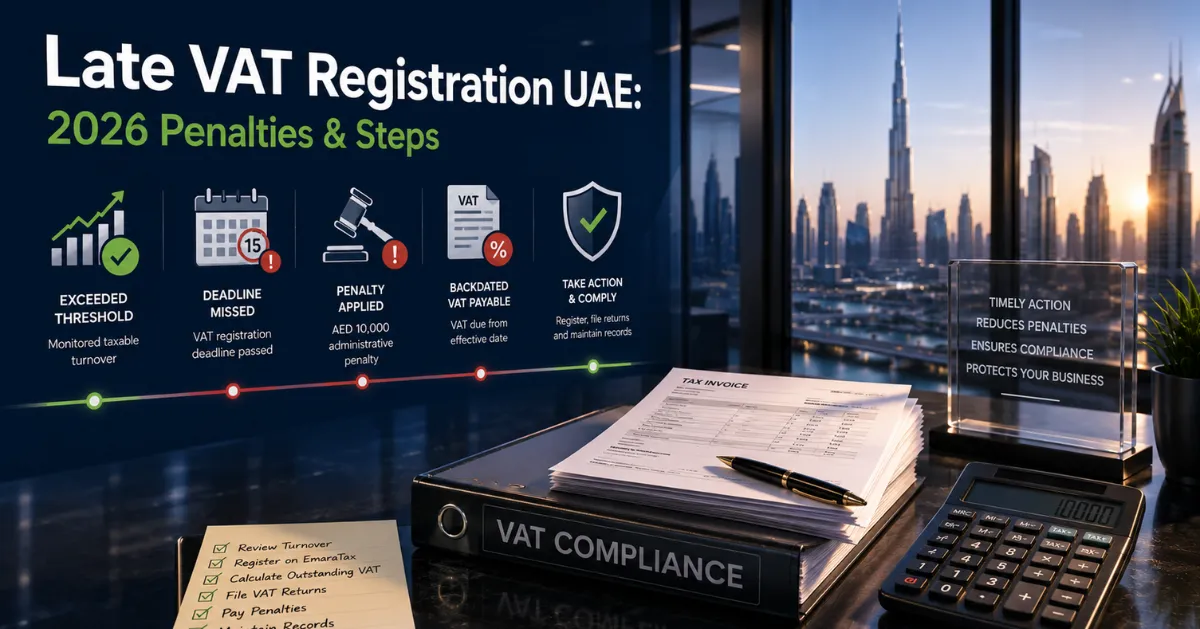
Businesses that discover they should have registered earlier should act immediately. Prompt corrective action improves compliance and helps ensure VAT obligations are addressed accurately.
Submit the VAT registration application through the EmaraTax portal as soon as the registration requirement is identified.
Avoid delaying the application while waiting for year-end accounts or additional business records.
Collect all documents required to determine the business’s VAT position.
These typically include:
Review taxable turnover carefully to identify when the mandatory VAT registration threshold was exceeded or expected to be exceeded.
This assessment forms the basis of the business’s VAT compliance review.
Review taxable transactions from the effective registration date.
Calculate:
Accurate calculations help reduce reporting errors.
Where required, prepare and submit VAT returns for the applicable tax periods in accordance with FTA requirements.
Returns should be supported by complete accounting records and valid documentation.
Businesses should settle outstanding VAT liabilities and any applicable administrative penalties as soon as possible to maintain compliance.
Update accounting systems to reflect:
Accurate bookkeeping reduces future compliance risks.
Submitting complete and accurate documentation helps the VAT registration process proceed smoothly. Businesses should ensure that the information provided through EmaraTax matches their trade licence and financial records.
The documents required may vary depending on the business activity and legal structure, but the following are commonly requested.
Preparing these documents in advance helps avoid delays during the VAT registration process.
Calculating taxable turnover accurately is essential for determining whether your business has crossed the VAT registration threshold. Businesses should review turnover regularly rather than waiting until the end of the financial year.
Taxable turnover generally includes supplies that are subject to UAE VAT.
Examples include:
Standard-rated supplies are generally subject to VAT at the applicable standard rate under UAE VAT legislation.
Examples include:
Zero-rated supplies remain taxable but are subject to a 0% VAT rate.
Examples may include:
Exempt supplies are generally not included in taxable turnover for mandatory VAT registration calculations where the legislation provides an exemption. Examples may include certain financial services and qualifying residential property transactions.
Businesses should classify exempt and zero-rated supplies correctly because they have different VAT treatments.
Businesses involved in international trade should include taxable imports and exports according to the applicable UAE VAT rules. Proper customs documentation and accounting records are important when calculating taxable turnover.
Depending on the applicable VAT rules, businesses may exclude certain transactions from taxable turnover calculations.
These can include:
A UAE trading company records the following during a rolling 12-month period:
Since expected taxable turnover exceeds the mandatory VAT registration threshold, the business should begin the VAT registration process without delay.
Many late registration cases result from avoidable errors in financial monitoring and VAT compliance.
Common mistakes include:
Regular monthly turnover reviews help businesses identify VAT obligations early.
The following examples illustrate how businesses may become liable for VAT registration.
A retail company experiences strong seasonal sales and exceeds the mandatory VAT registration threshold during the year. The business submits its VAT registration promptly and begins issuing VAT-compliant tax invoices from the applicable effective registration date.
An online retailer receives a significant increase in customer orders over several months. By monitoring monthly taxable turnover, the company identifies its registration obligation early and avoids late registration penalties.
A management consultancy secures several high-value contracts within a short period. The projected taxable turnover exceeds the mandatory threshold, requiring the business to register before reaching the projected sales level.
An import-export company combines domestic taxable supplies with qualifying international transactions. Regular turnover monitoring enables the business to register on time and maintain accurate VAT records.
A construction contractor signs multiple long-term projects that increase taxable revenue. Monthly financial reviews help the company identify its VAT registration requirement before the deadline.
Preventing late VAT registration requires consistent financial monitoring and accurate bookkeeping throughout the year.
Businesses should adopt the following practices:
A proactive compliance process reduces the likelihood of penalties and supports accurate VAT reporting.
Ripple Accountants helps businesses across the UAE manage VAT registration, late VAT registration, VAT return filing, bookkeeping, Corporate Tax compliance, and ongoing FTA requirements. Our experienced tax professionals assess your VAT obligations, determine the correct registration timeline, prepare accurate EmaraTax applications, and assist with resolving late registration issues efficiently. Whether you are a startup, SME, free zone company, or established business, we provide practical, compliant solutions tailored to your business needs.
Contact Details
The FTA may impose an AED 10,000 administrative penalty for failing to register for VAT within the required timeframe after becoming liable to register.
Yes. If the FTA determines that your business became liable to register earlier, it may assign an effective VAT registration date based on the applicable VAT rules.
In certain circumstances, businesses may recover eligible input VAT if they meet the conditions set out in the UAE VAT legislation and maintain valid supporting documentation.
You should review your taxable turnover immediately, register through EmaraTax without unnecessary delay, calculate any outstanding VAT obligations, and comply with applicable filing requirements.
Processing times vary depending on the completeness of the application and any additional information requested by the FTA.
Yes. Free zone businesses carrying out taxable activities may also have VAT registration obligations. Their location alone does not automatically exempt them from VAT.
No. Late registration penalties generally apply when a business fails to meet a mandatory VAT registration obligation, not when it chooses not to register voluntarily.
Yes. The FTA has the authority to review business records, assess VAT compliance, and request supporting documentation where necessary.
Late VAT registration can lead to administrative penalties, backdated VAT liabilities, and additional compliance obligations. Monitoring taxable turnover regularly, maintaining accurate financial records, and understanding the VAT registration thresholds are essential for avoiding unnecessary risks.
Disclaimer: This article is for general informational purposes only and does not constitute legal, tax, or financial advice. UAE VAT laws and FTA guidance may change. Businesses should consult a qualified tax adviser or the Federal Tax Authority for advice specific to their circumstances.
Tell us a little about your business and our UAE tax experts will get back to you with clear, practical answers — no obligation.
 Corporate Tax
Are you planning to apply for a UAE Tax Residency Certificate but unsure which documents you need or whether you qualify? Understanding…
Read article Corporate Tax
Do you need a UAE Tax Residency Certificate for a local administrative requirement or to claim benefits under a double taxation agreement?…
Read article Bookkeeping
How can UAE businesses ensure employees receive the correct salary every month? Payroll involves more than adding basic pay and allowances. Employers…
Read articlePage 1 of 58
Book a free consultation and get clear answers for your business.
0 Comments