Outsourcing Payroll: Benefits and Challenges Every Business Should Know
Managing payroll is one of the most important responsibilities for any business. Employees expect to receive accurate salaries on time, while businesses…
Read article
Have you discovered an incorrect VAT amount, missed transaction or input tax claim in a return already submitted to the Federal Tax Authority (FTA)?
Even small accounting mistakes can affect a business’s VAT position and create additional compliance responsibilities. However, businesses should not simply change figures in their next return without checking the applicable correction rules.
To correct VAT return error in UAE, businesses must first identify the mistake, calculate its financial impact and determine whether a future VAT return adjustment or a formal Voluntary Disclosure is required. The UAE Tax Procedures framework was updated in 2026, including changes to the AED 10,000 correction threshold and related procedures.
This guide explains the correction process, supporting documents, Emara Tax workflow and applicable administrative penalties so businesses can address VAT reporting mistakes correctly.
A VAT return error occurs when a previously submitted return contains incorrect information, calculations or transaction classifications.
These mistakes can affect output VAT, recoverable input VAT, net tax payable or the amount of VAT refundable by the FTA.
Common examples include:
For example, a trading company submits a VAT return showing AED 60,000 in output VAT and AED 25,000 in recoverable input VAT.
However, during an internal review, the finance team discovers that AED 5,000 of eligible input VAT was incorrectly excluded. The original return reported AED 35,000 as payable VAT, whereas the corrected calculation shows AED 30,000.
The business should review the applicable FTA correction procedure rather than simply changing its accounting records and assuming that the submitted return has been amended.
Understanding how to correct VAT return error in UAE starts with determining whether the mistake affected the tax payable or refundable amount.
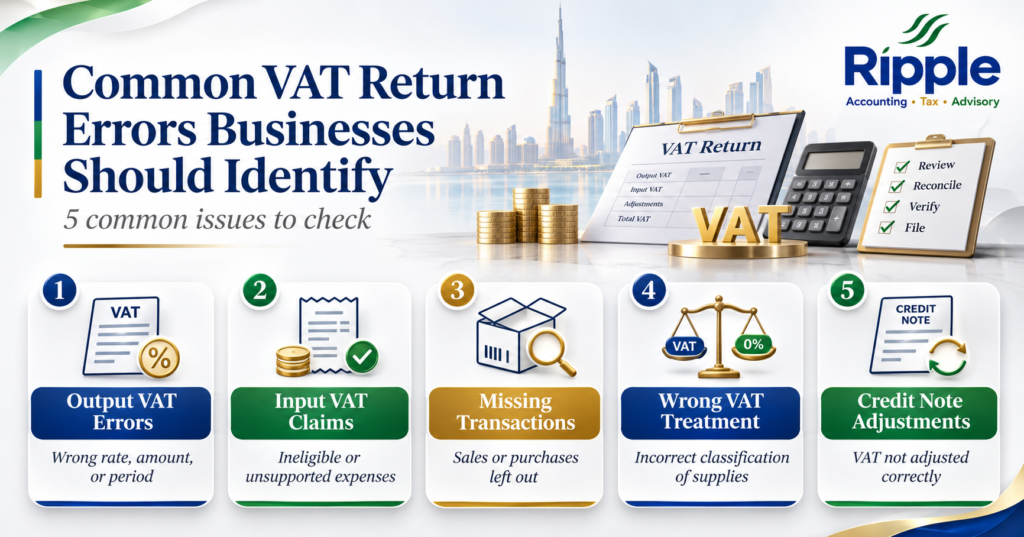
Before selecting a correction method, businesses should understand what caused the discrepancy. The following mistakes commonly arise during VAT preparation and accounting reconciliation.
Output VAT is the tax a registered business charges on its taxable supplies.
Errors can occur when businesses:
For example, a company may record a standard-rated sale of AED 20,000 but calculate VAT using an incorrect rate.
The business should identify the original transaction, verify its correct VAT treatment and calculate the resulting tax difference.
Input VAT is the VAT incurred on eligible business purchases and expenses. A business may incorrectly claim VAT on personal expenses, restricted expenditure or purchases that do not satisfy the applicable recovery conditions.
Other mistakes include:
Businesses should review the purchase invoice and applicable input tax recovery rules before making any correction.
Some transactions may be recorded in the accounting system but omitted from the submitted VAT return.
For example, a business may issue several sales invoices near the end of a tax period but fail to include them in its VAT reconciliation.
This can result in understated output VAT. Similarly, missing purchase invoices may cause eligible input VAT to be excluded from the return.
Businesses may incorrectly classify transactions as standard-rated, zero-rated, exempt or outside the scope of VAT. This can affect both the reported VAT amount and the business’s entitlement to recover input tax.
International transactions, exports, imports and reverse-charge supplies require particular attention because their VAT treatment depends on the applicable rules and supporting evidence.
Credit notes may affect the amount of output VAT or input VAT reported in a tax period. If a business issues a credit note but fails to reflect the appropriate adjustment, the submitted return may contain incorrect figures.
The business should review the original invoice, credit note and related accounting entries before determining the correction method.
The UAE introduced updated procedures for correcting certain tax return errors through Cabinet Decision No. 17 of 2026, effective from 1 April 2026.
Under Article 10 of Cabinet Resolution No. 74 of 2023, as amended, the correction route depends on the amount of understated payable tax and the nature of the error.
The AED 10,000 threshold is particularly relevant when an incorrect return or tax assessment has resulted in payable tax being calculated below the amount legally required.
If an error results in payable tax being understated by more than AED 10,000, the taxable person must submit a Voluntary Disclosure to the FTA.
The disclosure must generally be submitted within 20 business days from the date the taxpayer becomes aware of the error.
Example:
A company submits a VAT return showing AED 40,000 as payable tax.
During an accounting review, it discovers that the correct amount should have been AED 55,000.
| Particulars | Amount |
| Originally reported payable VAT | AED 40,000 |
| Correct payable VAT | AED 55,000 |
| Tax difference | AED 15,000 |
Since the understated tax exceeds AED 10,000, the business must submit a Voluntary Disclosure within the prescribed 20-business-day period.
If the error results in understated payable tax of AED 10,000 or less, the business generally corrects it through an eligible VAT return.
The correction should be included in:
whichever is earlier.
If there is no available VAT return through which the correction can be made, the business must submit a Voluntary Disclosure within 20 business days of becoming aware of the error.
Example:
A company discovers that it understated payable VAT by AED 7,500 in an earlier return. If an eligible subsequent VAT return is available, the business can correct the error through that return according to the applicable rules.
If no suitable return is available, it must submit a Voluntary Disclosure within the prescribed timeframe.
Some VAT return errors involve incorrect information but do not change the amount of tax due.
For example, a business may identify an incorrect entry or reporting detail that does not affect the net payable VAT.
Under the applicable rules, such errors should be corrected or reported through a Voluntary Disclosure, as determined by the FTA. Businesses should not assume that an error can be ignored simply because the final VAT amount remains unchanged.
| Type of error | General correction procedure |
| Understated payable tax exceeding AED 10,000 | Voluntary Disclosure within 20 business days |
| Understated payable tax of AED 10,000 or less | Correct through the eligible VAT return |
| No available return for a correction of AED 10,000 or less | Voluntary Disclosure within 20 business days |
| Incorrect tax refund application resulting in an excessive refund | Generally Voluntary Disclosure within 20 business days |
| Error with no difference in tax due | Correct or disclose as determined by the FTA |
Important: The AED 10,000 threshold does not apply identically to every VAT error. In particular, an excessive refund claimed through a separate refund application has its own disclosure requirements. Where an excessive refund results from an incorrect VAT return or tax assessment, the applicable correction thresholds must also be considered.
A Voluntary Disclosure is a formal notification submitted to the FTA to report an error or omission in a previously submitted tax return, tax assessment or tax refund application.
For VAT purposes, the relevant submission is commonly known as VAT Form 211.
Businesses should consider the following situations:
A business should not automatically submit Form 211 for every bookkeeping discrepancy. It must first determine whether the error falls within the legal disclosure requirements.
The following records can help support the correction:
| Document | Purpose |
| Original VAT return | Identifies the figures previously reported |
| Corrected VAT calculation | Shows the revised tax position |
| Sales invoices | Supports output VAT corrections |
| Purchase invoices | Supports input VAT corrections |
| Credit and debit notes | Explains transaction adjustments |
| General ledger | Helps identify accounting discrepancies |
| Trial balance | Supports financial reconciliation |
| Bank statements | Helps verify relevant payment records |
| Import and customs documents | Supports import-related corrections |
| Explanation of the error | Describes how and why the mistake occurred |
The required supporting information depends on the nature of the correction and any additional information requested by the FTA.
For a more detailed recordkeeping checklist, read our UAE VAT Return Filing Documents Checklist.
Businesses must use the FTA’s prescribed electronic process to submit a Voluntary Disclosure.
The following steps provide a general overview of the process.
In certain circumstances, businesses may be able to edit a submitted VAT return before the original filing deadline expires.
The FTA’s published FAQ explains that an Edit option may appear after submission. If the taxpayer chooses to make a correction before the filing deadline, the system directs the user to the relevant Voluntary Disclosure process.
The FTA’s guidance indicates that corrections made through this process before the filing deadline can be completed without penalties.
However, businesses should distinguish between correcting a return before its original deadline and correcting an error discovered after that deadline.
Once the applicable filing deadline has passed, the business should follow the correction requirements under the current Tax Procedures framework.
Always check the available options in EmaraTax and the latest FTA instructions before making changes.
Businesses that submit incorrect VAT returns or fail to disclose errors when required may face administrative penalties. The relevant framework was amended by Cabinet Decision No. 129 of 2025, effective from 14 April 2026.
The following penalties are particularly relevant to VAT error correction.
The administrative penalty for submitting an incorrect tax return is AED 500.
However, the penalty does not apply where the registrant:
A Voluntary Disclosure concerning an error in a tax return, tax assessment or refund application may attract a monthly penalty of 1% of the tax difference.
The calculation generally runs from the day following the relevant original return or refund application deadline until the Voluntary Disclosure is submitted.
If a taxpayer fails to submit a required Voluntary Disclosure before being notified that the FTA will conduct a tax audit, the following penalties may apply:
A business that fails to pay additional VAT within the applicable payment period may face a separate late payment penalty. The current framework provides for a monthly penalty calculated at 14% per annum on the unsettled payable tax amount, for each month or part thereof.
For Voluntary Disclosures, the relevant payment deadline is generally 20 business days from submission. These penalties are separate and should not be confused with the AED 10,000 correction threshold.
Businesses should consult the amended administrative penalty schedule before calculating their potential liability.
Although businesses can correct certain errors after submission, maintaining accurate records from the beginning is a more effective approach. The following practices can reduce reporting mistakes.
For further guidance, read our article on How to Prepare for an FTA Compliance Review in UAE.
Identifying a VAT reporting mistake is only the first step. Businesses must also determine the correct adjustment method, calculate the tax difference and prepare the supporting information required by the FTA.
Ripple Accounting, Tax & Advisory supports UAE businesses with VAT return reviews, error identification and compliance assistance.
The team can help with:
Whether a business has discovered a minor calculation error or a significant difference in its previously reported tax position, reviewing the issue promptly can help avoid unnecessary compliance complications.
If you need professional assistance to correct VAT return error in UAE, contact Ripple Accounting, Tax & Advisory to discuss your VAT filing position and correction requirements.
First, identify the error and calculate its impact on the payable or refundable VAT amount. Then determine whether it qualifies for correction through an eligible subsequent VAT return or requires a Voluntary Disclosure through EmaraTax.
A Voluntary Disclosure is generally required when an incorrect return or tax assessment has resulted in understated payable tax exceeding AED 10,000. It must be submitted within 20 business days of becoming aware of the error. Other circumstances, including excessive refund applications, have separate requirements.
Yes, where the error involves understated payable tax of AED 10,000 or less, it can generally be corrected through the eligible VAT return specified by Article 10 of Cabinet Resolution No. 74 of 2023, as amended. If no suitable return is available, a Voluntary Disclosure must be submitted within 20 business days of becoming aware of the error.
VAT Form 211 is the Voluntary Disclosure form used to notify the FTA of certain errors or omissions in previously submitted VAT returns, tax assessments or refund applications.
Under the administrative penalty framework effective from 14 April 2026, the penalty for submitting an incorrect tax return is AED 500, subject to exceptions for timely correction and qualifying Voluntary Disclosures without a difference in tax due. Additional penalties may apply to tax differences and failures to disclose errors when required.
Yes. Businesses can correct certain errors after the original filing deadline by following the applicable correction or Voluntary Disclosure procedure. The appropriate method depends on the nature and amount of the error.
If the FTA has already notified the business that it will be subject to a tax audit, the penalty treatment for failing to submit a required Voluntary Disclosure before notification may apply. Businesses should immediately review the affected tax periods and obtain appropriate professional advice.
Incorrect VAT returns can create financial and compliance challenges for UAE businesses, but the appropriate correction process depends on the nature of the error and its impact on the tax position. Businesses should review the AED 10,000 threshold, understand when a Voluntary Disclosure is required and maintain supporting evidence for every correction.
Knowing how to correct VAT return error in UAE helps businesses respond promptly, follow the applicable FTA procedures and reduce the risk of additional administrative penalties. Regular accounting reconciliations, accurate VAT calculations and periodic compliance reviews can also help prevent similar mistakes in future reporting periods.
For assistance with VAT return reviews, adjustments and Voluntary Disclosures, contact Ripple Accounting, Tax & Advisory.
Disclaimer: This article provides general information about UAE VAT correction procedures and administrative penalties. It is not individual tax or legal advice. The applicable correction method and penalty treatment depend on the circumstances of each case and the legislation in force. Businesses should verify current FTA guidance before submitting corrections.
Tell us a little about your business and our UAE tax experts will get back to you with clear, practical answers — no obligation.
 Bookkeeping
Managing payroll is one of the most important responsibilities for any business. Employees expect to receive accurate salaries on time, while businesses…
Read article Audit
Investing in a company involves more than reviewing its profits or growth projections. Investors need reliable financial information to understand whether a…
Read article Bookkeeping
Managing business finances is one of the most important responsibilities for any business owner. Whether you run a startup, a small business,…
Read articlePage 66 of 69
Book a free consultation and get clear answers for your business.
0 Comments