VAT Registration for UAE Freelancers and Consultants: Requirements and Process
Are you working independently as a freelancer or consultant in the UAE and wondering whether you need to register for VAT? Operating…
Read article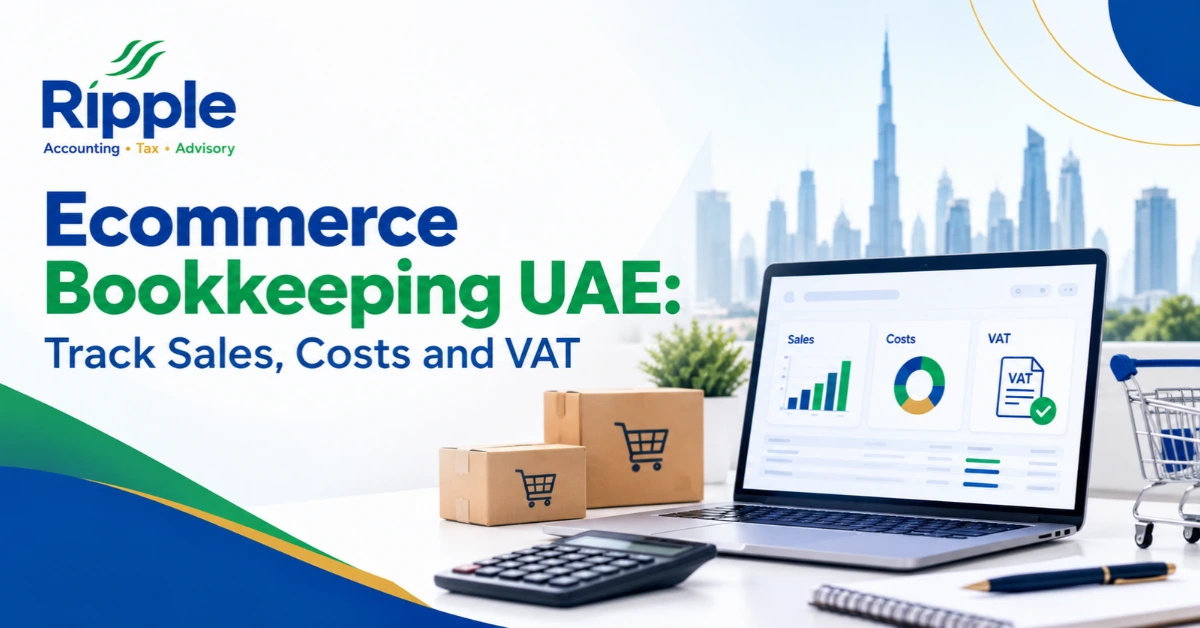
Running an online store in the UAE involves more than recording customer orders and checking bank deposits. Business owners must track sales, refunds, payment gateway fees, inventory purchases, shipping expenses, and applicable tax obligations. Without organized records, it becomes difficult to understand actual profit, manage cash flow, and prepare accurate financial reports. Ecommerce Bookkeeping UAE helps online sellers connect transactions from their websites, marketplaces, payment providers, and business bank accounts. Whether you operate a Shopify store, sell through Amazon, or manage an online business in Dubai or Abu Dhabi, a reliable bookkeeping process helps you understand where your money comes from and where it goes.
E-commerce bookkeeping is the process of recording, organizing, and reconciling the financial transactions generated by an online business. It includes customer payments, product sales, refunds, supplier invoices, inventory movements, operating expenses, and tax-related records.
Unlike a traditional shop, an online business may use several platforms to complete a single sale. A customer might place an order through a website, pay through a payment gateway, and receive the product through a third-party fulfilment provider. Each system generates different financial records.
Effective bookkeeping connects these records so the business can determine its actual revenue, expenses, cash position, and profitability.
A UAE e-commerce business should maintain organized records for:
Keeping these records together makes it easier to prepare financial statements and assess business performance.
A consistent bookkeeping process helps online sellers identify discrepancies before they affect financial reports or tax calculations.
Start by collecting sales reports from every channel. Record the relevant sales, discounts, cancellations, refunds, and returns according to the applicable accounting treatment. Do not automatically treat the amount deposited into your bank account as total sales. Payment providers and marketplaces may deduct fees or process refunds before releasing funds.
Payment gateway reconciliation compares transaction reports with the amounts received in your business bank account.
For example, an online store might record AED 30,000 in sales. The payment provider deducts AED 900 in processing fees and processes AED 1,100 in refunds. The resulting settlement would be AED 28,000, assuming no other adjustments.
The bookkeeping records should show the original sales, refunds, fees, and settlement separately where appropriate. The example is illustrative and does not represent a complete VAT or accounting calculation.
Record expenses such as:
Separate product costs from operating expenses so you can assess gross profit and operating profitability more accurately.
Compare inventory records with actual stock movements and supplier invoices. Then reconcile bank statements with payment gateway settlements and other financial transactions.
Regular reconciliation helps identify missing payments, duplicate entries, unrecorded fees, and unexplained differences.
VAT is an important consideration for online businesses selling taxable goods or services in the UAE. The standard VAT rate is generally 5% for supplies subject to that rate, but the correct treatment depends on the nature and location of the transaction and the applicable rules.
The Federal Tax Authority (FTA) provides the official VAT registration requirements and guidance.
For UAE-resident businesses, mandatory VAT registration generally applies when the value of taxable supplies and imports exceeds AED 375,000 over the previous 12 months, or is expected to exceed that threshold within the next 30 days.
Voluntary registration may be available when taxable supplies and imports, or eligible taxable expenses, exceed AED 187,500 over the relevant period, subject to the applicable conditions.
These thresholds do not mean every online seller must register immediately. Businesses should monitor their transactions and assess their specific circumstances. Different requirements may apply to non-resident businesses.
Where applicable, maintain:
Accurate records help businesses prepare VAT returns and support the figures submitted to the FTA.
For additional support, see VAT Registration and Filing in the UAE, which covers registration, return preparation, reconciliation, and related VAT procedures.
Online sellers may deal with UAE customers, overseas buyers, imported products, and international suppliers. VAT treatment can differ according to the transaction and place-of-supply rules.
A free zone company does not automatically receive a blanket VAT exemption. Businesses should assess the actual goods, services, customers, and transaction arrangements before applying a VAT treatment.
UAE e-commerce businesses must assess their corporate tax obligations based on their legal structure, taxable income, and applicable legislation.
Under the general UAE corporate tax framework, taxable income up to AED 375,000 is subject to a 0% rate, while taxable income above that threshold is generally subject to a 9% rate. Specific rules, reliefs, and exceptions may affect the final treatment.
Accurate bookkeeping helps businesses organize the financial information needed for corporate tax calculations, including:
Free zone businesses should not assume that all income automatically qualifies for a 0% corporate tax rate. Qualifying Free Zone Person conditions and the nature of income must be assessed separately.
Keeping records throughout the year makes tax preparation more manageable than reconstructing transactions at the filing stage.
Different e-commerce platforms generate different reports and settlement arrangements. Your bookkeeping process should reflect the platform you use.
Shopify merchants should reconcile their order reports with payment gateway transactions and bank deposits. They should also account for refunds, discounts, payment fees, shipping charges, and inventory movements.
If the business uses multiple payment methods or currencies, keep records that identify each settlement and its corresponding transactions.
Amazon sellers may need to account for marketplace commissions, fulfilment charges, storage fees, advertising expenses, refunds, reimbursements, and customer returns.
Marketplace settlement reports should be reconciled with the sales records and bank deposits. The payout alone does not explain the full financial performance of the store.
For both platforms, the objective is to connect sales, deductions, expenses, and inventory movements to reliable accounting records.
The right accounting software depends on your sales volume, inventory requirements, integrations, reporting needs, and VAT obligations.
Consider these factors when selecting a system:
Before choosing a platform, confirm that its integrations support your specific sales channels and business requirements. Automation can reduce repetitive data entry, but it does not remove the need to review transactions and reconcile accounts.
Revenue alone does not show whether an online store is profitable. Business owners should review product costs, operating expenses, inventory, and payment timing to understand their financial position.
Use these practices to improve visibility:
For example, an online store may report strong sales while holding too much unsold inventory. Its profit and loss statement and inventory records can help the owner understand product performance, while the cash flow report shows how much money remains available for operating expenses.
Professional bookkeeping support may become useful when an online business manages multiple marketplaces, processes frequent refunds, imports products, or struggles to reconcile payment settlements.
You may also benefit from support if you spend too much time organizing invoices, cannot explain differences between sales reports and bank deposits, or need more consistent financial reporting.
Ripple Accountants provides a starting point for businesses seeking accounting and bookkeeping services in Dubai. Online sellers can review their current bookkeeping process, reporting needs, and relevant UAE compliance requirements before deciding what level of support suits their operations.
Reliable ecommerce bookkeeping helps UAE online sellers track sales, understand costs, monitor cash flow, and maintain organized financial records. By reconciling payment gateways, tracking inventory, and reviewing applicable VAT and corporate tax requirements, business owners can make better-informed decisions as their stores grow.
Ripple Accountants can help businesses explore suitable bookkeeping and accounting support based on their transaction volumes, reporting needs, and operating structure.
If you want to improve your current process, visit Ripple Accountants or review the relevant bookkeeping services to discuss your requirements.
First, determine the applicable VAT treatment for each transaction. For supplies subject to the standard rate, VAT is generally 5%. You must also assess registration requirements, maintain supporting records, and account for eligible input VAT according to the applicable rules.
E-commerce businesses may be subject to UAE corporate tax depending on their structure, taxable income, and applicable rules. The general framework applies a 0% rate to taxable income up to AED 375,000 and 9% to the portion above that threshold, subject to relevant provisions.
Record product purchases, fulfilment, shipping, payment fees, marketplace commissions, advertising, software, and other operating expenses. Reconcile these transactions with supplier invoices, payment reports, and bank statements.
The best option depends on your sales channels, inventory complexity, transaction volume, and reporting requirements. Compare Xero, QuickBooks, and suitable inventory tools based on supported integrations and UAE tax-record needs.
No. Free zone status does not automatically exempt an e-commerce business from VAT. The applicable treatment depends on the transactions, goods or services involved, and relevant UAE VAT rules.
Reconciliation helps identify processing fees, refunds, chargebacks, missing transactions, and differences between recorded sales and bank deposits. It also supports accurate financial reporting.
Disclaimer: This article provides general information about ecommerce bookkeeping and UAE tax requirements. It is not a substitute for professional accounting, legal, or tax advice. Requirements can vary according to business activities and individual circumstances, so verify current rules with the relevant UAE authorities or a qualified professional.
Tell us a little about your business and our UAE tax experts will get back to you with clear, practical answers — no obligation.
 VAT
Are you working independently as a freelancer or consultant in the UAE and wondering whether you need to register for VAT? Operating…
Read article VAT
Does operating from a UAE free zone mean your company is automatically exempt from VAT registration? Not necessarily. Although free zones offer…
Read article Compliance
Are your business invoicing processes ready to meet the UAE’s electronic invoicing requirements? Non-compliance with the Electronic Invoicing System can result in…
Read articlePage 1 of 67
Book a free consultation and get clear answers for your business.
0 Comments