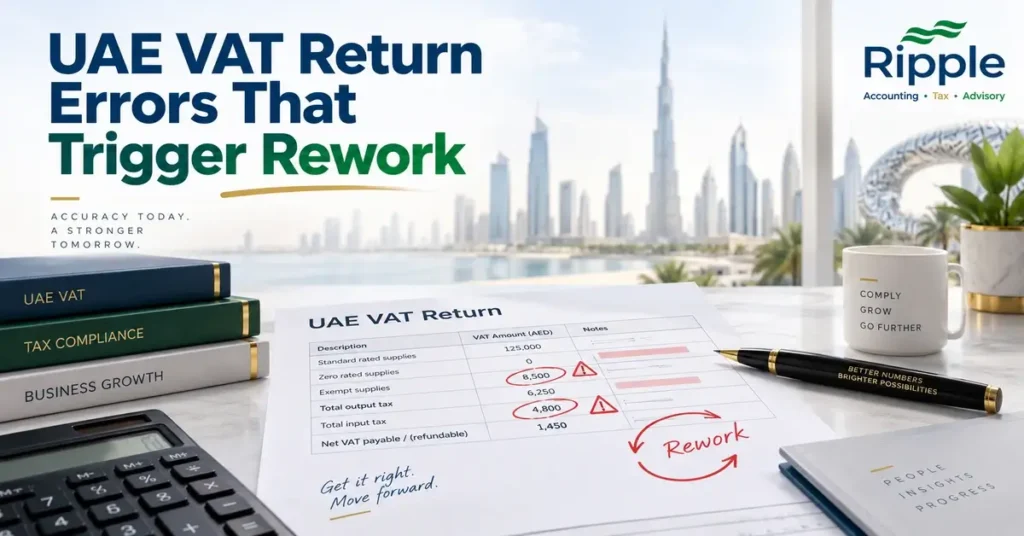
UAE VAT Return Errors That Trigger Rework
Are small VAT return mistakes creating more work for your finance team than the VAT filing itself? For VAT-registered businesses in the…
Read articleData analytics has transformed the way financial audits are planned, performed, and completed. Instead of relying only on manual sampling and spreadsheets, auditors now use advanced analytics tools to examine large volumes of financial data quickly and accurately. This modern approach helps identify errors, unusual transactions, fraud risks, and compliance issues before they become significant problems.
Data analytics in financial auditing is the process of collecting, organizing, analyzing, and interpreting financial data to improve audit accuracy and efficiency. It enables auditors to evaluate large datasets instead of relying on limited transaction samples. The primary objective is to identify financial irregularities, verify the accuracy of financial statements, assess compliance with accounting standards, and detect potential fraud or operational risks.
Unlike traditional audits, which often depend on manual testing, audit analytics uses technology to perform automated analyses across thousands or even millions of financial records. This provides broader audit coverage and increases confidence in audit findings.
Organizations across industries now integrate audit data analytics into their financial reporting processes because it delivers faster insights, stronger internal controls, and better decision-making.
Financial auditing has evolved significantly over the last decade. Businesses now process thousands of digital transactions daily, making manual auditing increasingly difficult. Data-driven auditing enables auditors to examine complete financial datasets rather than small samples. This results in more accurate findings, improved risk identification, and greater operational efficiency. Organizations also benefit from automated workflows that reduce repetitive tasks and allow audit professionals to focus on analyzing financial risks instead of gathering data manually.
Automated data analysis significantly reduces the time required for transaction testing, reconciliations, and report preparation.
Analyzing complete datasets minimizes the risk of overlooking material errors that may occur when using sample-based testing.
Advanced analytics identifies suspicious payment patterns, duplicate invoices, unusual journal entries, and unauthorized transactions much earlier.
Audit analytics helps ensure financial records comply with accounting standards, tax regulations, and internal company policies.
Auditors can identify high-risk business areas using historical trends, predictive models, and exception reporting.
Audit findings become more reliable because they are supported by comprehensive financial data rather than limited testing.
| Feature | Traditional Auditing | Data Analytics Auditing |
|---|---|---|
| Data Coverage | Limited sample testing | Analysis of complete datasets |
| Speed | Time-consuming | Significantly faster |
| Accuracy | Moderate | High |
| Fraud Detection | Often reactive | Proactive and continuous |
| Risk Assessment | Manual evaluation | Automated risk identification |
| Audit Evidence | Sample-based | Data-driven evidence |
| Reporting | Static reports | Interactive dashboards |
| Automation | Minimal | Extensive automation |
| Decision Support | Limited insights | Real-time financial insights |
Data analytics does not replace professional judgment. Instead, it provides auditors with stronger evidence and better insights to make informed audit decisions.
Different types of analytics serve different purposes throughout the audit process. Together, they help auditors understand historical performance, investigate financial issues, predict future risks, and recommend appropriate actions.
Descriptive analytics focuses on understanding historical financial information by summarizing past events. Auditors use descriptive analytics to review transaction histories, compare financial statements, monitor revenue trends, and identify unusual fluctuations across accounting periods.
Common uses include:
Diagnostic analytics explains why a financial event occurred. After identifying unusual results, auditors investigate the underlying causes using detailed financial analysis and transaction reviews.
Examples include:
This helps auditors determine whether unusual transactions resulted from operational issues, accounting errors, or intentional fraud.
Predictive analytics uses historical financial data, statistical models, and machine learning to forecast future financial risks. Auditors use predictive analytics to identify areas that are likely to require additional testing before problems arise.
Applications include:
Predictive analytics supports proactive auditing rather than reacting after financial issues occur.
Prescriptive analytics recommends the best course of action after identifying financial risks. It combines historical data, predictive models, and business rules to help auditors improve internal controls and reduce future risks.
Examples include:
Prescriptive analytics enables organizations to strengthen financial governance and improve audit outcomes.
Modern financial auditing depends on specialized analytics tools that simplify data collection, visualization, testing, and reporting. Each tool serves different audit requirements, from basic spreadsheet analysis to advanced automation and predictive modeling.
Microsoft Excel remains one of the most widely used tools in financial auditing because of its flexibility and accessibility.
Auditors commonly use Excel for:
Although Excel is powerful, it is most effective for small to medium-sized datasets.
Power BI enables auditors to transform large financial datasets into interactive dashboards and visual reports.
Its primary benefits include:
Power BI improves communication by making complex financial information easier to understand.
Tableau is a leading business intelligence platform known for advanced data visualization capabilities.
Auditors use Tableau to:
Interactive charts make it easier to communicate audit findings to management.
ACL Analytics is purpose-built for audit professionals handling large financial datasets.
Its capabilities include:
ACL significantly reduces manual audit work while improving audit quality.
CaseWare IDEA is another widely used audit analytics solution designed for financial auditors.
It supports:
Its automation features help auditors complete complex engagements more efficiently.
Structured Query Language (SQL) allows auditors to retrieve and analyze information directly from organizational databases.
SQL is commonly used for:
SQL is particularly valuable when auditing ERP systems containing millions of financial records.
Python has become increasingly popular among audit professionals because of its automation and analytical capabilities.
Auditors use Python for:
Python reduces repetitive work while supporting advanced audit analytics.
Enterprise Resource Planning (ERP) systems contain valuable financial information used throughout the audit process.
Common ERP platforms include:
Auditors use built-in reporting tools to review:
Integrating ERP reporting with audit analytics improves efficiency, enhances data accuracy, and provides comprehensive audit evidence for decision-making.
Data analytics techniques help auditors evaluate financial information efficiently, identify risks, and collect stronger audit evidence. The right technique depends on the audit objective, the type of financial data, and the level of risk involved.
Data mining identifies hidden patterns, relationships, and unusual activities within large financial datasets. Auditors use this technique to detect anomalies, duplicate transactions, and potential fraud that may not be visible through manual reviews.
Trend analysis compares financial data over different accounting periods to identify significant increases, decreases, or unusual fluctuations. It helps auditors determine whether changes in revenue, expenses, assets, or liabilities are reasonable.
Ratio analysis evaluates a company’s financial performance using key financial ratios such as:
Unexpected changes in these ratios may indicate accounting errors or financial risks.
Regression analysis examines the relationship between different financial variables. Auditors use it to assess whether financial trends are consistent with historical performance and business expectations.
Cluster analysis groups transactions with similar characteristics. This technique helps auditors identify unusual transactions that fall outside normal business behavior.
Benford’s Law analyzes the frequency of leading digits in numerical data. Significant deviations from expected digit patterns may indicate manipulated financial records or fraudulent transactions.
Outlier detection identifies transactions that differ significantly from normal financial activity.
Examples include:
These transactions require additional audit testing.
Duplicate testing identifies repeated invoices, duplicate payments, and duplicate vendor records that could result from system errors or fraud.
Journal entry testing reviews manual accounting entries for unusual characteristics, including:
Continuous monitoring uses automated systems to review financial transactions throughout the year instead of only during annual audits. This approach enables organizations to identify issues early and improve compliance.
Risk scoring assigns a risk level to financial transactions based on predefined criteria such as transaction value, user access, vendor history, and approval patterns. High-risk transactions receive additional audit attention.
Exception reporting automatically highlights transactions that violate business rules or internal policies.
Examples include:
Time series analysis evaluates financial information over time to identify seasonal patterns, long-term trends, and unexpected changes that require investigation.
Pattern recognition identifies recurring financial behaviors using statistical models and machine learning algorithms. It is widely used for fraud detection, compliance monitoring, and operational risk analysis.
Data analytics supports every phase of the financial audit process, from planning to final reporting. It improves efficiency, reduces manual effort, and strengthens audit quality.
During the planning stage, auditors analyze historical financial information to understand business operations and identify high-risk areas.
Data analytics helps auditors:
This creates a more focused and efficient audit plan.
Risk assessment determines where material misstatements are most likely to occur.
Data analytics improves risk assessment by identifying:
This enables auditors to concentrate on the areas that require the most attention.
Auditors assess whether internal controls effectively protect financial information.
Data analytics helps evaluate:
Weak controls can then be addressed before they lead to financial losses.
Traditional auditing often tests only selected transactions.
Data analytics enables auditors to examine complete populations of financial data, increasing confidence in audit findings.
Examples include:
This approach reduces audit risk while improving efficiency.
Reliable audit evidence supports every audit conclusion.
Data analytics strengthens audit evidence by:
This creates stronger support for audit opinions.
Modern analytics tools generate interactive reports that clearly communicate audit findings.
Auditors can present:
These reports help management make informed business decisions.
Continuous monitoring allows organizations to detect financial issues throughout the year rather than waiting for annual audits.
Benefits include:
Almost every financial process generates valuable data that auditors can analyze. Applying analytics to these areas improves audit coverage and strengthens financial controls.
Fraud detection is one of the most valuable applications of data analytics in financial auditing. Automated analysis allows auditors to identify suspicious activities much earlier than traditional audit methods.
Instead of reviewing only selected transactions, auditors can analyze complete financial datasets to identify unusual behavior, hidden relationships, and potential fraud indicators.
Common fraud indicators include:
Auditors also analyze user access logs, approval histories, transaction timing, and payment patterns to identify suspicious activities that require further investigation.
A manufacturing company processed more than 500,000 supplier payments annually. Using audit analytics software, auditors identified several duplicate invoices submitted under slightly different invoice numbers.
Further investigation revealed weaknesses in invoice verification controls. The organization strengthened its approval process, implemented automated duplicate invoice detection, and significantly reduced future payment errors while improving internal controls.
Artificial intelligence (AI) and machine learning are changing financial auditing by enabling systems to analyze data automatically, identify risks faster, and improve audit accuracy.
Unlike traditional software that follows fixed rules, machine learning continuously improves by learning from historical financial data.
Modern audit teams use AI for:
For example, AI can review thousands of invoices within minutes, compare them with purchase orders and payment records, and immediately flag inconsistencies for auditor review.
Machine learning also improves predictive risk models by identifying financial patterns that may indicate future compliance issues or fraudulent activities.
As organizations continue their digital transformation, AI-powered audit analytics will become an essential component of modern financial auditing, enabling faster, more accurate, and more data-driven audit decisions.
Organizations that integrate data analytics into their audit processes gain significant operational and financial advantages.
Key benefits include:
These benefits make data analytics an essential capability for organizations seeking more reliable financial reporting and stronger governance.
Although data analytics offers significant advantages, organizations may face several implementation challenges.
Incomplete, inconsistent, or inaccurate financial data can reduce the effectiveness of audit analytics.
Solution: Establish strong data governance policies and perform regular data validation.
Financial data contains sensitive information that must be protected.
Solution: Implement encryption, access controls, and secure data storage practices.
Advanced analytics software, infrastructure, and training require investment.
Solution: Begin with scalable solutions and expand analytics capabilities gradually.
Many audit professionals require additional training in data analytics, programming, and visualization tools.
Solution: Invest in continuous professional development and technical certifications.
Organizations often use multiple accounting and ERP systems that may not integrate easily.
Solution: Use standardized data formats and integration platforms where possible.
Employees may be reluctant to adopt new technologies and automated audit processes.
Solution: Provide training, communicate benefits clearly, and involve users throughout implementation.
Analytics processes must comply with auditing standards and applicable financial regulations.
Solution: Ensure audit methodologies align with professional standards and maintain complete documentation.
Organizations should follow these best practices to maximize the value of audit analytics:
Data analytics continues to evolve as businesses adopt digital technologies and generate larger volumes of financial data. Emerging technologies are enabling auditors to perform more accurate, efficient, and continuous audits while improving compliance and risk management.
Organizations that invest in modern audit analytics today will be better prepared to manage future financial reporting requirements and regulatory expectations.
Artificial intelligence is becoming a core component of financial auditing. AI-powered systems can analyze millions of transactions, identify unusual patterns, prioritize high-risk items, and assist auditors with decision-making.
Benefits include:
Cloud technology allows audit teams to securely access financial information from anywhere while collaborating in real time.
Advantages include:
Cloud-based audit platforms also improve business continuity and operational flexibility.
Traditional audits often occur annually or quarterly. Modern analytics enables continuous monitoring of financial transactions throughout the year.
Organizations can:
RPA automates repetitive audit tasks that previously required manual effort.
Common applications include:
Automation allows auditors to focus on risk analysis and strategic decision-making.
As blockchain adoption grows, auditors will increasingly verify transactions using immutable digital records.
Blockchain can improve:
Although blockchain does not eliminate audits, it changes how audit evidence is collected and verified.
Environmental, Social, and Governance (ESG) reporting is becoming increasingly important for investors and regulators.
Data analytics helps organizations:
Advanced analytics can predict potential compliance issues before they occur.
Organizations can proactively identify:
Predictive compliance reduces penalties and strengthens corporate governance.
Continuous assurance extends beyond periodic audits by providing ongoing evaluation of financial processes.
Benefits include:
Continuous assurance is expected to become a standard practice for organizations adopting digital finance technologies.
Even with advanced analytics tools, auditors must apply professional judgment and follow established audit standards. Avoiding common mistakes improves audit quality and ensures reliable results.
Following structured audit methodologies and maintaining professional skepticism helps prevent these issues.
Modern financial auditing requires accurate financial records, reliable bookkeeping, tax compliance, and well-prepared audit documentation. Ripple Consultants provides professional accounting, bookkeeping, financial reporting, VAT compliance, Corporate Tax support, internal audit assistance, and audit preparation services to help businesses maintain accurate financial records and meet regulatory requirements. Whether you are improving your financial reporting processes or preparing for an external audit, our experienced professionals can provide practical guidance tailored to your business needs. To learn more about our accounting and audit services, contact Ripple Consultants at +971 52 356 5409, email info@uaetaxcompliance.ae, or WhatsApp +971 4 250 0833.
Data analytics in financial auditing is the use of technology to collect, analyze, and interpret financial data. It helps auditors examine complete datasets, improve audit quality, detect fraud, and identify financial risks more efficiently than traditional sampling methods.
Popular financial auditing tools include Microsoft Excel, Microsoft Power BI, Tableau, ACL Analytics, CaseWare IDEA, SQL, Python, and ERP reporting systems such as SAP, Oracle ERP, Microsoft Dynamics 365, and NetSuite.
Data analytics identifies unusual financial patterns such as duplicate invoices, unauthorized journal entries, ghost employees, fake vendors, round-dollar transactions, and abnormal payment behavior. Automated analysis enables auditors to investigate suspicious activities quickly.
Yes. Small businesses can use affordable tools like Microsoft Excel, Power BI, and cloud-based accounting software to improve financial reporting, strengthen internal controls, and support audit readiness.
Yes. Excel remains one of the most widely used audit tools for financial analysis, reconciliations, PivotTables, formulas, ratio analysis, and transaction testing. It is particularly useful for small and medium-sized datasets.
Continuous auditing uses automated systems to monitor financial transactions throughout the year instead of conducting reviews only at specific periods. This approach improves fraud detection, compliance, and operational efficiency.
Artificial intelligence automates repetitive audit procedures, detects anomalies, predicts financial risks, reviews documents, and supports auditors by identifying high-risk transactions that require further investigation.
Modern auditors benefit from skills in financial analysis, data visualization, statistical analysis, SQL, Excel, Power BI, Python, audit software, risk assessment, and knowledge of accounting and auditing standards.
Data analytics has become an essential part of modern financial auditing. By analyzing complete financial datasets instead of relying solely on sample testing, organizations can improve audit accuracy, strengthen internal controls, detect fraud earlier, and make better business decisions.
Disclaimer: This article is for informational and educational purposes only and should not be considered accounting, auditing, tax, or legal advice. While every effort has been made to ensure accuracy, regulations and business requirements may change over time. Always consult a qualified accounting, auditing, or tax professional before making financial or compliance-related decisions.
Tell us a little about your business and our UAE tax experts will get back to you with clear, practical answers — no obligation.
 VAT
Are small VAT return mistakes creating more work for your finance team than the VAT filing itself? For VAT-registered businesses in the…
Read article Compliance
Are you sure your construction payroll shows not only who was paid, but also which site and project incurred the labor cost?…
Read article Bookkeeping
Could your UAE business manage payroll more efficiently in-house, or would outsourcing give your finance team more time and control? For UAE…
Read articlePage 17 of 59
Book a free consultation and get clear answers for your business.
0 Comments