Moving from Spreadsheets to ERP: Data Migration and Opening Balance Checklist
Are your spreadsheets still carrying your business’s accounting history? Moving from spreadsheets to an ERP can improve financial control and reporting, but…
Read article
Are you a UAE-based consultancy or agency selling services overseas while managing a remote team across different countries?
Cross-border business can create tax questions that are easy to overlook. A UAE company may need to consider VAT treatment for services supplied to overseas customers, Corporate Tax obligations, documentation, and the potential tax implications of employees or contractors working from other jurisdictions.
Understanding these areas before expanding internationally can help businesses structure transactions and maintain appropriate records. This guide explains the key cross border tax UAE services considerations for UAE businesses providing services internationally and operating with remote teams.

Cross-border tax refers to the tax considerations that arise when a business in one country provides services to customers, hires workers, or conducts business activities involving another country.
For a UAE consultancy, marketing agency, software company, professional-services firm, or other service provider, cross-border transactions may involve:
The fact that a customer is located outside the UAE does not automatically mean that the transaction has no UAE tax implications.
The tax treatment generally depends on the nature of the service, the customer’s status and location, where the service is performed or used, and the relevant UAE and foreign tax rules.
One of the first questions for a UAE service business is whether an overseas service qualifies for zero-rating or remains subject to UAE VAT.
The Federal Tax Authority explains that the place of supply determines whether a supply falls within UAE VAT legislation. For services, the general rule is that the place of supply is where the supplier is established, although special rules apply to certain categories of services.
This means that a UAE business should not assume that an overseas customer automatically makes a service outside the scope of UAE VAT.
Under the UAE VAT Executive Regulation, certain exported services can qualify for the zero rate when the applicable conditions are satisfied.
For example, the rules provide for zero-rating where services are supplied to a recipient who does not have a place of residence in an implementing state and is outside the UAE when the services are performed, subject to the conditions and exclusions in the legislation.
There are also specific restrictions where services are directly connected with certain property or assets located in the UAE.
The FTA’s current VAT legislation should therefore be checked before applying zero-rating to an international service transaction.
A business may have a customer incorporated or based outside the UAE, but other facts can affect the VAT treatment.
For example, the business should consider:
For this reason, businesses should maintain appropriate contracts, invoices, customer information, and supporting records.
The terms can sometimes be confused.An export of services generally concerns the VAT treatment of a service supplied by a UAE business to a customer outside the relevant jurisdiction.
However, a business can also create broader tax issues by actually carrying out activities in another country.
For example, a UAE consultancy might have:
These circumstances can raise questions beyond UAE VAT.
The company may need to determine whether the foreign jurisdiction considers its activities sufficient to create a taxable presence or other local obligations.
UAE Corporate Tax should also be considered when a UAE business earns revenue from international customers.
The UAE Ministry of Finance states that a UAE resident juridical person is generally subject to Corporate Tax on its taxable income derived from the UAE and from outside the UAE, subject to the provisions of the Corporate Tax Law.
Therefore, receiving revenue from overseas customers does not, by itself, remove the income from the UAE Corporate Tax framework.
Businesses should consider how their international revenue is recorded in their accounting records and how taxable income is calculated under the UAE Corporate Tax rules.
Another issue is whether the UAE business itself creates a taxable presence in another country.
The answer depends on the rules of the foreign jurisdiction and the company’s activities there.
For example, a business should examine whether it has:
The specific definition of a permanent establishment depends on the applicable domestic law and, where relevant, an applicable double tax treaty.
Businesses should therefore avoid treating every remote worker or overseas customer as automatically creating a permanent establishment. The actual facts and applicable rules need to be reviewed.

Remote working can make cross-border tax compliance more complicated because the business may have people physically working in several countries.
For example, a UAE marketing agency may be incorporated in Dubai but have:
The company may need to examine the tax and employment implications in each country where its people perform work.
An employee working remotely from another country may potentially become subject to that country’s personal income tax or other employment-related requirements.
The rules differ significantly between jurisdictions.
A UAE company should therefore not assume that an employee remains outside foreign tax requirements simply because the employment contract is issued by a UAE company.
The employee’s physical location, tax residence, length of stay, employment arrangement, and the local country’s rules may all be relevant.
Remote employees can also create local payroll, registration, employment, social-security, or reporting requirements. These obligations are separate from the UAE company’s own tax obligations.
Before allowing employees to work permanently from another country, businesses should establish:
This review is particularly important when a remote employee performs sales, contract negotiation, management, or core revenue-generating activities.
Using overseas freelancers or independent contractors can also create cross-border tax considerations.
The business should clearly document:
Calling someone a “contractor” in an agreement does not necessarily determine how another country’s tax or employment authorities will classify the relationship. The actual working arrangement may be relevant.
Good documentation is particularly important when a UAE business applies a specific VAT treatment to an overseas customer.
Businesses should consider maintaining records such as:
The purpose is not simply to keep paperwork. These records help demonstrate how the business reached its tax treatment.
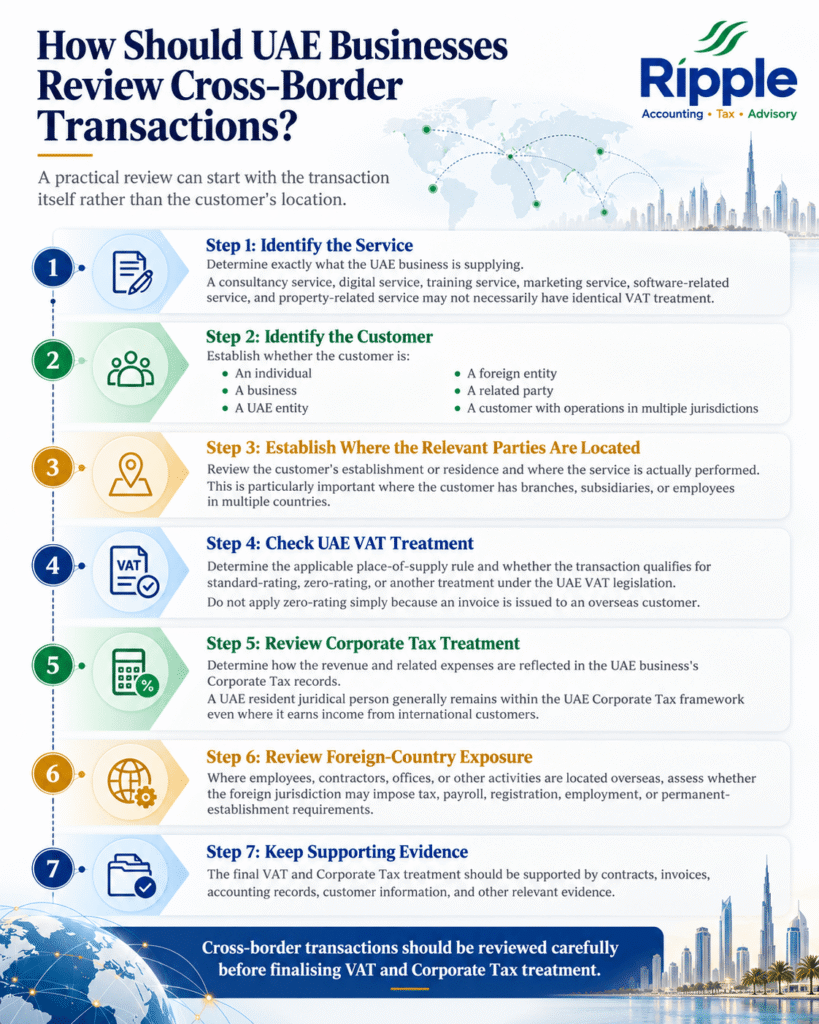
A practical review can start with the transaction itself rather than the customer’s location.
Determine exactly what the UAE business is supplying.
A consultancy service, digital service, training service, marketing service, software-related service, and property-related service may not necessarily have identical VAT treatment.
Establish whether the customer is:
Review the customer’s establishment or residence and where the service is actually performed.
This is particularly important where the customer has branches, subsidiaries, or employees in multiple countries.
Determine the applicable place-of-supply rule and whether the transaction qualifies for standard-rating, zero-rating, or another treatment under the UAE VAT legislation.
Do not apply zero-rating simply because an invoice is issued to an overseas customer.
Determine how the revenue and related expenses are reflected in the UAE business’s Corporate Tax records.
A UAE resident juridical person generally remains within the UAE Corporate Tax framework even where it earns income from international customers.
Where employees, contractors, offices, or other activities are located overseas, assess whether the foreign jurisdiction may impose tax, payroll, registration, employment, or permanent-establishment requirements.
The final VAT and Corporate Tax treatment should be supported by contracts, invoices, accounting records, customer information, and other relevant evidence.
The Federal Tax Authority provides specific guidance on the zero-rating of export of services, including the conditions that businesses need to consider when determining whether an exported service qualifies for the zero rate.
The FTA has also published its VAT legislation and updates to the Executive Regulation. Because VAT rules can change, businesses should check the current legislation before applying a treatment to a particular transaction.
Official government source: Federal Tax Authority — Zero-rating of Export of Services.
Professional tax advice can be particularly useful when a business is:
A transaction-by-transaction review can help businesses identify issues before international operations become difficult to restructure.
Cross-border transactions require more than checking whether a customer is located outside the UAE. Businesses need to consider the nature of the service, VAT treatment, Corporate Tax implications, documentation, and the activities of employees or contractors working internationally.
Ripple Accounting, Tax & Advisory can support UAE businesses with tax advisory and related compliance considerations for cross-border operations. The review can focus on the business model, international service arrangements, customer locations, remote-team structure, and available records.
If your consultancy, agency, or service business is selling services overseas or managing a remote team, contact Ripple Accounting, Tax & Advisory for a tailored assessment of your cross-border tax position and compliance requirements.
Not necessarily. The VAT treatment depends on the applicable place-of-supply rules and whether the conditions for zero-rating or another VAT treatment are satisfied. An overseas customer alone does not automatically make every service zero-rated.
Export of services refers to services supplied by a UAE business to customers outside the relevant UAE VAT jurisdiction. Certain exported services can qualify for the zero rate when the conditions in the UAE VAT legislation are met.
Yes. Where an employee physically works from another country, the business may need to consider local employment, payroll, social-security, personal tax, and potentially permanent-establishment implications. The exact consequences depend on the country and circumstances.
No. A UAE resident juridical person is generally subject to UAE Corporate Tax on taxable income derived from the UAE and outside the UAE, subject to the Corporate Tax Law and applicable provisions.
Businesses should consider obtaining advice before entering a new foreign market, hiring overseas employees, engaging international contractors, establishing an overseas presence, or applying a specific VAT treatment to international service transactions.
Cross-border services can create tax considerations that extend beyond the location shown on an invoice. UAE businesses should review VAT treatment, Corporate Tax implications, customer location, service characteristics, remote-team arrangements, and potential foreign-country obligations. A structured review supported by appropriate documentation can help businesses apply the relevant UAE tax treatment and identify issues arising from international operations.
Disclaimer: This article provides general information about UAE tax considerations for cross-border services and remote teams. The applicable VAT, Corporate Tax, employment, payroll, permanent-establishment, and foreign tax rules depend on the facts of each business and may change over time. It should not be treated as legal or tax advice. Businesses should review the current legislation and obtain professional advice for their specific circumstances.
Tell us a little about your business and our UAE tax experts will get back to you with clear, practical answers — no obligation.
 Compliance
Are your spreadsheets still carrying your business’s accounting history? Moving from spreadsheets to an ERP can improve financial control and reporting, but…
Read article Audit
Audit
Should your UAE business hire an accountant, a Tax Agent, or both? The answer depends on the work you need done. An…
Read article Corporate Tax
What happens when your UAE Corporate Tax filing deadline is approaching, but your accounting records are months behind? For many UAE SMEs,…
Read articlePage 17 of 45
Book a free consultation and get clear answers for your business.
0 Comments