UAE Corporate Tax Penalties: Registration, Filing and Payment
Have you missed a UAE Corporate Tax deadline and are unsure which penalty may apply to your business? UAE Corporate Tax compliance…
Read article
What happens when your UAE Corporate Tax filing deadline is approaching, but your accounting records are months behind?
For many UAE SMEs, delayed bookkeeping can turn Corporate Tax preparation into a stressful process. Missing invoices, unreconciled bank accounts, incorrect entries and incomplete financial records can make it difficult to determine the business’s actual profit and taxable income.
Backlog accounting UAE helps bring these records up to date before the tax return is prepared. The Federal Tax Authority (FTA) expects taxpayers to maintain financial statements and supporting records that substantiate the information reported in their Corporate Tax returns.

Backlog accounting UAE refers to the process of bringing incomplete, delayed or outdated accounting records up to date.
A business may have a backlog because its previous accountant stopped working, bookkeeping was neglected during a busy period, invoices were not recorded, bank accounts were not reconciled, or financial information was maintained across different spreadsheets and systems.
Backlog accounting is also commonly described as:
The objective is not simply to enter old transactions into accounting software. A proper cleanup should produce reliable and organized financial records that management can use and that can support applicable tax compliance.
This becomes particularly important before Corporate Tax filing in the UAE, because the accounting records form an important basis for determining taxable income.
Corporate Tax calculations should be based on reliable financial information. The FTA explains that taxable income is generally based on accounting net profit or loss after the adjustments required under the Corporate Tax Law.
If the underlying accounting records are incomplete, several problems can arise.
The FTA also reminded taxpayers in 2025 that relevant records and supporting documents must be retained for at least seven years following the end of the relevant Tax Period.
Therefore, accounting cleanup should ideally be completed well before the Corporate Tax filing deadline rather than treated as a last-minute task.
Not every business realizes that its books are behind. You may have an accounting backlog if:
If several of these conditions apply, the business may need bookkeeping cleanup UAE services before proceeding with tax preparation.
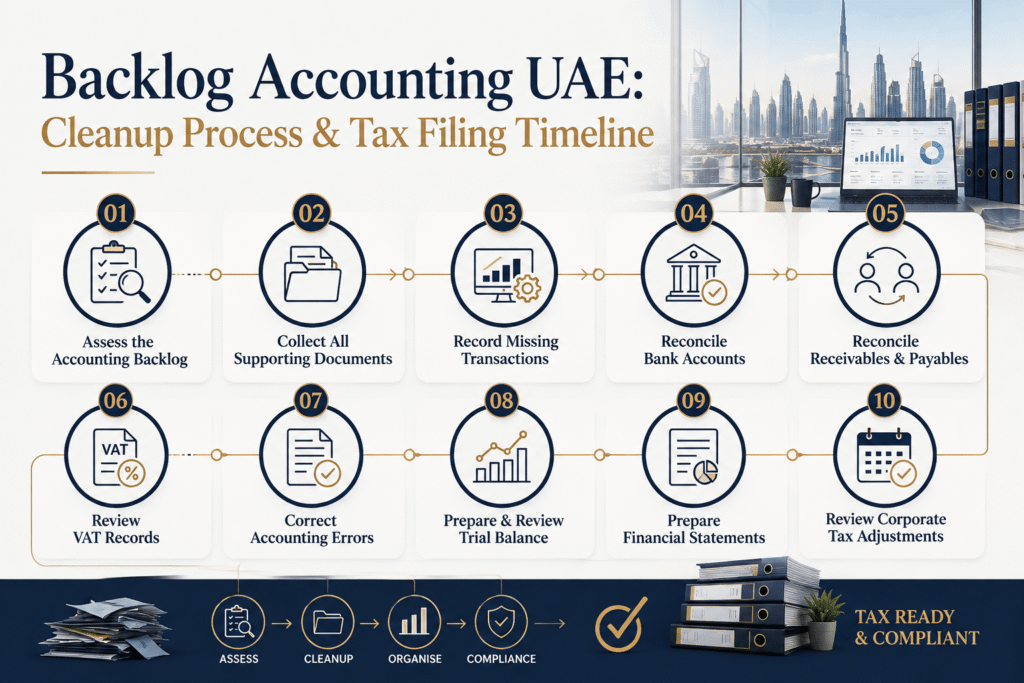
A structured approach makes accounting cleanup more manageable. Instead of entering transactions randomly, businesses should work through the backlog systematically.
The first step is to determine exactly what is incomplete.
Review:
For example, if bookkeeping was last completed in December 2025 and the current accounting period is August 2026, the business may have approximately eight months of records to review.
The cleanup timeline will depend heavily on the number and complexity of transactions during those months.
The next stage is document collection. Depending on the business, the accounting team may need:
The FTA specifically emphasizes the importance of maintaining records and documentation that support information reported in Corporate Tax returns. If documents are missing, the accounting team should identify those gaps rather than simply guessing the accounting treatment.
Once the documents have been organized, missing transactions can be entered into the accounting system.
This may include:
Transactions should be classified into the appropriate accounts rather than placed into miscellaneous categories simply to complete the books.
For example, if a company purchased office equipment for AED 15,000, the transaction may need to be considered as a fixed asset rather than an ordinary office expense, depending on the applicable accounting treatment.
Bank reconciliation is one of the most important stages of an accounting cleanup UAE project.
The accounting records should be compared against actual bank statements to identify:
Every bank account should be reviewed for the relevant period.
Businesses with multiple accounts may need additional time because each account requires separate reconciliation.
The cleanup should also examine money owed by customers and money owed to suppliers.
Check:
Check:
This process helps management understand whether reported receivables and payables represent genuine outstanding balances.
If the company is VAT registered, the accounting cleanup should include a review of VAT-related balances and transactions.
The review may cover:
If historical accounting errors affect previously submitted VAT returns, the appropriate corrective process should be assessed separately rather than simply changing historical records without documentation.
This is particularly important when a business is simultaneously preparing its accounting records for Corporate Tax.
Backlog bookkeeping often reveals errors in previous records.
Common examples include:
Corrections should be properly documented so that the final accounts provide a clear audit trail.
The purpose of cleanup is not to make the numbers “look right.” It is to establish accurate records supported by available evidence.
Once transactions and reconciliations are substantially complete, the accounting team can review the trial balance. The trial balance provides an overall view of the ledger balances and helps identify unusual or potentially incorrect balances.
Areas that may require additional review include:
Only after significant accounting issues have been addressed should the financial statements be finalized.
The cleaned accounting records can then be used to prepare appropriate financial statements. Depending on the business and applicable requirements, these may include:
The FTA states that taxpayers are expected to prepare and maintain financial statements for the purpose of calculating taxable income.
This is why accurate bookkeeping is closely connected with Corporate Tax compliance.
The final accounting profit is not necessarily the same as taxable income. The FTA explains that taxable income is generally determined from accounting net profit or loss after applying the relevant adjustments required by the Corporate Tax Law. These can include items such as exempt income, non-deductible expenses, and certain related-party transactions, depending on the circumstances.
Therefore, businesses should avoid assuming that simply multiplying accounting profit by a tax rate is sufficient.
The Corporate Tax calculation should be reviewed according to the applicable UAE rules and the company’s specific circumstances.
There is no universal timeline for backlog accounting UAE projects. The duration depends on transaction volume, number of accounts, quality of documentation and how many months are outstanding.
An indicative planning framework could look like this:
| Accounting Backlog | Indicative Cleanup Time |
| 1–3 months | 1–2 weeks |
| 3–6 months | 2–4 weeks |
| 6–12 months | 3–6 weeks |
| More than 12 months | 4–8+ weeks |
These are only planning estimates. A business with six months of very high-volume transactions may take longer than a business with twelve months of low-volume bookkeeping.
The availability of documents also makes a major difference.
If bank statements, invoices and expense records are readily available, cleanup can move quickly. If documents need to be collected from multiple employees, suppliers, banks and previous accountants, the timeline may increase.
Businesses should be cautious about filing a Corporate Tax return using incomplete or unreliable accounting information. The FTA has emphasized the importance of completing tax records and preparing the documents needed for Corporate Tax filing in advance. It identifies financial records and business information among the materials businesses should have available before beginning the filing process.
The FTA also states that Corporate Tax returns are generally due within nine months from the end of the relevant Tax Period.
For example, a business with a 31 December 2025 year-end would generally have a filing deadline of 30 September 2026, subject to the applicable rules.
Therefore, if your accounting is six or twelve months behind, waiting until the final weeks before the deadline can create unnecessary pressure.
Finding errors during cleanup does not necessarily mean the business has failed to maintain its records. Historical errors can occur for many reasons, especially when bookkeeping has changed between employees, accountants or accounting systems.
The important step is to identify, document and correct relevant errors appropriately. Depending on the issue, the business may need to review:
If an error may affect a previously submitted tax return, businesses should obtain appropriate professional tax advice before making corrections.
Once the historical backlog has been cleared, the business should establish a regular accounting routine.
A simple monthly process can include:
Collect documents → Record transactions → Reconcile banks → Review receivables/payables → Reconcile VAT → Review ledger → Prepare monthly reports
Businesses can also reduce future backlogs by:
The goal is to make accounting a continuous process rather than something that happens only before tax deadlines.
Clearing an accounting backlog can be time-consuming when business owners have to reconstruct transactions while also managing daily operations. Ripple Accountant can help UAE businesses bring outdated accounting records up to date by reviewing historical transactions, organizing supporting documents, and recording missing entries. We can also reconcile bank and ledger balances, review receivables and payables, and prepare reliable financial reports.
Contact Ripple Accountant to discuss your accounting cleanup requirements and get professional support for bringing your records up to date.
Backlog accounting is the process of bringing incomplete or outdated financial records up to date. It may involve recording missing transactions, reconciling accounts, correcting errors and preparing financial statements.
Corporate Tax calculations depend on reliable financial information. Accurate accounting records help businesses determine their accounting profit and make the appropriate tax adjustments.
It depends on the number of months outstanding, transaction volume, number of bank accounts, quality of documentation and complexity of the business. Small backlogs may take a few weeks, while larger historical backlogs can take several weeks or longer.
Yes, historical bookkeeping can generally be reconstructed if sufficient supporting documentation is available. However, larger backlogs require more detailed review and may take considerably longer.
Common documents include bank statements, invoices, receipts, expense records, payroll information, loan statements, VAT returns, financial statements and other records supporting business transactions.
No. Accounting cleanup and Corporate Tax return preparation are separate scopes of work unless the provider specifically includes both services in its engagement.
A bookkeeping backlog should not be left until the last few weeks before a UAE Corporate Tax deadline. Incomplete records can make it difficult to determine the company’s actual financial position, prepare reliable financial statements and calculate taxable income accurately.
Disclaimer: This article is provided for general informational and educational purposes only. Businesses should review their specific circumstances and consult a qualified UAE accounting or tax professional and, where appropriate, the Federal Tax Authority before making compliance or tax-related decisions.
Tell us a little about your business and our UAE tax experts will get back to you with clear, practical answers — no obligation.
 Corporate Tax
Have you missed a UAE Corporate Tax deadline and are unsure which penalty may apply to your business? UAE Corporate Tax compliance…
Read article Compliance
Could your UAE business need to prove its tax residency to a foreign tax authority before receiving cross-border tax benefits? A UAE…
Read article VAT
VAT
Has your UAE business accumulated more recoverable input VAT than output VAT, and are you unsure whether you can claim the difference…
Read articlePage 1 of 45
Book a free consultation and get clear answers for your business.
0 Comments