UAE Corporate Tax Penalties: Registration, Filing and Payment
Have you missed a UAE Corporate Tax deadline and are unsure which penalty may apply to your business? UAE Corporate Tax compliance…
Read article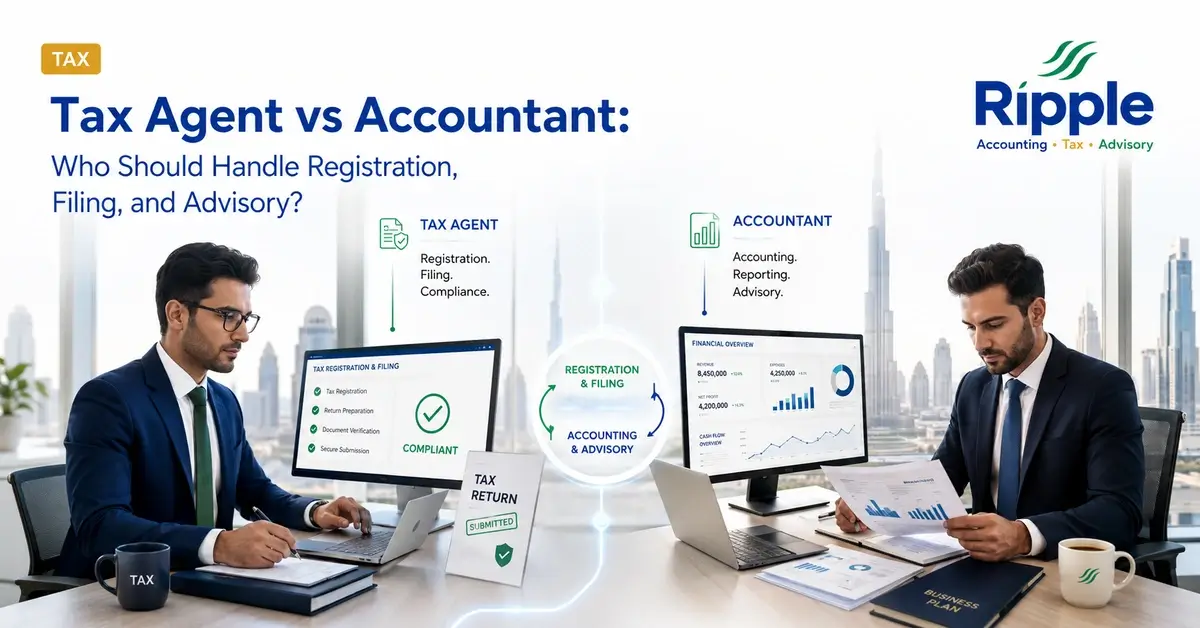
Should your UAE business hire an accountant, a Tax Agent, or both?
The answer depends on the work you need done. An accountant typically focuses on bookkeeping, reconciliations, financial statements, and management reporting, while a registered Tax Agent has a specific role under the UAE tax framework and can represent a taxable person in dealings with the Federal Tax Authority (FTA), subject to the applicable requirements and appointment. Understanding Tax Agent vs Accountant UAE can help SMEs avoid assigning tax responsibilities to the wrong professional.
Let’s compare their roles and identify who should handle registration, VAT, and Corporate Tax filing, tax matters, and ongoing accounting.

An accountant and a Tax Agent can both work with financial and tax-related information, but their roles are not identical.
An accountant generally manages the financial records of a business. This can include recording transactions, maintaining ledgers, reconciling accounts, preparing financial statements and producing management reports.
A Tax Agent, on the other hand, is a professional recognised and registered under the UAE tax framework. The FTA explains that a taxable person may appoint a Tax Agent to represent them in dealings with the FTA and assist with fulfilling tax obligations and exercising associated tax rights.
The FTA also maintains a list of Registered Tax Agents, allowing businesses to verify professionals with registered Tax Agent status.
This distinction is important because having accounting experience does not automatically make someone a registered Tax Agent.
An accountant’s main responsibility is usually maintaining accurate financial information and helping management understand the company’s financial position.
Accountants can record:
They can also maintain the general ledger and supporting accounting documentation.
For an SME, this work creates the financial foundation needed for tax compliance.
Regular reconciliation helps identify:
These checks are particularly important before VAT or Corporate Tax information is prepared.
An accountant may prepare or assist with:
Reliable financial statements also provide the starting point for many tax calculations and business decisions.
Accountants can help business owners understand:
This means an accountant’s role can extend well beyond simply entering transactions.
A registered Tax Agent has a more specific tax-related role. According to the FTA’s Tax Agents and Tax Agencies guidance, a Tax Agent can assist a taxable person with tax obligations and related tax rights under the applicable framework. Depending on the appointment and scope of work, tax-related activities can include:
The exact scope should always be established in the engagement or contractual arrangement.
Businesses should not assume that anyone offering “tax services” is automatically a Tax Agent. The FTA has a specific Tax Agent Registration service. Its current service page states that natural and juridical persons can register as Tax Agents through the FTA process, and it lists eligibility requirements and supporting documents.
This is the most useful official page for a business that wants to understand how Tax Agents are formally registered.
The simplest way to understand the distinction is to look at their typical responsibilities.
| Area | Accountant | Registered Tax Agent |
| Bookkeeping | Usually | May provide |
| Bank reconciliation | Usually | May provide |
| Financial reporting | Usually | May provide |
| Management accounts | Usually | May provide |
| Tax registration support | May assist with accounting information | Can assist within Tax Agent role |
| VAT return preparation | May prepare accounting information | Can assist with tax obligations |
| Tax return submission | Depends on role and authorisation | Can perform tax-agent functions within appointment |
| FTA representation | Not automatically | Within the Tax Agent’s authorised role |
| Tax enquiries | May provide financial information | Can assist in tax matters |
| Tax reconsideration support | Not automatically | Can assist within applicable Tax Agent role |
The key point is that accountant and Tax Agent are not mutually exclusive roles. One professional or firm may provide both accounting and tax services, but the Tax Agent status itself has specific FTA requirements.
Tax registration involves providing accurate business and financial information to the FTA. An accountant can help prepare the underlying financial information and supporting documents. However, where the business wants professional representation or assistance specifically within the Tax Agent framework, a registered Tax Agent may be appropriate.
The FTA’s current Corporate Tax registration service, for example, requires information such as the trade licence, commercial registration where applicable, identification documents and proof of authorisation for the signatory. Applications are submitted through EmaraTax. The important point is that registration should be based on the company’s actual circumstances. Businesses should not simply copy another company’s registration approach.
VAT filing requires accurate transaction records and correct tax treatment.
The accountant or bookkeeper may maintain the underlying records, including:
A Tax Agent can provide tax-focused support and, where properly appointed, act within the Tax Agent framework in dealing with the FTA.
The best arrangement for many SMEs is therefore:
Accountant → prepares and reconciles accounting information
Tax professional/Tax Agent → reviews tax treatment and handles the relevant tax compliance or representation
The roles can overlap, but responsibilities should be clearly defined.
Businesses using EmaraTax should also ensure that returns and payments are submitted through the appropriate FTA processes. The FTA provides official EmaraTax guidance for submitting tax returns and making payments.
Corporate Tax requires both good accounting records and appropriate tax analysis.
This is where an accountant and Tax Agent can complement each other.
The accountant can help ensure that:
A Tax Agent can provide tax-focused assistance, including reviewing the tax position, supporting tax-return preparation and dealing with the FTA within the scope of the appointment. This distinction matters because Corporate Tax is not simply a matter of taking an accounting profit figure and submitting it without review. The business needs to consider the applicable Corporate Tax rules and relevant adjustments.
For many UAE SMEs, the answer is both.
Imagine a trading company with five employees and AED 10 million in annual sales.
The accountant may be responsible for:
The Tax Agent may then assist with:
This arrangement creates a useful separation between financial accounting and specialised tax compliance.
It can also provide an additional review layer before important tax submissions.
Choosing between an accountant and Tax Agent should start with the actual requirement.
If your main problem is:
you may primarily need accounting support. If your main concern is:
specialised tax support may be more appropriate.
If a professional is offering services specifically as a Tax Agent, verify their registration status. The FTA provides a dedicated Registered Tax Agents resource. This is one of the simplest checks a UAE business can make before entering into an engagement.
Don’t assume that “tax services” includes everything. Ask whether the engagement covers:
The written engagement should clearly identify responsibilities.
A business in construction may have different accounting and tax considerations from an e-commerce company, professional services firm or trading company. Choose a professional who understands your business model.
Tax reconsideration is an area where the distinction becomes particularly important. The FTA’s current Reconsideration Request service explains that a request may be submitted by the concerned person and can also be submitted by an appointed Tax Agent.
The service requires documentary evidence supporting the factual and legal grounds of the request, along with relevant tax advice where applicable. This is a good example of why businesses should understand the difference between ordinary accounting support and formal tax-agent functions.
Managing accounting and tax obligations separately can become difficult for SMEs, especially when business owners are trying to coordinate bookkeeping, VAT, Corporate Tax and financial reporting at the same time.
Ripple Accountant can support UAE businesses with accounting, bookkeeping, reconciliations, financial reporting and tax-related accounting support. The team can also help businesses organise their financial records and prepare the accounting information required for tax compliance.
Contact Ripple Accountant today to discuss your UAE accounting and tax support needs.
No. Accountant and Tax Agent are different roles. Tax Agent status involves a specific FTA registration and eligibility process.
An accountant may prepare the accounting information and may provide VAT-related services depending on their qualifications, role and engagement. Where the business requires a registered Tax Agent to act within the Tax Agent framework, it should appoint an appropriately registered professional.
It can be beneficial, particularly when the accountant manages day-to-day financial records while a Tax Agent handles specialised tax compliance and FTA-related matters.
The FTA provides a Registered Tax Agents resource where businesses can check registered Tax Agents.
The FTA’s current registration service lists requirements that can include educational qualifications, relevant experience, good-conduct documentation, language evidence, VAT or Corporate Tax qualifications and identification documents, depending on the applicant and applicable requirements.
The question of Tax Agent vs Accountant UAE businesses face is not necessarily about choosing one professional over the other. In many cases, the strongest approach is to use accounting and tax expertise for their respective functions. An accountant can maintain books, reconcile accounts, prepare financial statements and provide management reporting. A registered Tax Agent has a specific role within the UAE tax framework and can assist taxable persons with tax obligations and, where properly appointed, dealings with the FTA.
Disclaimer: This article is intended for general informational purposes only and does not constitute accounting, tax, legal or professional advice. The role and responsibilities of a Tax Agent depend on applicable UAE legislation, FTA requirements and the scope of the appointment. Tax rules, procedures and government services may change. Businesses should consult the latest Federal Tax Authority guidance and legislation and obtain professional advice based on their specific circumstances.
Tell us a little about your business and our UAE tax experts will get back to you with clear, practical answers — no obligation.
 Corporate Tax
Have you missed a UAE Corporate Tax deadline and are unsure which penalty may apply to your business? UAE Corporate Tax compliance…
Read article Compliance
Could your UAE business need to prove its tax residency to a foreign tax authority before receiving cross-border tax benefits? A UAE…
Read article VAT
VAT
Has your UAE business accumulated more recoverable input VAT than output VAT, and are you unsure whether you can claim the difference…
Read articlePage 1 of 45
Book a free consultation and get clear answers for your business.
0 Comments