The Importance of Segregation of Duties in Accounting
Effective financial management depends on more than accurate bookkeeping. Businesses also need strong internal controls to protect their assets, reduce risks, and…
Read article
How long can your UAE startup continue operating if no new funding or major revenue comes in?
For a startup, having cash in the bank does not necessarily mean the business is financially safe. Founders need to know how quickly that cash is being used and how many months the business can continue before additional funding or revenue becomes necessary. This is where cash runway calculation for UAE startups becomes an important financial planning tool. A clear runway calculation can help founders plan payroll, manage VAT and tax obligations, control spending, and make better decisions about fundraising or growth.
Let’s look at how to calculate startup cash runway, what costs to include, and how UAE-specific obligations can affect the result.

Cash runway is the estimated amount of time a startup can continue operating before it runs out of available cash, assuming its current cash position and spending pattern remain broadly similar. It is usually expressed in months.
For example, if a startup has AED 600,000 in available cash and is spending AED 100,000 more than it receives each month, its estimated runway is:
AED 600,000 ÷ AED 100,000 = 6 months
This means the startup has approximately six months of cash runway.
However, a simple calculation can be misleading if the monthly cash burn does not reflect the company’s actual expenses, upcoming tax payments, payroll commitments, or changes in revenue.
That is why UAE startups should calculate runway using realistic cash-flow figures rather than relying only on their bank balance.
Startups often operate under significant financial uncertainty. Revenue may fluctuate from month to month, while certain costs such as salaries, office rent, software subscriptions and professional fees continue regardless of sales.
A startup may also have financial obligations that do not occur every month. VAT payments, Corporate Tax liabilities, annual licence costs, insurance, recruitment expenses and other commitments can create sudden cash outflows.
A cash runway calculation helps founders answer practical questions such as:
For early-stage businesses, these answers can influence decisions well before a cash shortage becomes an emergency.
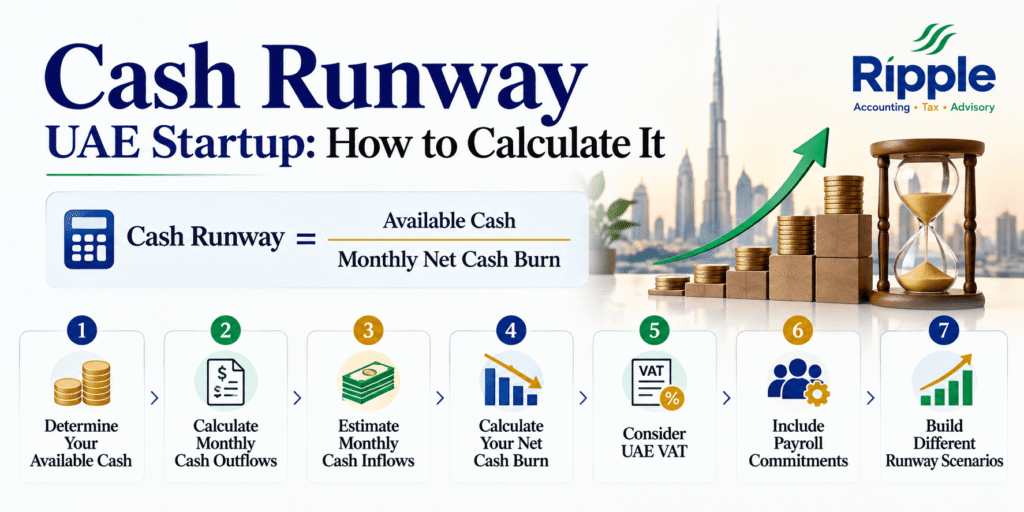
The basic formula is:
Cash Runway = Available Cash ÷ Monthly Net Cash Burn
Where:
For example, assume a UAE startup has:
The monthly net cash burn is:
AED 140,000 − AED 40,000 = AED 100,000
Therefore:
AED 750,000 ÷ AED 100,000 = 7.5 months
The startup has an estimated cash runway of 7.5 months under these assumptions.
However, founders should not stop at this basic calculation.
Start with the cash that is genuinely available for business operations. This can include:
Do not automatically include every balance shown on a bank statement.
For example, money collected from customers may include VAT that will later need to be paid to the Federal Tax Authority. Treating all of that money as freely available operating cash can make the runway look longer than it really is.
Similarly, restricted funds, deposits that cannot easily be accessed, or money earmarked for specific commitments should be considered separately. The objective is to identify the usable operating cash position.
Next, identify how much cash leaves the business each month. Common startup expenses include:
Payroll is often one of the largest recurring costs for startups.
Include:
A startup should also consider whether planned hiring will increase the monthly burn.
For example, hiring two employees at AED 15,000 each could increase monthly payroll costs by AED 30,000 before considering any additional employment-related expenses.
Include regular costs such as:
Separating essential costs from discretionary spending can help founders identify opportunities to extend runway.
Tax-related cash movements should also be considered when preparing a realistic forecast. A VAT-registered startup, for example, may need to make VAT payments after the end of its tax period. The Federal Tax Authority states that VAT returns and related payments must generally be made within 28 days from the end of the tax period.
This means VAT should not simply be treated as ordinary operating cash.
Similarly, Corporate Tax liabilities can create future cash requirements. The FTA states that Corporate Tax returns and Corporate Tax payments are generally due within a period not exceeding nine months from the end of the relevant Tax Period.
A startup should therefore include expected tax payments in its forward-looking cash forecast rather than waiting until the payment becomes due.
The next step is to estimate how much cash the startup receives each month. Potential inflows may include:
Be careful when forecasting customer revenue. Revenue is not always the same as cash received.
Suppose a startup invoices customers AED 100,000 in a month but customers generally pay after 60 days. The company cannot necessarily use that AED 100,000 immediately to pay salaries or suppliers.
For cash runway purposes, payment timing matters. This is why startups should monitor both:
Revenue earned and Cash actually collected.
Once monthly inflows and outflows are identified, calculate the net cash burn.
The formula is:
Monthly Net Cash Burn = Monthly Cash Outflows − Monthly Cash Inflows
For example:
| Cash Flow Item | Monthly Amount |
| Payroll | AED 75,000 |
| Rent and utilities | AED 15,000 |
| Software and technology | AED 10,000 |
| Marketing | AED 15,000 |
| Professional and other costs | AED 10,000 |
| Total cash outflows | AED 125,000 |
| Customer cash collections | AED 45,000 |
| Net cash burn | AED 80,000 |
If the startup has AED 640,000 in usable cash:
AED 640,000 ÷ AED 80,000 = 8 months
Its estimated runway is therefore 8 months.
VAT can affect startup cash flow because VAT collected from customers is not necessarily business income that can be spent freely.
For UAE-resident businesses, VAT registration becomes mandatory when taxable supplies and imports exceed the mandatory threshold of AED 375,000 over the previous 12 months or are expected to exceed that threshold within the next 30 days. Voluntary registration may be available above AED 187,500, subject to the applicable conditions.
Once registered, a startup needs to account for its VAT obligations when forecasting cash requirements.
For example, consider a startup that collects VAT from customers but has not yet paid the corresponding amount to the FTA. If the entire bank balance is included as available operating cash, the runway calculation may overstate the amount the business can actually spend.
A better approach is to separate:
This gives management a more realistic picture.
Payroll should receive special attention in any cash runway UAE startup calculation. Unlike some discretionary expenses, salaries are usually recurring commitments. A startup may also have payroll-related payments that need to be planned around specific dates. Founders should therefore create a forward-looking payroll schedule showing:
If a startup has six months of runway but plans to double its team within three months, its current runway figure may no longer be meaningful.
This is why cash runway should be recalculated whenever there is a major change in headcount or compensation.
One of the most useful ways to improve a runway calculation is to prepare more than one scenario.
This uses the startup’s current expected revenue and expenses.
Assume:
Assume:
For example:
| Scenario | Monthly Net Burn | Available Cash | Estimated Runway |
| Base case | AED 80,000 | AED 640,000 | 8 months |
| Downside | AED 110,000 | AED 640,000 | 5.8 months |
| Growth | AED 125,000 | AED 640,000 | 5.1 months |
This makes an important point: cash runway is not a fixed number. It changes when assumptions change.
Several decisions can shorten the runway quickly.
The FTA has also emphasised timely Corporate Tax filing and payment. For example, for businesses whose financial year ended on 31 December 2025, the filing and payment deadline was 30 September 2026.
Once the runway is known, founders can work on extending it.
A startup can be profitable on paper and still face a cash shortage.
For example, suppose a business records AED 100,000 in revenue during a month but collects only AED 30,000 because customers have 60-day payment terms.
The business may report revenue of AED 100,000, but only AED 30,000 has actually entered the bank. The opposite can also happen.
A startup may receive a large advance payment from a customer and temporarily have a strong cash position even though the revenue may be recognised differently for accounting purposes.
Therefore, founders should monitor:
These measures answer different financial questions.
Before calculating runway, review the following:
Calculating the runway once is useful. Monitoring it regularly is much more valuable.
Ripple Accounting, Tax & Advisory can help UAE startups improve the financial information behind their cash-flow decisions through practical accounting, financial reporting, budgeting and forecasting support.
With better financial visibility, founders can track cash inflows and outflows, review expenses, understand financial trends and plan for upcoming obligations. If you are unsure how much runway your UAE startup really has, contact Ripple Accounting, Tax & Advisory for tailored financial and compliance support.
A structured review can help you understand your current cash position, identify upcoming cash requirements and build a more practical cash-flow forecast for decision-making.
Ripple Accounting – CFO Services
The basic formula is: Cash Runway = Available Cash ÷ Monthly Net Cash Burn
For example, if a startup has AED 500,000 available and burns AED 100,000 per month, its estimated runway is five months.
However, startups should adjust the calculation for expected changes in revenue, payroll, taxes and major upcoming expenses.
A practical calculation should consider available cash, monthly operating expenses, payroll, customer collections, VAT-related cash movements, Corporate Tax liabilities, planned hiring and other significant future payments.
The more accurately these items are forecast, the more useful the runway estimate becomes.
Yes. VAT can affect cash availability because VAT collected from customers may need to be paid to the FTA.VAT-registered businesses generally have to file their VAT returns and make related payments within 28 days from the end of the relevant tax period.
A startup should ideally monitor the runway regularly rather than calculating it only once. Monthly monitoring is particularly useful for early-stage companies because revenue, payroll, hiring plans and expenses can change quickly. A rolling cash-flow forecast can provide a more current view than a static annual budget.
No. Profitability measures whether the business generates accounting profit or loss, while cash runway focuses on how long available cash can support the business at its current or expected burn rate. A startup can be profitable but have cash tied up in receivables. Similarly, a startup can have significant cash available from investment while still operating at a loss.
A startup’s bank balance tells only part of the financial story. Cash runway calculation for UAE startups helps founders turn that balance into a practical estimate of how long the business can continue operating. The calculation starts with available cash and monthly net cash burn, but a reliable forecast should go further. Payroll, customer payment timing, VAT, Corporate Tax, planned hiring and unexpected expenses can all change the amount of time a startup can operate. For UAE founders, regularly reviewing cash flow and updating runway assumptions can make it easier to identify financial pressure early and make informed decisions about spending, hiring and funding.
Disclaimer: This article is provided for general informational and educational purposes only. It does not constitute accounting, tax, financial, legal or investment advice. UAE tax rules, thresholds, deadlines and compliance requirements may change, and their application can depend on the specific circumstances of a business. Startups should review their individual position and obtain professional advice before making financial, tax or compliance decisions.
Tell us a little about your business and our UAE tax experts will get back to you with clear, practical answers — no obligation.
 Audit
Effective financial management depends on more than accurate bookkeeping. Businesses also need strong internal controls to protect their assets, reduce risks, and…
Read article Bookkeeping
Inventory valuation is one of the most important aspects of accounting and inventory management. Every business that buys, manufactures, or sells products…
Read article Bookkeeping
Non-current assets and capital expenditures play a critical role in a company’s long-term financial health. Whether you own a startup, manage an…
Read articlePage 54 of 59
Book a free consultation and get clear answers for your business.
0 Comments