UAE Tax Residency Certificate Requirements: Documents and Eligibility
Are you planning to apply for a UAE Tax Residency Certificate but unsure which documents you need or whether you qualify? Understanding…
Read article
Do schools in the UAE charge VAT on tuition fees, school transport, uniforms, extracurricular activities, and other services? The answer is not as simple as applying the UAE’s standard 5% VAT rate to every amount appearing on a student’s invoice.
The UAE VAT framework gives specific VAT treatment to qualifying education services, with some supplies being zero-rated, some services being exempt, and others remaining subject to 5% VAT. This distinction is particularly important for schools, nurseries, pre-schools, universities, training providers, and education businesses that offer several services under one commercial model.
Read more to learn UAE VAT on Education services in detail!
UAE VAT generally applies at 5% unless a supply is specifically zero-rated or exempt under the VAT legislation. Education is one of the sectors for which certain supplies can qualify for zero-rating. The key point is that not every service supplied by an educational institution automatically receives the same VAT treatment.
For qualifying educational services, the FTA states that the educational service can be zero-rated when both the curriculum and the educational institution are recognized by the competent federal or local government.
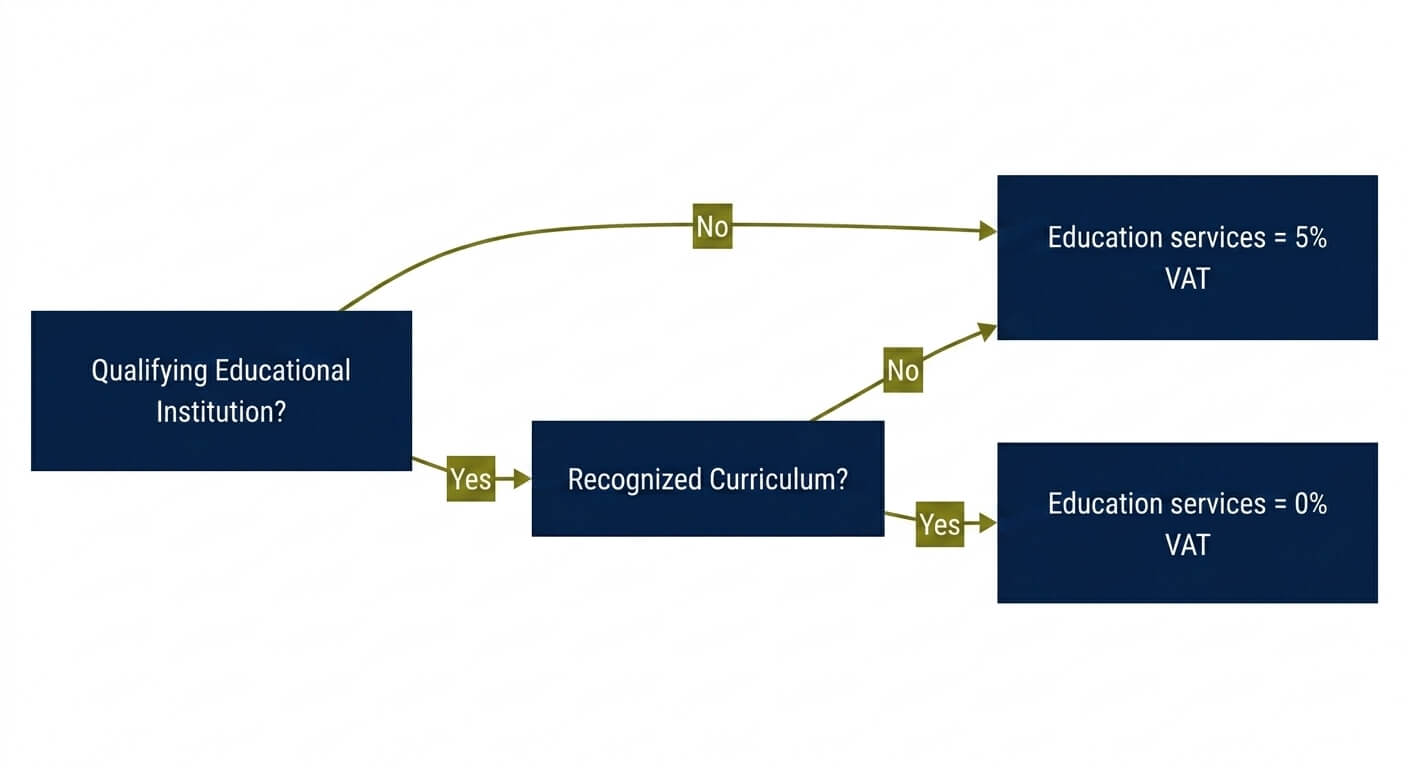
This means an education provider must look at the nature of the supply, the status of the institution, and the relationship between additional goods or services and the recognized educational service.
A useful way to understand the framework is:
| Supply | General VAT treatment |
| Qualifying educational services | 0% VAT |
| Directly related goods/services supplied by the qualifying institution | 0% VAT, subject to conditions |
| Related printed/digital educational materials | 0% VAT, subject to conditions |
| Student transportation from home to school and back | Exempt |
| Uniforms | 5% VAT |
| Electronic devices | 5% VAT |
| Food and beverages | 5% VAT |
| Certain extracurricular activities charged separately | 5% VAT |
| Certain non-curriculum field trips | 5% VAT |
| Supplies to people who are not enrolled students | 5% VAT |
The exact treatment should always be determined by examining the individual supplier rather than relying only on the fact that the supplier is a school or education provider.
You may also read: Healthcare VAT UAE: Zero-Rated vs 5% Standard Rate
The UAE education VAT exemption is often misunderstood because qualifying education is generally not exempt. Instead, it can be zero-rated.
Under the FTA’s education-sector guidance, an educational service is zero-rated when the relevant curriculum and educational institution are recognized by the competent federal or local government.
This distinction is extremely important.
For example, suppose a recognized school charges AED 40,000 for qualifying tuition.
If the tuition is a qualifying zero-rated educational service:
Tuition fee = AED 40,000
VAT at 0% = AED 0
Amount payable = AED 40,000
This is very different from saying that the school is making an exempt supply. The FTA’s VAT return guidance specifically identifies local supplies of certain educational services and related goods/services as zero-rated supplies.
For parents, one of the most important questions is whether VAT is added to tuition invoices. For a recognized educational institution providing a qualifying educational service, tuition fees can generally be zero-rated rather than charged at 5%. The FTA specifically confirms that qualifying educational services can be zero-rated.
However, the analysis should not stop at the word “tuition.” A school invoice may contain several separate charges, such as:
Each charge needs to be examined according to the VAT rules.
Example: School invoice
Suppose a school invoice contains:
If the tuition qualifies for zero-rating, the school should not simply apply one VAT treatment to the entire AED 42,500 invoice. Instead, each component should be classified according to the relevant rules.
This is why proper VAT treatment of education services in UAE requires a supply-by-supply analysis.
School transportation is one of the most important areas where education VAT rules differ from what many businesses expect. The FTA states that transporting students from home to the educational institution and back is exempt from VAT.
Therefore, qualifying school transportation should not automatically be treated as a zero-rated educational service merely because it is provided by a school.
Example: A school charges AED 4,000 for annual transportation between a student’s home and the school. If the service meets the relevant conditions for exempt student transportation:
Transportation charge = AED 4,000
VAT = Exempt
VAT charged = AED 0
This differs from a situation where the school operates a separate transport service for people who are not enrolled students.
The FTA’s guidance identifies supplies made to people who are not enrolled in the educational institution as standard-rated supplies. The broader VAT rules also distinguish local passenger transport from international transport. The FTA explains that local passenger transportation is generally exempt, while qualifying international transportation can be zero-rated.
The term ancillary education services can cover a wide range of products and services provided alongside education. The important question is whether the additional supply is directly related to the qualifying educational service and whether it satisfies the conditions for zero-rating.
The FTA confirms that goods or services supplied by the same qualifying educational institution can be zero-rated when they are directly related to the zero-rated educational service. Related printed or digital reading material can also qualify for zero-rating.
However, the legislation specifically excludes several categories from the zero-rating treatment. These include:
The Executive Regulation provides these specific exceptions.
Example: Educational books
Suppose a recognized school provides curriculum-related educational reading material as part of its educational service. Where the conditions are met, the related material may qualify for 0% VAT. But suppose the school sells a laptop to a student.
The fact that the laptop is used for education does not automatically make it zero-rated. Electronic devices are specifically excluded from the zero-rating treatment under the relevant provisions. Therefore, the device would generally be treated as a standard-rated supply at 5%.
One of the most common mistakes in education-sector VAT compliance is assuming that everything sold by a school is part of the educational service. That is not the case.
Correct classification affects more than the amount shown on a student’s invoice.
It can influence:
For example, an institution that incorrectly treats an exempt supply as zero-rated may recover input VAT that should not have been recovered. Conversely, incorrectly treating a qualifying zero-rated supply as exempt can create unnecessary restrictions on input VAT recovery.
This is particularly relevant where an educational institution has mixed supplies.
The FTA explains that where input VAT relates to taxable supplies, it may generally be recoverable, while input VAT associated with exempt supplies may not be recoverable. Where costs relate to both taxable and non-taxable supplies, an apportionment mechanism may be required.
Education providers should also determine whether they need to register for VAT.
The current mandatory registration threshold is AED 375,000 for taxable supplies and imports, while the voluntary registration threshold is AED 187,500, subject to the applicable conditions.
Importantly, a business making only zero-rated supplies may be able to apply for an exception from VAT registration, provided the applicable conditions are satisfied.
The FTA’s education-sector bulletin specifically explains that educational institutions making only zero-rated and/or standard-rated supplies must consider VAT registration when their taxable supplies and imports exceed the relevant threshold. It also notes that an institution making only zero-rated supplies may apply for an exception from VAT registration.
This means an education provider should not decide its registration position simply by looking at whether it charges 5% VAT to students.
A practical education business may have several revenue streams:
Core tuition + transport + uniforms + meals + extracurricular activities + devices + trips + other services.
Instead of treating all revenue as “education income,” we should classify each revenue stream. A useful internal process is:
This approach reduces the risk of applying the wrong VAT treatment to bundled invoices.
Educational institutions making zero-rated or standard-rated supplies should maintain appropriate VAT records.
The FTA’s education-sector bulletin confirms that tax invoices are required for standard-rated and zero-rated supplies, subject to specified exceptions. It also notes that simplified tax invoices may be used in qualifying circumstances.
For a school, records should therefore clearly distinguish between:
Strong documentation becomes particularly important where one invoice contains several VAT treatments.
1. Treating all school income as zero-rated: Being a school does not mean every supply automatically qualifies for 0% VAT.
2. Confusing zero-rated and exempt: A zero-rated supply remains taxable at 0%, while an exempt supply is treated differently for VAT purposes.
3. Assuming school transport is zero-rated: Qualifying transportation of students from home to the educational institution and back is treated as exempt, not simply zero-rated.
4. Applying 0% VAT to uniforms: Uniforms are specifically excluded from the education zero-rating provision.
5. Treating extracurricular activities as core tuition: An activity charged separately may be standard-rated even when provided by the same school.
6. Ignoring non-enrolled customers: The VAT treatment can change when goods or services are supplied to people who are not enrolled in the educational institution.
Managing education-sector VAT requires more than preparing a VAT return. The underlying accounting records need to correctly distinguish between zero-rated, exempt, and standard-rated supplies.
Ripple Accountant can support education businesses by helping them structure their VAT and accounting processes around the nature of each supply.
Professional VAT support helps businesses reduce compliance risks, maintain accurate records, and apply the correct VAT treatment with greater confidence. So, pick up your phone and contact our Ripple team today!
Phone: +971 52 356 5409
WhatsApp: +971 4 250 0833
Email: info@uaetaxcompliance.ae
A properly structured accounting system can instead separate these revenue categories and apply the relevant VAT treatment consistently. The result is better financial visibility, VAT reporting accuracy, and audit preparedness.
Certain qualifying educational services are zero-rated at 0%, provided the relevant conditions are met. Other education-related supplies may be exempt or subject to 5% VAT.
Qualifying tuition supplied by a recognized educational institution under a recognized curriculum can generally be zero-rated, meaning VAT is charged at 0%.
Yes, the FTA states that transportation of students from home to the educational institution and back is an exempt supply, subject to the relevant conditions.
Yes. Uniforms are specifically excluded from the education zero-rating provision and are generally subject to the standard 5% VAT rate.
No. Electronic devices are specifically excluded from the zero-rating provision for qualifying education supplies and are generally subject to 5% VAT.
An extracurricular activity provided for an additional fee is generally standard-rated rather than covered by the zero-rating applicable to qualifying educational services.
The mandatory VAT registration threshold is AED 375,000, while the voluntary registration threshold is AED 187,500, subject to the applicable rules.
The correct approach to UAE VAT on education services is not to classify every amount charged by a school or education provider in the same way. The UAE VAT framework distinguishes between qualifying zero-rated education, exempt student transportation, and standard-rated ancillary supplies. Tuition may qualify for 0% VAT, while uniforms, electronic devices, food, certain field trips, and separately charged extracurricular activities can fall under the 5% standard rate. Student transportation from home to the educational institution and back can be exempt. For education providers, the safest approach is to analyze each supply, document the VAT position, and ensure the accounting system reflects the correct classification.
General Disclaimer: This article provides general information for educational purposes only and does not constitute legal, tax, accounting, financial, or professional advice. Rules, regulations, and requirements may vary depending on the specific circumstances, industry, location, and applicable laws. Readers should verify the latest requirements with the relevant authorities and consult a qualified professional before making any business, financial, tax, or compliance decisions.
Tell us a little about your business and our UAE tax experts will get back to you with clear, practical answers — no obligation.
 Corporate Tax
Are you planning to apply for a UAE Tax Residency Certificate but unsure which documents you need or whether you qualify? Understanding…
Read article Corporate Tax
Do you need a UAE Tax Residency Certificate for a local administrative requirement or to claim benefits under a double taxation agreement?…
Read article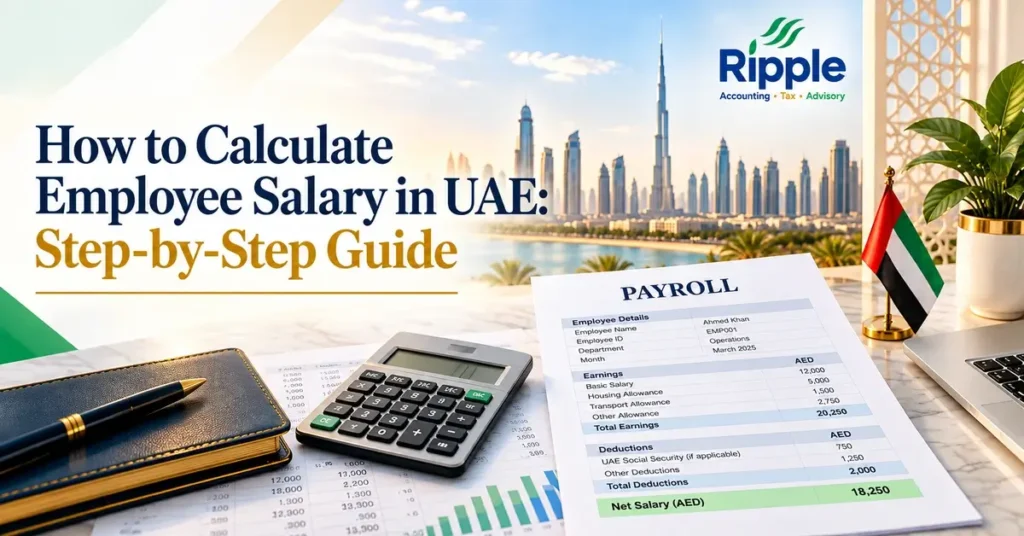 Bookkeeping
How can UAE businesses ensure employees receive the correct salary every month? Payroll involves more than adding basic pay and allowances. Employers…
Read articlePage 1 of 58
Book a free consultation and get clear answers for your business.
0 Comments