UAE Tax Residency Certificate Requirements: Documents and Eligibility
Are you planning to apply for a UAE Tax Residency Certificate but unsure which documents you need or whether you qualify? Understanding…
Read article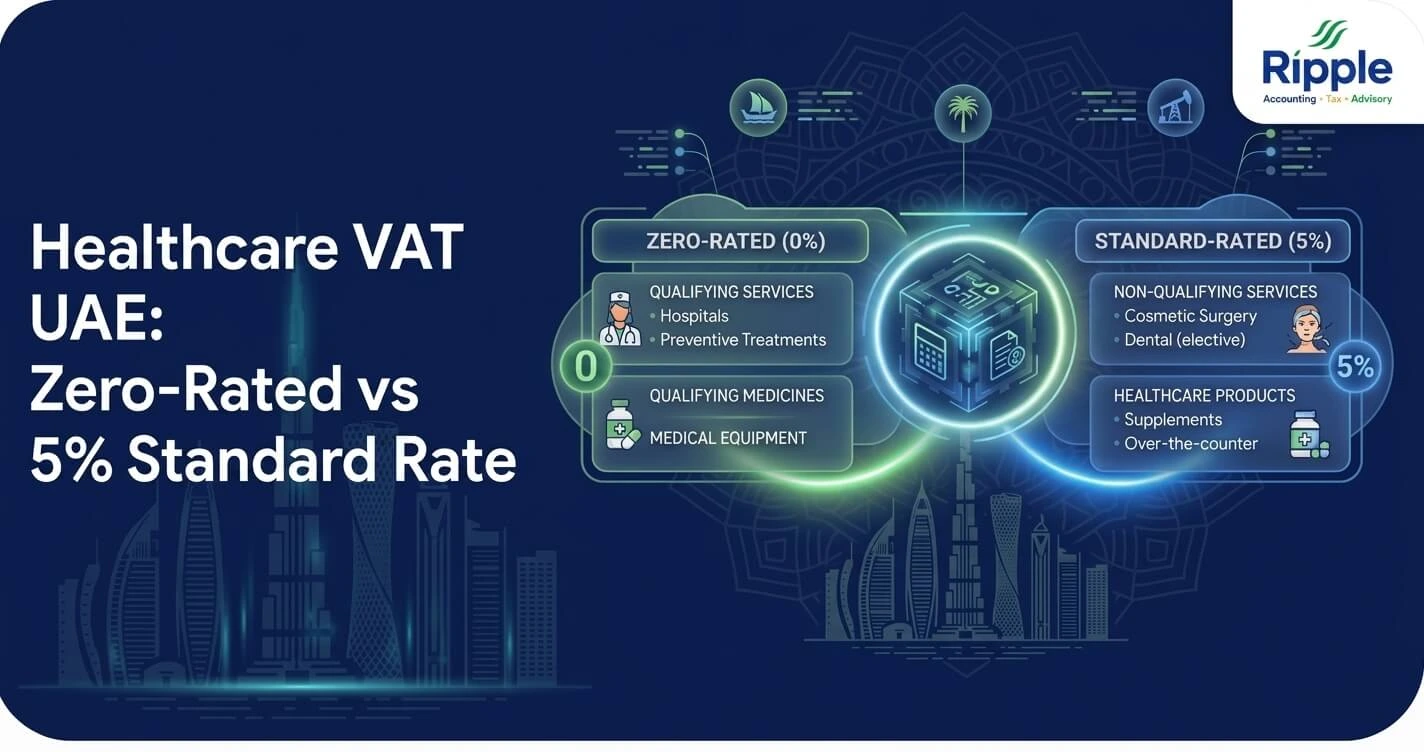
Does every medical treatment, prescription, or healthcare purchase in the UAE qualify for 0% VAT? Not necessarily.
The UAE VAT system applies different rules depending on the type of supply, provider, purpose, and applicable legal conditions. While qualifying healthcare services may be zero-rated, other healthcare-related supplies can be subject to the standard 5% VAT rate.
According to UAE Ministry of Health and Prevention data for 2024, the country had 34,912 doctors, 67,931 nurses, and 18,685 inpatient beds. For businesses operating at this scale, getting the VAT treatment wrong can affect pricing, invoices, VAT returns, input-tax recovery, and compliance with the Federal Tax Authority (FTA).
Read on to understand when healthcare is zero-rated and when 5% VAT applies!
Healthcare VAT refers to the VAT treatment applied to healthcare services, medicines, medical equipment, and other supplies made by healthcare businesses operating in the UAE.
The important point is that “healthcare” is not automatically synonymous with “zero-rated.” The VAT treatment depends on the nature of the supply and whether the legislative conditions for zero-rating are met.
Under Article 41 of the UAE VAT Executive Regulations, healthcare services generally include services that are accepted within the medical profession as necessary for treating the recipient, including preventive treatment. The service must also be supplied by an appropriately licensed healthcare body or professional and relate to human health.
This creates three practical questions for a healthcare business:
Answering these questions correctly is more reliable than simply classifying an invoice as “medical.”
For example, a licensed doctor provides treatment to a patient for a diagnosed medical condition. The service is directly related to human health and is supplied by a licensed professional. Subject to the applicable rules, this can qualify as a zero-rated medical services.
By contrast, a clinic may provide a purely elective cosmetic procedure requested for aesthetic purposes without a medical need. That supply does not automatically qualify for zero-rating and can fall under the 5% standard rate.
A healthcare service can qualify for zero-rating when the following fundamental requirements are satisfied:
The service should generally be accepted in the medical profession as necessary for treating the recipient, including preventive treatment. This can cover ordinary medical treatment and appropriate preventive healthcare.
For example, if a patient visits a licensed medical practitioner for diagnosis and treatment of an illness, the underlying medical consultation and treatment may qualify for zero-rating.
The service must be supplied by an eligible licensed healthcare provider, such as a healthcare institution, doctor, nurse, technician, dentist, or pharmacy, where the applicable licensing requirements are satisfied. This means the licensed provider VAT UAE requirement should not be overlooked. A business should retain evidence supporting its healthcare licence and ensure that its actual services fall within the scope of its licensed activities.
The zero-rating provision is directed toward healthcare relating to human health. For example, medical treatment supplied to a patient can satisfy this requirement. A service unrelated to treating or maintaining human health cannot become zero-rated merely because it is supplied inside a clinic or hospital.
The recipient of the healthcare service is particularly important in determining the VAT treatment.
The FTA’s Public Clarification on B2B healthcare services explains that the zero-rating provision is linked to healthcare supplied to the recipient who receives the treatment. Where a healthcare provider supplies services contractually to another healthcare provider rather than directly providing treatment to the patient as the recipient, the supply may be subject to 5% VAT.
For example, suppose:
The transaction therefore requires careful analysis and may be standard-rated rather than automatically treated as zero-rated healthcare.
The UAE framework provides zero-rating for qualifying healthcare services rather than applying a blanket exemption to everything connected with medicine.
Examples can include qualifying:
The UAE Government’s sector guidance also identifies preventive healthcare, including vaccinations, and healthcare services aimed at treating humans as zero-rated where the relevant conditions are met.
Example: Preventive Treatment
Consider a licensed medical centre that provides a vaccination to a patient as part of preventive healthcare.
The treatment is:
This is a strong example of preventive treatment VAT falling within the zero-rated healthcare framework. However, businesses should avoid assuming that every item appearing on a medical invoice automatically receives 0% VAT. The underlying supply must be analysed.
The UAE standard VAT rate is 5%. Supplies that do not qualify for zero-rating and are not specifically exempt generally fall under this standard rate. This is why healthcare businesses need a detailed VAT classification system.
Services can be standard-rated where they fall outside the definition or conditions for zero-rated healthcare. One of the most common examples involves elective cosmetic treatment.
Cosmetic procedures require particular attention because the VAT treatment depends on their purpose and medical necessity.
The UAE VAT rules exclude elective treatment for cosmetic reasons from the definition of qualifying healthcare services unless the treatment is prescribed by a doctor or medical professional for treating or preventing a medical condition. Therefore, a cosmetic procedure should not automatically be treated as zero-rated simply because it is performed by a doctor or inside a licensed hospital.
The critical distinction is therefore medical necessity versus elective cosmetic purpose.
Healthcare providers should maintain appropriate documentation supporting the classification rather than relying solely on the procedure’s commercial name.
Prescription medicine VAT requires a separate analysis because not every medicine automatically receives 0% VAT. The UAE VAT framework provides zero-rating for pharmaceutical products identified under the applicable Cabinet decision.
Similarly, only qualifying medical equipment identified under the relevant rules can receive zero-rating. This means healthcare businesses should maintain an accurate product classification rather than applying 0% to every pharmaceutical item.
Example:
The medical equipment VAT rate depends on whether the equipment falls within the categories identified under the applicable UAE VAT rules. The Executive Regulations provide for zero-rating of qualifying medical equipment specified under the relevant Cabinet decision. Other medical supplies can remain subject to the standard rate. Healthcare businesses should therefore maintain:
This becomes particularly important for hospitals and distributors handling hundreds or thousands of products. A hospital cannot safely assume that an item is zero-rated simply because it is used in an operating theater.
Healthcare providers also frequently deal with insurance companies, which creates another area of confusion. Health insurance VAT UAE treatment is separate from the VAT treatment of the underlying medical service.
The FTA’s insurance guidance states that the provision of health insurance is subject to VAT at the standard rate. Therefore, a healthcare provider should distinguish between:
For example, if an insurance company provides a health insurance policy to an individual or employer, the insurance premium can be subject to 5% VAT.
That does not automatically mean the patient’s qualifying medical treatment should also be charged at 5%. The two supplies need to be analyzed independently.
| Situation | Potential VAT treatment |
| Qualifying treatment by a licensed healthcare provider | 0% |
| Qualifying preventive treatment | 0% |
| Purely elective cosmetic treatment | Generally 5% if taxable and not medically prescribed |
| Medically necessary cosmetic treatment | Potentially 0% if requirements are satisfied |
| Specified qualifying pharmaceutical products | 0% |
| Specified qualifying medical equipment | 0% |
| B2B healthcare service where the recipient is not the patient | May not qualify for zero-rating |
| Medical insurance | Generally taxable, subject to applicable insurance rules |
| Other taxable healthcare-related supplies | 5% where no zero-rating/exemption applies |
This table is a practical overview, not a substitute for reviewing the exact transaction and current legislation.
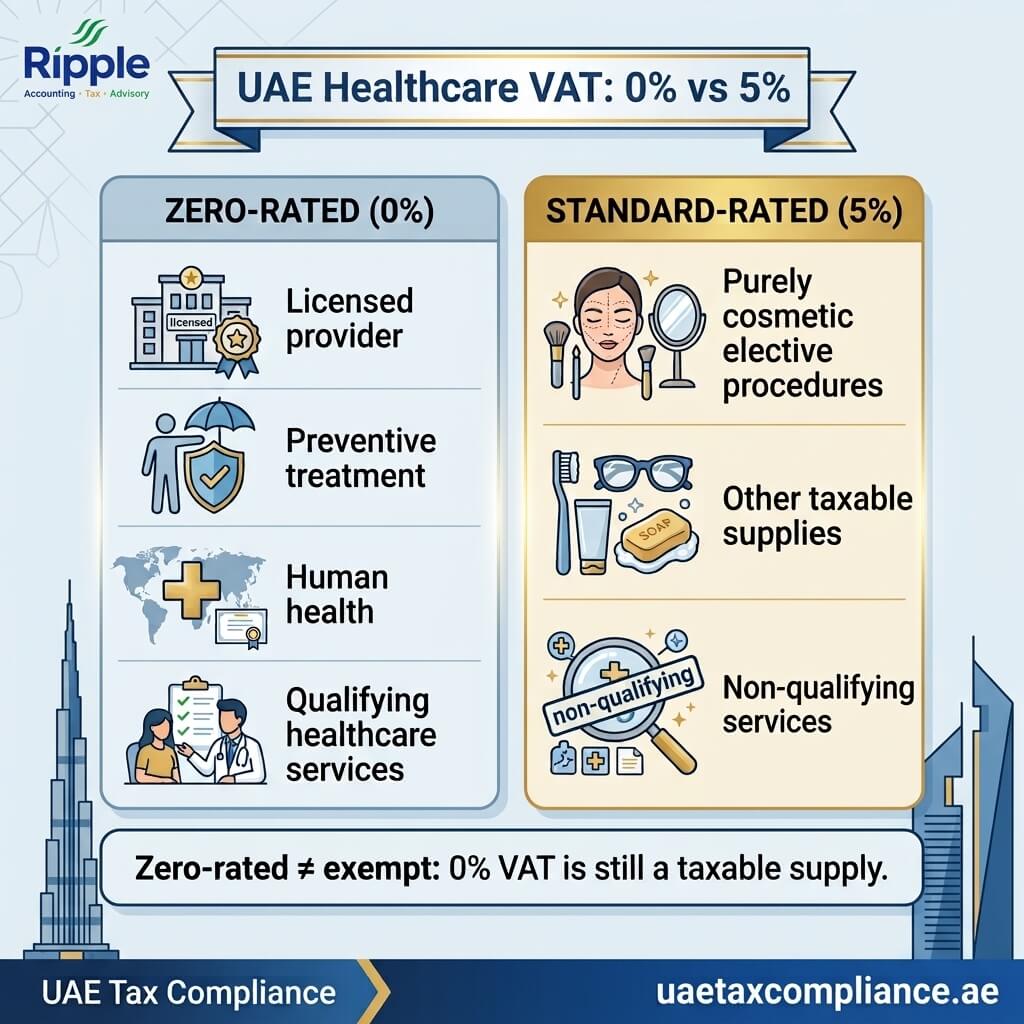
Zero-rated and exempt supplies are not the same under UAE VAT. A zero-rated supply is taxable at 0% VAT, while an exempt supply is not subject to VAT.
The key difference is input VAT recovery. For qualifying zero-rated healthcare services, a healthcare provider can generally recover eligible VAT paid on related business expenses, subject to the normal rules. With exempt supplies, input VAT recovery may be restricted.
Example: If a clinic provides qualifying medical treatment at 0% VAT, it can still potentially recover VAT paid on eligible expenses such as equipment or professional services. Therefore, 0% VAT does not mean VAT-exempt.
Healthcare providers can encounter VAT problems when they classify transactions according to their industry rather than the actual supply.
Incorrect VAT classification can create several problems.
Healthcare businesses should therefore maintain appropriate supporting records, contracts, invoices, licensing documents, and product classifications.
A healthcare business can make VAT compliance easier by developing a transaction-level classification framework.
Do not start with the VAT rate. Start by identifying what the business is actually selling.
Is it:
Determine whether the recipient is:
Confirm that the entity or professional supplying the healthcare service is appropriately licensed.
For treatments that could be considered cosmetic or elective, document whether there is a medical condition being treated or prevented.
Medicines and medical equipment should be checked against the applicable qualifying lists rather than automatically coded at 0%.
Once the supply has been classified, configure the accounting system so invoices and VAT returns use the correct treatment.
Where one transaction contains multiple components, determine whether each component has the same VAT treatment or requires separate analysis.
Healthcare VAT compliance becomes challenging when a business has hundreds of transactions involving patients, insurers, pharmacies, suppliers, medical professionals, and corporate customers.
Ripple Accountants – Accounting & Bookkeeping Services provides accounting and VAT-related support for UAE businesses, including bookkeeping, VAT compliance, and financial reporting.
Ripple Accountants’ services support businesses with:
Professional VAT support helps businesses reduce compliance risks, maintain accurate records, and apply the correct VAT treatment with greater confidence. So, pick up your phone and contact our Ripple team today!
Phone: +971 52 356 5409
WhatsApp: +971 4 250 0833
Email: info@uaetaxcompliance.ae
It can be either. Qualifying healthcare services supplied under the conditions of the UAE VAT rules can be zero-rated at 0%, while healthcare-related supplies that do not qualify for zero-rating can be subject to the standard 5% VAT rate.
Qualifying medical services can be zero-rated when they meet the applicable conditions, including being supplied by an appropriately licensed provider and relating to human health.
Elective cosmetic treatment that is not prescribed by a doctor or medical professional for treating or preventing a medical condition is excluded from the qualifying healthcare definition and can therefore be subject to the standard 5% rate.
Qualifying preventive healthcare can be zero-rated. The UAE framework expressly includes preventive treatment within the definition of healthcare services.
5. Are prescription medicines subject to VAT?
Some pharmaceutical products qualify for zero-rating, while medicines outside the qualifying categories can be subject to 5% VAT. Businesses should verify the applicable product classification rather than assuming that all prescription medicines are zero-rated.
Health insurance is generally subject to the standard 5% VAT rate.
Potentially, yes. The recipient of the supply is important. The FTA’s B2B healthcare clarification explains that where the healthcare service is supplied to another healthcare provider rather than directly to the patient as the recipient, the transaction can be subject to 5% VAT.
Understanding healthcare VAT in the UAE requires assessing the supply, provider, recipient, medical purpose, and applicable classification. Qualifying healthcare services may be zero-rated at 0%, while other supplies can be subject to the 5% standard rate.
Proper VAT classification, documentation, and regular reviews help healthcare businesses reduce compliance risks and avoid errors in FTA reporting. When the VAT treatment of a treatment, medicine, equipment, insurance, or B2B service is unclear, professional VAT advice can help ensure the correct rate is applied.
Pick up your phone and book a free consultation with our Ripple team today—we’ll help you understand your VAT obligations and find the right approach for your business!
Disclaimer: This article is for general informational purposes only and does not constitute legal, tax, or financial advice. UAE VAT laws and FTA guidance may change over time. Consult a qualified tax professional for advice specific to your business.
Tell us a little about your business and our UAE tax experts will get back to you with clear, practical answers — no obligation.
 Corporate Tax
Are you planning to apply for a UAE Tax Residency Certificate but unsure which documents you need or whether you qualify? Understanding…
Read article Corporate Tax
Do you need a UAE Tax Residency Certificate for a local administrative requirement or to claim benefits under a double taxation agreement?…
Read article Bookkeeping
How can UAE businesses ensure employees receive the correct salary every month? Payroll involves more than adding basic pay and allowances. Employers…
Read articlePage 1 of 58
Book a free consultation and get clear answers for your business.
0 Comments