UAE Tax Residency Certificate Requirements: Documents and Eligibility
Are you planning to apply for a UAE Tax Residency Certificate but unsure which documents you need or whether you qualify? Understanding…
Read article
Exporting goods and services from the UAE can provide significant VAT advantages when the conditions for zero-rated exports are met. Under the UAE VAT system, qualifying exports are generally subject to 0% VAT, allowing businesses to recover eligible input tax while remaining compliant with the law. However, applying the 0% rate is not automatic. Businesses must maintain sufficient VAT evidence to prove that the supply qualifies as a zero-rated export.
Zero-rated exports refer to supplies that are taxable at a VAT rate of 0% under the UAE VAT legislation, provided all legal conditions are met. Although no VAT is charged to the overseas customer, these supplies remain taxable, enabling the supplier to recover eligible input VAT incurred on related business expenses.
The UAE VAT regime distinguishes zero-rated supplies from exempt supplies. This distinction is important because businesses making zero-rated supplies generally retain the right to recover input tax, whereas exempt supplies often restrict input tax recovery.
A zero-rated export is generally the supply of qualifying goods or services from the UAE to recipients outside the UAE that satisfies the requirements set out under the UAE VAT legislation and related executive regulations.
Examples include:
Businesses should assess each transaction individually because not every international transaction automatically qualifies for the 0% VAT rate.
The UAE applies zero-rating to qualifying exports to support international trade while ensuring VAT is ultimately consumed in the destination country rather than the country of origin.
Applying the 0% VAT rate allows businesses to:
The zero rate is available only when businesses can demonstrate compliance with all documentation and export evidence requirements.
Businesses often confuse zero-rated supplies with VAT-exempt supplies, but they have different VAT consequences.
| Feature | Zero-Rated Supplies | VAT-Exempt Supplies |
|---|---|---|
| VAT Rate | 0% | No VAT charged |
| Taxable Supply | Yes | No |
| Input VAT Recovery | Generally allowed | Usually restricted |
| Included in VAT Return | Yes | Yes |
| Supporting Documentation Required | Yes | Yes |
Understanding this distinction helps businesses apply the correct VAT treatment and avoid errors during VAT return preparation or FTA audits.
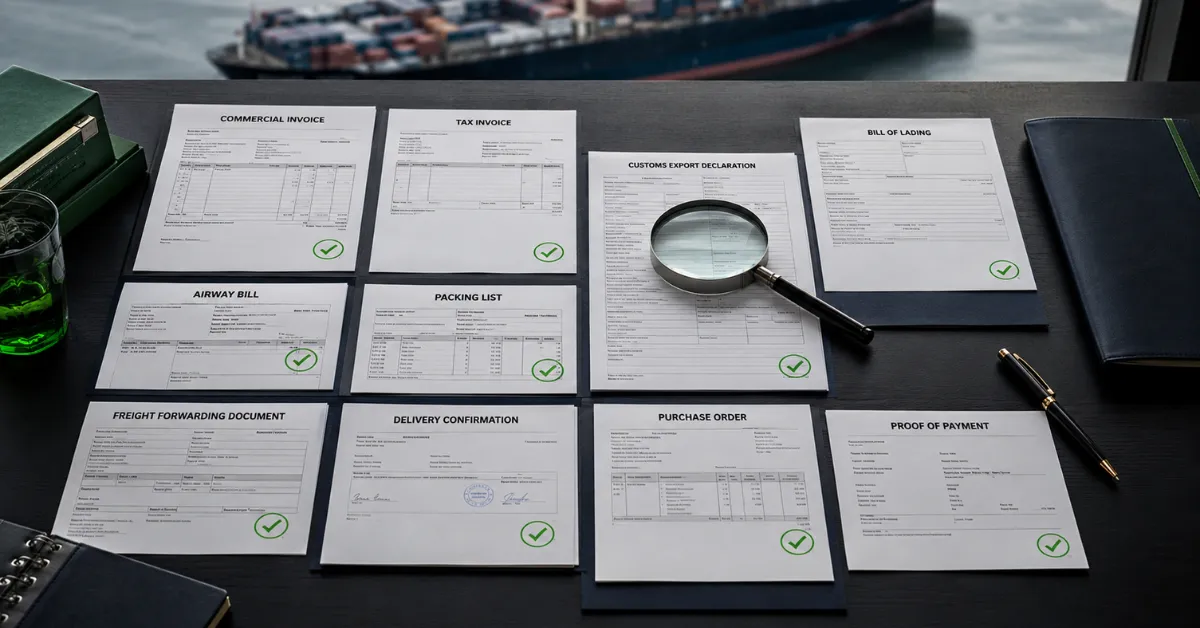
Applying the 0% VAT rate requires more than simply exporting goods or providing services to a foreign customer. Businesses must satisfy the conditions prescribed under the UAE VAT legislation and retain appropriate supporting evidence.
The UAE VAT framework provides for zero-rating of qualifying exports under the VAT legislation and Executive Regulation, subject to specific conditions. Businesses should ensure that every export transaction is assessed against the applicable legal requirements before applying the 0% VAT rate. Maintaining accurate accounting records and export documentation is a key part of demonstrating compliance.
To apply the 0% VAT rate on qualifying exports, businesses should generally ensure that:
Failure to satisfy any required condition may affect the eligibility of the supply for zero-rating.
Obtaining export evidence within the applicable timeframe is essential for defending the application of the 0% VAT rate.
Businesses should ensure they:
Strong internal controls help reduce compliance risks and simplify future VAT audits.
Businesses should not apply zero-rating where the legal requirements are not satisfied.
Common situations include:
In these situations, businesses should carefully review the transaction before determining the correct VAT treatment to minimise the risk of assessments, penalties, or disputes during an FTA review.
A direct export occurs when the UAE supplier is responsible for arranging the transportation of goods from the UAE to a destination outside the UAE. To apply the 0% VAT rate, businesses must maintain sufficient evidence that the goods physically left the UAE and that the export meets the applicable VAT conditions.
The Federal Tax Authority (FTA) may request supporting documentation during a VAT audit. Missing or inconsistent records can result in the export being treated as a standard-rated supply.
Businesses should retain the following documents for every qualifying direct export:
All documents should be consistent in terms of quantities, shipment dates, customer information, and product descriptions.
Businesses should:
An indirect export occurs when the overseas customer or another party on the customer’s behalf arranges the transportation of goods outside the UAE. Although the supplier does not control the shipment, the supplier must still obtain adequate evidence that the goods were exported in accordance with the UAE VAT rules.
Indirect exports generally carry a higher compliance risk because businesses rely on documentation provided by external parties.
In addition to standard commercial documents, businesses should retain:
Businesses should ensure these documents clearly demonstrate that the exported goods reached a destination outside the UAE.
Many VAT disputes arise because businesses fail to collect sufficient export evidence.
Common mistakes include:
Establishing a documented process for collecting export records helps reduce VAT compliance risks.
Certain services supplied to customers outside the UAE may qualify for zero-rating if the conditions under the UAE VAT legislation are satisfied. The place of supply rules and the nature of the service should always be reviewed before applying the 0% VAT rate.
Unlike goods, exported services do not have customs documentation. Instead, businesses should maintain commercial and contractual evidence demonstrating that the supply qualifies for zero-rating.
Businesses should maintain:
Maintaining complete documentation strengthens the business’s position during an FTA review.
The documentation requirements differ depending on who arranges the export.
| Requirement | Direct Export | Indirect Export |
|---|---|---|
| Export arranged by | UAE supplier | Overseas customer or third party |
| Customs export declaration | Required | Required |
| Transport documents | Required | Required |
| Commercial invoice | Required | Required |
| Tax invoice | Required | Required |
| Delivery confirmation | Recommended | Important |
| Customer export confirmation | Usually not required | Often required |
| Compliance risk | Lower | Higher |
| Evidence collection responsibility | Supplier | Supplier must obtain supporting evidence |
Businesses should understand these differences before applying the zero-rated VAT treatment.
Before applying the 0% VAT rate, businesses should confirm that the following records are available:
Using a standardized export documentation checklist helps businesses identify missing records before filing VAT returns and reduces the risk of adjustments during an FTA audit. Regular reviews of export files also improve record accuracy and support long-term VAT compliance.
The Federal Tax Authority (FTA) expects businesses to maintain complete and consistent evidence before applying the 0% VAT rate. During a VAT audit, missing or inaccurate documentation may lead to the export being treated as a standard-rated supply, together with additional tax liabilities and administrative penalties where applicable.
The most common reasons for rejected zero-rated export claims include:
Regular internal reviews can help identify documentation gaps before VAT returns are submitted.
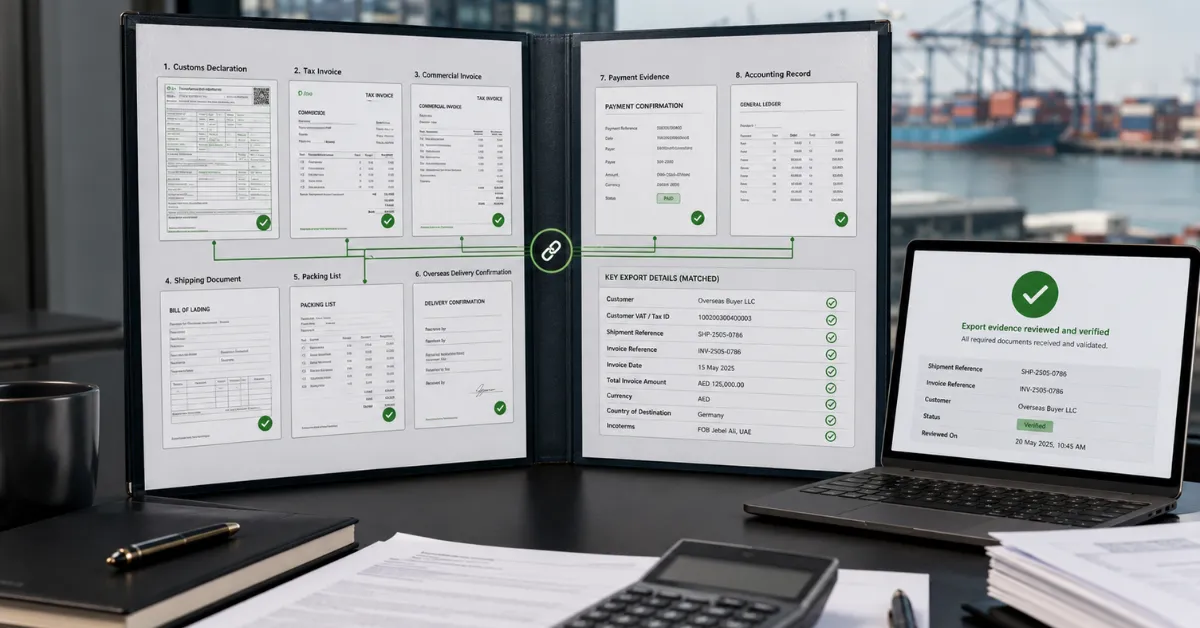
Well-organized records make VAT audits more efficient and reduce the risk of disputes with the FTA. Businesses should establish clear procedures for collecting, reviewing, and storing export documentation.
Businesses should retain VAT records for the period required under the UAE VAT legislation. Records should remain complete, accessible, and available upon request by the FTA.
Documents commonly retained include:
Electronic record management has become a common practice for businesses managing large volumes of export transactions.
Good practices include:
Digital records should remain accurate, complete, and easily retrievable during an FTA audit.
Businesses can simplify VAT audits by organizing export documentation consistently.
Recommended practices include:
Strong internal controls improve VAT compliance and reduce the likelihood of documentation errors.
Businesses should:
A UAE manufacturer sells industrial equipment to a customer in Germany. The supplier arranges international shipping, prepares the commercial invoice, issues the tax invoice, and obtains the customs export declaration, bill of lading, packing list, freight documents, and proof of payment.
The finance team reconciles all records before filing the VAT return. Since the transaction satisfies the applicable conditions and the supporting evidence is complete, the supplier applies the 0% VAT rate and retains the documentation for future FTA review.
This example illustrates how complete documentation supports a defensible zero-rated export claim.
A trading company exports products to an overseas customer but files its VAT return before receiving the customs export declaration. The company also fails to obtain complete transport documentation.
During an FTA audit, the business cannot provide sufficient evidence confirming that the goods were exported in accordance with the VAT rules. As a result, the FTA may determine that the conditions for zero-rating were not adequately supported and assess VAT based on the applicable legislation, together with any administrative consequences where relevant.
This example highlights the importance of collecting all required evidence before applying the 0% VAT treatment.
Businesses can strengthen their VAT compliance by following consistent documentation procedures.
Recommended practices include:
These practices help reduce audit risk and improve the quality of supporting evidence.
Managing VAT compliance requires more than filing VAT returns. Businesses must also maintain accurate records, apply the correct VAT treatment, and prepare documentation that can withstand an FTA audit.
Ripple Accountants supports businesses with:
Professional VAT support helps businesses reduce compliance risks, maintain accurate records, and apply the correct VAT treatment with greater confidence.
Contact Ripple Accountants
Phone: +971 52 356 5409
WhatsApp: +971 4 250 0833
Email: info@uaetaxcompliance.ae
Businesses should retain tax invoices, commercial invoices, customs export declarations, transport documents, proof of export, payment records, contracts, and accounting records that support the transaction.
If sufficient supporting evidence is unavailable, the FTA may determine that the conditions for applying the 0% VAT rate have not been met, depending on the facts of the case and the applicable legislation.
Yes. Certain services supplied to customers outside the UAE may qualify for zero-rating when they satisfy the relevant provisions of the UAE VAT legislation.
In a direct export, the UAE supplier arranges the transportation of goods outside the UAE. In an indirect export, the overseas customer or another party arranges the shipment, resulting in additional documentation requirements.
Businesses should retain VAT records for the period prescribed under the UAE VAT legislation and ensure they remain complete and accessible for FTA inspection.
Yes. Electronic records may be maintained provided they are accurate, complete, readable, secure, and can be produced when requested by the FTA.
Although payment evidence alone does not establish eligibility for zero-rating, it is an important supporting document that strengthens the overall export record.
Commonly requested documents include VAT invoices, commercial invoices, customs export declarations, bills of lading, airway bills, shipping records, contracts, payment records, and accounting documentation.
Applying the 0% VAT rate to qualifying exports can provide significant tax benefits, but it also places responsibility on businesses to maintain complete and reliable VAT evidence. Every export transaction should be supported by accurate invoices, customs documentation, transport records, contracts, and accounting records that clearly demonstrate compliance with UAE VAT requirements.
Disclaimer: This article is for general informational purposes only and does not constitute legal, tax, or financial advice. UAE VAT laws and FTA guidance may change over time. Consult a qualified tax professional for advice specific to your business.
Tell us a little about your business and our UAE tax experts will get back to you with clear, practical answers — no obligation.
 Corporate Tax
Are you planning to apply for a UAE Tax Residency Certificate but unsure which documents you need or whether you qualify? Understanding…
Read article Corporate Tax
Do you need a UAE Tax Residency Certificate for a local administrative requirement or to claim benefits under a double taxation agreement?…
Read article Bookkeeping
How can UAE businesses ensure employees receive the correct salary every month? Payroll involves more than adding basic pay and allowances. Employers…
Read articlePage 1 of 58
Book a free consultation and get clear answers for your business.
0 Comments