Principal vs Agent Under IFRS 15: Gross or Net Revenue for Platforms in the UAE
Should a UAE platform report the full customer payment as revenue or only its commission? Under IFRS 15 principal vs agent rules,…
Read article
Is your business profitable on paper but still struggling to maintain enough cash?
The problem may be tied to working capital rather than profitability alone. A working capital dashboard helps UAE businesses monitor how quickly customers pay, how long inventory remains unsold, and how quickly suppliers are paid. The three core measures Days Sales Outstanding (DSO), Days Payable Outstanding (DPO), and inventory days—can reveal where cash is getting trapped in day-to-day operations.

A working capital dashboard is a management reporting tool that brings together key indicators affecting a company’s short-term liquidity.
Instead of reviewing accounts receivable, inventory, and accounts payable separately, management can view the most important working-capital metrics in one place. A typical dashboard may show:
The purpose is not simply to produce attractive charts. A useful dashboard should help management answer practical questions:
For UAE SMEs, this visibility can be particularly useful when businesses are managing growth, supplier commitments, inventory purchases and customer credit simultaneously.
Working capital represents the resources a business uses to support its everyday operations. It is closely connected to receivables, inventory, and payables. A business may report strong sales and profits but still experience cash pressure if customers take too long to pay or inventory moves slowly.
For example, imagine a UAE trading company that sells AED 1 million of products during a month but allows customers extended payment terms. If large amounts remain outstanding, the business may need additional cash to pay suppliers, employees and other operating expenses while waiting for customers to settle their invoices.
Effective working capital management UAE businesses use should therefore focus on both profitability and the timing of cash movements.
A dashboard gives management a regular view of these movements and helps turn accounting data into actionable information.
The most useful starting point is to monitor DSO, DPO, and inventory days together.
Days Sales Outstanding (DSO) measures the average number of days a business takes to collect payment from customers after making credit sales.
A commonly used DSO calculation is:
DSO = Average Accounts Receivable ÷ Credit Sales × Number of Days
For example, suppose a company has average accounts receivable of AED 600,000 and annual credit sales of AED 3.6 million.
Using 365 days:
DSO = AED 600,000 ÷ AED 3,600,000 × 365 = 60.8 days
The business is therefore taking approximately 61 days, on average, to collect its credit sales. A rising DSO may indicate:
However, a high DSO is not automatically a problem. It should be compared with the company’s agreed payment terms, historical performance and industry characteristics.
Days Payable Outstanding (DPO) measures how long a business takes to pay its suppliers. A common DPO calculation is:
DPO = Average Accounts Payable ÷ Cost of Goods Sold × Number of Days
For example, if average accounts payable is AED 400,000 and annual COGS is AED 3.6 million:
DPO = AED 400,000 ÷ AED 3,600,000 × 365 = 40.6 days
The company is taking approximately 41 days to pay suppliers.
A falling DPO can mean that the business is paying suppliers faster, potentially reducing available cash.
A rising DPO can preserve cash, but management should be careful. Delaying payments beyond agreed terms may result in:
The objective is therefore not simply to maximise DPO. It is to manage supplier payments strategically while maintaining healthy commercial relationships.
Inventory days, also known as Days Inventory Outstanding (DIO), measure approximately how long inventory remains in the business before being sold.
The inventory days calculation is commonly expressed as:
Inventory Days = Average Inventory ÷ Cost of Goods Sold × Number of Days
Suppose a business has average inventory of AED 500,000 and annual COGS of AED 3.6 million:
Inventory Days = AED 500,000 ÷ AED 3,600,000 × 365 = 50.7 days
The business holds approximately 51 days of inventory.
A rising inventory-days figure may indicate:
For trading and distribution businesses, monitoring inventory days can be particularly important because inventory represents cash that has already been invested but has not yet been converted back into sales proceeds.
These three indicators become much more useful when viewed together. They form the basis of the cash conversion cycle (CCC):
Cash Conversion Cycle = DSO + Inventory Days − DPO
For example:
Therefore:
CCC = 60 + 50 − 40 = 70 days
This means the company’s operating cash is tied up for approximately 70 days between paying suppliers and collecting cash from customers, based on the simplified metrics above.
However, management should not pursue the lowest possible number without considering customer relationships, supplier agreements, service levels and business growth.
A useful dashboard should combine financial metrics with operational information.
| KPI | What it tells management |
| DSO | How quickly customers pay |
| DPO | How quickly suppliers are paid |
| Inventory Days | How long stock remains before sale |
| Cash Conversion Cycle | Overall operating cash cycle |
| Accounts Receivable | Total customer balances |
| Overdue Receivables | Collection risk |
| Accounts Payable | Amount owed to suppliers |
| Payables Due | Upcoming cash commitments |
| Inventory Value | Cash tied up in stock |
| Slow-Moving Inventory | Potential stock risk |
Management can also add actual vs target figures.
For example:
| KPI | Target | Actual | Status |
| DSO | 45 days | 61 days | Needs attention |
| DPO | 45 days | 41 days | Monitor |
| Inventory Days | 45 days | 51 days | Monitor |
| CCC | 45 days | 71 days | Needs attention |
This makes the dashboard more useful than presenting isolated numbers.
The real value of a dashboard comes from understanding what changes in the numbers mean.
Management should investigate why customers are taking longer to pay.
Possible actions include:
The business should investigate whether stock is moving as expected. Management can review:
A lower DPO may indicate that the business is paying suppliers sooner. Management should determine whether this is intentional or caused by changes in supplier terms or payment processes.
An increasing CCC can signal that cash is being tied up for longer. Management should analyse all three components rather than focusing on one KPI in isolation.
Once a dashboard identifies a problem, management needs to take action.
Businesses can improve cash conversion by:
Businesses can reduce unnecessary inventory investment by:
Businesses should review supplier terms and determine whether payment schedules can be aligned with their cash cycle. Negotiating commercially reasonable payment terms can improve liquidity without damaging supplier relationships.
The objective should be balanced working capital management, not simply delaying payments or reducing inventory regardless of the consequences.
Consider a UAE wholesale business with the following figures:
The dashboard produces approximately:
DSO: 61 days
Inventory Days: 51 days
DPO: 41 days
Therefore:
CCC = 61 + 51 − 41 = 71 days
Management now knows that approximately 71 days of operating cash are tied up in the simplified working-capital cycle.
Instead of immediately seeking additional financing, management can investigate whether DSO can be reduced from 61 to 50 days or whether inventory days can be reduced from 51 to 45 days.
Even relatively small improvements can release cash from the operating cycle.
For example, reducing DSO by 10 days on AED 3.6 million of annual credit sales represents approximately AED 98,630 of working-capital improvement, assuming the sales level remains unchanged.
Businesses often make the following mistakes when creating working-capital reports:
A working capital dashboard is most useful when the underlying accounting data is accurate and updated regularly.
Ripple Accountant can support UAE businesses with management reporting, working capital analysis, KPI dashboards, cash-flow forecasting and financial data review.
Ripple Accountant can also support businesses with management accounts and cash-flow reporting, helping owners and managers move beyond simply reviewing the bank balance and understand what is driving their company’s liquidity.
Want better visibility over your working capital?
Contact Ripple Accountant to discuss your UAE accounting, KPI dashboard, cash-flow forecasting and working capital reporting requirements.
A working capital dashboard is a management reporting tool that tracks key liquidity indicators such as DSO, DPO, inventory days, receivables, payables, and the cash conversion cycle.
DSO measures how quickly customers pay. DPO measures how long a business takes to pay suppliers. Inventory days measures approximately how long inventory remains in the business before being sold.
There is no single ideal DSO for every UAE business. The appropriate level depends on the company’s industry, customer contracts, credit terms, and historical performance. Management should compare actual DSO against agreed payment terms and internal targets.
The basic formula is:
Cash Conversion Cycle = DSO + Inventory Days − DPO
It provides an indication of how long operating cash remains tied up in receivables and inventory after considering supplier payment timing.
For most SMEs, a monthly review provides useful visibility. Businesses experiencing rapid growth, significant cash-flow pressure or volatile inventory may benefit from more frequent monitoring.
Yes. It can identify where cash is being tied up, such as overdue customer balances, excess inventory, or inefficient payment timing. Management can then take targeted action to improve the operating cash cycle.
A working capital dashboard turns accounting information into practical management insight. Instead of looking at receivables, payables and inventory as separate accounting balances, UAE businesses can use DSO, DPO, inventory days and the cash conversion cycle to understand how efficiently cash moves through their operations.
Disclaimer: This article is provided for general informational purposes only and does not constitute accounting, tax, financial, or business advice. Businesses should assess their individual financial position and consult a qualified accounting or financial professional before making decisions based on working capital ratios or dashboard results.
Tell us a little about your business and our UAE tax experts will get back to you with clear, practical answers — no obligation.
 Compliance
Should a UAE platform report the full customer payment as revenue or only its commission? Under IFRS 15 principal vs agent rules,…
Read article Compliance
What happens when a UAE business changes the terms of an existing lease? Under IFRS 16 lease modification requirements, changes such as…
Read article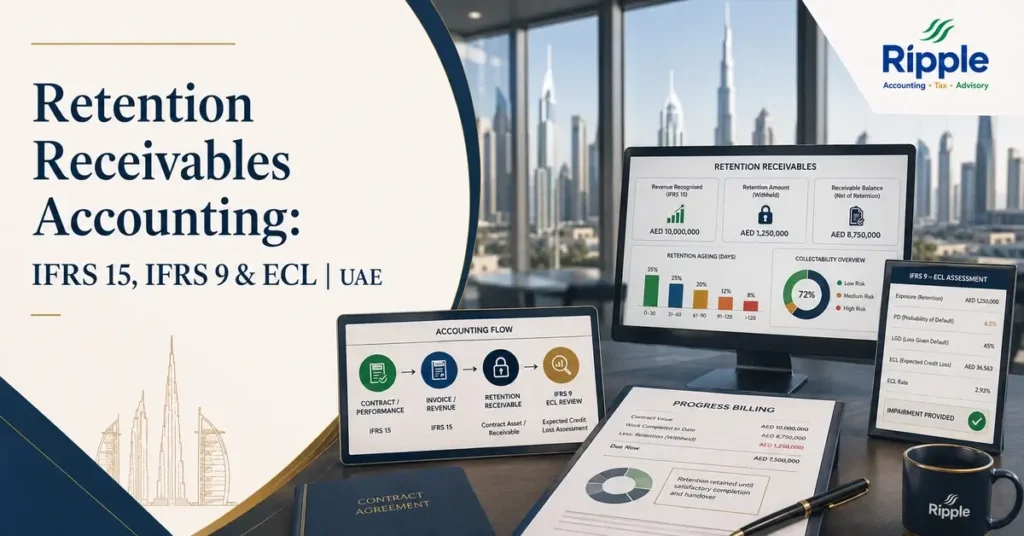 Compliance
A construction company may complete work and earn revenue, yet still have part of its payment withheld by the customer as retention.…
Read articlePage 15 of 45
Book a free consultation and get clear answers for your business.
0 Comments