UAE Corporate Tax Penalties: Registration, Filing and Payment
Have you missed a UAE Corporate Tax deadline and are unsure which penalty may apply to your business? UAE Corporate Tax compliance…
Read article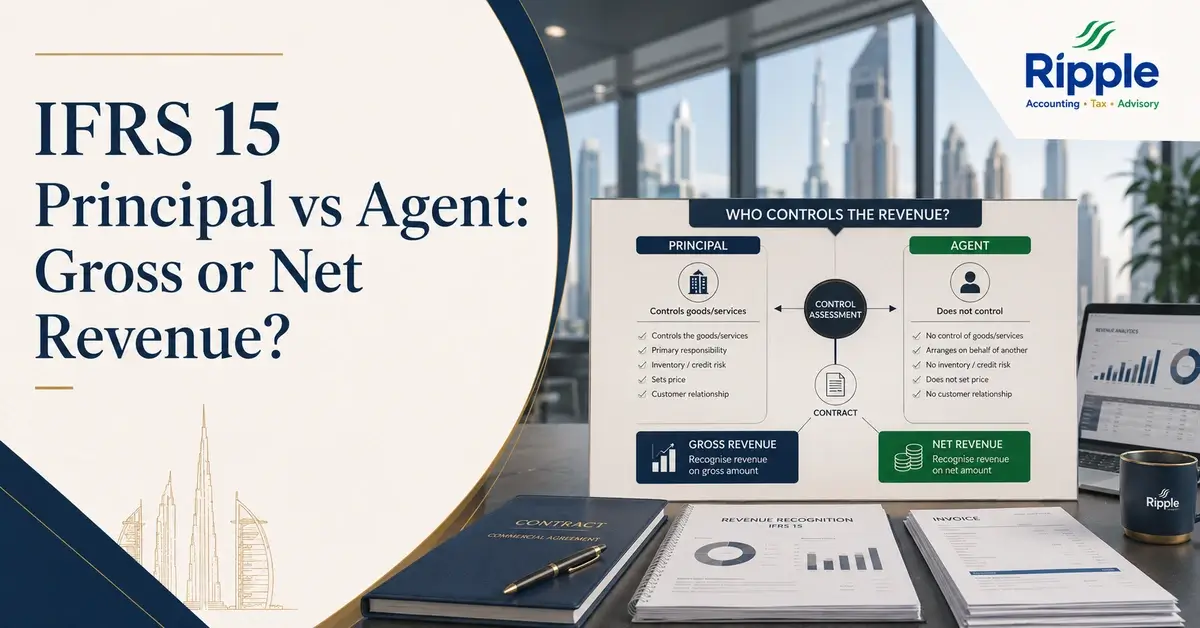
Should a UAE platform report the full customer payment as revenue or only its commission?
Under IFRS 15 principal vs agent rules, the answer depends on whether the platform controls the specified good or service before it is transferred to the customer. This distinction determines whether revenue is generally recognised on a gross or net basis and can directly affect financial reporting and Corporate Tax considerations for UAE platforms.
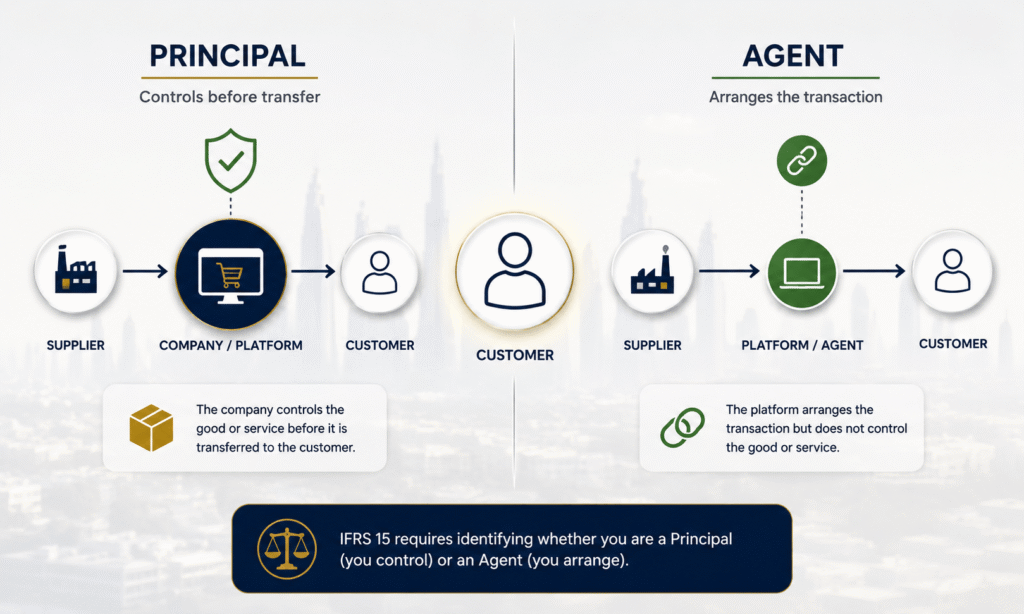
IFRS 15 provides a framework for determining whether an entity acts as a principal or an agent when another party is involved in providing goods or services to a customer.
A platform is generally a principal when it controls the specified good or service before transferring it to the customer. An entity is generally an agent when it arranges for another party to provide the specified good or service and does not control that good or service before transfer.
The IFRS Foundation explains that the assessment starts by identifying the specified goods or services and then determining whether the entity controls each specified good or service before it is transferred to the customer. This framework is contained in paragraphs B34–B38 of IFRS 15. This distinction directly affects revenue presentation.
When the platform is the principal, it recognises revenue for the consideration to which it expects to be entitled for transferring the specified goods or services.
For example, suppose a UAE online platform sells a product to a customer for AED 1,000 and the platform controls the product before transferring it to the customer.
If the platform is the principal:
The AED 1,000 is therefore presented as revenue, rather than merely the AED 250 margin.
If the platform is acting as an agent, it generally reports the amount of its fee or commission as revenue rather than the full amount collected from the customer.
For example, assume a UAE marketplace facilitates a transaction worth AED 1,000 and retains a 10% commission. If the platform is an agent:
The AED 1,000 may pass through the platform’s payment system, but that does not automatically make AED 1,000 the platform’s revenue.
The difference between gross and net revenue can be substantial. Imagine two UAE platforms each facilitate AED 10 million of customer transactions.
Both businesses may facilitate the same transaction volume, but their reported revenue can be dramatically different. This affects:
Therefore, a platform should not determine its accounting treatment simply by looking at the amount deposited into its bank account.
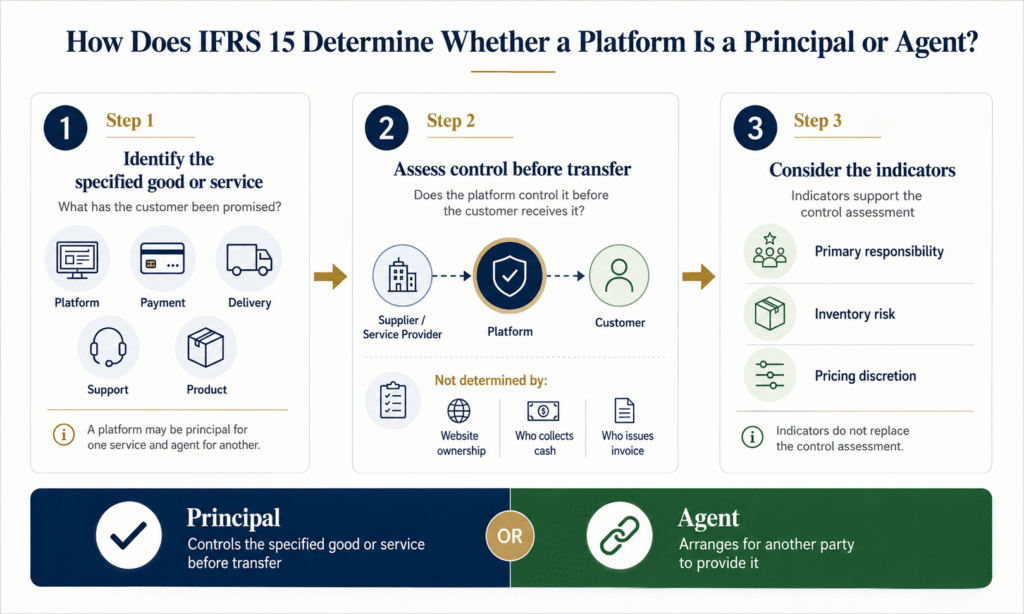
The first step is to identify what the customer has actually been promised. A platform may provide more than one service. For example, an online marketplace might provide:
Each specified good or service needs to be considered appropriately. This is important because a platform could potentially be a principal for one service and an agent for another.
The IFRS Foundation’s guidance specifically explains that an entity assesses the nature of its promise and identifies the specified goods or services before applying the principal-versus-agent assessment.
After identifying the specified good or service, the platform considers whether it controls that item before it is transferred to the customer. This is the central principle under IFRS 15.
Control is not necessarily determined by:
Instead, the analysis focuses on whether the platform controls the specified good or service before transferring it to the customer.
IFRS 15 includes indicators that can help an entity evaluate whether it controls a specified good or service. Important indicators include whether the platform:
These indicators are not a substitute for the underlying control assessment. The IFRS Foundation has also emphasised that entities need to apply judgement within the overall framework of paragraphs B34–B38.
Consider a UAE food-delivery platform. If the platform promises customers that it will provide the food delivery service and is primarily responsible for ensuring that the customer’s order is fulfilled, this may provide evidence relevant to the principal assessment.
However, the existence of customer-facing responsibility alone does not automatically prove that the platform is the principal. The complete control assessment remains necessary.
Inventory risk can be particularly relevant to e-commerce platforms. For example, if a platform purchases products before selling them to customers and is exposed to the risk that the products may remain unsold, become obsolete or require discounting, this may provide evidence supporting a principal conclusion.
By contrast, a marketplace that simply connects independent sellers with customers may have little or no inventory risk.
Pricing discretion can also provide evidence. Suppose a platform purchases a product from a supplier and independently determines the selling price offered to customers. This may support the conclusion that the platform has characteristics of a principal.
However, pricing discretion by itself does not automatically establish control. It should be evaluated alongside the other relevant facts.
A UAE marketplace lists products from independent sellers. A customer pays AED 500 for a product. The seller is responsible for supplying the product, while the platform retains a 12% commission.
If the platform does not control the product before it is transferred to the customer and its promise is to arrange for the seller to provide the product, the platform may be acting as an agent.
The platform’s revenue could therefore be:
AED 500 × 12% = AED 60
The AED 60 commission would generally be the relevant revenue amount rather than the full AED 500.
Now assume a UAE company purchases products from suppliers, controls those products and subsequently sells them to customers through its own digital platform.
The company may be acting as principal because it controls the specified goods before transfer to the customer.
If the customer pays AED 500, the company may therefore recognise AED 500 as revenue, with the related cost of sales recognised separately.
Software arrangements can be particularly complex. The IFRS Interpretations Committee has considered a software reseller fact pattern under IFRS 15 and confirmed that the reseller needs to apply judgement in assessing whether it is a principal or agent, including considering the relevance of the indicators to the assessment of control.
For a UAE software reseller, the analysis should therefore consider the contractual arrangement, the nature of the software licence or service, customer rights, responsibility for fulfilment and other relevant facts.
Suppose a UAE travel platform allows customers to book hotels through its website. The customer pays AED 2,000 for a hotel booking, while the platform receives a 10% commission from the hotel.
If the platform is arranging for the hotel to provide the accommodation service and does not control the accommodation before transfer, the platform may be an agent. Its revenue may therefore be the AED 200 commission rather than the AED 2,000 booking value.
A UAE platform can use the following high-level framework when reviewing an arrangement:
Customer contract → Identify specified good/service → Determine whether platform controls it before transfer → Assess principal/agent indicators → Determine revenue presentation
If the platform controls the specified good or service:
Principal → Gross revenue presentation
If the platform does not control the specified good or service and instead arranges for another party to provide it:
Agent → Net fee/commission revenue
This should not be treated as a mechanical checklist. Contracts can contain multiple promises and different specified goods or services, so professional judgement may be necessary.
The principal-versus-agent conclusion can also have implications for UAE Corporate Tax because financial reporting and accounting income form an important part of determining taxable income.
The UAE Federal Tax Authority states that taxable income is determined from accounting net profit or loss after applying the relevant Corporate Tax adjustments.
The FTA’s Accounting Standards and Interaction with Corporate Tax guidance states that taxable persons use accounting standards accepted in the UAE for Corporate Tax purposes. It identifies IFRS and, where the applicable conditions are met, IFRS for SMEs.
The UAE Ministry of Finance’s Ministerial Decision No. 114 of 2023 on the Accounting Standards and Methods for the Purposes of Corporate Tax is also directly relevant. The decision addresses the accounting standards and methods used for Corporate Tax purposes.
The FTA also confirms that IFRS is the most frequently used accounting standard in the UAE for Corporate Tax purposes. (Federal Tax Authority)
If a platform incorrectly records gross revenue when it should report only commission revenue, its financial statements may materially overstate revenue. Conversely, recording only a commission when the entity is actually the principal could understate reported revenue and distort the financial statements.
For UAE businesses, the accounting records supporting the Corporate Tax return should therefore be consistent with the applicable accounting framework and properly supported by documentation.
The FTA also states that taxpayers should maintain documents and records supporting information included in their Corporate Tax filings.
A principal-versus-agent conclusion should be supported by evidence rather than being based solely on management’s interpretation.
Useful documentation can include:
A documented accounting position can also make discussions with external auditors and tax advisers more efficient.
Therefore, the analysis should be performed at the appropriate specified-good-or-service level.
For UAE platforms, marketplaces, resellers and intermediary businesses, determining whether revenue should be presented gross or net can require a detailed review of contracts, transaction flows and accounting policies.
Ripple Accounting can support UAE businesses with accounting and bookkeeping, financial reporting, Corporate Tax compliance, and related accounting advisory requirements. Ripple’s services are designed to help UAE businesses maintain accurate records and remain aligned with applicable UAE compliance requirements.
Contact Ripple Accountant for a review of your revenue model and accounting treatment!
No. A platform is not automatically an agent. IFRS 15 requires the entity to determine whether it controls the specified good or service before transferring it to the customer.
Gross revenue generally reflects the consideration recognised by a principal for transferring the specified good or service. An agent generally recognises its fee or commission as revenue.
No. The amount of money collected from customers does not, by itself, determine whether the platform is a principal. The control assessment under IFRS 15 is fundamental.
Yes. Where a platform provides multiple specified goods or services, the principal-agent assessment may differ between those services.
Not necessarily. Inventory risk and pricing discretion are indicators that help assess control. They should be considered within the overall IFRS 15 principal-versus-agent framework.
UAE Corporate Tax calculations use accounting information prepared under accepted accounting standards, subject to the relevant tax adjustments. Correct revenue recognition therefore contributes to reliable financial reporting and the appropriate starting point for determining taxable income.
For UAE platforms, the question of gross or net revenue under IFRS 15 cannot be answered simply by looking at customer collections or transaction volume. The critical issue is whether the platform controls the specified good or service before it is transferred to the customer. A principal generally recognises the relevant consideration as gross revenue, while an agent generally recognises its fee or commission.
Disclaimer: This article is provided for general informational and educational purposes only and should not be treated as legal, tax, accounting or audit advice. UAE businesses should obtain professional advice before finalising revenue recognition policies or Corporate Tax treatment. Always refer to the latest legislation, regulations, official UAE government guidance, and applicable IFRS requirements before making a compliance or reporting decision.
Tell us a little about your business and our UAE tax experts will get back to you with clear, practical answers — no obligation.
 Corporate Tax
Have you missed a UAE Corporate Tax deadline and are unsure which penalty may apply to your business? UAE Corporate Tax compliance…
Read article Compliance
Could your UAE business need to prove its tax residency to a foreign tax authority before receiving cross-border tax benefits? A UAE…
Read article VAT
VAT
Has your UAE business accumulated more recoverable input VAT than output VAT, and are you unsure whether you can claim the difference…
Read articlePage 1 of 45
Book a free consultation and get clear answers for your business.
0 Comments