VAT Return Filing Deadline in UAE: Quarterly and Monthly Rules
M Maria November 6, 2026 14 min read
Does your business know when its next VAT return is due, and whether it follows a monthly or quarterly filing schedule?
VAT-registered businesses in the UAE must submit their returns and settle any payable VAT within the prescribed timeframe. However, the filing schedule is not identical for every business. The Federal Tax Authority (FTA) assigns tax periods according to the applicable requirements, and businesses must follow their assigned reporting dates.
Understanding the VAT Return Filing Deadline in UAE is important for avoiding late submissions, managing tax payments and maintaining accurate compliance records. This guide explains monthly and quarterly VAT filing rules, how to calculate deadlines, which documents to prepare and how to submit returns through EmaraTax.
Let’s learn more about it!
What Is the VAT Return Filing Deadline in UAE?
A VAT return filing deadline in UAE is the final date by which a VAT-registered business must submit its tax return to the FTA for an assigned tax period.
Under the UAE VAT framework, businesses generally have 28 days from the end of their tax period to submit the VAT return and pay any VAT due.
A tax period is the specific reporting period during which a registered business calculates its output VAT, recoverable input VAT and resulting tax liability.
For example, a business with a quarterly tax period ending on 31 March must generally submit its return and settle the payable amount by 28 April.
The deadline applies even when the business has no sales or purchases during the reporting period. A registered business must generally submit a nil VAT return where no transactions have taken place.
Businesses should also check their EmaraTax accounts for the actual filing date assigned by the FTA. Specific instructions or deadline announcements from the Authority should take precedence over a general calendar.
How Do Monthly and Quarterly VAT Filing Periods Work in the UAE?
The FTA determines the tax period applicable to each registered business. Monthly and quarterly reporting are the two common filing arrangements. The standard tax period is generally three calendar months, although the FTA may assign a different period to certain businesses.
A. Quarterly VAT Filing
Quarterly VAT filing means that a business reports its VAT-related transactions for a three-month period in one return. It is commonly used by businesses with lower annual turnover and relatively straightforward reporting requirements.
The UAE Government’s VAT guidance identifies the following general arrangement:
Businesses with annual turnover below AED 150 million generally have quarterly tax periods.
Businesses with annual turnover of AED 150 million or more generally have monthly tax periods.
However, these are general arrangements, not a substitute for checking the tax period actually assigned by the FTA. The Authority may determine a different reporting period depending on the business’s circumstances.
Example of quarterly VAT filing:
A business assigned the January–March tax period must report its relevant transactions for all three months in one VAT return.
Particulars
Details
Tax period starts
1 January
Tax period ends
31 March
Return submission deadline
28 April
VAT payment deadline
28 April
The business should prepare its invoices, purchase records, accounting reports and VAT calculations before the deadline.
B. Monthly VAT Filing
Monthly VAT filing requires a registered business to prepare and submit a separate return for each calendar month.
The FTA may assign monthly periods to businesses that meet the relevant turnover criteria or where a different tax period is required.
For example, a business assigned a monthly period for January must report the transactions made during January rather than combining them with the following months.
Example of monthly VAT filing:
Particulars
Details
Tax period starts
1 January
Tax period ends
31 January
Return submission deadline
28 February
VAT payment deadline
28 February
Monthly reporting requires more frequent accounting reviews and VAT reconciliations. Businesses should therefore maintain updated transaction records throughout the month rather than waiting until the reporting period ends.
C. Monthly vs Quarterly VAT Filing: Key Differences
Requirement
Monthly VAT filing
Quarterly VAT filing
Reporting frequency
Every month
Every three months
Transaction review
Monthly
Every three months
Return preparation
One return per month
One return per quarter
General deadline
Within 28 days after period end
Within 28 days after period end
Accounting workload
More frequent
Less frequent
Cash flow monitoring
More regular
Less frequent reporting
Neither filing arrangement removes the requirement to maintain accurate VAT records and submit returns on time.
Businesses should follow the tax period shown in their FTA account rather than choosing a filing schedule based on convenience.
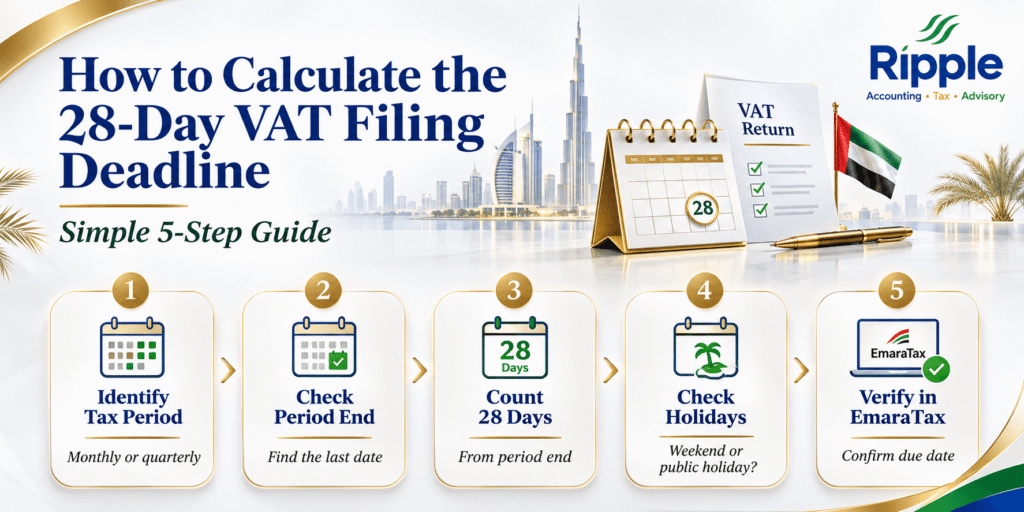
How to Calculate the 28-Day VAT Filing Deadline
The general deadline calculation is straightforward once the assigned tax period is identified. Businesses should follow these steps:
Step 1: Identify the assigned tax period
Check whether your business follows a monthly or quarterly reporting schedule.
Step 2: Confirm the last date of the reporting period
Identify the final day covered by the VAT return.
Step 3: Calculate the 28-day deadline
The return must generally reach the FTA within 28 days following the end of the relevant tax period.
Step 4: Check weekends and public holidays
Where the applicable deadline falls on a weekend or national holiday, the deadline is extended to the first business day thereafter under the relevant FTA guidance.
Step 5: Confirm the date in EmaraTax
Check the Required Actions section of your account to verify the actual submission and payment dates.
Practical VAT Filing Deadline Examples
The following examples illustrate how the 28-day rule generally applies.
Tax period
Period ending
General filing deadline
January 2027
31 January 2027
28 February 2027
February 2027
28 February 2027
28 March 2027
March 2027
31 March 2027
28 April 2027
April–June 2027
30 June 2027
28 July 2027
July–September 2027
30 September 2027
28 October 2027
These dates are illustrative calculations. A weekend, public holiday or specific FTA deadline instruction may change the applicable submission date.
Businesses should not rely exclusively on online calendars when their EmaraTax account provides a different deadline.
What Documents Should Businesses Prepare Before the Filing Deadline?
Preparing the required documents early helps businesses complete their VAT returns accurately and avoid last-minute filing problems. The supporting records should cover all relevant sales, purchases, imports and other VAT-related transactions during the assigned tax period.
The following documents are commonly required for VAT return preparation:
Document
Why it is important
Sales tax invoices
Verify taxable sales and output VAT
Purchase tax invoices
Support eligible input VAT recovery
Credit and debit notes
Identify adjustments to previous transactions
Monthly sales reports
Reconcile recorded revenue and taxable supplies
Purchase and expense reports
Review business expenses and input VAT
Bank statements
Compare recorded receipts and payments
Import and customs documents
Verify relevant import transactions
Export documentation
Support qualifying zero-rated supplies
General ledger
Review VAT-related accounting entries
Trial balance
Identify discrepancies in account balances
Previous VAT returns
Check earlier declarations and outstanding adjustments
Businesses should also review transactions subject to the reverse charge mechanism and any relevant VAT adjustments.
Why Is Document Reconciliation Important?
A business may have issued all its sales invoices but still report incorrect VAT if some transactions are missing from its accounting system.
For example, duplicate purchase entries or unrecorded credit notes can affect the amount of output VAT or recoverable input VAT reported in the return.
Reconciliation helps identify these discrepancies before submission.
Businesses must submit their VAT returns electronically through the FTA’s EmaraTax platform. The VAT201 return includes details of taxable supplies, output VAT, recoverable input VAT, imports, reverse-charge transactions and other applicable adjustments.
The general filing process involves the following steps.
Step 1: Log In to EmaraTax
Access the official FTA EmaraTax portal using the authorised account credentials.
Select the relevant taxable person or business profile.
Step 2: Open the VAT Return Section
Navigate to the VAT section and select the applicable VAT return for the reporting period.
Check the displayed tax period and submission deadline before proceeding.
Step 3: Enter Sales and Output VAT Information
Report the relevant sales and other output transactions according to their VAT treatment.
This may include:
Standard-rated supplies.
Zero-rated supplies.
Exempt supplies.
Supplies subject to the reverse charge mechanism.
Relevant imported goods and adjustments.
Ensure that the figures agree with the sales ledger and supporting invoices.
Step 4: Enter Purchase and Input VAT Information
Review the purchase invoices and expenses for which input VAT recovery is permitted.
Only claim VAT that meets the applicable recovery conditions.
Businesses should not automatically claim every amount of VAT appearing in their expense records.
Step 5: Review the Net VAT Position
The net VAT liability is generally calculated by deducting recoverable input VAT from output VAT.
For example:
Particulars
Amount (AED)
Output VAT
65,000
Recoverable input VAT
24,000
Net VAT payable
41,000
The business must pay AED 41,000 by the applicable deadline, assuming no other adjustments affect the calculation.
Step 6: Review and Submit the Return
Check all mandatory fields, confirm the figures and complete the declaration.
Submit the return through EmaraTax and retain the submission acknowledgement.
Step 7: Pay the VAT Due
If the return shows a payable amount, arrange payment within the prescribed period.
Retain the payment confirmation and verify that the transaction has been reflected in the FTA account.
What Happens If a Business Misses the VAT Return Filing Deadline in UAE?
Missing a VAT return filing deadline in UAE can result in administrative penalties and additional compliance responsibilities. The applicable penalties should be checked against the current UAE administrative penalty framework rather than older articles that may contain outdated rates.
Under Cabinet Decision No. 40 of 2017, as amended by Cabinet Decision No. 129 of 2025, the updated penalty framework became effective on 14 April 2026.
A. Penalty for Late VAT Return Submission
The penalty for failing to submit a tax return within the prescribed timeframe is:
Violation
Administrative penalty
First occurrence
AED 1,000
Repetition within 24 months
AED 2,000
The penalty applies to the late submission of the tax return.
B. Penalty for Late VAT Payment
Late payment is a separate violation. Under the amended framework, the penalty is calculated at 14% per annum on the unsettled payable tax amount, for each month or part of a month, starting from the day following the payment deadline.
For example, a business that submits its return on time but fails to settle the payable VAT by the deadline may still face a late payment penalty.
C. Other Compliance Consequences
Missing a filing deadline may also lead to additional issues, including:
FTA follow-up and compliance notifications.
Tax assessments where the required return has not been submitted.
Additional administrative work to correct outstanding obligations.
Difficulties maintaining an accurate tax compliance record.
Importantly, paying an administrative penalty does not remove the obligation to pay the underlying VAT liability.
What If There Are No Transactions During the VAT Tax Period?
A VAT-registered business may still have a filing obligation even if it has not made any sales or purchases during a reporting period.
In such circumstances, it generally needs to submit a nil VAT return through EmaraTax. A nil return indicates that there are no relevant amounts to report for the applicable period.
This requirement is important for:
Newly established businesses.
Seasonal businesses.
Companies temporarily not trading.
Businesses waiting for commercial operations to begin.
Registered entities with no taxable transactions during a particular period.
Not having business activity does not automatically cancel VAT registration or remove the return submission obligation.
If a business no longer meets the conditions for remaining registered, it should separately assess whether VAT deregistration is required.
How Can Businesses Avoid Missing VAT Return Deadlines?
An organised filing process helps businesses avoid late submissions and incomplete returns. Instead of preparing all financial information immediately before the deadline, finance teams should maintain a regular reporting routine.
Maintain an Internal VAT Compliance Calendar
Create a calendar that records:
Assigned tax period.
Tax period closing date.
Internal document collection deadline.
VAT reconciliation date.
Management review date.
Final return submission date.
VAT payment date.
Businesses should set internal deadlines several working days before the statutory due date.
Reconcile Accounts Regularly
Review sales, purchases, bank transactions and VAT control accounts throughout the reporting period.
A designated employee or finance professional should be responsible for monitoring filing dates, preparing supporting records and checking submission status.
For larger businesses, management should also review the return before it is submitted.
Maintain Evidence of Submission and Payment
Save the following records after every filing:
Submitted VAT return.
FTA submission acknowledgement.
Payment confirmation.
VAT calculation workings.
Supporting invoices and accounting reports.
These records help businesses respond to future FTA queries and maintain a reliable compliance history.
How Ripple Accounting, Tax & Advisory Can Help With VAT Return Filing
Managing VAT returns requires consistent financial record-keeping, accurate tax calculations and attention to the deadlines assigned by the FTA. For businesses following monthly or quarterly reporting schedules, these responsibilities can become more demanding as transaction volumes increase.
Reviewing assigned VAT tax periods and upcoming filing dates.
Preparing sales and purchase records for VAT reporting.
Reconciling output VAT and recoverable input VAT.
Reviewing tax invoices, credit notes and supporting documents.
Preparing VAT calculations and return information.
Supporting EmaraTax submission and payment procedures.
Reviewing previous filing issues and outstanding compliance requirements.
Whether your business files monthly or quarterly, maintaining an organized reporting process can help reduce avoidable delays and improve the accuracy of VAT declarations.
VAT returns must generally be submitted within 28 days following the end of the assigned tax period. Any VAT payable must also be settled within the applicable deadline. Businesses should confirm the actual date through EmaraTax.
2. Is VAT filing monthly or quarterly in the UAE?
The FTA commonly assigns quarterly tax periods to businesses with annual turnover below AED 150 million and monthly periods to businesses with annual turnover of AED 150 million or more. However, the FTA determines the actual tax period, and businesses should follow their assigned schedule.
3. Can the FTA change a business’s VAT filing period?
Yes. The FTA has the authority to assign a different tax period where applicable. Businesses should check their EmaraTax account and official FTA notifications for changes to their reporting schedule.
4. Do businesses need to submit VAT returns if they have no sales?
Yes. VAT-registered businesses generally need to submit nil VAT returns when they have no transactions to report during an assigned tax period. A period without sales does not automatically remove the filing obligation.
5. What is the penalty for late VAT return filing in the UAE?
Under the amended penalty framework effective from 14 April 2026, the penalty is AED 1,000 for the first late return and AED 2,000 for a repeated violation within 24 months. Late payment of VAT is subject to a separate penalty calculated at 14% per annum on unpaid tax for each month or part thereof.
6. Can I pay VAT after submitting my return?
A business may submit its return and arrange payment separately, but both obligations must generally be completed within the same prescribed deadline. Delaying payment beyond that date can result in a late payment penalty.
Conclusion
Understanding the assigned tax period and calculating the filing date correctly are essential parts of UAE VAT compliance. Businesses should check whether they follow monthly or quarterly reporting, prepare supporting documents throughout the period and allow sufficient time for reconciliations before submitting their returns. The VAT Return Filing Deadline in UAE is generally 28 days after the end of the assigned tax period, with any applicable VAT payment due within the same timeframe.
For professional assistance with VAT return preparation, filing and compliance reviews, contact Ripple Accounting, Tax & Advisory.
Disclaimer: This article provides general information about UAE VAT filing requirements and is not individual tax advice. Tax periods, filing deadlines and administrative penalties are subject to applicable UAE legislation and FTA instructions. Businesses should verify their specific obligations through EmaraTax and the official FTA guidance before taking action.
The UAE Federal Tax Authority (FTA) has introduced important amendments to the Marking Tobacco and Tobacco Products Scheme through Federal Tax Authority…




0 Comments