VAT Registration in UAE: Required Documents & Checklist
M Maria October 20, 2026 13 min read
Are you planning to register your business for VAT in the UAE but unsure which documents you need to prepare?
VAT registration in UAE is an important compliance requirement for businesses that meet the applicable registration criteria. While the process is completed online through the Federal Tax Authority (FTA), accurate financial records, valid business documents and supporting evidence are essential for a smooth application.
In this guide, you’ll learn about the required documents, eligibility criteria, registration process and common mistakes to avoid, along with how Ripple Accountants can provide professional support throughout your VAT registration journey.
Let’s start with the basic requirements.
What Is VAT Registration in UAE?
VAT registration is the process through which an eligible business registers with the Federal Tax Authority to obtain a Tax Registration Number (TRN).
Once registered, a business must comply with the applicable VAT requirements, including issuing appropriate tax invoices, maintaining records, submitting VAT returns and paying any VAT due.
The UAE generally applies Value Added Tax at a standard rate of 5%, although certain supplies are zero-rated or exempt.
VAT registration may be mandatory or voluntary depending on the business’s taxable supplies, imports and other applicable criteria.
The FTA processes VAT registration applications through its digital tax administration platform, EmaraTax.
Before gathering documents, businesses should determine whether VAT registration is mandatory or whether voluntary registration is available.
Mandatory VAT Registration
A UAE-resident business is generally required to register when:
Its taxable supplies and imports exceed AED 375,000 during the previous 12 months; or
It expects taxable supplies and imports to exceed AED 375,000 during the next 30 days.
Taxable supplies generally include both standard-rated and zero-rated supplies. Exempt supplies are normally excluded from taxable turnover calculations.
For example, a consultancy generating AED 410,000 in taxable supplies over the previous 12 months would generally meet the mandatory registration threshold.
The business should establish when the registration obligation arose and calculate its application deadline.
Non-resident businesses may have different registration requirements, including mandatory registration without a turnover threshold where no other person is responsible for accounting for the UAE VAT.
Voluntary VAT Registration
A UAE-resident business that does not meet the mandatory registration criteria may qualify for voluntary registration when its relevant taxable supplies and imports, or taxable expenses, exceed AED 187,500 during the previous 12 months or are expected to exceed that threshold within the next 30 days.
Voluntary registration may be relevant for startups with substantial qualifying expenses or businesses seeking to recover eligible input VAT.
However, registration also introduces VAT reporting and recordkeeping obligations.
The documents required for VAT registration in UAE depend on the applicant’s legal structure, business activities and grounds for registration. A mainland LLC, free zone company, sole establishment or other legal entity may have different supporting-document requirements.
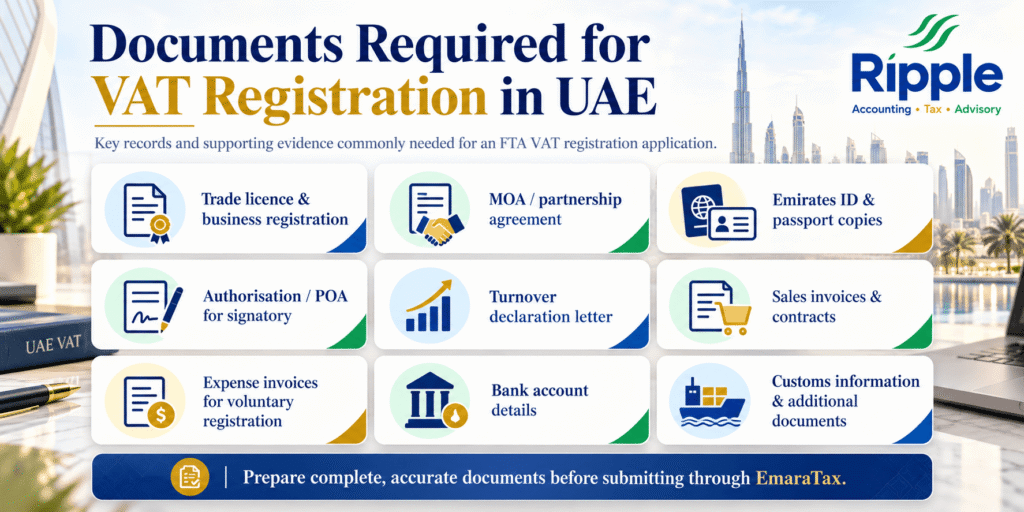
The following checklist covers the principal documents identified in the FTA’s registration service guidance.
1. Valid Trade Licence and Business Registration Documents
The FTA generally requires documents establishing the applicant’s legal identity and business activities.
These may include:
Valid trade licence or business licence.
Commercial registration certificate.
Certificate of incorporation.
Branch licences, where applicable.
Other official documentation issued by the relevant licensing authority.
The documents should reflect the company’s current legal name, licence number and registered activities.
For companies operating multiple branches, relevant branch details should also be prepared.
2. Memorandum of Association or Partnership Agreement
Depending on the business structure, the applicant may need to provide its Memorandum of Association (MOA), partnership agreement or equivalent constitutional documents.
These documents help establish the entity’s ownership, management and legal arrangements.
Before submission, check whether the information matches the company’s current official records.
If ownership or management details have changed, the relevant supporting documents should reflect those changes.
3. Emirates ID and Passport Copies
Businesses should prepare valid identification documents for the relevant owners and authorised signatories.
The FTA lists the following among its registration requirements:
Emirates ID copies.
Passport copies.
Identification details of owners.
Identification details of authorised signatories.
The documentation required may depend on the applicant’s legal form and the individuals associated with the application.
Names, identification numbers and expiry dates should be checked carefully.
Expired or inconsistent identification documents may create additional verification requirements.
4. Authorisation Documents for the Signatory
The person submitting or signing the VAT registration application must have the appropriate authority.
A Power of Attorney (POA) or another acceptable authorisation document may be necessary where the signatory’s authority is not established through the company’s constitutional documents.
For example, the FTA may require a POA when the manager is not identified in the MOA or when additional authorised signatories are appointed.
Businesses should confirm the authority of the relevant individual before submitting the application.
5. Turnover Declaration Letter
A turnover declaration is one of the most important documents supporting VAT registration.
According to the FTA’s registration requirements, businesses must provide an official declaration identifying their total taxable supplies and monthly sales from establishment until the application date.
The declaration should be signed and stamped by the authorised signatory.
Businesses should prepare a clear monthly breakdown supported by reliable accounting records.
The information should generally distinguish relevant categories of supplies so that the VAT registration threshold can be assessed correctly.
For example:
Month
Taxable supplies
January
AED 42,000
February
AED 55,000
March
AED 48,000
April
AED 61,000
Total
AED 206,000
Illustrative figures only.
This example shows a partial turnover record. The actual registration assessment must consider the relevant rolling 12-month period and, where applicable, the next 30-day forecast.
Businesses should not confuse accounting profit with taxable turnover.
A company may report limited profits while still exceeding the VAT registration threshold because its taxable sales are substantially higher.
6. Sales Invoices, Contracts and Supporting Evidence
The FTA may require supporting documentation demonstrating the business’s taxable supplies.
Depending on the business activities and application, relevant evidence may include:
Sales invoices.
Local purchase orders.
Customer contracts.
Completion certificates.
Ownership documents.
Lease agreements.
Other records supporting the declared business transactions.
These documents help establish that the figures submitted in the application are supported by genuine transactions.
The supporting evidence should be consistent with the turnover declaration and relate to the appropriate period.
For businesses applying on the basis of expected revenue, signed contracts and purchase orders may be particularly important.
7. Expense Invoices for Voluntary Registration
A business seeking voluntary registration based on taxable expenses must provide sufficient evidence supporting those expenses.
The FTA’s service requirements specify at least five tax invoices supporting the relevant expense threshold, where applicable.
These invoices should demonstrate qualifying expenses and meet the relevant documentation requirements.
Businesses should distinguish expenses subject to VAT from exempt expenses, non-business expenditure and amounts that do not qualify for the relevant registration test.
For example, a new professional services company may incur substantial VAT-bearing startup expenditure before generating significant sales.
Such expenditure could support voluntary registration where the applicable requirements are satisfied.
However, businesses should not assume that every startup cost qualifies.
8. Bank Account Details
The FTA identifies a bank letter containing account information as an optional document for VAT registration.
Where bank details are provided:
A legal entity’s account should be in the company’s name.
An individual may provide an eligible personal or sole establishment account.
Businesses should ensure the account information is accurate.
Additional banking information may be relevant for subsequent tax refund procedures.
9. Customs Information and Additional Documents
Businesses involved in importing goods should prepare their customs information where applicable.
Additional documentation may be required for particular applicants, including government entities, charities, clubs or associations.
A business operating in a VAT Designated Zone may also need to demonstrate its supply chain, business activities and movement of goods.
Because requirements differ according to the legal structure and activity, the FTA may request supporting information beyond the standard checklist.
Create an account or sign in using the available authentication method.
Step 2: Create a Taxable Person Profile
From the dashboard, establish the appropriate taxable person profile.
Enter the company’s legal details and information relevant to its business structure.
Step 3: Select VAT Registration
Access the taxable person account and select the VAT registration service.
Complete the required application sections.
Step 4: Enter Business and Financial Information
Provide the required details concerning ownership, activities, taxable supplies, imports and registration eligibility.
Ensure that the declared figures agree with the supporting records.
Step 5: Upload Supporting Documents
Attach the requested documents in the prescribed format.
The FTA’s VAT registration service currently specifies PDF attachments, with a maximum file size of 15 MB per document.
Check that all submitted documents are legible and complete.
Step 6: Review and Submit
Review the application carefully before submission.
Once submitted, monitor the EmaraTax account for additional information requests or an FTA decision.
If the application is approved, the registration certificate and TRN become available through the taxpayer’s account.
Common Mistakes to Avoid During VAT Registration
Incorrect Turnover Calculations: Using only standard-rated sales while overlooking zero-rated supplies can produce an inaccurate eligibility assessment. Businesses should classify transactions correctly and review the full relevant period.
Submitting Unsupported Financial Figures:A turnover declaration should agree with sales invoices and other supporting records. Estimated figures without appropriate evidence may result in further FTA questions.
Uploading Outdated Company Documents: Expired licences, incorrect ownership details or outdated signatory information can create verification problems.
Selecting the Wrong Registration Basis:Businesses should distinguish mandatory registration from voluntary registration. The supporting evidence required may differ according to the chosen basis.
Missing the Registration Deadline: Some businesses focus on obtaining documents but fail to monitor when the registration obligation arises. Maintaining a monthly VAT eligibility review can help reduce this risk.
VAT Registration Checklist Before Submission
Before applying, review the following checklist:
Confirm whether mandatory or voluntary registration applies.
Review taxable supplies and imports for the previous 12 months.
Assess any relevant next 30-day forecast.
Prepare the valid trade licence and incorporation documents.
Verify owners’ and authorised signatories’ identification.
Obtain the appropriate authorisation documents.
Prepare a signed and stamped turnover declaration.
Organise invoices, contracts and supporting records.
Prepare expense evidence where relevant.
Check customs and additional sector-specific information.
Confirm the registration deadline.
Review all information before submitting through EmaraTax.
A complete checklist can reduce avoidable document requests and make the process easier to manage.
How Ripple Accountants Can Help with VAT Registration in UAE
Preparing a VAT registration application involves more than uploading a trade licence and entering financial information.
Businesses must determine their registration obligations, classify transactions and provide accurate evidence supporting their application.
VAT eligibility assessment: Reviewing turnover and identifying relevant registration requirements.
Document preparation: Organising corporate records, identification documents and financial evidence.
Turnover review: Checking taxable supplies, imports and supporting invoices.
EmaraTax application assistance: Helping prepare and submit the registration application.
Ongoing VAT support: Assisting businesses with VAT recordkeeping, return preparation and compliance requirements.
Whether you operate a mainland company, free zone business or growing SME, professional support can help you prepare a more accurate application.
Need help with VAT registration in UAE?Book a free VAT registration consultation with Ripple Accountants.
Email: info@uaetaxcompliance.ae
Phone: +971 52 356 5409
WhatsApp: +971 4 250 0833
Contact our team to discuss your VAT eligibility, supporting documents and registration requirements.
Frequently Asked Questions About VAT Registration in UAE
1. What documents are required for VAT registration in UAE?
The common requirements include a valid trade licence, incorporation documents, identification documents for relevant owners and authorised signatories, a turnover declaration and financial evidence supporting the application. Additional documents may be required depending on the applicant’s legal structure and registration basis.
2. Can I register for VAT in UAE without reaching AED 375,000 in sales?
Yes. Eligible UAE-resident businesses may apply for voluntary registration when their relevant taxable supplies, imports or qualifying taxable expenses exceed AED 187,500 during the applicable period, or are expected to do so within the next 30 days. The business must satisfy the relevant conditions.
3. How long does VAT registration take in UAE?
The FTA publishes an estimated processing time of 20 business days from receipt of a completed VAT registration application. Applications requiring clarification or additional supporting documents may take longer.
4. Is VAT registration mandatory for free zone companies?
Free zone businesses are not automatically exempt from VAT registration. Their obligations depend on their taxable supplies, imports, activities and the applicable VAT rules. Businesses in Designated Zones may also need to consider the special VAT treatment of particular transactions.
5. Can a UAE business apply for VAT registration without a trade licence?
Potentially, yes. The FTA states that VAT registration provisions can apply to natural or legal persons carrying out economic activities even where they do not hold a trade licence. Such applicants must provide appropriate evidence of their activities and satisfy the relevant registration conditions.
Conclusion
VAT registration in UAE requires accurate financial information, valid business documents and a clear understanding of the applicable eligibility criteria. Preparing the correct documents before submission can help businesses avoid unnecessary complications and respond efficiently to FTA requirements. Most importantly, businesses should monitor their taxable turnover regularly rather than waiting until the end of the financial year. With organised records and the right professional guidance, VAT registration becomes easier to manage.
Disclaimer: This article is intended for general informational purposes only and does not constitute legal, accounting or tax advice. UAE VAT laws, administrative procedures, documentation requirements and FTA guidance may change. Registration obligations depend on the facts and circumstances of each business. Readers should review current official FTA guidance and obtain professional advice before making VAT registration or compliance decisions.
Environmental, Social, and Governance (ESG) reporting has become a critical part of modern corporate reporting. Investors, regulators, customers, and financial institutions increasingly…
Businesses are under constant pressure to process financial data faster, reduce manual work, and improve accuracy. Traditional accounting methods often rely on…
Businesses are expanding beyond domestic markets more than ever before. Companies buy products from overseas suppliers, sell to international customers, receive payments…



0 Comments