Bookkeeping for Real Estate Companies in UAE
The UAE real estate market continues to grow, creating new opportunities for property developers, real estate agencies, brokers, and property management companies.…
Read article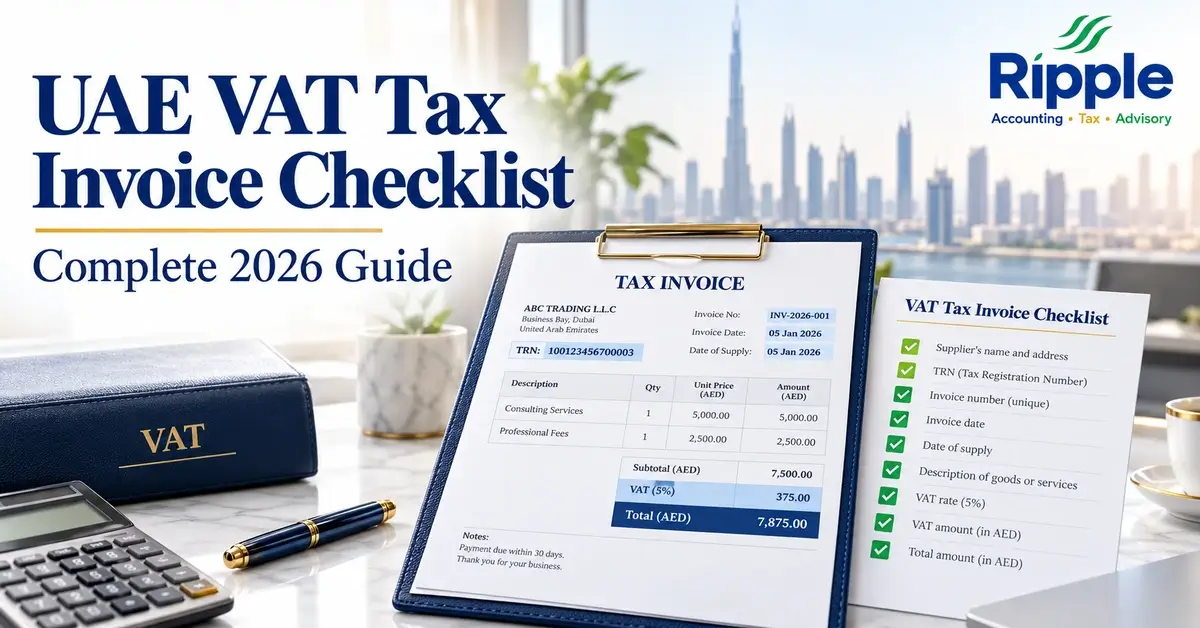
Could one missing detail on your invoice create a UAE VAT compliance problem?
A tax invoice may look like a routine sales document, but for a VAT-registered UAE business it is an important part of the tax record. Missing TRNs, incorrect dates, wrong VAT calculations or using a simplified invoice when a full invoice is required can create problems during VAT reconciliation and review. Understanding the UAE VAT tax invoice requirements therefore matters to business owners, accountants, sellers and finance teams alike.
Now let’s get started to study VAT Tax Invoice Checklist!
A tax invoice is a document issued by a VAT registrant for a taxable supply and containing the information prescribed under UAE VAT legislation.
Article 59 of the UAE VAT Executive Regulation sets out the particulars required on tax invoices. The FTA has clarified that only VAT registrants, who hold a Tax Registration Number or TRN, can issue tax invoices.
A VAT invoice is more than a payment request.
It helps establish:
These details help support VAT reporting and provide an audit trail between invoices, accounting records and VAT returns.
A business registered for UAE VAT is generally required to issue tax invoices in respect of taxable supplies where the VAT legislation requires one.
The first step should therefore be to confirm whether the supplier is VAT registered. The supplier should also assess:
This assessment should ideally happen within the accounting or invoicing workflow rather than after the VAT return is prepared.
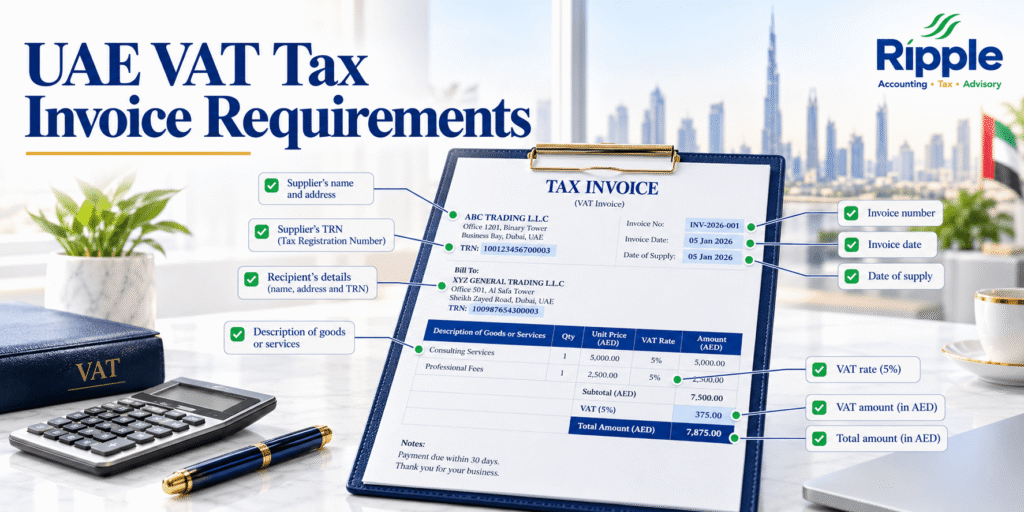
A full tax invoice has more detailed requirements than a simplified tax invoice.
Under Article 59, businesses should review the following particulars when preparing a full tax invoice UAE transaction.
The document should clearly display the words:
Tax Invoice
A commercial document should not be assumed to meet the VAT rules merely because it is titled “Invoice,” “Receipt,” “Bill” or “Pro Forma Invoice.”
The required tax-invoice information must be present.
The invoice should state the supplier’s:
The TRN is particularly important because it identifies the supplier as a VAT registrant.
Businesses should make sure the TRN used on invoice templates matches their VAT registration records.
Where the recipient is VAT registered, the full tax invoice should include the recipient’s:
The VAT status of the customer should therefore be correctly maintained within the accounting or ERP system.
A full tax invoice should contain a sequential tax invoice number or another unique number that identifies the invoice and its position within the invoice sequence.
Examples may include:
Businesses should avoid duplicate invoice numbers and unexplained gaps in their invoicing records.
The date on which the tax invoice was issued should be clearly displayed.
Do not automatically assume that the invoice date is also the date of supply.
Where the date of supply is different from the invoice issue date, the date of supply should also be stated.
This is important because VAT timing obligations are generally linked to the date of supply rules contained in the UAE VAT legislation.
The invoice should clearly identify what was supplied.
For example, descriptions such as:
“Professional Services”
may provide less useful information than a description such as:
“VAT compliance review services – September 2026.”
The description should allow the transaction to be understood and matched to the underlying business activity.
For each relevant good or service, the invoice requirements include information such as:
Article 59 specifically includes these elements within the full invoice particulars.
The invoice lines should reconcile mathematically with the invoice totals.
Where a discount is offered, it should be correctly reflected on the invoice.
The accounting treatment and VAT calculation should correspond with the actual consideration for the supply.
The invoice should correctly show the applicable totals and VAT amount in AED.
Businesses should check that:
This is especially important where an invoice includes multiple products or services with different VAT treatments.
Finance teams can use the following practical checklist before releasing a full tax invoice:
This UAE VAT invoice checklist can be incorporated directly into an invoice approval workflow.
UAE VAT rules allow a simplified tax invoice in certain circumstances.
According to FTA guidance, a simplified tax invoice may generally be issued where:
This format can be particularly relevant to retail or lower-value transactions.
However, businesses should not assume that every low-value transaction automatically qualifies.
The amended Article 59 specifically provides that simplified tax invoices are not permitted where the reverse charge mechanism applies under Article 48, unless the relevant circumstances or an approved administrative exception apply.
The FTA identifies a shorter list of mandatory information for a simplified invoice.
It should contain:
The FTA’s updated Article 59 guidance also confirms that both the total consideration and VAT amount appearing on a simplified tax invoice must be expressed in AED.
A normal cash-register receipt is therefore not automatically a compliant simplified tax invoice.
It must contain the required information.
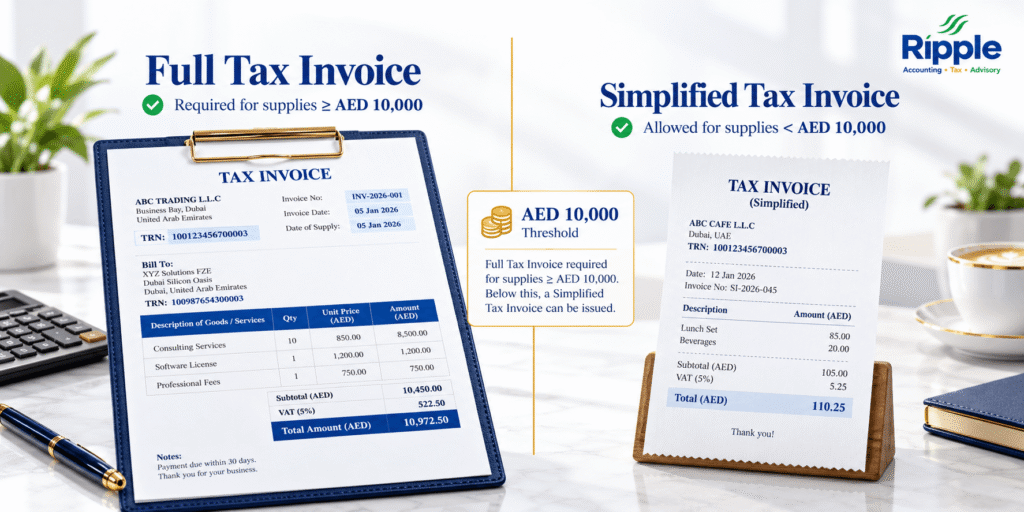
Understanding the difference helps businesses avoid using the wrong VAT invoice format.
| Requirement | Full Tax Invoice | Simplified Tax Invoice |
| “Tax Invoice” wording | Required | Required |
| Supplier details | Required | Required |
| Supplier TRN | Required | Required |
| Recipient details | Required where applicable | Generally not part of the simplified particulars |
| Recipient TRN | Required where recipient is registered | Generally not part of the simplified particulars |
| Unique invoice sequence | Required | Reduced requirements |
| Description | Required | Required |
| Detailed line information | Required | Reduced requirements |
| Total consideration | Required | Required |
| VAT amount | Required | Required |
| Suitable for all taxable transactions | Subject to applicable rules | No |
The transaction circumstances—not convenience—should determine which invoice type is used.
Timing is a particularly important part of the UAE tax invoice requirements.
Registrants are generally required to issue the relevant tax invoice within 14 days from the date of supply, as determined under the VAT Decree-Law.
However, the amended Executive Regulation introduced more specific rules for certain invoices.
A simplified tax invoice must be issued on the date of supply. This is an important distinction. Businesses operating retail or point-of-sale systems should therefore make sure simplified invoices are generated at the correct time.
Where a summary tax invoice is permitted, it must generally be issued and delivered within 14 days after the end of the calendar month in which the relevant dates of supply occurred. Businesses should therefore configure their accounting processes according to the type of invoice involved.
International companies and UAE businesses dealing with overseas customers may issue commercial invoices in currencies other than AED.
However, UAE VAT reporting still requires relevant amounts to be expressed in dirhams.
Where foreign currency is involved, the tax invoice requirements can include:
The UAE electronic invoicing guidelines confirm that VAT and applicable total amounts must be reported in AED and refer to conversion using the applicable Central Bank exchange rate.
Finance teams should retain sufficient documentation showing how foreign-currency VAT amounts were calculated.
Reverse-charge transactions require additional care.
Where the recipient is responsible for accounting for VAT under the reverse-charge mechanism, the applicable full invoice requirements should be considered along with any required wording or legal reference.
One important 2024 Executive Regulation amendment clarified that simplified invoices cannot be used where Article 48 reverse charge applies.
Businesses dealing with imported services, cross-border transactions or other reverse-charge scenarios should therefore review the VAT treatment before determining the invoice format.
Many invoice problems are operational rather than intentional. Common errors include:
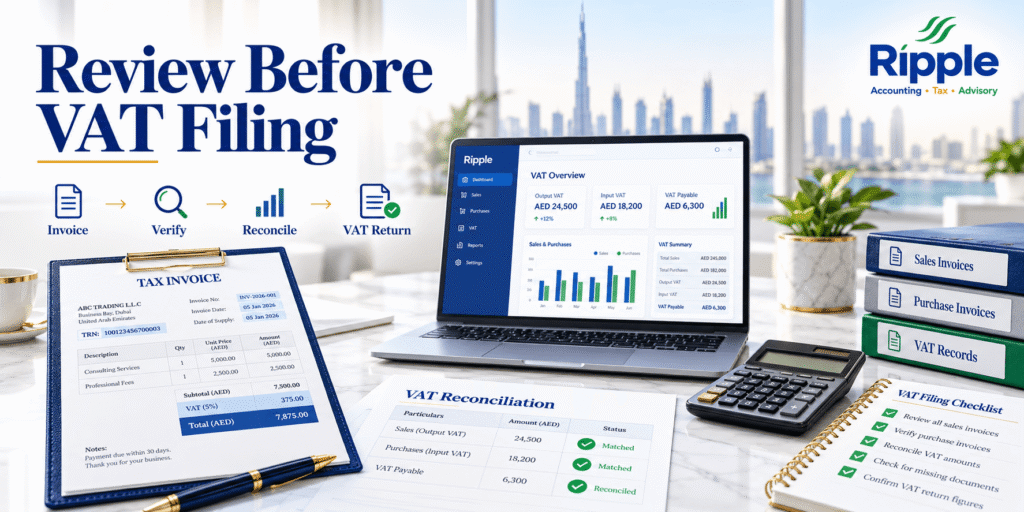
A good VAT compliance process does not begin when the return is due. Businesses should review invoices throughout the tax period. Before preparing a VAT return, reconcile:
The invoice records should ultimately support the amounts reported within the VAT return.
Regular reconciliation can identify errors while documents and supporting information are still readily available.
Purchase invoices are particularly important for businesses seeking to recover input VAT. A business should not rely simply on the fact that VAT appears on a supplier document. Finance teams should review whether:
Invoice validity is one element of input VAT recovery; businesses should assess the wider recovery conditions applying to the transaction.
No.
This distinction is becoming increasingly important in 2026.
The UAE Ministry of Finance states that an eInvoice is structured invoice data that is electronically issued and exchanged between a supplier and buyer and reported electronically to the FTA.
Unstructured documents such as:
are not, by themselves, eInvoices under the UAE Electronic Invoicing System.
A PDF can therefore still be a human-readable VAT tax invoice where applicable, but sending a PDF by email does not transform it into a structured UAE eInvoice.
The UAE E-Invoicing pilot commenced in July 2026.
According to the Ministry of Finance’s latest September 2026 update, entities within the first mandatory phase with annual revenue of AED 50 million or more remain required to implement the Electronic Invoicing System from 1 January 2027.
The Ministry had previously extended the deadline for these businesses to appoint an Accredited Service Provider from 31 July 2026 to 30 October 2026, while keeping the January 2027 implementation date unchanged.
Businesses should therefore treat VAT invoice compliance and eInvoicing readiness as related but separate workstreams.
A correctly formatted PDF invoice alone will not satisfy future structured eInvoicing requirements where those requirements apply.
Finance teams can reduce errors by introducing a simple five-step process.
Check:
Identify whether the supply is:
Determine whether the transaction requires:
Check:
Match invoice data to:
A systematic review is usually more reliable than trying to correct errors immediately before a filing deadline.
Managing the UAE VAT tax invoice requirements becomes more difficult as transaction volumes increase, especially where a business deals with multiple VAT treatments, overseas customers, foreign currencies or different invoice systems.
Ripple Accounting, Tax & Advisory can support UAE businesses with:
Rather than checking invoices only after an error occurs, businesses can establish a repeatable compliance process that connects invoicing, bookkeeping and VAT reporting.
Need to check whether your current invoice format meets UAE VAT requirements? Speak with Ripple Accounting, Tax & Advisory for a tailored VAT compliance review.
A full UAE tax invoice generally includes the words “Tax Invoice,” supplier details and TRN, recipient details and TRN where applicable, a unique invoice reference, issue date, date of supply where different, description of goods or services, pricing and quantity information, applicable VAT information, required totals and relevant amounts in AED. Article 59 of the VAT Executive Regulation provides the detailed requirements.
A full tax invoice contains detailed supplier, recipient and transaction information. A simplified tax invoice has fewer required fields and may generally be used where the recipient is not VAT registered or where a VAT-registered recipient receives a supply with consideration of AED 10,000 or less, subject to the applicable conditions.
Under the amended Article 59 rules, a simplified tax invoice must be issued on the date of supply.
Registrants are generally required to issue the relevant tax invoice within 14 days from the date of supply, subject to the applicable UAE VAT rules and specific exceptions.
Potentially, if the recipient is VAT registered and the consideration does not exceed AED 10,000, provided the other applicable conditions are satisfied. A simplified invoice cannot be used merely based on the amount where the reverse-charge restriction or another requirement for a full invoice applies.
Meeting the UAE VAT tax invoice requirements is an important part of maintaining accurate VAT records. A full tax invoice may need detailed supplier, customer, transaction, VAT and currency information, while simplified invoices are available only where the relevant conditions are met. Businesses should pay particular attention to TRNs, invoice sequencing, dates of supply, VAT calculations, AED reporting and invoice deadlines. The amended rules also make timing important: full tax invoices are generally subject to the 14-day requirement, whereas simplified tax invoices must be issued on the date of supply. A clear internal UAE VAT invoice checklist, combined with regular VAT reconciliations, can help businesses maintain stronger records and identify issues before VAT returns are submitted.
For further understanding, you can read:
Disclaimer: This article is provided for general informational and educational purposes only. It does not constitute tax, accounting or legal advice and should not be relied upon as a substitute for advice based on the specific facts of a transaction.
Tell us a little about your business and our UAE tax experts will get back to you with clear, practical answers — no obligation.
The UAE real estate market continues to grow, creating new opportunities for property developers, real estate agencies, brokers, and property management companies.…
Read article Corporate Tax
Is your business ready for UAE E-Invoicing without creating gaps in its Corporate Tax records? The UAE is moving towards a structured…
Read article VAT
Can your business recover input VAT on employee-related expenses? The UAE Federal Tax Authority (FTA) has issued Decision No. 17 of 2026,…
Read articlePage 12 of 59
Book a free consultation and get clear answers for your business.
0 Comments