Are small VAT return mistakes creating more work for your finance team than the VAT filing itself?
For VAT-registered businesses in the UAE, preparing a return requires more than entering figures into EmaraTax. Sales, purchases, input tax, output tax, credit notes, adjustments and supporting records all need to agree with the underlying accounting data. Even a small inconsistency can lead to additional checking, corrections or follow-up work. Understanding the most common UAE VAT return errors can help businesses identify problems before a return is submitted and reduce unnecessary rework.
Read on to see which VAT filing mistakes commonly require correction and how a structured pre-filing review can help.
What Are UAE VAT Return Errors?
A VAT return error occurs when information reported to the Federal Tax Authority (FTA) does not accurately reflect the business’s VAT position for the relevant tax period.
The error could relate to:
Sales or output tax
Purchases or input tax
Credit notes
Taxable, zero-rated or exempt supplies
Imports or reverse-charge transactions
VAT adjustments
Recoverable input tax
The figures reported in the relevant VAT return boxes
Missing or incorrect supporting records
The issue is not always that the underlying transaction was recorded incorrectly. Sometimes the accounting records may be correct, but the VAT return preparation process does not transfer the information accurately.
For this reason, a VAT return review should compare the return with the accounting records and supporting documentation rather than relying only on the final figures displayed in the tax software.
Why Do VAT Return Errors Create Rework?
A VAT return is usually prepared using information collected from several parts of a business.
Sales invoices may come from the sales team. Purchase invoices may be processed by accounts payable. Import information may come from customs or logistics records, while credit notes and adjustments may be processed separately.
If these records are not reviewed together, differences can remain unnoticed until the VAT return is being prepared or, in some cases, after submission.
For example, a business may have:
Recorded an invoice in the accounting system but omitted it from the VAT report.
Included a purchase invoice but claimed input tax incorrectly.
Posted a credit note without updating the VAT calculation.
Applied an incorrect VAT treatment to a transaction.
Failed to identify a transaction requiring special VAT treatment.
Carried forward an accounting adjustment without considering its VAT impact.
Each issue can require the finance team to return to the source records, investigate the transaction and determine the appropriate correction.
Common UAE VAT Return Errors to Check Before Filing
Here are the following UAE VAT return errors:
1. Sales Figures Do Not Match the VAT Return
One of the first checks should be whether taxable sales recorded in the accounting system agree with the amounts reported in the VAT return.
Differences can arise because of:
Unposted sales invoices
Cancelled invoices
Credit notes
Manual accounting adjustments
Transactions recorded in the wrong tax period
Differences between sales reports and the general ledger
A business should not assume that the accounting system’s total sales figure can simply be copied into the VAT return.
The finance team should understand what makes up the balance and whether each relevant transaction has been treated correctly for VAT purposes.
2. Output VAT Is Calculated Incorrectly
Output VAT represents VAT charged or otherwise accounted for on taxable supplies.
Errors can occur when the wrong VAT treatment is applied to a transaction or when the tax amount on invoices does not agree with the accounting records.
If these four sources do not reconcile, the difference should be investigated before filing.
3. Input VAT Is Claimed Without Checking Supporting Records
Businesses may be entitled to recover input tax when the applicable conditions are met, but input tax should not simply be claimed because VAT appears on a supplier invoice.
The business should consider whether the expense is eligible for recovery and whether the required supporting documentation is available.
The FTA’s recent VAT clarification on tax invoices and input tax recovery specifically addresses supporting documentation and input tax recovery requirements.
The FTA’s input tax apportionment guidance also explains that input tax recovery depends on the use of goods or services and that special considerations can apply where costs relate to both recoverable and non-recoverable activities.
Therefore, businesses should review:
Supplier tax invoices
VAT amounts
Business purpose of the expense
Recoverability of the input tax
Any applicable restrictions
Supporting documentation
4. Credit Notes Are Not Reflected Correctly
Credit notes can change the VAT position of a transaction. A common problem is that the original invoice is included in the VAT records, but the corresponding credit note is processed separately and not reflected correctly in the return.
Before filing, businesses should compare credit notes issued and received during the tax period with the relevant sales and purchase records.
The review should establish:
Which original transaction the credit note relates to
The relevant VAT amount
The accounting treatment
The VAT return treatment
Whether the adjustment belongs to the current tax period
This can prevent differences between the sales ledger, purchase ledger and VAT return.
5. Transactions Are Reported in the Wrong VAT Category
Not every transaction should automatically be treated in the same way. Businesses need to distinguish between relevant VAT categories based on the nature of the supply and applicable UAE VAT rules.
Errors can occur when businesses:
Treat an exempt supply as taxable
Treat a taxable supply as exempt
Apply zero-rating incorrectly
Apply standard VAT treatment without considering the transaction’s specific rules
Use an incorrect VAT code in the accounting system
These errors can affect both output tax and the amount reported in the VAT return.
Where the VAT treatment is uncertain, the transaction should be reviewed before the return is submitted rather than corrected after filing.
6. Reverse-Charge Transactions Are Missed
Reverse-charge transactions can create additional VAT reporting requirements because the supplier may not charge UAE VAT in circumstances where the UAE recipient accounts for VAT under the reverse-charge mechanism.
The FTA’s VAT guidance explains that where the reverse charge applies, the recipient accounts for the VAT rather than the non-resident supplier charging UAE VAT.
This means finance teams should identify relevant transactions involving overseas suppliers and determine whether reverse-charge treatment applies.
A review can include:
Overseas supplier invoices
Imported services
Relevant imported goods
VAT treatment in the accounting system
Output VAT reporting
Recoverable input VAT, where applicable
The treatment should be based on the specific transaction and applicable rules rather than simply using the supplier’s invoice as the VAT treatment.
7. VAT on Imports Is Not Reconciled
Businesses involved in importing goods may have VAT information coming from sources outside their normal purchase ledger. For this reason, import VAT should be reconciled with the relevant accounting and VAT records.
A useful review may compare:
Import records → customs information → accounting entries → VAT report → VAT return
Differences should be investigated before the VAT return is finalised.
This is particularly important for businesses with frequent imports because even small recurring differences can accumulate over several reporting periods.
8. VAT Transactions Are Recorded in the Wrong Tax Period
Another common source of rework is assigning a transaction to the wrong tax period. For example, an invoice may be entered into the accounting system after month-end even though the relevant VAT treatment belongs to an earlier period.
The finance team should therefore review transactions around the beginning and end of each tax period. Pay particular attention to:
Late invoices
Credit notes
Advance payments
Imports
Adjustments
Transactions posted after period-end
The FTA states that VAT returns and related payments are generally due within 28 days from the end of the relevant tax period.
A clear month-end and VAT-period closing process can reduce the risk of last-minute corrections.
9. Accounting Records and VAT Return Figures Do Not Reconcile
A VAT return should not be reviewed in isolation. The finance team should be able to explain the relationship between the return and the underlying accounting records.
A practical reconciliation may compare:
Record
Review against
Sales ledger
Output VAT report
Purchase ledger
Input VAT report
General ledger
VAT control accounts
Credit notes
VAT adjustments
Import records
Import VAT
VAT report
VAT return
VAT return
Previous period and expected movement
Large or unusual differences should be investigated before submission.
The objective is not simply to make the numbers match. The finance team should understand why the figures match and retain appropriate supporting records.
10. Manual Adjustments Are Not Properly Supported
Manual VAT adjustments can be necessary in some circumstances, but they should not become unexplained figures in the VAT working papers. Each material adjustment should have:
A clear explanation
Supporting documentation
The relevant accounting entry
The applicable VAT treatment
Evidence of review or approval
This becomes particularly important when a reviewer is trying to understand why the VAT return differs from the standard accounting reports.
A documented adjustment is much easier to review than a figure that appears without explanation.
A Practical Pre-Filing Review for UAE VAT Returns
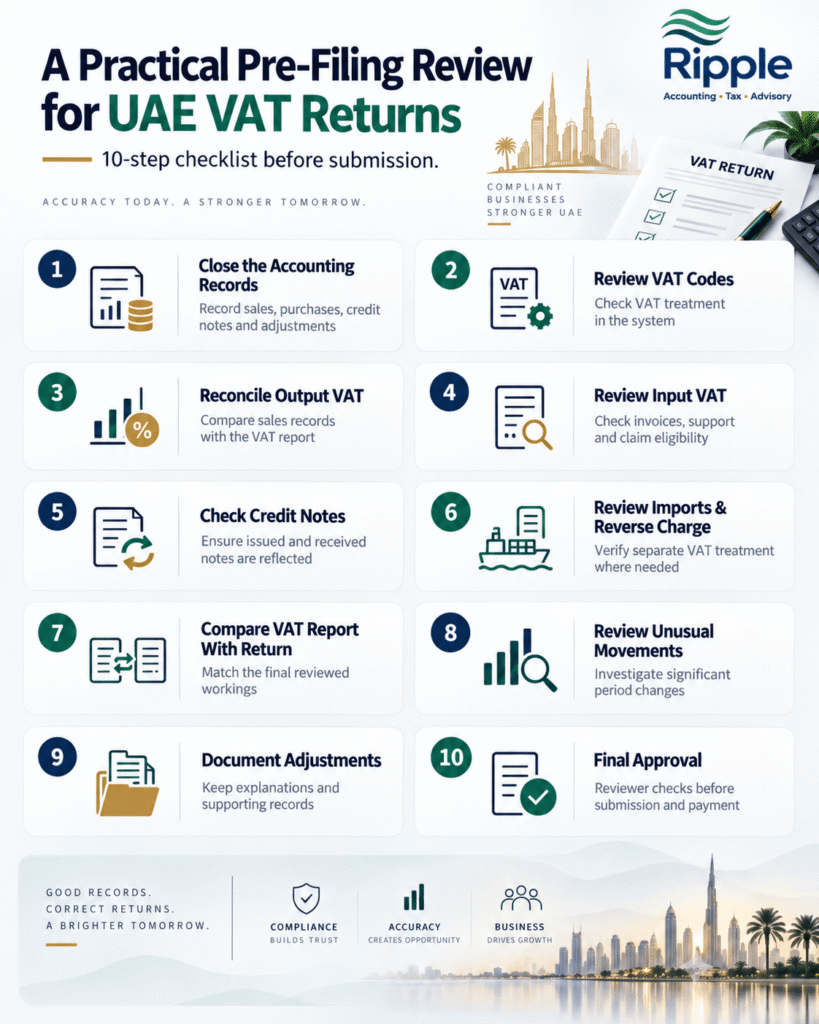
Businesses can reduce rework by introducing a standard review before every VAT return is submitted.
Step 1: Close the Accounting Records
Ensure relevant sales, purchases, credit notes and adjustments for the tax period have been recorded.
Step 2: Review VAT Codes
Check whether transactions have been assigned the appropriate VAT treatment in the accounting system.
Step 3: Reconcile Output VAT
Compare sales records with the VAT report and investigate significant differences.
Step 4: Review Input VAT
Check purchase invoices, supporting documentation and the eligibility of input tax claims.
Step 5: Check Credit Notes
Confirm that credit notes issued and received have been reflected correctly.
Step 6: Review Imports and Reverse Charge
Identify transactions that require separate VAT consideration and verify their treatment.
Step 7: Compare the VAT Report With the Return
Make sure the figures entered into the VAT return agree with the final reviewed VAT workings.
Step 8: Review Unusual Movements
Compare the current period with previous periods and investigate significant changes.
Step 9: Document Adjustments
Keep explanations and supporting records for manual adjustments or corrections.
Step 10: Final Approval
Have an appropriate reviewer check the return before submission and payment.
What Happens When a VAT Return Error Is Discovered?
Finding an error does not automatically mean that the same correction process applies to every situation.
The appropriate action depends on the nature and amount of the error and the applicable UAE tax procedures.
The FTA’s current FAQ states that where an error in a previously submitted VAT return resulted in payable tax being understated by no more than AED 10,000, the correction can be made in the current VAT return in which the error is discovered, subject to the applicable requirements. Where the error resulted in payable tax being understated by more than AED 10,000, the FTA states that a Voluntary Disclosure should be submitted.
The FTA’s VAT Return User Guide also sets out the correction treatment and explains that the VAT amount of an eligible correction is reported in the relevant correction field.
Businesses should therefore assess the error before deciding how to correct it rather than automatically changing the next VAT return.
How to Reduce VAT Filing Mistakes in the Future
Correcting an error is important, but preventing recurring errors can save considerably more time. Businesses can strengthen their VAT process by:
Maintaining Consistent VAT Codes: Use clearly defined VAT codes in the accounting system and review them periodically.
Reconciling Every VAT Period: Do not wait until year-end to identify differences between VAT records and accounting records.
Reviewing High-Value Transactions: Large invoices, unusual transactions and manual adjustments deserve additional attention.
Keeping Supporting Documents Organised: Invoices, credit notes, import documentation and other relevant records should be accessible during the review process.
Separating Preparation From Review: Where practical, the person preparing the VAT return should not be the only person reviewing it.
Maintaining a VAT Review Checklist: A repeatable checklist reduces the risk of overlooking the same issue each filing period.
How Ripple Accounting Can Help With UAE VAT Returns
VAT filing becomes more manageable when the underlying accounting records are complete, reconciled and reviewed before the return is prepared.
Ripple Accountants can support UAE businesses with VAT-related accounting and filing processes, including reviewing accounting records, organizing VAT information, reconciling relevant figures, and helping businesses identify discrepancies before they create additional filing work.
So, If your business is spending too much time correcting VAT figures, reconciling records or investigating filing differences, contact Ripple Accountants to discuss your requirements.
Email: info@uaetaxcompliance.ae
Phone: +971 52 356 5409
WhatsApp: +971 4 250 0833
FAQs
1. What are the most common UAE VAT return errors?
Common errors include incorrect sales figures, input VAT claims without adequate review, missed credit notes, incorrect VAT treatment, omitted reverse-charge transactions, import VAT differences and transactions reported in the wrong tax period.
2. How can businesses reduce VAT filing mistakes in the UAE?
Businesses can reduce errors by reconciling sales and purchase records with VAT reports, reviewing VAT codes, checking supporting documents, investigating unusual movements and completing a documented pre-filing review before submitting the VAT return.
3. What happens if a business discovers an error after filing a VAT return?
The correction method depends on the nature and amount of the error and the applicable FTA requirements. The FTA states that certain errors involving an understatement of payable tax of no more than AED 10,000 can be corrected through the current VAT return, while an understatement of more than AED 10,000 requires a Voluntary Disclosure.
4. Should input VAT be claimed on every supplier invoice that includes VAT?
No. The presence of VAT on an invoice does not by itself mean that the entire amount is recoverable. Businesses should consider the applicable input tax recovery requirements, the nature and use of the expense and whether the necessary supporting documentation is available.
5. How often should a UAE business review its VAT records?
VAT records should be reviewed for each tax period before the return is submitted. A regular review allows businesses to identify differences between accounting records and VAT workings while supporting documents and transaction details are still readily available.
Conclusion
UAE VAT return errors often begin with small differences between accounting records, transaction documents and VAT workings. A structured pre-filing review can help businesses identify these issues before submission. The process should connect the VAT return with the underlying sales, purchases, accounting records and supporting documents. Where an error has already been identified in a submitted return, businesses should determine the appropriate correction procedure based on the applicable FTA requirements rather than simply adjusting the next return.
Disclaimer: This article is provided for general informational purposes and does not constitute tax, legal or accounting advice. UAE VAT legislation, FTA guidance and administrative procedures may change. The appropriate treatment of a transaction or VAT return error depends on the specific facts and applicable rules. Businesses should review the latest FTA guidance and obtain professional advice where required before filing or correcting a VAT return.
Environmental responsibilities have become an essential part of modern business operations. Companies across industries must consider not only their financial performance but…
Non-profit organizations play a vital role in supporting communities, advancing education, promoting healthcare, protecting the environment, and delivering humanitarian aid across the…
Businesses have traditionally relied on financial reports such as revenue, profit, cash flow, and expenses to evaluate performance. While these metrics remain…





0 Comments