UAE Tax Residency Certificate Requirements: Documents and Eligibility
Are you planning to apply for a UAE Tax Residency Certificate but unsure which documents you need or whether you qualify? Understanding…
Read article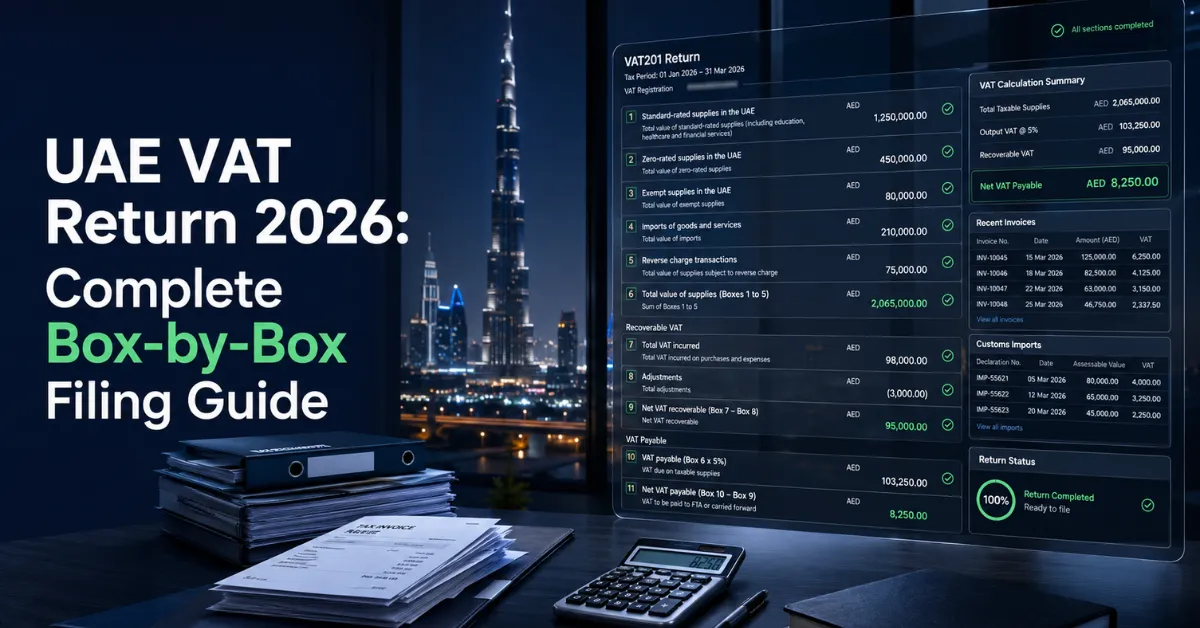
Value Added Tax (VAT) compliance remains an important responsibility for every VAT-registered business in the UAE. Filing your VAT return accurately helps you meet the requirements of the UAE Federal Tax Authority (FTA), avoid administrative penalties, and maintain reliable financial records. Whether you operate a mainland company, a free zone business, or an e-commerce venture, understanding how to complete each section of the VAT201 return is essential.
Many businesses face challenges when preparing their VAT return because different types of supplies, imports, reverse charge transactions, and recoverable input VAT must be reported correctly. Even small errors can result in incorrect tax calculations, delayed refunds, or additional compliance reviews.

A UAE VAT return is the official tax declaration submitted by VAT-registered businesses to the Federal Tax Authority (FTA) at the end of each tax period. The return reports taxable sales, purchases, imports, output VAT collected, input VAT recoverable, and the final amount of VAT payable or refundable.
The VAT return is submitted electronically through the EmaraTax portal using the VAT201 form. Every registered business must ensure that the information reported matches its accounting records, tax invoices, customs documents, and financial transactions.
Accurate VAT filing helps businesses:
The VAT return allows the FTA to determine how much VAT a business has collected from customers and how much VAT it has paid on eligible business expenses. The difference between these amounts determines whether the business must pay VAT to the FTA or is entitled to a VAT refund.
The VAT return also enables the FTA to monitor tax compliance, verify business transactions, and ensure VAT is correctly applied across different industries.
Every business registered for VAT in the UAE must submit VAT returns for each assigned tax period, even if there were no taxable sales during that period. Filing obligations continue until the business is officially deregistered for VAT by the FTA.
Businesses that commonly file VAT returns include:
The FTA assigns a tax period to each registered business based on its circumstances. Businesses should always follow the filing frequency shown in their EmaraTax account.
The two common filing frequencies are:
The assigned filing period cannot be changed unless approved by the FTA.
Businesses must continue submitting VAT returns even if they have:
A nil VAT return is still a mandatory filing requirement. Failure to submit it within the prescribed deadline may result in administrative penalties.
The VAT201 form is the official VAT return used by VAT-registered businesses in the UAE to report VAT transactions for each tax period. It captures taxable supplies, exempt supplies, imports, reverse charge transactions, recoverable input VAT, and the final VAT payable or refundable.
The VAT201 form is structured into different reporting boxes, with each box covering a specific category of transactions. Businesses should report figures accurately based on their accounting records and supporting documentation.
The information entered into each box directly affects the VAT calculation. Incorrect reporting may result in additional tax liabilities, delayed VAT refunds, or the need to submit a voluntary disclosure where applicable.
VAT returns are submitted electronically through the UAE’s EmaraTax platform. After logging into the portal, businesses can access their assigned VAT return, complete the required fields, review the calculated amounts, and submit the return before the filing deadline.
Businesses should also ensure that any VAT due is paid on time to avoid late payment consequences.
Before completing the VAT return, businesses should gather and reconcile all relevant records to ensure the figures reported are accurate.
Prepare the following information:
Businesses should reconcile sales, purchases, imports, and VAT balances before filing. Reviewing records in advance helps identify discrepancies, reduce filing errors, and support compliance with UAE VAT regulations.
Having complete and accurate documentation before filing your VAT return reduces errors and supports compliance during any future FTA review or audit.
Prepare the following documents before accessing the VAT201 form:
Maintaining these records in an organized manner helps businesses complete the VAT201 form accurately, respond efficiently to FTA information requests, and demonstrate compliance with UAE VAT record-keeping requirements.
The VAT201 return is divided into multiple reporting boxes, with each box capturing a specific type of transaction. Businesses should report figures based on their accounting records, tax invoices, customs documents, and supporting evidence for the relevant tax period. Completing each box accurately helps ensure the correct VAT liability is calculated and reduces the risk of filing errors.
Box 1 is used to report supplies subject to the UAE’s standard VAT rate. Include the total value of taxable supplies made during the tax period, excluding VAT, along with the corresponding output VAT.
Common examples include:
Before completing this box:
This box is used by eligible retailers participating in the UAE Tourist Refund Scheme to report VAT relating to tourist refunds processed during the tax period.
Businesses not participating in the scheme generally leave this box blank.
Before reporting:
Report the value of supplies subject to the 0% VAT rate.
Typical examples include:
Although VAT is charged at 0%, these supplies must still be reported in the VAT return.
Ensure that:
Box 4 is used to report supplies that are exempt from VAT.
Examples may include:
Unlike zero-rated supplies, exempt supplies do not allow recovery of related input VAT unless permitted under specific rules.
Businesses should correctly distinguish between exempt and zero-rated supplies to avoid reporting errors.
This box captures supplies where the reverse charge mechanism applies for specified transactions.
Businesses should report:
Typical situations include qualifying domestic reverse charge transactions prescribed under UAE VAT legislation.
Verify:
Businesses should report imported goods where VAT is accounted for through the VAT return in accordance with UAE VAT requirements.
Before completing this box:
Proper reconciliation between customs records and accounting records is essential.
Use this box to report any adjustments relating to previously declared imported goods where adjustments are required under the VAT rules.
Examples include:
Supporting documentation should be retained for every adjustment reported.
Report supplies received where the recipient is required to account for VAT under the reverse charge mechanism.
Common examples may include qualifying imported services received from overseas suppliers.
Businesses should:
This box reports purchases and expenses subject to the standard VAT rate where input VAT may be recoverable.
Common expenses include:
Before claiming input VAT:
This box covers expenses where VAT must be accounted for under the reverse charge mechanism.
Examples may include:
Businesses should:
Report imported goods where VAT is payable under the applicable import VAT rules.
Before reporting:
This box records adjustments affecting previously reported import VAT.
Adjustments may arise due to:
Businesses should retain complete evidence supporting every adjustment.
Box 13 reports the amount of input VAT that can be legally recovered on eligible business expenses.
Input VAT may generally be recoverable where:
Input VAT may not be recoverable for expenses restricted under UAE VAT legislation.
Businesses should review recoverability carefully before submitting the return.
Box 14 calculates the overall VAT position for the tax period.
The calculation generally reflects:
Example:
Review all calculations carefully before submission.

This is the final result of the VAT return. If output VAT exceeds recoverable input VAT, the business has VAT payable to the FTA. If recoverable input VAT exceeds output VAT, the business may have a refundable VAT balance or an amount carried forward, subject to applicable UAE VAT procedures.
Always review the final figures before submitting the VAT201 return to ensure consistency with accounting records.
The following example illustrates how a VAT return may be calculated for a tax period.
| Description | Amount (AED) |
|---|---|
| Standard-rated sales | 500,000 |
| Output VAT collected | 25,000 |
| Eligible business purchases | 240,000 |
| Recoverable input VAT | 12,000 |
| Net VAT payable | 13,000 |
In this example, the business collected AED 25,000 in output VAT from customers and incurred AED 12,000 in recoverable input VAT on eligible business expenses. After deducting the recoverable VAT, the business is required to pay AED 13,000 to the Federal Tax Authority for the relevant tax period.
Before submitting the VAT return, businesses should reconcile the figures reported in every VAT201 box with accounting records, tax invoices, customs declarations, and supporting documentation. This final review helps identify discrepancies early, supports accurate VAT reporting, and reduces the risk of amendments or administrative penalties.
Even businesses with established accounting processes can make VAT filing errors. Reviewing your VAT201 return before submission helps reduce compliance risks and avoids unnecessary corrections.
Common mistakes include:
Every VAT-registered business must submit its VAT return according to the tax period assigned by the Federal Tax Authority (FTA). The assigned filing frequency is available in the business’s EmaraTax account.
Businesses may be assigned:
The VAT return and any VAT payable must generally be submitted by the deadline specified for the applicable tax period. Businesses should rely on the filing due date displayed in EmaraTax and avoid waiting until the last day to complete the return.
To help ensure timely filing:
Timely filing reduces the risk of administrative penalties and supports ongoing VAT compliance.
Failure to comply with UAE VAT requirements may result in administrative penalties in accordance with the applicable tax legislation and FTA regulations.
Situations that may lead to penalties include:
Businesses should regularly review their VAT records and correct errors promptly in line with applicable FTA procedures.
Following good accounting practices can significantly improve the accuracy of your VAT return.
Best practices include:
Complete the following checklist before filing your VAT return:
The UAE VAT Return is the VAT201 form submitted electronically through EmaraTax by VAT-registered businesses to report taxable supplies, purchases, imports, output VAT, input VAT, and the final VAT liability for each tax period.
The VAT201 form is the official VAT return used by the Federal Tax Authority for reporting VAT transactions in the UAE.
Businesses file VAT returns according to the tax period assigned by the FTA, which is typically monthly or quarterly.
Late submission or payment may result in administrative penalties and additional compliance obligations under UAE tax regulations.
Where an error is identified after submission, businesses should follow the applicable FTA procedures for correcting VAT returns.
Recoverable input VAT generally includes VAT paid on eligible business expenses supported by valid tax invoices and meeting the conditions set out in UAE VAT legislation.
Yes. VAT returns are submitted electronically through the UAE EmaraTax portal.
Businesses should retain:
Preparing an accurate VAT return requires careful review of financial records, VAT classifications, and compliance requirements. Ripple Accountants assist businesses with VAT return preparation, VAT reconciliation, transaction reviews, input VAT assessment, and timely VAT201 filing. Our team helps reduce filing errors, supports FTA compliance, and ensures your VAT obligations are managed efficiently.
Contact Ripple Accountants
Accurate VAT return filing is an essential part of business compliance in the UAE. Understanding every section of the VAT201 form helps businesses report transactions correctly, calculate VAT accurately, and reduce the risk of administrative penalties.
Disclaimer: This article is provided for general informational purposes only and reflects UAE VAT requirements applicable at the time of writing. It should not be considered legal, tax, or financial advice. Businesses should refer to the latest guidance issued by the UAE Federal Tax Authority (FTA) or consult a qualified tax professional before making compliance or filing decisions.
Tell us a little about your business and our UAE tax experts will get back to you with clear, practical answers — no obligation.
 Corporate Tax
Are you planning to apply for a UAE Tax Residency Certificate but unsure which documents you need or whether you qualify? Understanding…
Read article Corporate Tax
Do you need a UAE Tax Residency Certificate for a local administrative requirement or to claim benefits under a double taxation agreement?…
Read article Bookkeeping
How can UAE businesses ensure employees receive the correct salary every month? Payroll involves more than adding basic pay and allowances. Employers…
Read articlePage 1 of 58
Book a free consultation and get clear answers for your business.
0 Comments