Bookkeeping for Real Estate Companies in UAE
The UAE real estate market continues to grow, creating new opportunities for property developers, real estate agencies, brokers, and property management companies.…
Read article
Are you planning to apply for a UAE Tax Residency Certificate but unsure which documents you need or whether you qualify?
Understanding the UAE TRC requirements before submitting an application can help you avoid missing paperwork and unnecessary delays. Whether you are an individual, entrepreneur or company, reviewing your residency evidence and financial records is an important first step.
This guide explains the eligibility criteria, required documents and application process for obtaining a UAE Tax Residency Certificate. Exploring the tax residency certificate support available from Ripple Accountants can also help you prepare for the process with greater confidence.
Let’s get started!
A UAE Tax Residency Certificate (TRC), also referred to as a tax domicile certificate, is an official certificate issued by the Federal Tax Authority (FTA) to eligible applicants who meet the applicable requirements.
The certificate may be used to establish UAE tax residency for a particular period. Depending on the certificate type and the applicable rules, it can support an individual’s or company’s request to benefit from an agreement for the avoidance of double taxation between the UAE and another country.
For example, a UAE-based professional receiving income from abroad may need evidence of UAE tax residency when dealing with a foreign tax authority. Similarly, a company conducting cross-border business may need a certificate to support its treaty-related tax position.
However, obtaining a TRC does not automatically guarantee tax relief in another country. The relevant tax treaty, income type, supporting evidence and foreign jurisdiction’s procedures must also be considered.
The FTA distinguishes between certificates for domestic purposes and treaty purposes. Selecting the correct category is essential because the eligibility criteria and supporting documents can differ.
Eligibility depends on the applicant’s legal status, physical presence, residence arrangements, financial circumstances and intended use of the certificate.
Individuals may apply if they meet the relevant UAE tax residency criteria for the requested period. Depending on the application category, this may involve demonstrating the number of days spent in the UAE, holding appropriate residency documents, establishing a permanent place of residence, or showing that the UAE is their usual or primary residence and the centre of their financial and personal interests.
The evidence required will depend on the circumstances and the certificate’s purpose.
A company may be eligible if it satisfies the applicable conditions for UAE tax residency and provides the required corporate documentation.
For a treaty-purpose application, the FTA’s published guidance states that a legal person must generally have been established in the UAE for at least one year. The applicant must also provide evidence relevant to the requested period and its legal and financial position.
Individuals and businesses involved in cross-border transactions may seek a TRC to support their tax position under an applicable double taxation agreement.
Before applying, applicants should confirm that the certificate is appropriate for their circumstances. A TRC is not a substitute for checking the specific treaty conditions or determining whether the foreign country will accept the certificate for the intended claim.
The documents required for an individual application depend on the certificate purpose and the applicant’s residency circumstances.
For domestic-purpose applications, the FTA’s guidance identifies different categories based on the number of days spent in the UAE. These include applicants who have spent more than 183 days, between 90 and 183 days, or fewer than 90 days in the UAE.
The relevant eligibility criteria and supporting evidence must be assessed for the application type. The categories should not be interpreted as guaranteeing approval solely because an applicant falls within a particular day-count range.
For treaty-purpose applications, the FTA FAQ states that an individual must have been a UAE resident for at least 183 days during the required financial year. Applicants should verify the applicable requirements for their particular application and requested period.
Depending on the circumstances, an applicant may need to provide:
Applicants relying on the UAE as their primary residence or the centre of their financial and personal interests may need additional evidence to demonstrate their circumstances.
The FTA may request further documents where necessary to determine whether the applicant meets the applicable tax residency criteria.
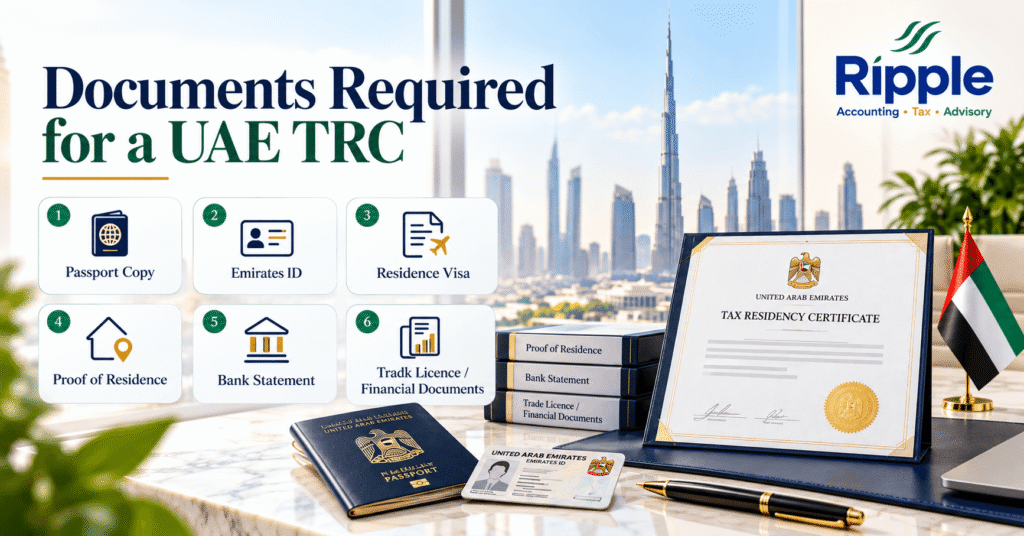
Preparing a complete document file before applying can make the process easier. The following checklist outlines common supporting documents; the exact requirements depend on the applicant’s category and the period requested.
| Document | Why it may be required |
| Passport copy | Establishes identity and supports immigration records |
| Emirates ID and residence visa | Supports UAE residency information, where applicable |
| Entry-and-exit report | Demonstrates physical presence in the UAE |
| Tenancy agreement or title deed | Supports evidence of a permanent place of residence |
| Utility bills | May support the claimed residential address and period |
| Salary certificate or employment evidence | Supports employment and income information |
| Local bank statements | Provides evidence of financial activity during the relevant period |
| Business licence or other business evidence | May be required for self-employed applicants |
| Additional supporting documents | Addresses individual circumstances or country-specific requirements |
Not every applicant will need every document. For example, an individual relying on employment income may submit different evidence from a self-employed applicant or a person relying on investments.
The FTA’s application guidance also identifies supporting documents such as marriage certificates in certain spouse-sponsored cases, property lease agreements for rental income, and evidence of savings or investments for some retired applicants.
Companies applying for a TRC should prepare their corporate and financial records in advance. Common requirements for treaty-purpose applications include:
The FTA’s published user manual also specifies that the financial audit report should cover the requested financial year’s start date or the preceding year, as applicable to the application instructions.
Companies should check the current portal requirements before submitting their files, particularly if their legal structure, reporting period or establishment date differs from a straightforward UAE-incorporated business.
One of the most important UAE TRC requirements is choosing the correct certificate purpose.
| Area | Domestic-purpose TRC | Treaty-purpose TRC |
| Intended use | Evidence of UAE tax residency for a domestic purpose | Supporting a claim under an applicable double taxation agreement |
| Individual eligibility | Assessed under the relevant UAE domestic criteria | Includes the treaty-purpose conditions specified by the FTA |
| Day-count consideration | Relevant categories include more than 183 days, 90–183 days and fewer than 90 days | FTA guidance specifies at least 183 days during the required financial year for individuals |
| Company eligibility | Assessed according to the relevant domestic requirements | FTA guidance generally requires at least one year of establishment |
| Supporting evidence | Depends on the applicant’s circumstances | May include residency, financial, corporate and treaty-related evidence |
These are broad distinctions rather than a complete eligibility test. The FTA’s published rules and portal instructions should be checked for the specific certificate being requested.
For example, an individual who needs to demonstrate tax residency to a foreign tax authority may require a treaty-purpose certificate rather than one intended only for domestic use. Selecting the wrong purpose could mean that the resulting certificate does not meet the applicant’s intended needs.
Applicants should also check whether the destination country requires a specific form, additional certification or other documentation alongside the UAE TRC.
If you want to explore the key differences between UAE Tax Residency Certificates for domestic and treaty purposes in detail, read our comprehensive guide: Domestic-Purpose TRC vs Treaty-Purpose TRC
The FTA provides an online application process through its tax services platform. Applicants can follow these general steps.
Determine whether the application is for domestic purposes or treaty purposes. Consider why the certificate is needed, the relevant period and any requirements communicated by the foreign tax authority.
Collect identification, immigration, residence, employment, banking or corporate documents appropriate to the application. Ensure that they cover the relevant period and that the information is consistent.
Visit the official FTA Tax Residency Certificate portal. Follow the current login instructions. The portal directs applicants to use their EmaraTax credentials.
Enter the requested applicant details, certificate purpose and relevant period. Upload the supporting documents according to the instructions displayed in the application.
Check that names, identification numbers, dates and corporate information match the supporting documents. Confirm that all required files are legible and relate to the correct applicant.
Review the fee displayed for the selected application category and applicant status. Keep the payment confirmation for your records.
Check the portal for updates or requests for additional information. Respond promptly if the FTA asks for clarification or further evidence.
The FTA’s published FAQ provides a reference processing period of five working days for reviewing an application, but applicants should check current service information and allow for additional time if clarification or further documents are required.
The cost of obtaining a Tax Residency Certificate depends on the applicant’s category and whether the applicant is registered with the FTA.
The FTA’s published FAQ lists the following fees:
| Fee component | Individuals | Legal persons |
| Application submission fee | AED 50 | AED 50 |
| Certificate fee for registered applicants | AED 500 | AED 500 |
| Certificate fee for non-registered applicants | AED 1,000 | AED 1,750 |
| Printed certificate, if requested | AED 250 | AED 250 |
These amounts are based on the FTA’s published fee information. Applicants should verify the current fees shown in the official portal before submitting an application, as the applicable charge may depend on the service selected.
The published FAQ states that the FTA reviews applications within five working days. This should be treated as a reference rather than a guarantee of issuance within that period. Incomplete applications, discrepancies in supporting records or requests for further evidence may affect the overall timeline.
Even applicants who appear to meet the eligibility criteria can encounter problems if their documents do not adequately support their applications.
A careful document review before submission can help identify these issues early and reduce avoidable delays.
Determining the appropriate Tax Residency Certificate (TRC) purpose and preparing supporting documents can be challenging, particularly for applicants with overseas income, company interests or cross-border transactions.
Ripple Accounting, Tax & Advisory can help individuals and businesses understand the documentation requirements for a UAE Tax Residency Certificate, organize relevant financial records and navigate the application process. Whether you need a TRC for domestic administrative purposes or to explore benefits under a double taxation agreement, obtaining guidance on the applicable requirements can help you prepare more effectively.
If you need assistance with your UAE Tax Residency Certificate application, explore Ripple Accountants services to discuss your circumstances, documentation requirements and the support available for your tax residency needs.
The main requirements depend on whether the applicant is an individual or a company and whether the certificate is for domestic or treaty purposes. Supporting evidence may include identification documents, immigration records, proof of residence, income records, bank statements and corporate documents.
Eligibility depends on the certificate purpose and the applicable criteria. The FTA identifies different day-count categories for domestic-purpose applications, including applicants who have spent between 90 and 183 days or fewer than 90 days in the UAE. Treaty-purpose applications have separate conditions, and applicants should check the requirements applicable to their circumstances.
No. A residence visa can support an application, but it does not automatically establish eligibility. The applicant must meet the relevant tax residency criteria and provide the required supporting evidence.
The FTA’s published FAQ refers to a five-working-day application review period. Actual processing may vary depending on the application, the completeness of the documents and whether additional information is requested.
No. A TRC may support a claim under an applicable double taxation agreement, but it does not guarantee an exemption, refund or reduced tax rate. The relevant treaty provisions and the foreign jurisdiction’s requirements must also be satisfied.
Understanding the UAE TRC requirements before applying can help individuals and companies identify the appropriate certificate type, establish eligibility and prepare the necessary documents. Residency evidence, financial records and corporate documentation should be consistent with the requested period and the purpose of the application.
Before submitting your request, review the latest guidance from the Federal Tax Authority and confirm whether additional documentation is needed for your circumstances. Where financial records or business documentation require attention, Ripple Accounting, Tax & Advisory can provide relevant accounting, bookkeeping and tax advisory support to help you prepare more effectively.
Disclaimer: This article is for general informational purposes only and does not constitute tax or legal advice. UAE Tax Residency Certificate eligibility, documentation requirements, fees and processing arrangements may vary according to the applicant’s circumstances and the applicable rules. Always consult the latest Federal Tax Authority guidance or a qualified adviser before applying.
Tell us a little about your business and our UAE tax experts will get back to you with clear, practical answers — no obligation.
The UAE real estate market continues to grow, creating new opportunities for property developers, real estate agencies, brokers, and property management companies.…
Read article Corporate Tax
Is your business ready for UAE E-Invoicing without creating gaps in its Corporate Tax records? The UAE is moving towards a structured…
Read article VAT
Can your business recover input VAT on employee-related expenses? The UAE Federal Tax Authority (FTA) has issued Decision No. 17 of 2026,…
Read articlePage 12 of 59
Book a free consultation and get clear answers for your business.
0 Comments