Cash on Delivery Accounting for E-Commerce: Complete Guide
Cash on Delivery (COD) remains one of the most popular payment methods in e-commerce, especially in markets where customers prefer to pay…
Read article
Are you living in the UAE and need proof of your tax residency for a foreign tax authority, bank or tax-related process? A UAE Tax Residency Certificate can help establish your tax residency for the relevant period and purpose, provided you meet the applicable requirements.
The Federal Tax Authority (FTA) issues Tax Residency Certificates (TRCs) to eligible individuals for domestic purposes or to support claims under applicable double taxation agreements. Understanding the eligibility criteria, required documents, fees and application process of UAE TRC for individuals can help you prepare a more complete application.
Let’s get started!
A UAE Tax Residency Certificate is an official document issued by the FTA to confirm an individual’s tax residency for the relevant period.
Individuals may need this certificate when dealing with a foreign tax authority, seeking benefits under an applicable double taxation agreement (DTA), or providing formal evidence of their UAE tax residency.
A TRC is not the same as a UAE residence visa. A residence visa establishes immigration status, whereas tax residency is determined under the relevant tax rules and the individual’s circumstances.
The UAE’s tax residency framework includes domestic criteria and rules applicable under double taxation agreements. Therefore, applicants should first establish why they need the certificate and which requirements apply to their situation.
For further information, refer to the FTA’s official Tax Resident and Tax Residency Certificate Guide.
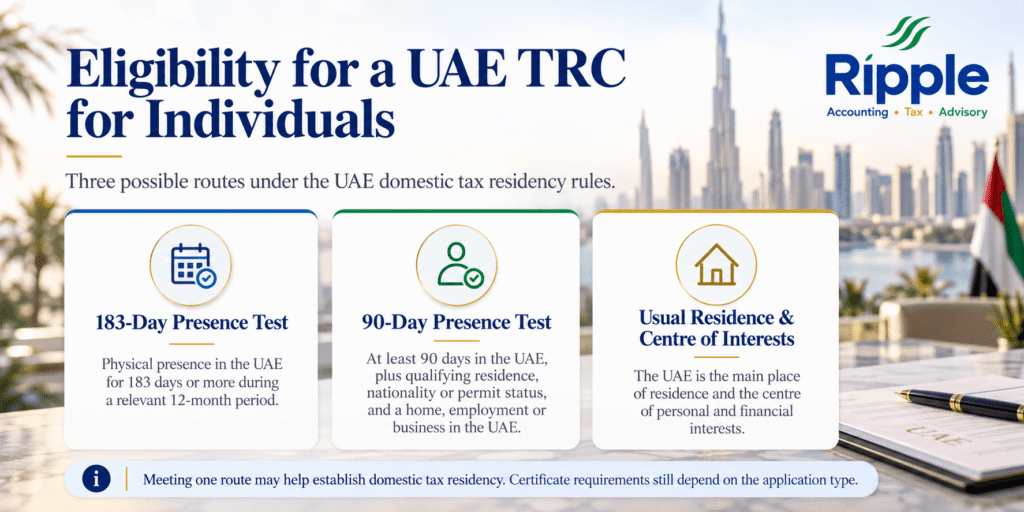
The UAE’s domestic tax residency rules provide three alternative routes through which a natural person may qualify as a UAE tax resident. Meeting at least one applicable test can establish domestic tax residency, but applicants must also satisfy the requirements relevant to the certificate they request.
An individual may qualify as a UAE tax resident if physically present in the country for 183 days or more during the relevant consecutive 12-month period.
The days do not have to be consecutive. Under the FTA’s guidance, a day or part of a day spent physically in the UAE generally counts as a full day for this calculation.
For example, someone who spends several separate periods in the UAE may qualify if their combined physical presence reaches the required threshold within the relevant 12-month period.
Applicants should maintain reliable travel records and verify the dates covered by their application rather than relying on estimates.
An individual who spends fewer than 183 days in the UAE may still qualify under the domestic rules if they meet the conditions of the 90-day test.
They must generally:
A permanent place of residence does not necessarily have to be owned by the individual. A rented dwelling may qualify if it is continuously available to them and meets the applicable criteria.
For example, a person who spends 120 days in the UAE, holds a valid residence permit and has a qualifying permanent residence or carries on employment in the country may meet this test, subject to the full applicable rules.
An individual may also qualify where their usual or primary place of residence and the centre of their financial and personal interests are both in the UAE.
This test looks beyond the number of days spent in the country. Relevant factors may include employment, business activities, financial investments, family connections and social relationships.
For example, an individual whose settled routine, employment and significant personal and financial connections are centred in the UAE may be able to rely on this test, provided both conditions are satisfied.
The assessment depends on the individual’s complete circumstances. Merely holding a UAE visa, renting a property or maintaining a bank account does not automatically establish eligibility.
The FTA Tax Residency Guide explains these three domestic tests in detail.
Before applying, determine whether you need a certificate for domestic purposes or to claim benefits under a double taxation agreement.
For treaty-purpose applications, the FTA’s published guidance identifies a requirement for a natural person to have been resident in the UAE for at least 183 days during the relevant financial year. The applicable agreement and the rules governing the specific application must also be considered.
Domestic-purpose applications may involve different eligibility routes, including the 90-day test and the usual-residence and centre-of-interests test.
Do not assume that satisfying a domestic tax residency test automatically means you meet every condition for treaty benefits. Review the requirements for your intended use before applying.
For a more detailed comparison, read UAE Tax Residency Certificate for Domestic vs Treaty Purposes: Key Differences.
The supporting documents depend on the eligibility test, application purpose and period requested. The FTA may ask for additional evidence when necessary to determine whether the applicant qualifies.
Common documents include the following:
Not every applicant needs every document listed above. For example, the FTA’s guide identifies different documentary requirements for individuals who have spent 183 days or more in the UAE, those who have spent 90–182 days, and those relying on the usual-residence and centre-of-interests test.
Use the official FTA guidance to identify the documents applicable to your circumstances.
Eligible individuals can submit their applications through the FTA’s online service.
The published FTA fee schedule distinguishes between registered and unregistered natural persons.
| Fee component | Individual applicant |
| Submission fee | AED 50 |
| Electronic certificate fee for a registered applicant with a Corporate Tax TRN | AED 500 |
| Electronic certificate fee for an unregistered natural person | AED 1,000 |
| Additional printed certificate fee, if requested | AED 250 |
The submission fee is non-refundable according to the FTA’s tax residency guide. The electronic certificate processing fee is paid after approval.
The FTA’s published FAQ states a processing timeframe of five working days for reviewing the application. Applicants should treat this as the stated review timeframe, not a guarantee that gathering documents or resolving additional queries will take no longer.
For the current fee breakdown and service information, consult the FTA’s TRC FAQs.
Even applicants who appear to meet the eligibility criteria can encounter problems if their applications are incomplete or inconsistent.
A careful review before submission can help reduce avoidable delays and the need to correct application details.
Preparing a UAE TRC application may require you to organise financial records, employment evidence, income documents and other supporting information. This can be particularly challenging when you need to demonstrate the location of your financial interests or provide records for a cross-border tax matter.
Ripple Accounting, Tax & Advisory offers accounting and bookkeeping services and tax advisory services to help businesses maintain organized financial information and understand relevant tax documentation requirements.
Depending on the engagement, professional support may include reviewing available financial records, identifying inconsistencies and helping organize relevant documentation for a tax compliance process.
Need help preparing your tax documents? Contact Ripple Accounting, Tax & Advisory to discuss your requirements and explore how professional support may help you prepare for your TRC application.
The FTA remains responsible for assessing eligibility and issuing the certificate. Professional assistance cannot guarantee approval.
Possibly. Under the domestic rules, an individual may qualify through the 90-day test if the additional nationality or residence-permit and permanent-residence or employment/business conditions are met. The usual-residence and centre-of-interests test is another possible route. Treaty-purpose requirements must be checked separately.
No. Immigration residence and tax residency are different concepts. You must meet the relevant tax residency criteria for the period and purpose concerned.
The published government fees include a AED 50 submission fee, plus AED 500 for a registered applicant with a Corporate Tax TRN or AED 1,000 for an unregistered natural person. A printed certificate costs an additional AED 250 if requested.
The FTA’s published FAQ states that application review takes within five working days. Additional document preparation or requests for clarification may extend the overall process.
Yes, if you meet the applicable requirements. The FTA’s guidance identifies a 183-day residence requirement for natural persons applying for treaty purposes during the relevant financial year. Check the applicable agreement and the FTA’s requirements before applying.
Obtaining a UAE Tax Residency Certificate requires applicants to identify the correct eligibility route, prepare supporting evidence and select the appropriate certificate purpose. The 183-day test is one route to domestic tax residency, but the 90-day test and the usual-residence and centre-of-interests test may also be relevant.
Before applying, review the FTA’s latest guidance, confirm which documents you need and ensure that the requested period matches your circumstances. If you need help organising your financial documentation, Ripple Accounting, Tax & Advisory can discuss suitable accounting and tax advisory support.
Disclaimer: This article is for general informational purposes only and does not constitute legal or tax advice. Eligibility, documentation and treaty requirements depend on the applicant’s circumstances and applicable rules. Check the latest Federal Tax Authority guidance before submitting an application.
Tell us a little about your business and our UAE tax experts will get back to you with clear, practical answers — no obligation.
 Bookkeeping
Cash on Delivery (COD) remains one of the most popular payment methods in e-commerce, especially in markets where customers prefer to pay…
Read article Compliance
Corporate governance and accounting are closely connected because both help businesses operate with honesty, transparency, and accountability. A strong governance framework ensures…
Read article Bookkeeping
Enterprise Resource Planning (ERP) systems have become essential tools for modern businesses that want to manage their accounting and finance operations more…
Read articlePage 53 of 59
Book a free consultation and get clear answers for your business.
0 Comments