Using Machine Learning to Automate Routine Accounting Tasks
Businesses are under constant pressure to process financial data faster, reduce manual work, and improve accuracy. Traditional accounting methods often rely on…
Read article
How much does a UAE Tax Residency Certificate cost, how long does it take to obtain, and when does it expire? Understanding these details can help individuals and businesses plan their applications without unnecessary delays or expenses.
The UAE Federal Tax Authority (FTA) issues Tax Residency Certificates (TRCs) to eligible applicants for domestic purposes or to access benefits under applicable double taxation agreements. The total cost and processing time depend on the applicant’s registration status, the type of certificate requested, and whether additional documentation is required. This guide explains UAE TRC fees, processing time, validity, and the steps involved in applying.
Let’s get started!
A UAE Tax Residency Certificate is an official document issued by the Federal Tax Authority to confirm an applicant’s tax residency for the relevant period and purpose.
Individuals may need a TRC to support tax residency claims in another country, while companies may use it when seeking benefits under an applicable double taxation agreement (DTA). It can also be required when a foreign tax authority requests evidence of UAE tax residency.
The UAE provides certificates for two main purposes:
The requirements and supporting documents can differ depending on the applicant’s circumstances and the purpose of the application.
For official guidance, consult the FTA Tax Resident and Tax Residency Certificate Guide.
The UAE TRC fees depend primarily on whether the applicant is registered with the FTA for tax purposes. According to the FTA’s published service guide, applicants pay a submission fee and an applicable certificate issuance fee.
The following table summarises the published government charges for an electronic Tax Residency Certificate.
| Applicant category | Submission fee | Certificate fee | Total government fee |
| Registered natural or legal person | AED 50 | AED 500 | AED 550 |
| Unregistered natural person | AED 50 | AED 1,000 | AED 1,050 |
| Unregistered legal person | AED 50 | AED 1,750 | AED 1,800 |
These figures represent the published FTA fees for the relevant applicant categories. Registration status should be checked carefully before submitting an application.
The FTA’s service guide identifies tax registrants for the AED 500 certificate fee and distinguishes unregistered individuals from unregistered legal entities. For current details, see the official FTA service guide.
Yes. Applicants who request a physical copy of the certificate should budget for an additional AED 250 government fee.
For example, an unregistered individual requesting an electronic certificate and a printed copy would pay AED 1,300 in total, based on the published fee schedule:
The corresponding total for an unregistered legal person requesting a printed copy would be AED 2,050.
These totals exclude any additional professional, translation, courier or document-attestation expenses that may apply to the applicant’s circumstances.
The government fee is not necessarily the full cost of obtaining a TRC. Some applicants may incur additional expenses when preparing the supporting documents.
Potential additional costs include:
These costs are not fixed FTA TRC charges. They depend on the documents required and the professional services selected.
Applicants should confirm the applicable government fees and any third-party charges before proceeding.
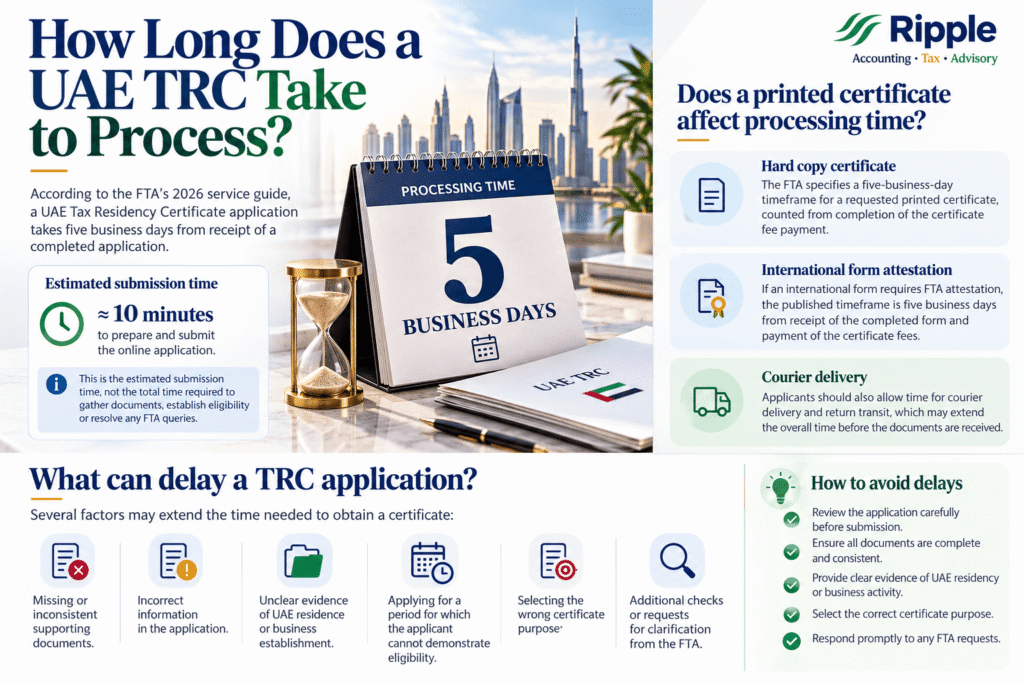
According to the FTA’s 2026 service guide, a Tax Residency Certificate application takes five business days from receipt of a completed application.
The FTA estimates that preparing and submitting the online application takes approximately 10 minutes. However, this is the estimated submission time, not the total time required to gather documents, establish eligibility or resolve issues with an application.
The actual time required can therefore be longer than five business days if the applicant needs to prepare additional documents or respond to an FTA request.
Yes. The FTA’s service guide specifies a five-business-day timeframe for a requested hard copy, counted from completion of the certificate fee payment.
If an international form requires FTA attestation, the published timeframe is five business days from receipt of the completed form and payment of the certificate fees.
Applicants should also account for courier delivery and return transit where physical documents are involved. These delivery periods may extend the overall time before the applicant receives the documents.
Several factors may extend the time needed to obtain a certificate:
To reduce the likelihood of delays, review the application carefully before submission and ensure that the supporting records correspond to the relevant period.
The validity of a UAE Tax Residency Certificate should be understood in relation to the period and purpose for which it is issued.
A TRC is not a permanent confirmation of tax residency. It relates to the relevant period stated in the certificate and the supporting application. Applicants should therefore check the certificate’s covered period rather than assuming that every certificate remains valid for a full year from its issue date.
For example, a certificate issued during one calendar year may relate to an earlier financial or tax period. The issue date alone does not establish which period the certificate covers.
No. A certificate should not be treated as indefinite proof of tax residency.
If an overseas authority, bank or other organisation requests evidence for a different period, the applicant may need to obtain another certificate covering that period. Whether a new application is required depends on the circumstances and the receiving authority’s requirements.
Applicants should not assume that a certificate issued for domestic purposes will automatically satisfy a request for treaty benefits.
The purpose of the certificate, the relevant period and the rules of the applicable double taxation agreement can affect whether it is accepted. Foreign tax authorities may also have their own documentation requirements.
Before applying, establish which country and period the certificate must cover and whether the receiving authority requires a treaty-purpose certificate.
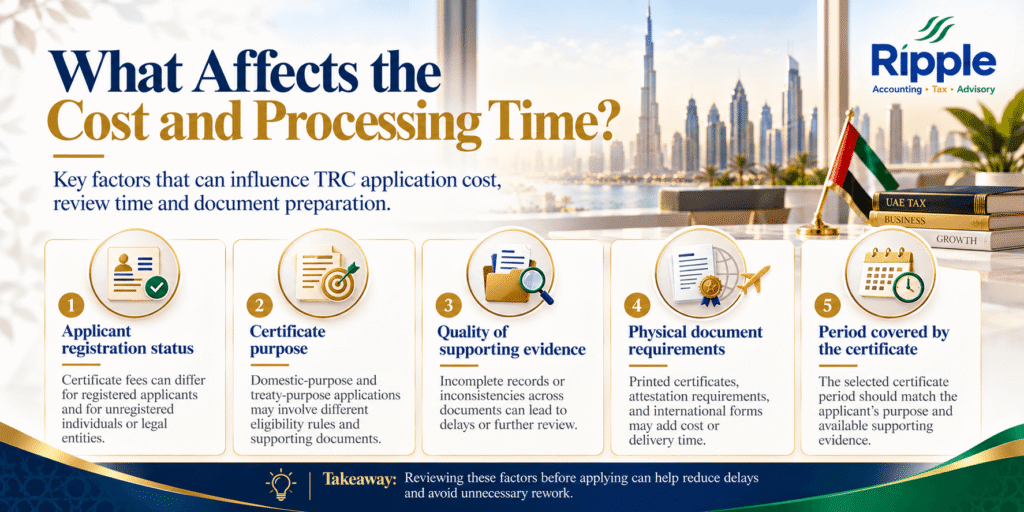
Understanding the factors that affect an application helps individuals and businesses budget appropriately and avoid preventable delays.
Reviewing these factors before submitting the application can help applicants avoid unnecessary rework.
Eligible individuals and businesses can apply through the FTA’s online service.
Applicants can reduce unnecessary complications by avoiding a few common errors.
Determining the appropriate Tax Residency Certificate (TRC) purpose and preparing supporting documents can be challenging, particularly for applicants with overseas income, company interests or cross-border transactions.
Ripple Accounting, Tax & Advisory can help individuals and businesses understand the documentation requirements for a UAE Tax Residency Certificate, organize relevant financial records and navigate the application process. Whether you need a TRC for domestic administrative purposes or to explore benefits under a double taxation agreement, obtaining guidance on the applicable requirements can help you prepare more effectively.
If you need assistance with your UAE Tax Residency Certificate application, explore Ripple Accountants services to discuss your circumstances, documentation requirements and the support available for your tax residency needs.
The published FTA government fees are AED 550 for registered applicants, AED 1,050 for an unregistered natural person and AED 1,800 for an unregistered legal person. These totals include the AED 50 submission fee and the applicable electronic certificate fee.
The FTA’s 2026 service guide specifies five business days from receipt of a completed application. Additional document requirements, physical delivery and other circumstances can affect the overall timeframe.
Applicants should check the period stated in their certificate rather than assume it is valid for one year from its issue date. The relevant tax period and the purpose for which the certificate was issued determine its applicability.
The FTA publishes a separate fee category for natural persons who are not registered with the Authority. However, applicants must still satisfy the applicable eligibility and documentation requirements for the certificate they request.
Yes. The published FTA fee schedule lists an additional AED 250 for a printed certificate. Applicants should confirm the charges and requirements applicable to their particular request before payment.
Understanding UAE TRC fees, processing time and validity helps applicants plan their applications and prepare the right documents. The published government charges depend on registration status, while the FTA’s 2026 service guide specifies five business days for processing a completed application. Before applying, confirm your eligibility, the period you need the certificate to cover and the requirements of the authority requesting it. Checking the latest FTA guidance can help you avoid unnecessary delays and costs.
Disclaimer: This article is for general informational purposes only and does not constitute legal, tax or financial advice. Government fees, service timelines and eligibility requirements may change. Always verify the current requirements with the UAE Federal Tax Authority and obtain professional advice where necessary.
Tell us a little about your business and our UAE tax experts will get back to you with clear, practical answers — no obligation.
 Bookkeeping
Businesses are under constant pressure to process financial data faster, reduce manual work, and improve accuracy. Traditional accounting methods often rely on…
Read article Bookkeeping
Businesses are expanding beyond domestic markets more than ever before. Companies buy products from overseas suppliers, sell to international customers, receive payments…
Read article Compliance
Environmental responsibilities have become an essential part of modern business operations. Companies across industries must consider not only their financial performance but…
Read articlePage 51 of 59
Book a free consultation and get clear answers for your business.
0 Comments