UAE Tax Advisory for Cross-Border Services and Remote Teams
Are you a UAE-based consultancy or agency selling services overseas while managing a remote team across different countries? Cross-border business can create…
Read article
Do you need a UAE Tax Residency Certificate for a local administrative requirement or to claim benefits under a double taxation agreement? Choosing the wrong certificate purpose can complicate your application and delay your plans.
A UAE Tax Residency Certificate (TRC), also known as a Tax Domicile Certificate, is issued by the Federal Tax Authority (FTA) when the applicant satisfies the relevant requirements. However, a UAE TRC domestic vs treaty purposes serve different objectives and may involve different eligibility conditions. Understanding these differences helps individuals and businesses prepare the appropriate application.
If you need guidance on selecting the right certificate, explore the tax residency certificate services offered by Ripple Accountants. It can help you approach the application process with greater clarity.
Let’s get started!
A UAE Tax Residency Certificate is an official document issued by the FTA to establish that an applicant qualifies as a UAE tax resident under the applicable rules.
Individuals may need a certificate to support their tax residency position when dealing with banks, authorities or overseas tax administrations. Companies may need one when documenting their UAE tax residency for an international tax matter.
The purpose of the certificate matters because the applicable residency conditions depend on whether the applicant needs it for a domestic purpose or to rely on a specific double taxation agreement (DTA).
The FTA provides a dedicated Tax Residency Certificate service through its online application system. Applicants should review the official requirements before submitting their documents.
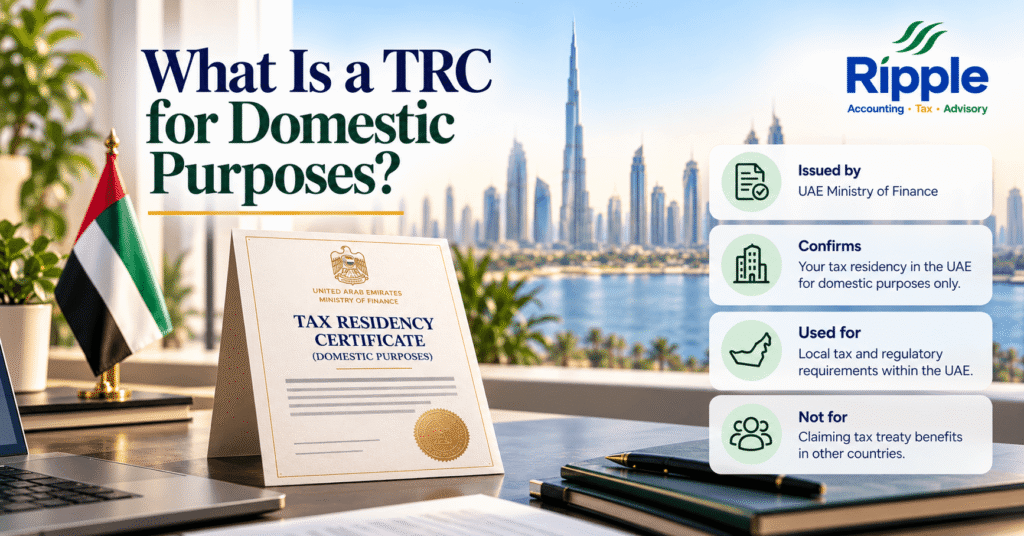
A TRC for domestic purposes is intended for situations in which an applicant needs to establish UAE tax residency for a purpose other than claiming benefits under a double taxation agreement.
For example, an individual may need evidence of their UAE tax residency for a domestic administrative or financial requirement. A company may also need documentation to support a matter that does not involve claiming relief under a particular tax treaty.
The applicable eligibility criteria are based on UAE domestic tax residency rules. For individuals, these rules can consider physical presence in the UAE, the person’s usual or primary place of residence, and the centre of their financial and personal interests.
Depending on the applicable conditions, potential applicants include:
Meeting one of these broad descriptions does not automatically guarantee approval. Applicants must satisfy the applicable criteria and provide sufficient supporting evidence.
For individuals, supporting documents may include an Emirates ID, residence visa, passport and entry-and-exit report. Depending on the residency route, the FTA may also request evidence of employment or business activity, a salary certificate, a tenancy agreement, property ownership documents or utility bills.
For companies, documents may include a trade licence, incorporation documents, financial records and other evidence relevant to the application.
The exact list depends on the applicant’s circumstances and the requirements applicable to the requested period. Consult the FTA’s Tax Resident and Tax Residency Certificate guide before preparing the application.
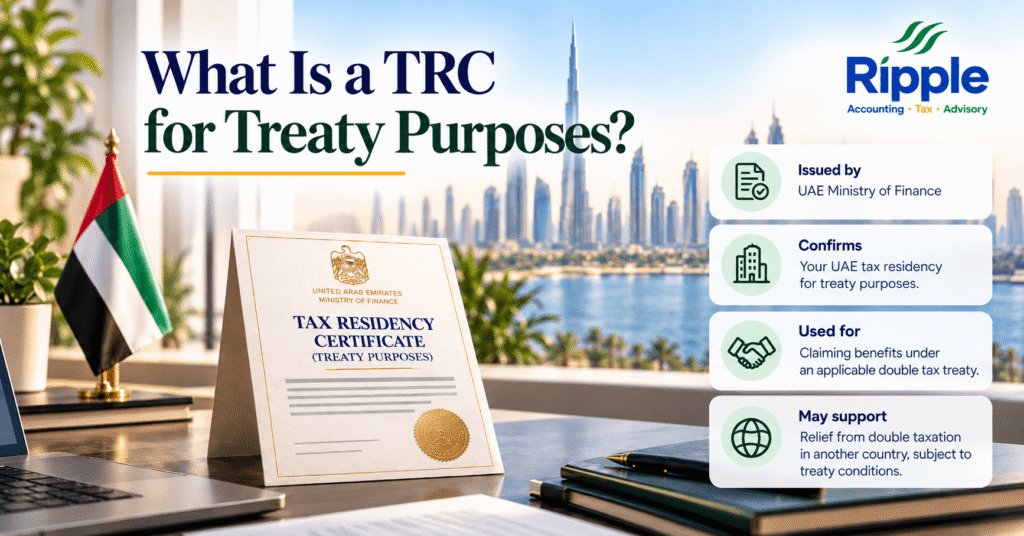
A TRC for treaty purposes is intended for applicants who need to rely on a UAE double taxation agreement with another country.
A DTA is an agreement between jurisdictions that establishes rules for addressing specified forms of international double taxation. Depending on the agreement and the circumstances, it may determine which country can tax particular income, provide reduced withholding tax rates or allow relief from tax charged in both jurisdictions.
A treaty-purpose TRC can support an applicant’s claim that they qualify as a UAE tax resident for the relevant agreement. However, obtaining the certificate does not automatically guarantee treaty benefits. The applicant must also meet the conditions of the applicable agreement and any relevant requirements imposed by the other country’s tax authority.
This type of certificate may be relevant to:
For example, a UAE-based company receiving overseas income may need to establish its residency when seeking relief under a treaty. Whether relief is available depends on the particular income, the treaty provisions and the company’s circumstances.
The documentation depends on the applicant and the relevant treaty. Individuals may need to provide proof of UAE residence, entry-and-exit records, bank statements, employment or income evidence, and documents establishing their connection to the UAE.
Companies may need to provide incorporation details, trade licences, financial information and other records requested by the FTA.
The foreign country may also require additional forms or evidence before granting treaty relief. Applicants should confirm these requirements with the relevant foreign tax authority or the organisation requesting the certificate.
The main distinction is the purpose for which the certificate is requested and the rules that apply.
| Comparison | Domestic-purpose TRC | Treaty-purpose TRC |
| Primary purpose | Establish UAE tax residency for a non-treaty purpose | Support a claim under a specific double taxation agreement |
| Applicable rules | Relevant UAE domestic tax residency rules | Relevant treaty conditions, together with applicable UAE requirements |
| Foreign tax relief | Does not itself establish eligibility for treaty relief | May support a treaty claim if all applicable conditions are met |
| Residency assessment | Based on the relevant domestic residency criteria | Depends on the applicable treaty and relevant residency conditions |
| Supporting documents | Evidence relevant to the domestic eligibility route | Evidence required by the FTA and, where applicable, the treaty or foreign authority |
| Intended use | The domestic or administrative purpose specified by the applicant | A cross-border tax matter involving an applicable treaty |
The important point is that these certificates are not interchangeable simply because both relate to UAE tax residency. Applicants should establish why the certificate is needed before selecting the application purpose.
One of the most important differences concerns the criteria used to assess residency.
Under the UAE’s domestic framework, an individual’s tax residency may be established through different routes. These include physical presence for the relevant period or, where the applicable conditions are met, having a primary place of residence and the centre of financial and personal interests in the UAE.
The FTA’s guidance discusses situations involving at least 183 days of physical presence, between 90 and 182 days with additional supporting conditions, and residency based on a person’s primary residence and centre of interests.
These routes have specific conditions. Spending 90 days in the UAE does not automatically qualify every applicant for a TRC.
For a treaty-purpose TRC, the applicable double taxation agreement is particularly important. The relevant treaty may contain its own definition of a resident, conditions for accessing treaty benefits or rules for resolving cases in which a person is considered resident in both countries.
The FTA’s general FAQ states that natural persons applying for a certificate for treaty purposes must meet the relevant residency requirements, including a 183-day condition in the circumstances described in its guidance. However, applicants should not treat that statement as a universal substitute for reviewing the relevant treaty and current FTA requirements.
For companies, the analysis may involve the applicable corporate residency rules and the relevant agreement’s provisions. Incorporation in the UAE alone should not be assumed to resolve every treaty-residency question.
Before starting an application, identify the organisation requesting the certificate and the purpose for which it will be used.
Ask whether you need to establish UAE tax residency for a domestic administrative matter or to claim a benefit under a specific DTA.
If you are applying for treaty purposes, establish which country and treaty are involved. Check whether the agreement covers the income or tax issue in question.
Review the applicable domestic residency rules or treaty conditions. Consider the relevant period, physical presence, residence evidence and other requirements that apply to your circumstances.
Collect the documents requested for your applicant category and application purpose. Ensure that names, dates, identification details and financial records are consistent.
Use the FTA’s official TRC service and follow the current application instructions. Review the application carefully before submitting it.
If the certificate will be used outside the UAE, confirm whether the foreign tax authority, bank or other recipient requires a particular certificate, a prescribed form or additional supporting documents.
Determining the appropriate Tax Residency Certificate (TRC) purpose and preparing supporting documents can be challenging, particularly for applicants with overseas income, company interests or cross-border transactions.
Ripple Accounting, Tax & Advisory can help individuals and businesses understand the documentation requirements for a UAE Tax Residency Certificate, organize relevant financial records and navigate the application process. Whether you need a TRC for domestic administrative purposes or to explore benefits under a double taxation agreement, obtaining guidance on the applicable requirements can help you prepare more effectively.
If you need assistance with your UAE Tax Residency Certificate application, explore Ripple Accountants services to discuss your circumstances, documentation requirements and the support available for your tax residency needs.
A domestic-purpose TRC is requested for a non-treaty purpose, while a treaty-purpose TRC supports a claim under a specific double taxation agreement. The applicable eligibility conditions and intended use differ.
Do not assume that a domestic-purpose certificate will meet the requirements for a treaty claim. Confirm the correct certificate type with the FTA and the foreign tax authority involved.
Not necessarily for every domestic-purpose application. UAE domestic rules provide different residency routes, subject to specific conditions and supporting evidence. Treaty-purpose applications must be assessed against the relevant agreement and current FTA requirements.
A company may apply if it meets the applicable requirements. Its legal status, relevant tax residency conditions, requested period and treaty circumstances should be reviewed before applying.
No. A TRC can support a claim under an applicable tax treaty, but relief depends on the agreement, the type of income and the applicant’s eligibility. Additional documentation or procedures may be required.
Choosing between a domestic-purpose and treaty-purpose TRC depends on why you need to establish UAE tax residency. Understanding the relevant eligibility rules, gathering the correct documents and checking the requirements of the requesting authority can help prevent application delays and misunderstandings.
Ripple Accounting, Tax & Advisory can support businesses with tax advisory and accounting services to help organise relevant records and prepare for tax compliance requirements.
Disclaimer: This article provides general information about UAE Tax Residency Certificates and is not legal or tax advice. Eligibility, documentation and treaty benefits depend on current UAE legislation, the relevant double taxation agreement and the applicant’s circumstances. Consult the FTA and the relevant tax authority before making an application or relying on a certificate for tax relief.
Tell us a little about your business and our UAE tax experts will get back to you with clear, practical answers — no obligation.
 VAT
Are you a UAE-based consultancy or agency selling services overseas while managing a remote team across different countries? Cross-border business can create…
Read article Compliance
Do you receive monthly financial reports but still struggle to answer one simple question: “What actually needs my attention right now?” For…
Read article Compliance
Could an entity qualify for UAE Corporate Tax exemption but still face an issue because it applied at the wrong time or…
Read articlePage 15 of 59
Book a free consultation and get clear answers for your business.
0 Comments