Corporate Tax Return Filing Cost in UAE 2026: Fees Explained
How much does Corporate Tax return filing cost in UAE, and are you paying the right amount for your business? The UAE…
Read article
Could your business explain every employee’s salary payment, deduction, overtime amount, and leave adjustment if an employee or regulator asked for proof?
For UAE employers, payroll involves more than transferring salaries to employees’ bank accounts. Businesses need reliable records showing how wages are calculated, what employees are entitled to receive, and whether payments match employment terms and applicable requirements. This guide explains UAE payslip requirements, the information a practical payslip should contain, the payroll records employers should maintain, and how to improve monthly payroll controls.
UAE payslip requirements concern the information employers provide to employees about their wages and the records used to calculate and verify payroll.
Employers should distinguish between three related areas:
These records serve different purposes. A payslip explains the salary calculation, while payroll records support that calculation and payment records demonstrate what was actually paid.
The UAE’s Federal Decree-Law No. 33 of 2021 on the Regulation of Employment Relationships, as amended, establishes important employer obligations concerning wages and employee records. However, the precise requirements depend on the employee’s category, applicable employment regime, and relevant regulations.
Employers can consult the official UAE Labour Law and the UAE government’s employment laws guidance when reviewing their obligations.
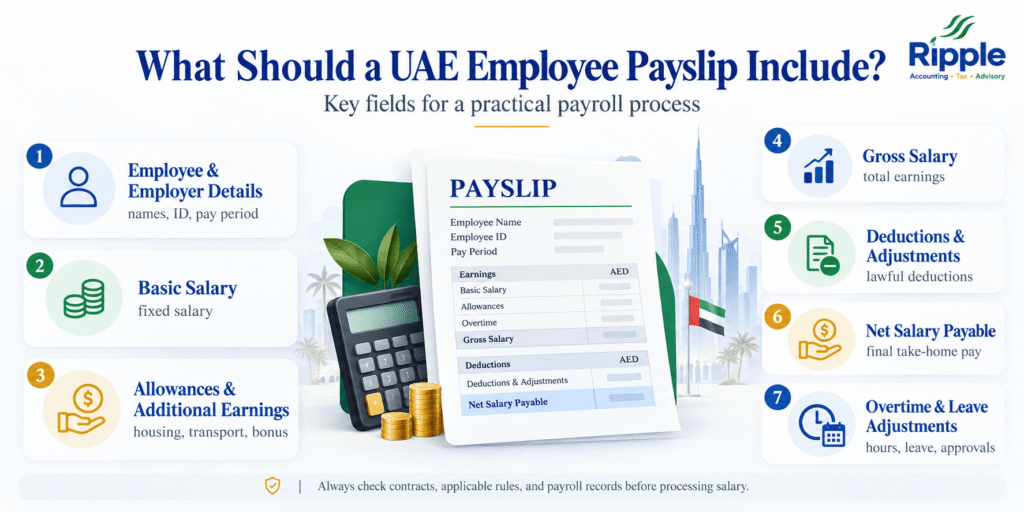
A clear payslip helps employees understand how their gross earnings translate into their final take-home pay. It also gives employers a consistent format for communicating salary calculations.
The following fields are recommended for a practical payroll process. They should not all be interpreted as universally mandated fields on every UAE payslip.
Each payslip should identify the employee and the business responsible for paying the salary.
Useful details include:
These details help HR and finance teams connect the payslip to the correct employment contract and payroll records.
For businesses with several branches or legal entities, identifying the correct employing entity is particularly important.
Basic salary is a key part of an employee’s remuneration and should be clearly distinguished from allowances and other payments.
For example, an employee’s monthly salary package might be structured as follows:
The actual contractual structure determines the employee’s entitlements. Employers should not assume that every component of the salary package is treated identically for all employment-related calculations.
Keeping basic salary separate from allowances also supports calculations where the applicable rules use basic salary rather than total remuneration.
A payslip should explain additional earnings included in the payment.
Depending on the employment contract and payroll arrangements, these may include:
Employers should classify each item consistently and distinguish salary components from reimbursements or other payments where appropriate.
If an employee receives a commission or bonus, the supporting payroll records should show how the amount was calculated and approved.
Gross salary represents the total earnings included in the payroll calculation before deductions.
A useful payslip should show how gross earnings were calculated rather than presenting only the final amount transferred to the employee.
For example:
| Earnings component | Amount |
| Basic salary | AED 6,000 |
| Housing allowance | AED 2,000 |
| Transport allowance | AED 1,000 |
| Gross monthly earnings | AED 9,000 |
This example assumes the employee is entitled to the full fixed monthly amounts for the relevant period and has no additional earnings or adjustments.
Where an employee joins or leaves during a month, or has unpaid leave or other adjustments, the payroll calculation should reflect the applicable contractual and legal rules.
Deductions should be transparent and supported by the relevant legal basis, contractual terms, or other applicable authority.
Depending on the employee’s circumstances, a payslip may show:
A deduction should not be made simply because an employer wishes to reduce the amount payable. UAE labour law regulates deductions and withholding from wages, including the circumstances in which they are permitted.
Employers should verify the applicable limits and conditions before processing a deduction.
For example, if an employee’s gross earnings are AED 9,000 and a lawful adjustment of AED 300 applies, the payroll statement should identify the reason for that adjustment rather than merely showing an unexplained reduction.
Net salary is the amount payable to the employee after accounting for the relevant earnings and lawful deductions.
A basic calculation is:
Net salary = Gross earnings − Applicable deductions
For example:
| Payroll calculation | Amount |
| Gross earnings | AED 9,000 |
| Lawful deductions | AED 300 |
| Net salary payable | AED 8,700 |
This is an illustrative calculation, not a statement that the listed deduction is appropriate in every situation.
The net salary shown on the payslip should agree with the payroll register and, subject to properly documented adjustments, the actual salary payment record.
Where overtime or leave affects payroll, supporting calculations should be retained.
Relevant information may include:
UAE labour law contains rules on working hours and overtime, subject to applicable exceptions and employment categories. Employers should calculate overtime using the correct legal basis rather than applying one formula to every employee.
Similarly, annual leave, sick leave, unpaid leave, and other absences should be processed according to the applicable rules and the employee’s circumstances.
A payslip is only one part of a complete payroll recordkeeping process.
Under Article 13 of Federal Decree-Law No. 33 of 2021, employers must maintain workers’ files and records according to the applicable Ministry requirements. The law specifies a minimum retention period of two years after the end of the worker’s service.
Employers should review the applicable rules to determine which documents must be retained and whether other laws or obligations require longer retention.
A practical payroll recordkeeping system should cover the following areas.
Retain the relevant employment contract and supporting documents that establish the employee’s salary and benefits.
Records may include:
These documents help establish what the employee was entitled to receive during each pay period.
A payroll register summarises the payroll calculation for all employees in a particular period.
It should generally capture employee identifiers, gross earnings, deductions, net salary, and relevant payment details.
The register should be reconciled with the individual payslips and the accounting entries for salaries and related expenses.
Where payroll is processed through software, businesses should ensure that reports can be retrieved in a readable format and linked to the underlying records.
Attendance and leave records support payroll calculations where working time or absence affects remuneration.
Maintain relevant records such as:
Access to sensitive employee documents should be limited to authorised personnel.
Salary calculations should be checked against actual payments.
For employees and establishments covered by WPS, retain the applicable wage transfer files, bank or exchange-house records, payment confirmations, and relevant exception documentation.
The UAE government’s official wage payment guidance explains the WPS framework and salary payment obligations. The current framework identified on that page includes Ministerial Resolution No. 340 of 2026. <Cite refs={[“turn785162search3”]}/>
Employers should verify which WPS rules and procedures apply to their establishment rather than assuming that the same arrangements apply to every entity or employment category.
Retain documentation supporting payroll adjustments and deductions.
Depending on the circumstances, this may include the relevant contractual provision, employee authorisation where applicable, approved adjustment, or other supporting evidence.
This helps the employer demonstrate why the payroll amount differs from the employee’s standard monthly remuneration.
When an employee leaves, payroll records should support the calculation of final salary and other applicable entitlements.
Depending on the circumstances, this may involve:
The calculation should follow the rules applicable to the employee’s employment arrangement.
The Wages Protection System is an electronic salary payment framework used to monitor wage payments for covered private-sector establishments.
WPS records and payslips serve different functions. A payslip explains the salary calculation, while WPS and related payment records provide evidence of wage transfers and compliance with the applicable payment process.
A sound monthly payroll control should compare:
Differences should be investigated promptly.
For example, if the payroll register shows AED 120,000 in net salaries but the submitted payment file totals AED 118,000, the employer should identify the reason before treating the payroll as fully reconciled.
The difference might relate to a legitimate documented adjustment, an excluded employee, a rejected transfer, or a processing error. It should not be left unexplained.
Employers should also monitor salary payment deadlines under the current WPS framework and applicable employment arrangements.
For workers covered by Federal Decree-Law No. 33 of 2021, Article 13 establishes a minimum period of two years for retaining worker files and records after the employment relationship ends. <Cite refs={[“turn785162search21″,”turn785162search22”]}/>
However, employers should not automatically apply this period to every record without considering other applicable obligations.
Additional requirements may arise from:
A practical retention policy should specify which records are retained, the applicable retention period, who can access them, and how documents are securely disposed of when retention is no longer required.
Electronic records can help employers retrieve historical payslips, payroll registers, and payment evidence efficiently, provided the records remain accessible, accurate, and appropriately protected.
A payment confirmation may prove that money was transferred, but it does not explain how the amount was calculated.
Better approach: Provide a clear salary breakdown and retain the supporting payroll calculation.
Combining all salary components into one figure can make it harder to check contractual entitlements and calculations based on basic salary.
Better approach: Record salary components separately in the payroll register and payslip where relevant.
An unexplained deduction can lead to disputes and make it difficult to demonstrate that payroll was processed correctly.
Better approach: Document the reason, calculation, and applicable authority for each deduction.
A successful wage transfer does not necessarily establish that all payroll calculations, leave adjustments, or employment entitlements are correct.
Better approach: Reconcile WPS records with the payroll register, payslips, and supporting documents.
Scattered records make it difficult to retrieve historical payroll information when an employee raises a query or an authorised reviewer requests documentation.
Better approach: Use a controlled digital filing system with consistent naming, restricted access, and reliable backups.
Employers can use this checklist before closing each payroll period.
A consistent monthly process reduces the risk of payroll errors and makes it easier to answer employee questions.
Managing payroll requires accurate calculations, reliable records, and a consistent review process. As a business grows, manual spreadsheets and scattered documents can make it harder to reconcile salaries, deductions, and payment records.
Ripple Accounting, Tax & Advisory provides payroll support to help UAE businesses organize payroll processes and maintain clearer financial records.
Support can include:
The precise scope of support depends on your business requirements and the applicable employment arrangements.
If your HR or finance team spends too much time correcting payroll differences or locating employee records, a structured review can help establish a more reliable process.
Contact Ripple Accounting, Tax & Advisory to discuss your payroll requirements and explore practical ways to improve payroll accuracy and recordkeeping.
Explore Ripple’s Payroll Services
A practical payslip should identify the employer, employee, and pay period, then show the relevant salary components, gross earnings, applicable deductions, and net salary payable. Overtime, leave adjustments, and other earnings should be shown where relevant. Employers should confirm any specific payslip requirements applicable to their employment arrangements.
Employers should maintain transparent payroll records and comply with applicable wage and employment requirements. A clear payslip is a good practice for explaining salary calculations, but employers should verify whether specific payslip issuance requirements apply to their establishment, employee category, or regulatory regime.
Article 13 of Federal Decree-Law No. 33 of 2021 specifies that worker files and records must be retained for at least two years after the end of service. Other applicable requirements may require additional or longer retention for particular documents. Employers should confirm the rules relevant to their records.
No. A payslip explains how an employee’s salary was calculated. WPS is an electronic wage payment framework for covered establishments. Employers should reconcile payslips, payroll registers, and wage payment evidence to ensure the figures agree.
Only deductions permitted under the applicable legal and contractual framework should be processed. UAE labour law regulates wage deductions and withholding. Employers should confirm the relevant conditions and limits, document the basis for each deduction, and retain supporting records.
UAE payslip requirements are part of a broader payroll control process. Employers need more than proof of a bank transfer: they need reliable calculations, clear salary breakdowns, supporting documents, and records that demonstrate how each employee’s pay was determined. By reviewing payslips, maintaining payroll registers, reconciling WPS payments where applicable, and following the relevant retention rules, employers can improve payroll accuracy and respond more confidently to employee queries and authorised reviews.
Need help organising your payroll records? Contact Ripple Accounting, Tax & Advisory for payroll support and practical guidance on improving your business’s payroll processes.
Disclaimer: This article provides general information and is not legal, employment, or tax advice. Applicable requirements may differ according to the employee’s category, employer’s jurisdiction, free-zone rules, and current regulations. Verify the latest requirements with the relevant UAE authority or a qualified adviser before making compliance decisions.
Tell us a little about your business and our UAE tax experts will get back to you with clear, practical answers — no obligation.
 Corporate Tax
How much does Corporate Tax return filing cost in UAE, and are you paying the right amount for your business? The UAE…
Read article Corporate Tax
Are you a freelancer in the UAE who earns income from consulting, design, marketing, or other independent services? Do you know when…
Read article Audit
Do you know how much cash your UAE business can actually use after accounting for customer payments due, supplier bills, and upcoming…
Read articlePage 3 of 58
Book a free consultation and get clear answers for your business.
0 Comments