UAE Metal Scrap VAT Reverse Charge: VATP046 Explained
M Maria October 6, 2026 7 min read
If your UAE business buys or sells metal scrap, who is now responsible for accounting for the VAT—the supplier or the buyer?
The Federal Tax Authority (FTA) has clarified this through VAT Public Clarification VATP046, covering the UAE metal scrap VAT reverse charge rules under Cabinet Decision No. 153 of 2025. The rules apply to qualifying metal scrap supplies made on or after 14 January 2026 and introduce specific responsibilities for both suppliers and recipients.
Here is what UAE metal scrap businesses need to understand.
What Is the UAE Metal Scrap VAT Reverse Charge?
Under normal UAE VAT rules, a supplier generally charges VAT on a taxable supply and accounts for that VAT in its return.
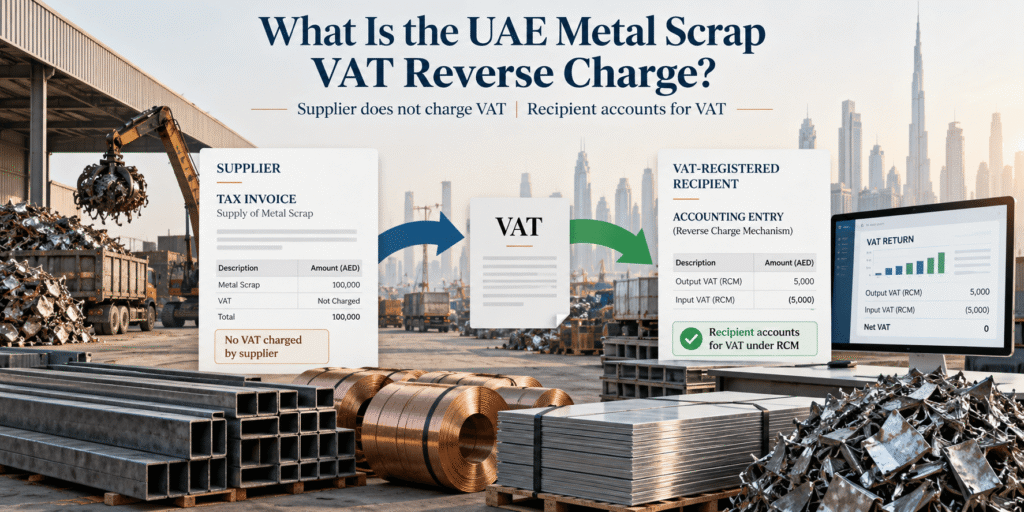
The reverse charge mechanism for metal scrap in the UAE changes this responsibility for qualifying transactions.
Where the conditions are met:
the supplier does not account for VAT on the qualifying metal scrap supply; and
the recipient becomes responsible for accounting for the VAT under the Reverse Charge Mechanism.
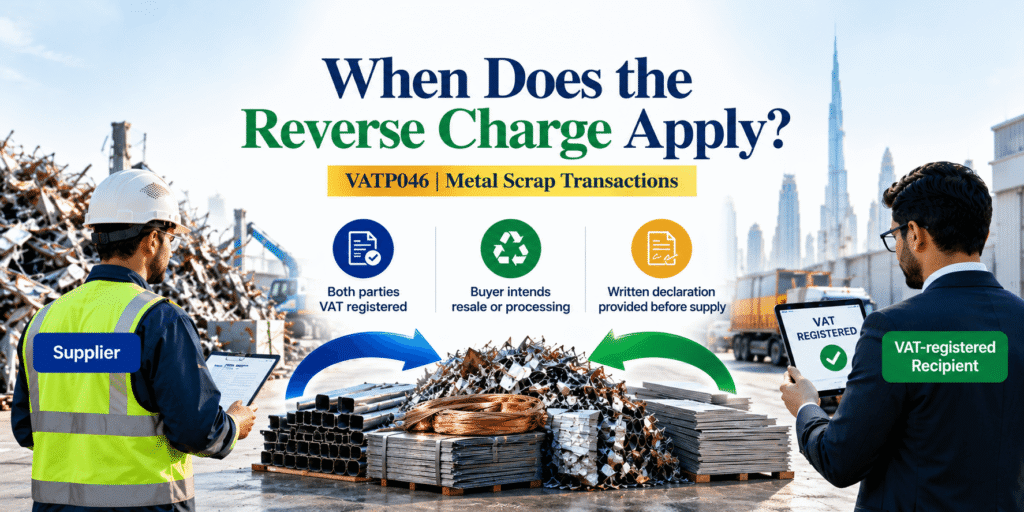
VATP046 confirms that this treatment applies when metal scrap is supplied between VAT Registrants and the recipient intends to resell the scrap or use it in processing.
Cabinet Decision No. 153 of 2025 introduced the mechanism, effective from 14 January 2026. The Ministry of Finance explained that the measure is intended to strengthen VAT compliance and reduce risks of fraud in the metal scrap sector.
Which Metal Scrap Is Covered?
VATP046 defines qualifying Metal Scrap as ferrous or non-ferrous metal waste that:
has commercial value; and
can be used following processing.
Processing includes converting the scrap into materials that can be used to manufacture new products through recycling, repair or another method.
For example, certain used lead-acid batteries may qualify where lead forms the majority of the product and is the main material recovered during processing.
However, the clarification specifically states that materials such as:
paper;
plastic;
glass;
textiles;
organic waste; and
rubber
do not fall within this metal scrap reverse charge rule and remain subject to normal VAT treatment.
When Does the Reverse Charge Mechanism Apply?
The UAE metal scrap VAT reverse charge does not apply merely because both businesses trade scrap.
The recipient must intend to either:
Resell the metal scrap, whether at wholesale or retail level; or
Use the metal scrap in processing to produce usable materials or new products.
Metal scrap purchased for another internal business purpose may not qualify.
For example, the FTA explains that scrap purchased for internal maintenance—such as repairing storage racks, fences or structural supports—is not considered to have been acquired with an intention to resell.
What Must the Recipient Do?
Before the date of supply, the recipient must provide the supplier with written declarations confirming:
that the metal scrap is being purchased for resale or processing; and
that the recipient is registered for UAE VAT, including relevant tax registration details such as its TRN.
The FTA allows these two declarations to be combined into one document.
Where all requirements are satisfied, VATP046 states that the recipient must report the transaction in Box 3 of the VAT Return and may recover eligible VAT in Box 10. Box 9 should not be used for this input tax recovery.
What Must the Supplier Do?
The supplier also has specific responsibilities before applying the reverse charge mechanism on metal scrap in the UAE.
The supplier must:
receive and retain the recipient’s declarations;
verify that the recipient is VAT registered using the FTA’s TRN verification tool; and
ensure the tax invoice clearly states that the metal scrap supply is subject to the Reverse Charge Mechanism.
Where the RCM conditions are satisfied, the supplier does not account for VAT on the supply and does not report that supply and related VAT in its VAT Return.
What Happens If the Conditions Are Not Met?
This is one of the most important compliance points in VATP046.
If the recipient fails to provide the required declarations before the date of supply, the reverse charge conditions are not satisfied.
The normal VAT rule then applies.
The supplier must:
charge VAT at the applicable standard rate; and
report the supply in Box 1 of the VAT Return.
VATP046 further states that, in this situation, the recipient would not be eligible to recover the input tax incurred on that purchase under the provisions explained in the clarification.
This makes pre-supply documentation particularly important for businesses applying the metal scrap VAT UAE rules.
Are Metal Scrap Exports Covered?
No—not where the relevant export qualifies for zero-rating.
VATP046 confirms that Cabinet Decision No. 153 of 2025 does not apply to qualifying Direct or Indirect Exports of Metal Scrap.
Where the zero-rating conditions are satisfied, normal VAT rules apply and the supplier reports the transaction as a zero-rated supply.
Practical VATP046 Compliance Checklist
Businesses involved in UAE metal scrap trading should review whether they:
correctly identify qualifying metal scrap;
confirm both parties’ VAT registration status;
determine whether the buyer intends resale or processing;
obtain written declarations before the supply date;
verify the recipient’s TRN through the FTA;
retain supporting declarations and transaction records;
include the required RCM statement on tax invoices; and
report transactions in the correct VAT Return boxes.
Documentation should form part of the transaction process—not something reconstructed after the VAT Return is prepared.
How Can Ripple Accountants Help?
Applying the UAE metal scrap VAT reverse charge incorrectly can affect invoicing, VAT reporting and input tax recovery.
VATP046 is an FTA VAT Public Clarification explaining how the Reverse Charge Mechanism applies to qualifying metal scrap transactions between UAE VAT Registrants.
When did the UAE metal scrap reverse charge rules become effective?
Qualifying metal scrap supplied on or after 14 January 2026 is subject to Cabinet Decision No. 153 of 2025 and the relevant compliance requirements.
Does the supplier charge VAT under the metal scrap RCM?
Where all conditions are satisfied, no. The supplier does not account for VAT; the recipient accounts for the VAT under the Reverse Charge Mechanism.
Does the RCM apply to plastic or paper scrap?
No. VATP046 states that paper, plastic, glass, textiles, organic waste and rubber are outside this specific metal scrap mechanism and remain subject to normal VAT rules.
What declarations are required before supply?
The recipient must confirm in writing that it is VAT registered and that the metal scrap is being acquired for resale or processing. The declarations may be combined into one document.
What happens if the required declaration is missing?
If the conditions are not met, the supplier must apply the normal VAT treatment and report the supply accordingly. The recipient may also lose the right to recover the related input tax as explained in VATP046.
Conclusion
VATP046 provides important practical guidance for businesses applying the reverse charge mechanism to metal scrap in the UAE. The main principle is straightforward: where qualifying metal scrap is supplied between VAT Registrants for resale or processing, responsibility for accounting for VAT shifts to the recipient—but only when all required conditions and documentation are completed. For suppliers and recipients, written declarations, TRN verification, correct invoicing and accurate VAT Return reporting are therefore essential.
Disclaimer: This article is for general informational purposes only and does not constitute tax, legal or professional advice. The VAT treatment of a transaction depends on its specific facts and supporting documentation. Businesses should review the applicable UAE VAT legislation, Cabinet Decision No. 153 of 2025, VATP046 and current Federal Tax Authority guidance before applying the Reverse Charge Mechanism.
Non-profit organizations play a vital role in supporting communities, advancing education, promoting healthcare, protecting the environment, and delivering humanitarian aid across the…
Businesses have traditionally relied on financial reports such as revenue, profit, cash flow, and expenses to evaluate performance. While these metrics remain…
Auditing different types of businesses is essential because every industry operates with unique financial processes, regulations, and risks. A manufacturing company manages…



0 Comments