Accounting for Non-Current Assets and Capital Expenditures
Non-current assets and capital expenditures play a critical role in a company’s long-term financial health. Whether you own a startup, manage an…
Read article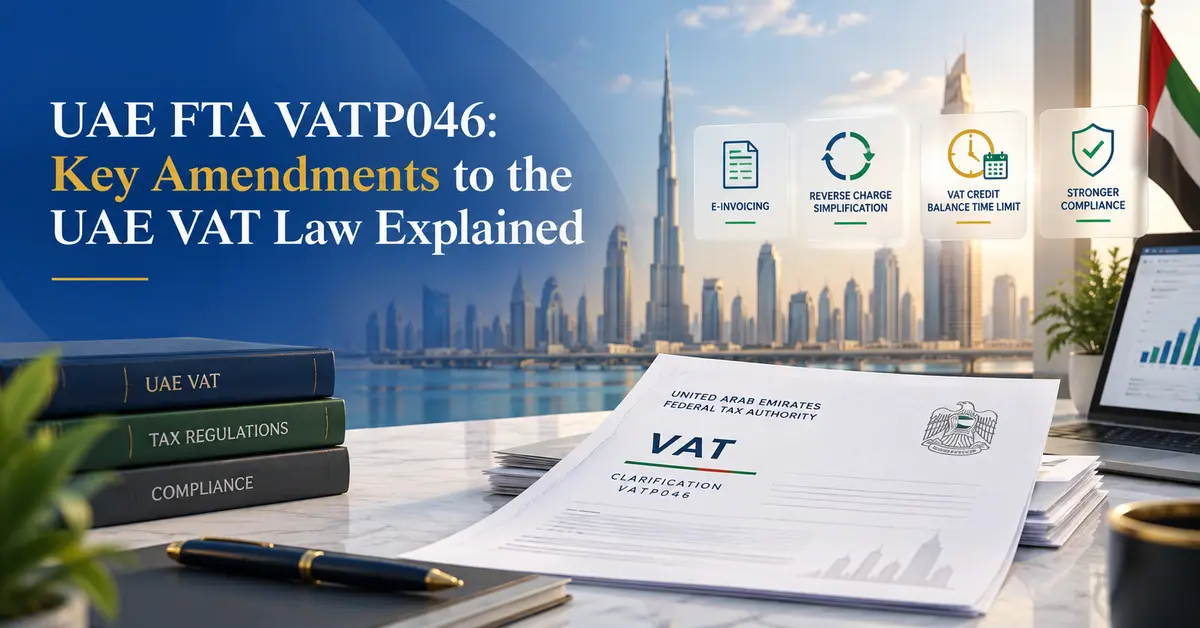
The UAE Federal Tax Authority has issued VAT Public Clarification VATP046 on 4 September 2026, providing detailed guidance on significant amendments to Federal Decree-Law No. 8 of 2017 on Value Added Tax.
The clarification covers amendments introduced through Federal Decree-Law No. 16 of 2024, effective from 30 October 2024, and Federal Decree-Law No. 16 of 2025, effective from 1 January 2026. Importantly, VATP046 itself does not create new legislation. Its purpose is to explain the FTA’s position on how the amended VAT provisions should be understood and applied.
For UAE businesses, finance teams, and tax professionals, VATP046 is significant because it addresses practical areas including e-invoicing, input VAT recovery, reverse charge transactions, VAT credit balances, supplier due diligence and administrative penalties.
VATP046 is an official VAT Public Clarification issued by the Federal Tax Authority. The FTA states that its purpose is to highlight the main changes made to the UAE VAT Decree-Law by the 2024 and 2025 amendments. The clarification covers amendments to Articles 1, 48, 55, 65, 70, 74 and 76, introduces new Article 54 bis, and explains the repeal of Article 79 bis.
This means businesses should not view VATP046 as simply another technical publication. Several of the clarified provisions affect everyday VAT controls, particularly invoicing, recoverability of input VAT and documentation.
| Area | Main Change |
| E-Invoicing | Electronic Invoice, Electronic Credit Note and Electronic Invoicing System formally recognised |
| Input VAT Recovery | Electronic tax invoice may be required to support recovery where e-invoicing applies |
| Tax Invoices | Businesses subject to e-invoicing must issue and transmit qualifying invoices electronically |
| Reverse Charge | Self-issued tax invoices removed for certain imported goods and services from 1 January 2026 |
| VAT Credit Balances | Five-year period applies to refund/use of relevant excess recoverable VAT |
| Tax Evasion | Input VAT may be denied where a supply chain is linked to tax evasion |
| Supplier Due Diligence | Businesses need to verify the validity and integrity of supplies |
| Penalties | Failure to issue required invoices or credit notes within prescribed periods may result in penalties |
| Statute of Limitation | VAT Article 79 bis repealed as limitation rules are covered by the Tax Procedures legislation |
One of the amendments explained in VATP046 concerns the definition of a Non-Resident for UAE VAT purposes. The clarification explains that a person may be considered resident where that person has a Place of Establishment or Fixed Establishment in the UAE, regardless of whether the person owns the premises.
The FTA gives the example of employees of a foreign business regularly working from a client’s premises in the UAE. Depending on the circumstances, the presence of employees together with technological resources used in the UAE may create a Fixed Establishment. Consequently, the foreign business would not necessarily be treated as a Non-Resident for VAT purposes.
This is particularly relevant to international businesses that provide services in the UAE using personnel or resources located within the country.
Businesses should therefore avoid assuming that a lack of property ownership automatically means there is no UAE Fixed Establishment.
A major part of the 2024 VAT amendments concerns the UAE’s move towards electronic invoicing. Article 1 introduced definitions for:
Under VATP046, an Electronic Invoice is an invoice issued, transmitted and received in a structured electronic format that enables automatic and electronic processing in accordance with the Electronic Invoicing System.
The Ministry of Finance previously explained that these changes form part of the UAE’s broader implementation of its e-invoicing framework, intended to standardise and automate invoice exchange and tax reporting.
This distinction is particularly important. VATP046 states that merely being an Electronic Invoice does not automatically make a document a valid Tax Invoice.
Similarly, an Electronic Credit Note does not automatically qualify as a Tax Credit Note. The normal VAT requirements contained in the Executive Regulation must still be satisfied. Businesses therefore need to consider both: the technical e-invoicing requirements, and the substantive VAT invoice requirements.
Meeting one does not necessarily mean the other has automatically been satisfied.
VATP046 also explains an important amendment to Article 55, dealing with the recovery of input VAT. Where an Electronic Invoice is required to be issued under the Electronic Invoicing System, or where one has been issued in accordance with that system, the taxable person must retain the tax invoice in the required electronic format to recover the related input VAT.
This has a practical consequence. E-invoicing should not be treated purely as an accounting software or IT project. Invoice compliance may directly affect the business’s ability to support its input VAT deduction.
Businesses preparing for e-invoicing should therefore coordinate between their tax, finance, accounting, procurement and IT functions.
Changes to Article 65 require registrants that are subject to the Electronic Invoicing System to issue and transmit Tax Invoices in the form of Electronic Invoices according to that system. Likewise, the amendment to Article 70 requires affected registrants to issue and transmit Tax Credit Notes in the required electronic format.
However, VATP046 also makes an important distinction for businesses that are not yet subject to the Electronic Invoicing System. Those businesses must continue following the existing general VAT rules for issuing and delivering Tax Invoices and Tax Credit Notes.
In other words, businesses should determine whether and when the e-invoicing requirements apply to them rather than assuming the same requirement automatically applies to every VAT registrant at the same time.
VATP046 also explains amendments to Article 76 concerning administrative penalties. Failure to issue a required Tax Invoice, Tax Credit Note or qualifying alternative document within the legally prescribed period may lead to an Administrative Penalty Assessment.
For registrants covered by the Electronic Invoicing System, the obligation extends to issuing and transmitting the relevant invoices and credit notes electronically through the prescribed system.
This increases the importance of having reliable invoice controls. Businesses should review not only whether their invoices contain the correct information, but also whether they are being issued and transmitted within the prescribed timeframe and in the required format.
Another important change explained by UAE FTA VATP046 concerns the Reverse Charge Mechanism. Article 48(1) was amended to remove the requirement for a taxable person to issue a Tax Invoice to itself when importing Concerned Goods or Concerned Services.
The change applies to relevant goods and services imported on or after 1 January 2026. However, removing the self-invoice does not remove the VAT obligation.
The taxable person must still: account for VAT on the relevant supply, and retain the supporting documentation required under the Executive Regulation.
The Ministry of Finance described the change as a measure designed to reduce administrative burden while maintaining sufficient audit evidence and compliance controls. For imports before 1 January 2026, VATP046 directs taxpayers to the relevant earlier FTA clarifications—VATP044 for Concerned Services and VATP045 for Concerned Goods.
One of the most commercially important amendments concerns excess Recoverable Tax under Article 74. Where excess recoverable VAT remains after the FTA has offset amounts against Payable Tax or applicable Administrative Penalties, the taxable person may submit an application for a refund. The amended provision introduces a five-year time limit for requesting the refund of the relevant excess Recoverable Tax. The five-year period is calculated from the end of the Tax Period in which the excess arose.
VATP046 also explains that where the amount is neither refunded nor used to settle Payable Tax or Administrative Penalties before the five-year period expires, the taxpayer’s entitlement in relation to the remaining balance can lapse.
VATP046 gives an example of a taxable person with excess recoverable VAT arising from a Tax Period ending 31 January 2026. That credit balance may be carried forward for five years, until 31 January 2031. During that period, the balance may be used against Payable Tax or Administrative Penalties, or the taxpayer may apply for a refund.
If the relevant balance remains unused and no refund request is made before the end of that five-year period, the right relating to the unused balance may be forfeited.
For businesses with long-standing VAT credit positions, this makes VAT credit ageing an important compliance and cash-flow management issue.
VATP046 also explains the introduction of Article 54 bis, which deals with input VAT connected to tax evasion. The FTA may reject the deduction of Recoverable Input Tax where it establishes that the underlying supply—or a chain of supplies, is related to Tax Evasion and the taxable person:
knew about the connection, or should have known about it based on the circumstances. This introduces an important compliance consideration for purchasers.
VAT recovery is no longer only about having an invoice and satisfying the standard conditions for deduction. The integrity of the underlying transaction and supply chain can also become relevant.
VATP046 goes further by explaining when a taxable person may be regarded as someone who should have known about a connection to tax evasion. The clarification states that a taxable person can be considered required to have been aware where it failed to verify the validity and integrity of the supplies before deducting input VAT.
The concept of the supply chain is also not restricted only to the taxpayer’s direct supplier or customer. It can extend to other persons involved in the wider chain connected with the tax evasion.
The FTA has also issued FTA Decision No. 13 of 2026, setting out measures, procedures and conditions relating to the verification of the validity and integrity of supplies before input tax is deducted.
This means supplier onboarding and transaction verification should increasingly be viewed as part of VAT risk management.
Businesses may need stronger procedures around supplier identity, commercial legitimacy, supporting documentation and unusual transaction patterns.
VATP046 also confirms that Article 79 bis of the VAT Decree-Law, relating to the statute of limitation, has been repealed. The reason is that statute-of-limitation provisions are already addressed under Federal Decree-Law No. 28 of 2022 on Tax Procedures and its amendments.
This does not mean limitation periods have disappeared. Rather, the relevant rules are dealt with under the broader Tax Procedures legislation instead of being duplicated within the VAT Decree-Law.
The significance of VATP046 extends beyond individual legislative amendments. It demonstrates a broader direction in UAE VAT compliance: greater digitisation, stronger documentation requirements and increased attention to the integrity of transactions behind VAT deductions.
A business may file mathematically correct VAT returns and still face issues if the underlying processes are weak.
Businesses should therefore review their current VAT framework across several areas: e-invoicing readiness, invoice validation, input VAT documentation, reverse charge procedures, aged VAT credit balances, supplier due diligence and record retention.
Particular attention should be given to VAT credit balances that have been carried forward for extended periods. Businesses should identify when each relevant balance arose and determine whether action is required before the applicable five-year period expires.
At the same time, procurement and accounts-payable teams should understand that supplier verification is no longer only a commercial risk-management exercise. It can also affect whether input VAT remains recoverable.
Following the clarification, a UAE business should consider reviewing whether its accounting system can support applicable e-invoicing requirements; whether electronic invoices satisfy VAT invoice requirements; whether valid supporting documents are retained for input tax recovery; whether reverse charge procedures have been updated for imports from 1 January 2026; whether VAT credit balances are tracked by originating tax period; whether supplier onboarding includes sufficient verification controls; and whether Tax Invoices and Tax Credit Notes are issued within applicable deadlines. The exact actions required will depend on the taxpayer’s business model, transactions and the e-invoicing rules applicable to it.
No. This distinction is important. VATP046 is a Public Clarification, not a new Federal Decree-Law. The underlying legislative amendments were introduced by Federal Decree-Law No. 16 of 2024 and Federal Decree-Law No. 16 of 2025.
The 2024 amendments took effect from 30 October 2024, while the 2025 amendments took effect from 1 January 2026. VATP046, issued on 4 September 2026, explains the FTA’s position regarding the implementation of those provisions.
The FTA expressly states that the clarification neither amends nor seeks to amend the legislation and generally takes effect from the implementation date of the relevant legislation unless otherwise stated.
Ripple Accountant can support UAE businesses with accounting and bookkeeping processes, inventory-related accounting, reconciliations, VAT support and management reporting. Contact Ripple Accountant to review your accounting and control processes and build a system suited to your operations.
UAE FTA VATP046 is an important clarification for VAT-registered businesses because it brings several significant legislative changes into one practical framework. E-invoicing is becoming integrated with VAT compliance and input tax recovery. Reverse charge procedures have been simplified, but documentation remains essential. Excess recoverable VAT can no longer simply be left unmanaged indefinitely. And businesses now face clearer expectations around validating suppliers and transactions before claiming input VAT.
Disclaimer: This article is for general informational purposes only and should not be considered tax or legal advice. The application of UAE VAT legislation depends on the specific facts and circumstances of each business.
Tell us a little about your business and our UAE tax experts will get back to you with clear, practical answers — no obligation.
 Bookkeeping
Non-current assets and capital expenditures play a critical role in a company’s long-term financial health. Whether you own a startup, manage an…
Read article Bookkeeping
Expanding into international markets is an exciting milestone for any business. It opens the door to new customers, increased revenue, and long-term…
Read article Compliance
Financial instruments play a critical role in modern business, from trade receivables and business loans to investments and corporate debt. To improve…
Read articlePage 41 of 45
Book a free consultation and get clear answers for your business.
0 Comments