Input VAT vs Output VAT UAE: A Practical Guide
Do you know the difference between the VAT your business charges customers and the VAT it pays on business expenses? Understanding input…
Read article
Would your business be ready if the Federal Tax Authority asked for your tax records tomorrow?
UAE FTA audit readiness is not just about responding when an audit begins. It means keeping accurate tax records, maintaining supporting documents, reconciling financial information, and ensuring that tax returns can be supported by reliable evidence. For UAE businesses, preparing in advance can make the audit process more organized and help identify gaps before they become compliance problems. This checklist explains the key areas businesses should review when preparing for an FTA tax audit.
A tax audit is a procedure through which the FTA examines a person’s tax position, records, information or other relevant data to verify compliance with UAE tax legislation.
Under the UAE Tax Procedures Law, the FTA has powers relating to tax audits, while taxpayers subject to an audit have corresponding rights and obligations. The law also requires businesses with tax obligations to maintain accounting records and commercial books and retain tax-related information as required by the applicable legislation.
The FTA’s VAT guidance explains that a tax audit can involve examination of records and information and may take place at the business premises or at FTA offices.
Businesses should therefore treat audit preparation as an ongoing compliance process rather than something that begins only after receiving an audit notification.
An FTA audit may require a business to explain how figures reported in tax returns were calculated and provide supporting records. If accounting records are incomplete, transactions are difficult to trace or supporting documents cannot be located, responding to the FTA can become more difficult. Good preparation can help businesses:
The FTA has specifically reminded Corporate Tax taxpayers of their obligation to maintain records and documents supporting information reported in their Tax Returns. The FTA notes examples such as records of transactions, assets, liabilities and shares held at the end of the tax period.
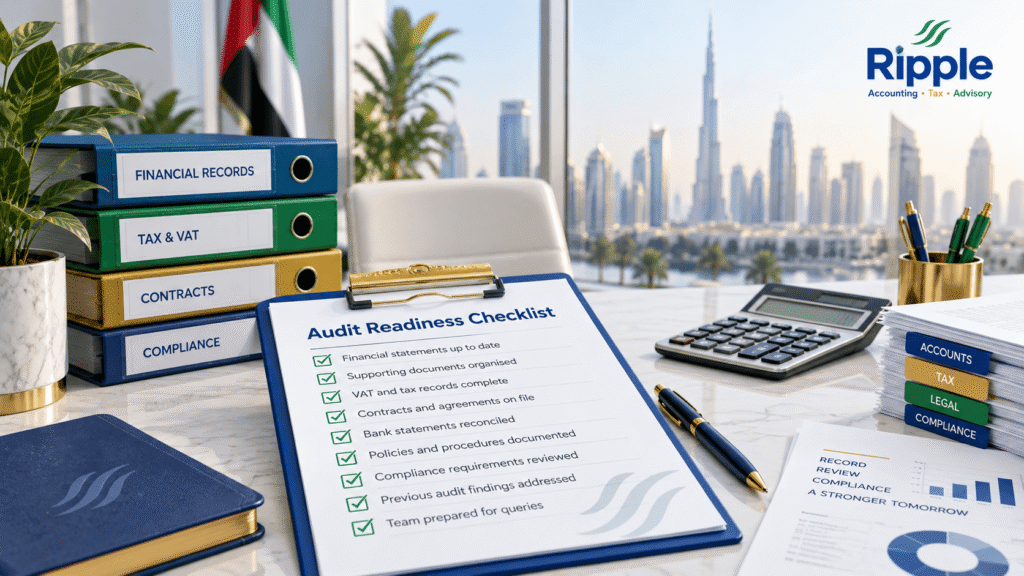
A practical UAE FTA audit readiness review should cover tax registrations, returns, accounting records, invoices, reconciliations, payments and supporting documentation.
Start by checking whether the information held in your FTA tax records is accurate and up to date. Review details such as:
Changes to business information should not simply be ignored because the business has already registered. The FTA has previously highlighted the importance of keeping tax registration information updated and complying with the applicable notification requirements.
Keeping registration information accurate helps ensure that the company’s tax profile reflects its actual circumstances.
Collect copies of your previous VAT, Corporate Tax or other applicable tax returns. Then compare the returns with the underlying accounting records. Ask:
This review can help identify inconsistencies before the FTA asks the business to explain them.
Accounting records form an important part of audit readiness. Businesses should be able to trace reported figures back to supporting transactions and documentation.
Review whether the business maintains:
The Tax Procedures Law requires persons conducting business or having a tax obligation to keep accounting records and commercial books and retain tax-related information according to the applicable requirements. For detailed legal requirements, businesses should refer directly to the official Federal Decree-Law No. 28 of 2022 on Tax Procedures.
Sales invoices should be reviewed to determine whether they contain the information required under the applicable tax rules.
Businesses should check:
For VAT-registered businesses, sales transactions should also be reconciled with VAT return figures. Missing or inconsistent invoices can make it harder to demonstrate how reported taxable supplies were calculated.
The same level of attention should be given to purchases and expenses. Check whether significant expenses have appropriate supporting documentation, such as invoices, contracts, receipts, payment evidence or other relevant records.
The purpose is not to create documents after the fact. It is to ensure that legitimate transactions are supported by records that were maintained as part of normal business operations.
For VAT-registered businesses, reconciliation should be a key part of an FTA tax audit UAE preparation process.
Compare:
Accounting records → VAT workings → VAT return → FTA submission → Tax payment
Investigate differences rather than carrying them forward without explanation.
Review:
The FTA’s VAT guide explains that VAT is a self-assessment tax and that tax audits allow the Authority to verify whether declarations are correct.
Corporate Tax taxpayers should make sure that the figures reported in the Corporate Tax return can be reconciled to their accounting records.
Review:
The FTA has specifically stated that Corporate Tax taxpayers must retain records and documents supporting information provided in their Tax Returns.
Bank reconciliation is another important audit-readiness control. Make sure business bank accounts are reconciled and that old unreconciled items have been investigated.
Review whether:
A tax audit may involve tracing transactions through financial records, so unexplained bank activity can create unnecessary questions.
Businesses should check whether tax amounts reported as payable were actually paid and whether the accounting records reflect the correct balances.
Review:
If a tax amount remains outstanding, the business should understand why and determine what action is required.
One of the simplest ways to improve UAE FTA audit readiness is to organise documents before they are requested. Create a structured digital filing system for relevant tax periods.
Depending on the business, this may include:
| Document Category | Examples |
| Tax records | VAT and Corporate Tax returns |
| Accounting records | General ledger, trial balance |
| Sales | Invoices, credit notes, contracts |
| Purchases | Supplier invoices, receipts |
| Banking | Bank statements, reconciliations |
| Payroll | Payroll records and supporting information |
| Assets | Asset register, purchase and disposal records |
| Tax payments | Payment confirmations and records |
| Corporate Tax | Tax computation and supporting schedules |
| Agreements | Customer, supplier and related-party agreements |
The exact documents required will depend on the business and the nature of the FTA request.
There is no single universal document list that applies identically to every business or every audit. The documents requested can depend on the tax type, business activity, accounting records and matters being reviewed.
However, businesses should generally be prepared to provide relevant records supporting their tax position. These may include:
Under the Tax Procedures Law, a person subject to a tax audit is required to cooperate and provide assistance to the tax auditor. The law also provides certain rights, including the right to request identification from the tax auditor and obtain a copy of the tax audit notification.
Receiving an FTA information request does not mean the business should respond without first organising its records.
A practical approach is to:
Identify the tax type, tax period and specific information requested.
Turn the request into a checklist so nothing is accidentally missed.
Before submitting documents, check that the figures agree with accounting records and previous tax filings.
If information is missing or inconsistent, investigate the reason rather than ignoring the issue.
Organise documents logically and provide explanations where necessary.
Maintain a complete record of what was submitted and when it was submitted.
The Tax Procedures Law provides that the FTA informs the person subject to the tax audit of the audit result within the applicable timeframe and procedures. It also provides rights concerning access to documents and data on which certain assessments and penalties are based.
Businesses can face unnecessary difficulties when their records are not properly organised. Common weaknesses include:
These issues do not automatically mean that a business has breached tax legislation. However, they can make it harder to demonstrate that tax returns are accurate.
Preparing for an FTA audit can involve reviewing accounting records, tax returns, reconciliations and supporting documentation across multiple periods.
Ripple Accountants can support UAE businesses with practical accounting, tax, and compliance services, including accounting and bookkeeping, financial reporting, account reconciliation, VAT registration and filing, Corporate Tax support, compliance reviews and, audit support. Ripple can help businesses review their records, identify potential gaps, and organize relevant financial information before an FTA audit or compliance review.
If your business has received an FTA query or wants to improve its UAE FTA audit readiness, contact Ripple Accounting, Tax & Advisory to discuss your requirements and get tailored compliance support!
UAE FTA audit readiness means keeping a business’s tax returns, accounting records, supporting documents and reconciliations organised and available so the business can respond appropriately if the FTA conducts an audit or requests information.
The documents depend on the tax type, business and scope of the audit. They may include tax returns, general ledgers, financial statements, invoices, bank statements, reconciliations, contracts, tax calculations, payment records and other documents supporting the company’s tax position.
The applicable tax legislation provides rules concerning tax audit notification and procedures. Businesses should not assume that every audit will follow exactly the same process. The FTA’s Tax Procedures Law and applicable regulations should be reviewed for the circumstances of the specific audit.
A business can prepare by reviewing tax registrations, previous returns, accounting records, invoices, bank reconciliations, VAT records, Corporate Tax calculations, tax payments and supporting documents. It should also organise records by tax period so requested information can be located efficiently.
Yes. Ripple Accounting, Tax & Advisory can support businesses with accounting, reconciliation, tax, compliance review and audit-support requirements. Businesses can contact Ripple to discuss their specific FTA audit-readiness needs.
Good UAE FTA audit readiness starts long before an audit notification arrives. Businesses should maintain accurate accounting records, keep supporting documents organised, reconcile tax information with financial records and regularly review their compliance position. A practical readiness checklist can help businesses identify gaps in invoices, tax returns, reconciliations, accounting records and supporting documentation. Regular internal reviews can make tax compliance more manageable and help businesses respond to official requests in a clear and organised way.
Disclaimer: This article is provided for general informational purposes and does not constitute legal, tax, accounting or professional advice. UAE tax legislation, regulations, decisions and FTA guidance may change. The appropriate treatment can also depend on the specific facts and circumstances of a business. Businesses should verify the latest requirements through official FTA publications and obtain professional advice where necessary.
Tell us a little about your business and our UAE tax experts will get back to you with clear, practical answers — no obligation.
 VAT
VAT
Do you know the difference between the VAT your business charges customers and the VAT it pays on business expenses? Understanding input…
Read article VAT
VAT
Are small VAT return mistakes creating more work for your finance team than the VAT filing itself? For VAT-registered businesses in the…
Read article Compliance
Are you sure your construction payroll shows not only who was paid, but also which site and project incurred the labor cost?…
Read articlePage 4 of 45
Book a free consultation and get clear answers for your business.
0 Comments