UAE Free Zone vs Designated Zone: TAXP010 Explained
M Maria October 3, 2026 7 min read
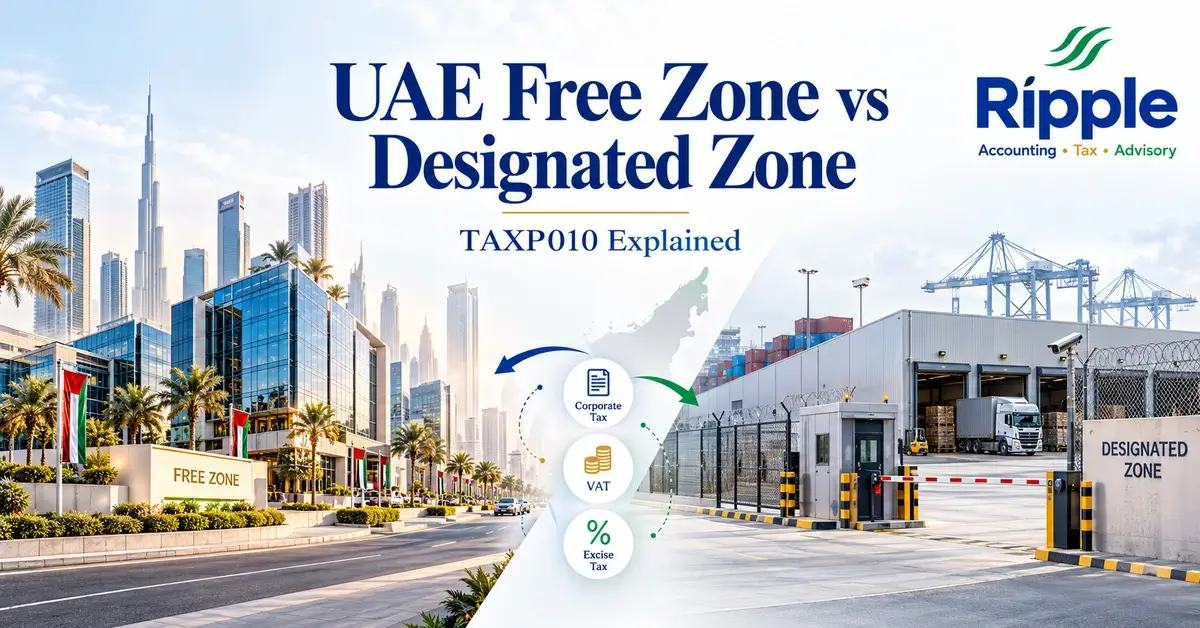
Is your UAE Free Zone automatically treated as a Designated Zone for Corporate Tax, VAT and Excise Tax?
The answer is no — and this is the key point behind the Federal Tax Authority’s new TAXP010 – Free Zones and Designated Zones for Tax Purposes, issued on 2 October 2026.
The clarification explains that the meaning of a Free Zone or Designated Zone can differ depending on whether the business is being assessed for Corporate Tax, VAT or Excise Tax. Businesses therefore need to check their zone status separately under each tax regime rather than assuming one classification applies across all taxes.
What Does UAE Free Zone vs Designated Zone Mean?
The distinction between a UAE Free Zone vs Designated Zone is important because the tax treatment may differ significantly depending on the applicable tax law.
A business may therefore be located in a Free Zone but may not necessarily qualify as a Designated Zone for VAT, Corporate Tax or Excise Tax.
This is why businesses should verify their exact location and tax status before relying on any special Free Zone tax treatment.
Corporate Tax Free Zone
For Corporate Tax purposes, a Free Zone is a defined geographic area in the UAE specified by a Cabinet Decision.
Businesses incorporated, established or registered in such a Free Zone may potentially qualify as a Qualifying Free Zone Person, provided all applicable Corporate Tax conditions are satisfied.
A Qualifying Free Zone Person may benefit from a 0% Corporate Tax rate on Qualifying Income.
However, being incorporated in a Free Zone alone does not automatically guarantee the 0% rate.
The business must still satisfy the relevant conditions under the UAE Corporate Tax Law, Cabinet Decision No. 100 of 2023, Ministerial Decision No. 229 of 2025 and other applicable requirements.
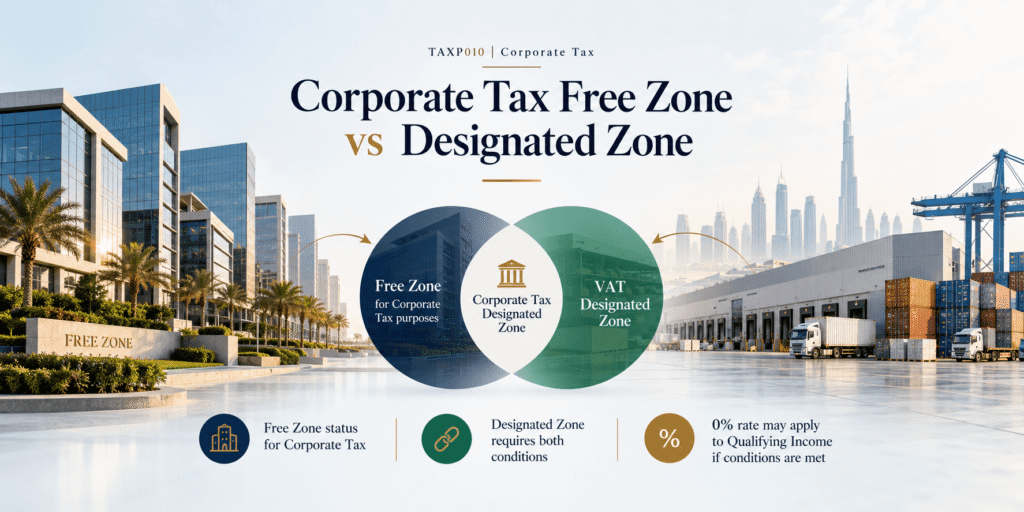
What Is a Corporate Tax Designated Zone?
A Corporate Tax Designated Zone is more specific.
According to TAXP010, the area must:
qualify as a Designated Zone under the VAT framework; and
also be recognised as a Free Zone for Corporate Tax purposes.
This means a VAT Designated Zone is not automatically a Corporate Tax Designated Zone.
For businesses involved in distribution, this distinction can be particularly important.
Under the Corporate Tax rules, the distribution of goods or materials in or from a Corporate Tax Designated Zone may qualify as a Qualifying Activity where the relevant requirements are satisfied.
VAT Designated Zone UAE
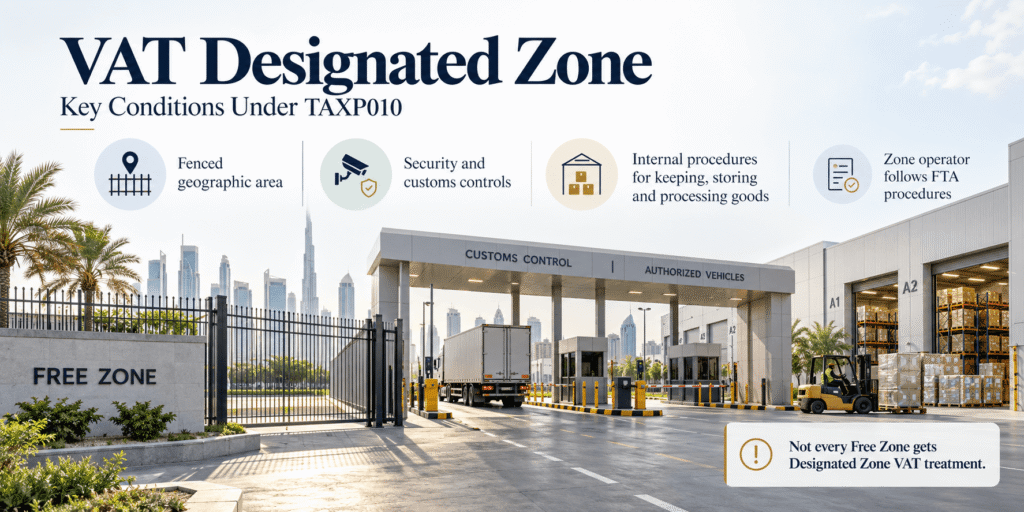
For VAT purposes, a VAT Designated Zone UAE is a Free Zone listed under the relevant Cabinet Decision and meeting the conditions of Article 51 of the VAT Executive Regulation.
To receive the special VAT treatment applicable to a Designated Zone, the area must generally have:
a defined and fenced geographic boundary;
security measures;
customs controls;
internal procedures governing the keeping, storage and processing of goods; and
compliance by the zone operator with FTA procedures.
Businesses should not assume that every UAE Free Zone receives Designated Zone VAT treatment.
They should check the FTA’s official List of Designated Zones and confirm the position with the relevant Free Zone authority.
Excise Tax Designated Zones
The rules are different again for Excise Tax.
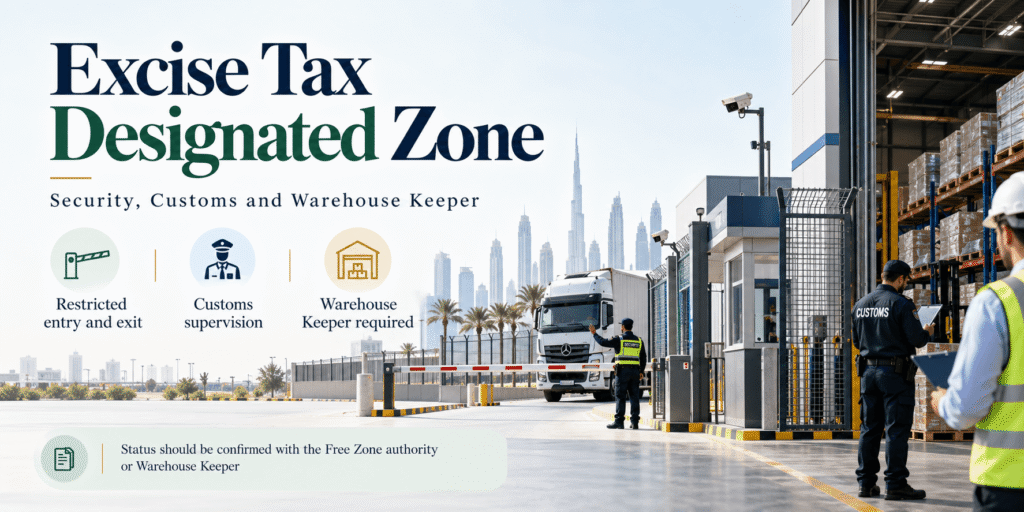
An Excise Tax Designated Zone generally needs to meet specific operational and control requirements.
These may include:
restricted entry and exit;
security controls;
customs supervision; and
appointment of a registered Warehouse Keeper.
Businesses dealing with Excise Goods should confirm their zone status with the relevant Free Zone authority or Warehouse Keeper and verify whether the FTA has approved the area as an Excise Tax Designated Zone.
Why the UAE Free Zone vs Designated Zone Distinction Matters
The main message from TAXP010 is that one tax classification should not be assumed to apply to another tax.
For example:
A business may operate from a VAT Designated Zone but still need to separately confirm whether the same area qualifies as a Corporate Tax Designated Zone.
Likewise, an Excise Tax Designated Zone follows its own conditions and approval requirements.
This makes the UAE Free Zone vs Designated Zone analysis particularly important for businesses involved in:
trading;
distribution;
warehousing;
import and export;
manufacturing;
logistics; and
Excise Goods.
0% Corporate Tax and the Risk of Losing Qualifying Status
One of the most important points in TAXP010 concerns businesses relying on the 0% Corporate Tax rate on Qualifying Income.
If a Qualifying Free Zone Person fails to meet the required conditions at any time during a Tax Period, it may cease to qualify from the beginning of that Tax Period and for the following four Tax Periods.
For Free Zone businesses, this makes regular tax-status reviews important.
A business should not rely only on its trade licence or Free Zone address when determining tax treatment.
What Should UAE Free Zone Businesses Check?
Businesses should consider reviewing:
the exact Free Zone in which they operate;
whether the area is a Corporate Tax Free Zone;
whether it is a Corporate Tax Designated Zone;
whether it appears on the FTA’s VAT Designated Zone list;
whether VAT Designated Zone conditions are actually satisfied;
whether Excise Tax Designated Zone requirements apply;
whether the business meets Qualifying Free Zone Person conditions;
whether its income qualifies for the 0% Corporate Tax rate; and
whether specific activities such as distribution meet the Designated Zone requirements.
How Can Ripple Accountants Help?
The UAE Free Zone vs Designated Zone rules can affect Corporate Tax, VAT, Excise Tax and the availability of certain Free Zone tax benefits.
No. A Free Zone does not automatically qualify as a Designated Zone. The status depends on the relevant tax law and applicable conditions.
Is a VAT Designated Zone automatically a Corporate Tax Designated Zone?
No. TAXP010 confirms that the area must also qualify as a Free Zone for Corporate Tax purposes.
Can a Free Zone company get 0% Corporate Tax?
A Qualifying Free Zone Person may benefit from 0% Corporate Tax on Qualifying Income, provided all relevant conditions are satisfied.
How can a business check its VAT Designated Zone status?
Businesses should review the FTA’s official List of Designated Zones and confirm with the relevant Free Zone authority that the applicable conditions are satisfied.
What is required for an Excise Tax Designated Zone?
The zone generally needs security controls, customs supervision and a Warehouse Keeper, along with other applicable requirements.
Conclusion
TAXP010 makes one point particularly clear: being located in a UAE Free Zone does not automatically mean the business has the same status for Corporate Tax, VAT and Excise Tax. Each tax regime has its own rules, definitions and conditions. Businesses should therefore verify their exact Free Zone and Designated Zone status separately for each tax, especially where they rely on 0% Corporate Tax, special VAT treatment or Excise Tax Designated Zone rules.
Disclaimer: This article is provided for general informational purposes only and does not constitute tax, legal or professional advice. Free Zone and Designated Zone treatment depends on the specific business, location, activities and applicable tax legislation. Businesses should review the latest FTA guidance and obtain professional advice before relying on any Corporate Tax, VAT or Excise Tax treatment.
Non-profit organizations play a vital role in supporting communities, advancing education, promoting healthcare, protecting the environment, and delivering humanitarian aid across the…
Businesses have traditionally relied on financial reports such as revenue, profit, cash flow, and expenses to evaluate performance. While these metrics remain…
Auditing different types of businesses is essential because every industry operates with unique financial processes, regulations, and risks. A manufacturing company manages…


0 Comments