UAE Payroll Processing Checklist for Small Businesses
Are you confident that your business has completed every step correctly before this month’s salaries are processed? For small businesses, payroll errors…
Read article
Is your business ready for UAE E-Invoicing without creating gaps in its Corporate Tax records?
The UAE is moving towards a structured electronic invoicing system that will change how businesses create, exchange, report and store invoice data. For businesses planning system changes, UAE e-invoicing Corporate Tax readiness is not only about choosing software. It also involves making sure invoice data flows accurately into accounting records, tax reporting processes and supporting documentation.
The UAE E-Invoicing programme uses structured electronic invoice data exchanged through accredited channels and reported to the Federal Tax Authority. PDF files, scanned invoices and ordinary email attachments are not treated as E-Invoices under the official framework.
Let’s look at what businesses should review now to prepare their invoicing systems and Corporate Tax records for the transition.
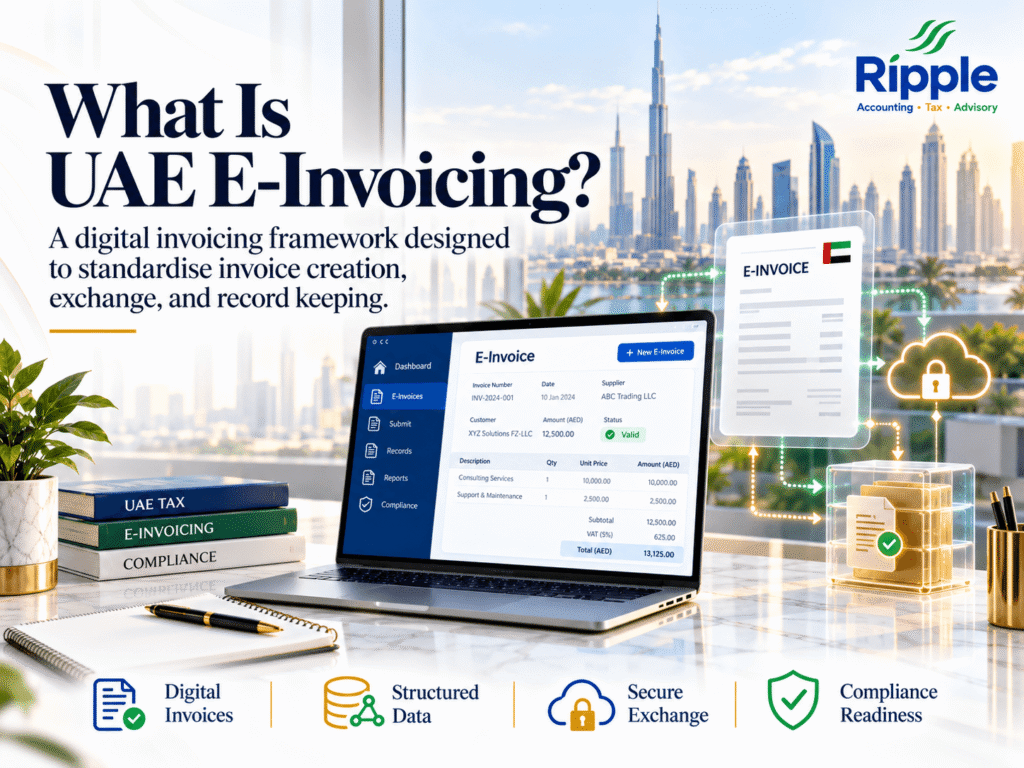
An E-Invoice is a structured form of invoice data that is issued and exchanged electronically between a supplier and buyer and reported electronically to the Federal Tax Authority.
This is different from simply sending an invoice electronically.
For example, sending a PDF invoice by email does not by itself make that document an E-Invoice. The UAE framework is based on structured data and an electronic exchange process involving accredited service providers.
The Ministry of Finance has published the official UAE Electronic Invoicing Guidelines together with mandatory field requirements and other implementation materials. The government has also published the relevant legislative decisions governing the system.
For businesses, this means E-Invoicing should be considered as part of a wider finance and tax process rather than as a standalone invoicing upgrade.
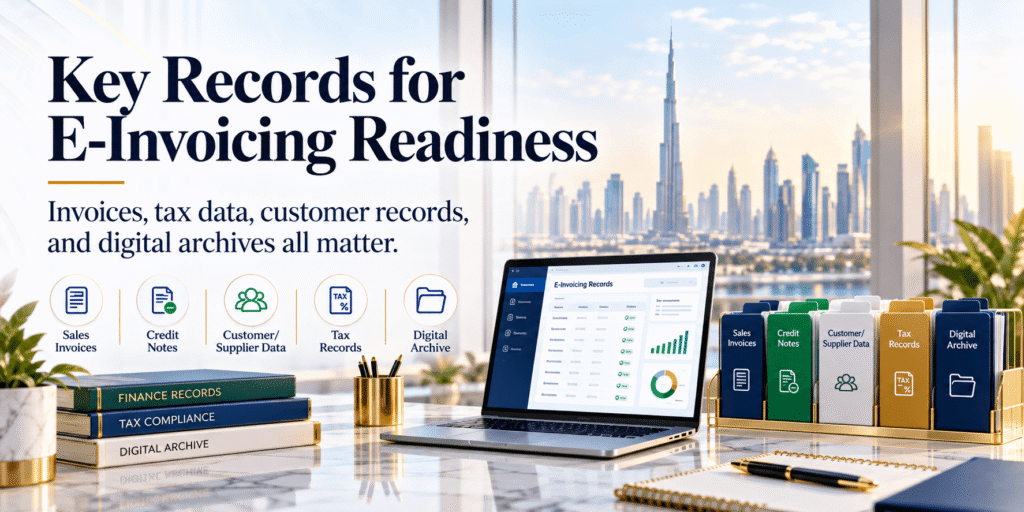
Corporate Tax calculations depend on reliable financial information. Businesses therefore need accounting records that can support the figures reported in their tax returns.
When invoicing becomes more structured and automated, businesses may have an opportunity to improve the connection between:
The Ministry of Finance explains that E-Invoicing is designed to improve digitalization, efficiency, transparency and the availability of structured transaction data. The system also reports relevant tax data through the electronic invoicing framework.
For Corporate Tax purposes, the important point is that businesses should not treat E-Invoices as isolated documents. They should form part of a consistent transaction trail from the original sale through accounting and tax reporting.
Traditional invoicing processes may involve manually entering information from invoices into accounting software.
A structured E-Invoicing environment can reduce some of this manual work because invoice information is exchanged in a standardized electronic format. However, automation does not eliminate the need for accounting review. Businesses still need to ensure that invoice data is correctly classified and posted to the appropriate accounts.
For example, a system should distinguish between revenue categories, customer balances, discounts, credit notes and other relevant accounting entries.
A business should be able to trace a transaction from the original invoice to the accounting records. A useful transaction trail may look like this:
Customer transaction → E-Invoice → Accounting entry → Receivable balance → Bank receipt → Financial statements → Tax records
If these stages operate separately, errors may still occur even when invoices are electronically generated. System integration should therefore be tested before full implementation.
Businesses should not focus only on standard sales invoices. Credit notes, cancellations, corrections, returns and other adjustments can affect revenue and customer balances.
These transactions should be mapped correctly between the E-Invoicing system and accounting software. This is particularly important when accounting teams rely heavily on automated posting. A system that creates invoices correctly but handles credit notes incorrectly can still produce inaccurate financial records.
Electronic invoicing does not replace the broader requirement to maintain appropriate accounting and tax records.
The UAE Electronic Invoicing Guidelines specifically address storage and retention obligations. They state that persons subject to the Electronic Invoicing System must retain electronic invoices, electronic credit notes and associated data for the period defined under the Tax Procedures Law, with records capable of being produced to the Authority when requested.
This means businesses should consider document retention when selecting or configuring their accounting and E-Invoicing systems.
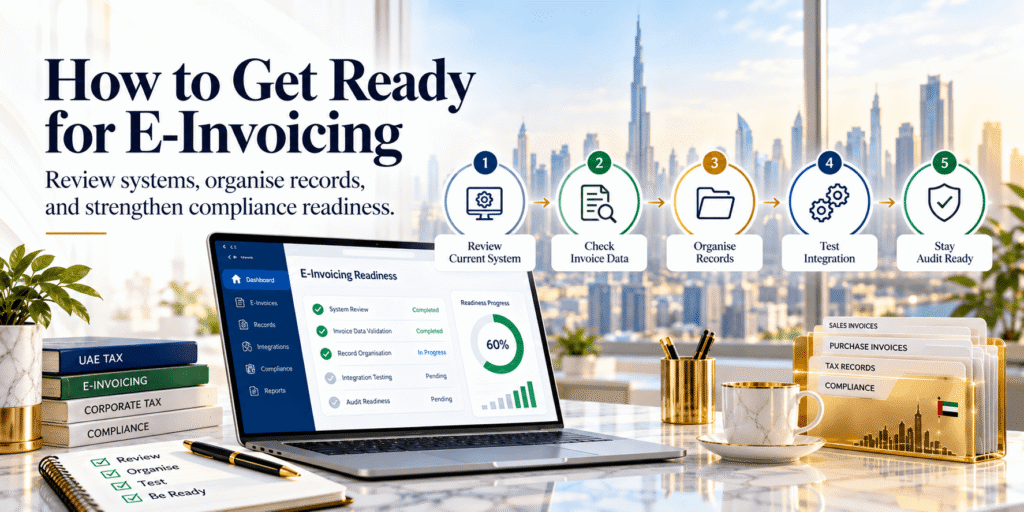
A successful transition requires more than purchasing new software. Businesses should first document how invoices currently move through the organization.
Map the current process from the point of sale to accounting.
Ask:
This exercise can reveal manual steps that may create problems during system migration.
Businesses should check whether their existing accounting or ERP system can work with the required E-Invoicing environment.
The review should cover:
The Ministry of Finance has published guidance for businesses on selecting an Accredited Service Provider, as well as information about accredited providers.
A new electronic invoicing process is also an opportunity to review the chart of accounts.
Businesses should check whether revenue and expense categories are sufficiently clear to support financial reporting and tax analysis.
For example, businesses may need clear treatment for:
A poorly structured chart of accounts can make automated reporting less useful.
Businesses planning system changes can use the following checklist.
Check whether:
Check whether:
Check whether:
Check whether:
The UAE is introducing E-Invoicing through a phased implementation process.
The Ministry of Finance previously announced that the pilot phase would begin in July 2026, followed by phased mandatory implementation. Under the published timeline, businesses with annual revenue of AED 50 million or more were initially subject to an earlier Accredited Service Provider appointment deadline, while businesses below AED 50 million have a later implementation timetable. The Ministry subsequently announced an extension of the Accredited Service Provider appointment deadline for businesses above AED 50 million to 30 October 2026.
The official Ministry of Finance portal should be checked for the latest implementation information because the programme is being rolled out in stages and the government continues to publish updates.
As of September 2026, the pilot phase is already underway, and the Ministry has reported that the 5-Corner Model is operational as part of practical testing.
E-invoicing readiness should be connected to the wider accounting and tax record process.
Every significant transaction should be traceable from the invoice through the accounting records.
A business should be able to explain how the figures in its financial statements were generated from underlying transactions.
Businesses should not wait until year-end to identify differences.
Regular reconciliation can compare:
Differences should be investigated and corrected promptly.
If a business changes accounting or invoicing software, it should determine how historical invoice data will be retained.
Migration should not result in the loss of supporting records.
Before switching systems, businesses should identify:
Businesses should maintain documentation showing significant changes to their accounting and invoicing processes.
This can include:
This documentation can make future reviews easier.
When properly implemented, structured invoice data can help businesses create a more consistent transaction trail.
It can support:
The Ministry of Finance identifies improved efficiency, financial visibility and simplified compliance among the potential benefits of the UAE E-Invoicing system.
However, automation should not be confused with compliance by itself. Businesses still need appropriate accounting controls, reviews and documentation.
Preparing for E-Invoicing can involve accounting, tax, systems and process decisions at the same time.
Ripple Accounting, Tax & Advisory can help businesses review their existing accounting processes and identify areas that may need attention before system changes are introduced.
Support can include:
If your business is planning system changes, contact Ripple Accounting, Tax & Advisory for a tailored compliance review or E-Invoicing readiness checklist!
A review can help identify gaps in accounting records, transaction mapping, reconciliations and supporting documentation before implementation.
UAE E-Invoicing is a structured electronic invoicing system through which invoice data is issued, exchanged electronically and reported to the Federal Tax Authority through the applicable framework. A PDF, Word file, scanned document or invoice sent by ordinary email is not automatically considered an E-Invoice.
No. E-Invoicing forms part of the transaction and invoicing process, but businesses still need appropriate accounting records and supporting documentation for their tax and financial obligations.
E-Invoicing can change how invoice information enters and moves through accounting systems. Businesses should ensure that electronic invoice data is accurately reflected in their ledgers, customer balances, financial reports and supporting tax records.
Yes. The UAE Electronic Invoicing Guidelines state that persons subject to the system must retain electronic invoices, electronic credit notes and associated data for the period defined under the Tax Procedures Law and ensure that the records can be produced to the Authority when requested.
Businesses should begin reviewing their invoicing, accounting and data processes before their applicable implementation date. Preparation can include reviewing software integration, data quality, system controls, record retention, reconciliations and Accredited Service Provider requirements.
UAE E-Invoicing is more than a change in how businesses issue invoices. It can affect the way transaction data moves between invoicing systems, accounting records and tax processes. For businesses preparing for implementation, the priority should be creating a reliable connection between electronic invoices and the underlying accounting records. Reviewing system integration, data quality, reconciliation, credit notes, record retention and historical data now can make the transition more manageable. The UAE Ministry of Finance continues to update the official E-Invoicing programme, so businesses should monitor the latest government guidance and implementation requirements before making final system decisions.
Disclaimer: This article provides general information about UAE E-Invoicing and Corporate Tax record readiness. It should not be treated as legal, tax or accounting advice for a specific business. E-Invoicing requirements and implementation timelines may be updated by the UAE authorities. Businesses should review the latest official guidance and obtain professional advice based on their circumstances.
Tell us a little about your business and our UAE tax experts will get back to you with clear, practical answers — no obligation.
 Bookkeeping
Are you confident that your business has completed every step correctly before this month’s salaries are processed? For small businesses, payroll errors…
Read article Compliance
Are your accounting records actually ready for a UAE Corporate Tax return, or are you relying on a trial balance that has…
Read article VAT
If your UAE business buys or sells metal scrap, who is now responsible for accounting for the VAT—the supplier or the buyer?…
Read articlePage 7 of 59
Book a free consultation and get clear answers for your business.
0 Comments