Accounting for Non-Current Assets and Capital Expenditures
Non-current assets and capital expenditures play a critical role in a company’s long-term financial health. Whether you own a startup, manage an…
Read article
How confident are you that your construction project costs are complete and correctly recorded at month-end?
For UAE contractors, subcontractor invoices can include progress claims, certified work, retention, variations, advances and VAT. If these items are not reconciled properly, project reports may show inaccurate costs, margins and outstanding liabilities. Subcontractor invoice reconciliation provides a structured way to compare subcontractor claims with contracts, approved work, project records and accounting entries before the month is closed. It also helps finance teams identify missing invoices, duplicate costs, incorrect project allocations and unrecorded liabilities.
Before closing the books, let’s look at the month-end checks that can help UAE construction businesses establish a more reliable project-cost position.
Subcontractors often represent a significant portion of the total cost of a construction project. A business may have separate subcontractors for civil works, electrical systems, mechanical works, plumbing, finishing, landscaping and specialist installations.
Simply recording every invoice received during the month is therefore not enough. A proper reconciliation should establish whether:
This process connects construction project costing with financial accounting and gives management a clearer view of what a project has actually cost.

Project cost reconciliation means comparing the costs recorded in the accounting system with the underlying operational and contractual information for the project.
For subcontractors, a useful reconciliation trail can look like this:
Subcontract agreement → Purchase order/work order → Work completed → Certification → Invoice → Accounting entry → Payment
Each stage provides evidence for the next.
For example, assume a subcontractor has a contract worth AED 2 million. By the end of the month, the project team has certified AED 800,000 of work. The subcontractor submits an invoice for AED 850,000.
The finance team should not automatically post AED 850,000 simply because the invoice has been received.
Instead, the difference should be investigated. It could represent an approved variation, a timing difference, unapproved work, an invoice error or another legitimate contractual adjustment. The objective is to understand the difference and ensure the accounting treatment reflects the underlying transaction.
Start the month-end process by obtaining a complete list of subcontractors that have worked on the project during the period. Collect relevant documents such as:
Do not rely only on the accounts payable system. A subcontractor may have completed work and submitted a claim to the project team without the final invoice reaching finance.
This is why finance should communicate with project managers, quantity surveyors, and procurement personnel before closing the period.
The next step is to compare the invoice with the original contractual terms. Check:
This helps determine whether the invoice is commercially consistent with the subcontract.
For example, if the agreed value of electrical works is AED 500,000 but cumulative invoices have reached AED 560,000, the finance team should identify the reason for the additional AED 60,000.
If there is an approved variation, the additional amount may be justified. If there is no supporting approval, the difference requires investigation before the project cost is finalised.
Invoice reconciliation should also connect the financial claim with actual project progress. Depending on the project, supporting evidence may include:
Suppose a subcontractor claims AED 300,000 for September, but the project records show AED 250,000 of work certified.
The AED 50,000 difference should be investigated.
It might be:
This step is particularly important because an invoice alone does not necessarily explain the entire project-cost position.
Correct cost allocation is an important part of subcontractor accounting. A legitimate subcontractor invoice can still distort management reporting if it is posted against the wrong project or cost category.
Before posting, verify:
For example, if a contractor performs mechanical work on both Project A and Project B, finance should ensure that each invoice or invoice component is allocated to the correct project.
This allows management to compare actual project costs with budgets and forecasts.
Never assess the current subcontractor invoice in isolation. Compare it with the subcontractor’s cumulative position.
A month-end schedule might show:
| Description | Amount |
| Revised subcontract value | AED 2,000,000 |
| Certified to previous month | AED 900,000 |
| Current certified work | AED 300,000 |
| Total certified to date | AED 1,200,000 |
| Remaining certified value | AED 800,000 |
This helps identify duplicate billing, unusual movements and claims that exceed the remaining contractual amount. The review should also consider amounts already paid and any outstanding balances.
Construction invoices may contain more than the cost of current-period work. Finance teams should separately review:
These checks prevent the accounts from showing an inaccurate subcontractor liability or project cost.
One of the most important month-end controls is identifying costs that have been incurred but for which an invoice has not yet been received. For example:
The finance team should assess whether a month-end accrual is required under the company’s applicable accounting policies and the facts of the transaction.
A useful month-end question for each project is:
“What subcontractor work has been completed or incurred by month-end but is not yet recorded in accounts payable?”
Project managers and quantity surveyors can help finance identify these items. This is particularly important where subcontractor invoices are submitted several days or weeks after the work is performed.
After individual invoices have been checked, compare the accounting records with the project cost report. The reconciliation can follow this structure:
Accounts payable ledger
↓
General ledger
↓
Project cost report
↓
Budget/forecast
Any difference should have an explanation.
Common causes include:
The reconciliation should be documented so that another member of the finance team can understand how the final balance was established.
For UAE businesses registered for VAT, tax documentation should also be considered during the reconciliation process. The Federal Tax Authority provides an official Tax Invoices resource explaining UAE tax-invoice requirements. Businesses can use the FTA’s official page to check the relevant invoice requirements rather than relying on third-party summaries.
The FTA’s current guides and references page is also useful because it is regularly updated and provides access to current VAT guides, public clarifications and related references.
When reviewing a subcontractor invoice, finance teams should therefore consider whether the available tax documentation is appropriate for the transaction and whether the VAT treatment has been reviewed according to the specific circumstances.
The objective is not to turn the project-cost reconciliation into a full VAT review. Rather, VAT documentation should form part of the overall month-end control process.
A reconciliation is more useful when the business can demonstrate how the final figure was reached. Maintain records such as:
The UAE Federal Tax Authority’s FTA Decision No. 4 of 2026 specifically addresses the rules and requirements for maintaining information contained in accounting records and commercial books. The FTA published the decision on its official website in August 2026.
The related UAE tax-procedure framework also identifies supporting documents such as invoices and contracts as documents supporting accounting entries and establishes recordkeeping requirements.
This makes document organisation an important part of the month-end process rather than an administrative task that can be postponed indefinitely.
The UAE Commercial Companies legislation also requires companies to maintain accounting records that provide a clear picture of their financial position and enables shareholders or partners to verify that the accounts are properly maintained. Article 26 states that companies must keep accounting records for at least five years from the end of the fiscal year.
For construction businesses, this reinforces the importance of maintaining a traceable relationship between the project transaction, supporting documentation and accounting entry.
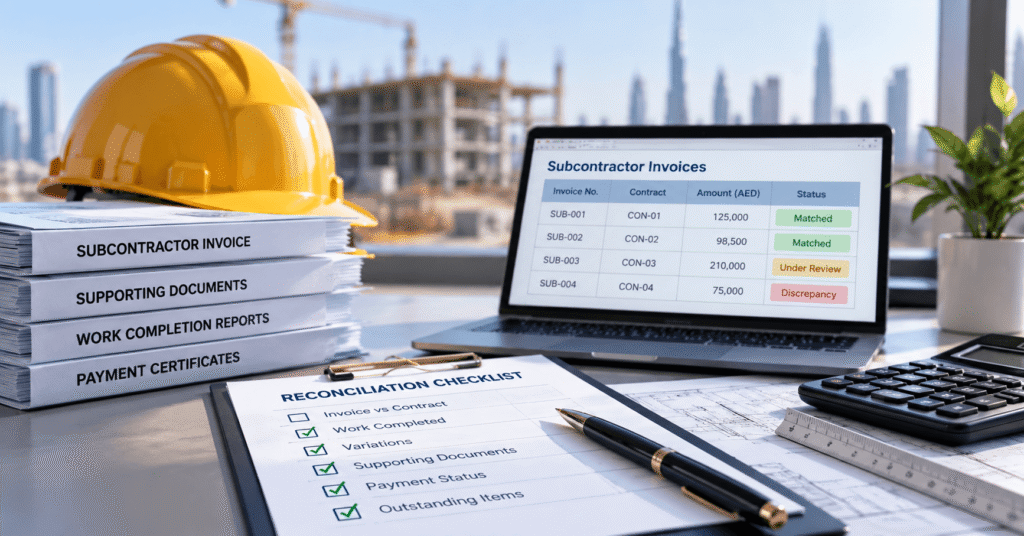
Before closing the month, finance teams can use this checklist:
Several mistakes can reduce the reliability of project-cost information.
Ripple Accountant can support UAE businesses with accounting and bookkeeping processes that help organise financial information and improve month-end controls. Depending on the business’s requirements, support can include:
If your UAE construction business needs help with subcontractor invoice reconciliation, project cost tracking, bookkeeping or month-end accounting, contact Ripple Accountant to discuss your requirements and build a suitable accounting process for your business.
You can learn more about Ripple’s services here.
Subcontractor invoice reconciliation is the process of comparing subcontractor invoices with contracts, purchase orders, certified work, project records, previous invoices and accounting entries. It helps UAE construction businesses identify duplicate invoices, incorrect project allocations, missing costs and discrepancies before closing the month.
It helps construction businesses maintain accurate project costs and financial reports. Regular reconciliation can identify billing discrepancies, unrecorded subcontractor costs, incorrect cost codes, retention differences and timing issues that could otherwise affect project profitability and month-end reporting.
Depending on the transaction, businesses may review the subcontract agreement, purchase order, tax invoice, payment application, interim payment certificate, work-completion records, approved variations, retention calculations, credit notes and payment records. The exact documents required depend on the project and contractual arrangements.
Finance teams should communicate with project managers and quantity surveyors to identify work completed by the reporting date but not yet invoiced. Where appropriate under the business’s accounting policies and the relevant facts, the business should assess whether an accrual is required so that project costs are not understated.
Ripple Accountant can support UAE construction businesses with bookkeeping, accounts payable reconciliation, subcontractor balance reconciliation, project cost tracking and month-end accounting processes. Businesses can contact Ripple Accountant to discuss their accounting requirements and develop appropriate financial controls.
For UAE construction businesses, subcontractor invoice reconciliation is more than checking whether an invoice has been entered into the accounting system. It involves connecting the invoice with the underlying contract, certified work, project code, previous claims, retention, variations and period-end cost position. A consistent month-end process can help finance teams identify missing costs, duplicate claims, incorrect allocations and timing differences before the accounts are closed. It also creates a stronger audit trail by linking accounting entries with contracts, invoices and project documentation.
Disclaimer: This article is provided for general informational purposes only and does not constitute accounting, tax, legal, financial or other professional advice. UAE VAT, Corporate Tax, accounting and recordkeeping requirements may depend on the nature of the business, transaction, contract terms, tax status and other circumstances. Government rules and guidance may also change. Readers should consult the latest information published by the Federal Tax Authority and other relevant UAE authorities and obtain advice from a qualified professional before making decisions or taking action based on this article.
Tell us a little about your business and our UAE tax experts will get back to you with clear, practical answers — no obligation.
 Bookkeeping
Non-current assets and capital expenditures play a critical role in a company’s long-term financial health. Whether you own a startup, manage an…
Read article Bookkeeping
Expanding into international markets is an exciting milestone for any business. It opens the door to new customers, increased revenue, and long-term…
Read article Compliance
Financial instruments play a critical role in modern business, from trade receivables and business loans to investments and corporate debt. To improve…
Read articlePage 41 of 45
Book a free consultation and get clear answers for your business.
0 Comments