The Value of Personal Financial Statements for Business Owners
Running a successful business requires more than tracking company revenue and expenses. As a business owner, your personal financial position also plays…
Read article
Running a restaurant is not only about increasing sales. A restaurant can have strong revenue and still lose profit through excessive food purchases, inaccurate portioning, spoilage, overproduction, stock discrepancies and unrecorded wastage. This is why restaurant food cost control UAE should be treated as an accounting and operational priority.
A proper system connects purchasing, inventory, kitchen consumption, wastage, sales and accounting records so management can see where food costs are increasing. For UAE restaurants, these controls can also support reliable financial records and tax compliance. The Federal Tax Authority expects businesses to maintain records that support their transactions, while VAT-registered businesses must retain relevant invoices and records.
So, how can a restaurant build an accounting system that actually controls food costs and wastage? Let’s look at the process step by step.
Restaurant food cost control is the process of monitoring how much a restaurant spends on ingredients compared with the revenue generated from selling food.
A simple food-cost percentage can be calculated as:
Food Cost % = Food Cost ÷ Food Sales × 100
For example, suppose a restaurant generates AED 100,000 in food sales during a month and the cost of ingredients consumed is AED 30,000.
Its food cost percentage would be:
AED 30,000 ÷ AED 100,000 × 100 = 30%
The percentage itself is only one part of the analysis. Management also needs to understand why the cost is at that level.
A higher food cost may result from:
This is where accounting and operational controls need to work together.
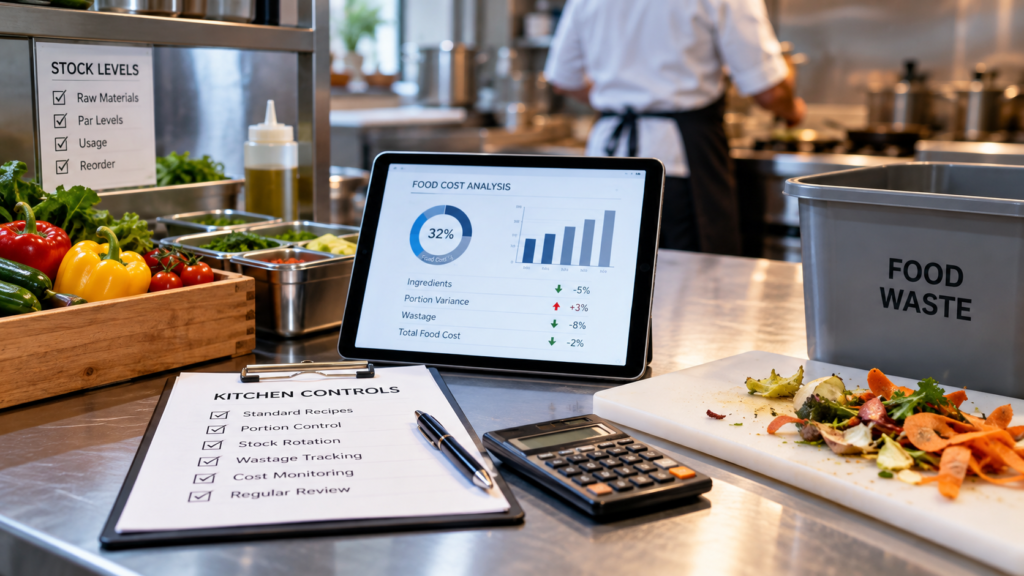
Food wastage is often treated as a kitchen issue. In reality, it directly affects the restaurant’s financial statements.
Consider a restaurant that purchases AED 50,000 of ingredients during a month. If AED 5,000 of food is spoiled, discarded or otherwise wasted without proper recording, the business needs to understand what happened to that inventory. If wastage is not recorded correctly, management may see:
For example, if a restaurant repeatedly purchases too much fresh produce and throws away part of it every week, the accounting records may show purchases accurately but fail to explain why gross margins are deteriorating.
A proper restaurant wastage accounting process makes the loss visible.
An effective system should connect five major areas:
Purchasing → Inventory → Kitchen Consumption → Sales → Accounting
When these areas operate separately, errors become difficult to identify.
Every purchase should be supported by appropriate documentation.
The restaurant should record:
Purchase invoices should then be matched with goods received. This prevents situations where the accounting system records an invoice for quantities that were never actually delivered.
The receiving process is one of the most important points of restaurant inventory control UAE. When ingredients arrive, employees should compare the delivery against the purchase order and supplier invoice.
For example:
A restaurant orders:
The receiving employee should verify the actual quantities and condition before accepting the delivery.
If only 18 kg of chicken arrives, the system should reflect the actual quantity received rather than automatically recording 20 kg.
This small control can prevent inventory inaccuracies from accumulating.
Every major menu item should have a standard recipe.
Suppose a restaurant sells a chicken burger. Its standard recipe may include:
| Ingredient | Standard Quantity |
|---|---|
| Chicken | 150 g |
| Bun | 1 |
| Sauce | 25 g |
| Cheese | 1 slice |
| Vegetables | 50 g |
The accounting or inventory system can assign a cost to each ingredient.
If the total recipe cost is AED 12 and the selling price is AED 40, management can calculate the food-cost percentage of the menu item.
This allows restaurants to identify products that generate strong sales but weak margins.
One of the simplest ways to reduce food costs is to control portion sizes. Without standard portions, two chefs may use different quantities of the same ingredient.
For example, one employee may use 150 g of chicken while another uses 200 g.
The difference may appear insignificant on one order. But if the restaurant sells hundreds of portions every month, the additional consumption can become substantial.
Restaurants can control this through:
Accounting data can then be compared with expected consumption.
A restaurant should not simply record “wastage” as one general figure. Wastage should ideally be classified.
This classification helps management identify the underlying cause rather than simply seeing a large wastage number.
A simple wastage log can significantly improve accountability.
It can include:
| Date | Item | Quantity | Reason | Estimated Cost | Approved By |
|---|---|---|---|---|---|
| 5 Sept | Chicken | 3 kg | Spoilage | AED 75 | Kitchen Manager |
| 6 Sept | Rice | 4 kg | Overproduction | AED 20 | Chef |
| 7 Sept | Burger | 2 units | Preparation error | AED 24 | Supervisor |
The accounting team can then post the appropriate adjustment based on the approved wastage records. This creates a connection between the kitchen and accounting department.
Restaurants should not rely entirely on accounting software’s theoretical inventory balance. Physical stock counts are necessary. Depending on the type of inventory, restaurants may conduct:
The actual quantity should be compared with the accounting or inventory system.
For example:
System quantity: 100 kg
Physical quantity: 92 kg
Variance: 8 kg
The next question should be: Why?
Possible explanations include:
The purpose of stock reconciliation is not simply to adjust the number. It is to investigate the reason behind the difference.
This is one of the most useful controls for restaurant management.
Theoretical food cost represents what the restaurant should have consumed based on:
Actual food cost represents what the restaurant actually consumed.
A simplified formula is:
Actual Food Consumption = Opening Inventory + Purchases − Closing Inventory
Management can compare actual consumption with theoretical consumption.
If the theoretical cost is AED 28,000 but actual consumption is AED 33,000, there is an AED 5,000 variance that needs investigation.
This doesn’t automatically mean the restaurant lost AED 5,000 through wastage. Price changes, recipe changes, inventory errors and other factors may contribute.
However, the variance gives management a clear starting point.
A restaurant accounting system should connect inventory consumption with point-of-sale data.
For example, if the POS system reports that the restaurant sold:
500 chicken burgers
and the standard recipe requires:
150 g chicken per burger
Expected chicken consumption would be:
500 × 150 g = 75 kg
If inventory records show that 95 kg of chicken was consumed, management has a 20 kg variance to investigate.
This is much more useful than simply looking at the total monthly food purchases.
Food cost can increase even when wastage remains unchanged. Supplier prices may change because of:
Restaurants should therefore maintain a supplier price comparison process.
For key ingredients, management can monitor:
Previous Cost → Current Cost → Percentage Change
For example:
Chicken breast:
If the restaurant continues using the old recipe cost, its menu profitability report may become inaccurate.
Recipe costing should therefore be updated when material ingredient prices change.
Multi-branch restaurants need additional controls. If one branch transfers AED 5,000 of inventory to another location, the transaction should be recorded in both locations.
Otherwise:
A proper inventory transfer document should identify:
This creates a reliable audit trail.
A restaurant accounting system should produce more than a monthly profit and loss statement.
Useful management reports include:
Shows food cost as a percentage of sales.
Shows the value and type of discarded food.
Compares physical stock with system records.
Tracks changes in ingredient costs.
Shows the current cost of menu items.
Compares selling price, food cost and gross margin.
Shows purchasing trends by supplier and category.
These reports turn accounting data into management information.
Food-cost controls also support the wider accounting and tax record-keeping framework applicable to UAE businesses. The FTA states that taxpayers should maintain financial statements and records supporting information reported in Corporate Tax returns. Its guidance also identifies transaction, asset, liability and stock records among the types of information businesses may need to maintain.
For VAT-registered businesses, the FTA states that VAT invoices issued and received must generally be retained for at least five years.
The FTA has also published FTA Decision No. 4 of 2026 concerning rules and requirements for maintaining information contained in accounting records and commercial books.
Restaurants should therefore make sure that purchase invoices, inventory records, stock counts, wastage records and accounting entries can be connected through a clear audit trail.
There is no single review frequency suitable for every restaurant.
However, a practical control structure can include:
Daily:
Review major wastage, receiving issues and unusual stock movements.
Weekly:
Review food cost trends, supplier prices and significant inventory variances.
Monthly:
Perform full inventory reconciliation and compare actual versus theoretical food cost.
Quarterly:
Review recipes, supplier contracts, menu pricing and broader profitability.
This layered approach allows management to identify problems before they become large financial losses.
Restaurants need accounting systems that do more than record sales and expenses. The system should help management understand where money is being spent, where inventory is disappearing and why gross margins are changing. Ripple Accountant can support UAE restaurant businesses with accounting and bookkeeping processes, inventory-related accounting, reconciliations, VAT support, and management reporting. With better restaurant food cost control UAE, businesses can connect purchasing, inventory, wastage and sales data to make more informed financial decisions.
If your restaurant is experiencing unexplained food-cost increases, stock variances or declining margins, contact Ripple Accountant to review your accounting and control processes and build a system suited to your operations.
Restaurant food cost control is the process of monitoring ingredient purchases, inventory, consumption, wastage and food sales to keep food costs within an acceptable level and protect profit margins.
A basic calculation is:
Food Cost % = Food Cost ÷ Food Sales × 100
Restaurants can also calculate actual food consumption using opening inventory, purchases and closing inventory.
Restaurants can reduce wastage through accurate purchasing, FIFO inventory practices, standard recipes, portion control, proper storage, production planning and detailed wastage reporting.
Inventory reconciliation compares recorded stock with physical stock. It can help identify wastage, theft, receiving errors, incorrect recipe usage, stock transfers, and accounting mistakes.
Yes. Recording wastage helps management understand the cost of spoiled, damaged, overproduced or incorrectly prepared food and provides better visibility into actual food costs.
The exact records depend on the business and its tax obligations, but relevant accounting, transaction, inventory, purchase, and tax documentation should be maintained to support financial and tax reporting. The FTA provides specific record-keeping guidance for VAT and Corporate Tax.
Food wastage is not simply a kitchen problem, it is a profitability and accounting problem. Restaurants that monitor purchasing, inventory, recipes, portions, wastage, and sales together can identify margin leakage much earlier. For UAE restaurants, an effective restaurant food cost control UAE system should combine operational discipline with reliable accounting records. Regular stock counts, wastage logs, recipe costing, supplier monitoring and actual-versus-theoretical food-cost analysis can give management a clearer picture of what is really happening behind the sales figures.
Disclaimer: This article is provided for general informational purposes only and does not constitute tax, accounting, legal, or professional advice. Regulations and requirements may change, and their application can vary depending on individual business circumstances. Readers should refer to the latest information from the relevant UAE authorities and seek professional advice where appropriate.
Tell us a little about your business and our UAE tax experts will get back to you with clear, practical answers — no obligation.
 Bookkeeping
Running a successful business requires more than tracking company revenue and expenses. As a business owner, your personal financial position also plays…
Read article Audit
Audit
Financial fraud can happen in businesses of any size, from startups to multinational corporations. As the UAE continues to strengthen its regulatory…
Read article Bookkeeping
Bookkeeping is one of the most important functions in any business, yet it is often overlooked by small and medium-sized enterprises (SMEs).…
Read articlePage 44 of 45
Book a free consultation and get clear answers for your business.
0 Comments