UAE Corporate Tax Registration 2026: Requirements, Deadlines & Process
Are you unsure whether UAE Corporate Tax registration is mandatory for your business and how to complete the process? UAE Corporate Tax…
Read article
Is your construction project still profitable after you account for actual spending, outstanding purchase orders, subcontractor commitments, and the cost of completing the remaining work?
A project may appear profitable because invoices are being raised and payments are coming in. Yet rising material prices, labor overruns, delayed variations, or unrecorded commitments can reduce the margin before the project is complete. A monthly project profitability report construction helps contractors compare the original budget with actual costs, committed spending, forecast costs, and expected profit. It gives owners and finance teams a clearer view of which projects are performing well and where action is needed.
Let’s get started to learn more about it!
A project profitability report is a management report that shows the financial performance of an individual construction project. It brings together contract revenue, budgeted costs, actual expenditure, outstanding commitments, estimated costs to complete, and projected profit.
Unlike a simple expense statement, it looks beyond what has already been spent. It also considers the costs a contractor has committed to and the spending still expected before handover.
For example, a contractor may have spent AED 600,000 on a project with a total approved cost budget of AED 1 million. That does not automatically mean the remaining work will cost AED 400,000. Signed subcontract agreements, pending supplier invoices, additional labour requirements, and changes in scope may push the final cost higher.
A well-prepared report helps answer five essential questions:
The purpose is not simply to report past performance. It is to identify emerging problems early enough for management to respond.
Construction projects can run across several months or financial periods. Costs may be incurred before they are invoiced to the client, and supplier commitments may arise well before payments are made.
Without regular project-level reporting, the accounts may show the company’s overall financial position but fail to reveal which individual jobs are losing margin.
Comparing actual expenditure with the budget helps identify overspending in labour, materials, equipment hire, transport, and subcontracting.
A variance is not automatically evidence of poor performance. Some costs may simply have occurred earlier than planned. The finance team should investigate the reason, assess its impact on the final cost, and decide whether corrective action is needed.
A project can be profitable on paper but still put pressure on cash flow if customer payments are delayed or large supplier payments fall due before the next progress payment.
The profitability report should therefore be reviewed alongside receivables, payables, billing milestones, and a cash-flow forecast. Profit and available cash answer different questions.
Project managers need reliable cost information to decide whether to change procurement plans, review productivity, renegotiate a subcontract, or escalate a variation.
Monthly reporting helps them focus on the categories where the financial impact is greatest.
A budget prepared before work begins is based on estimates. As the project progresses, the contractor gains information about actual productivity, material prices, work completed, and remaining requirements.
The monthly report should use this information to update the forecast rather than assuming the original estimate will remain accurate.
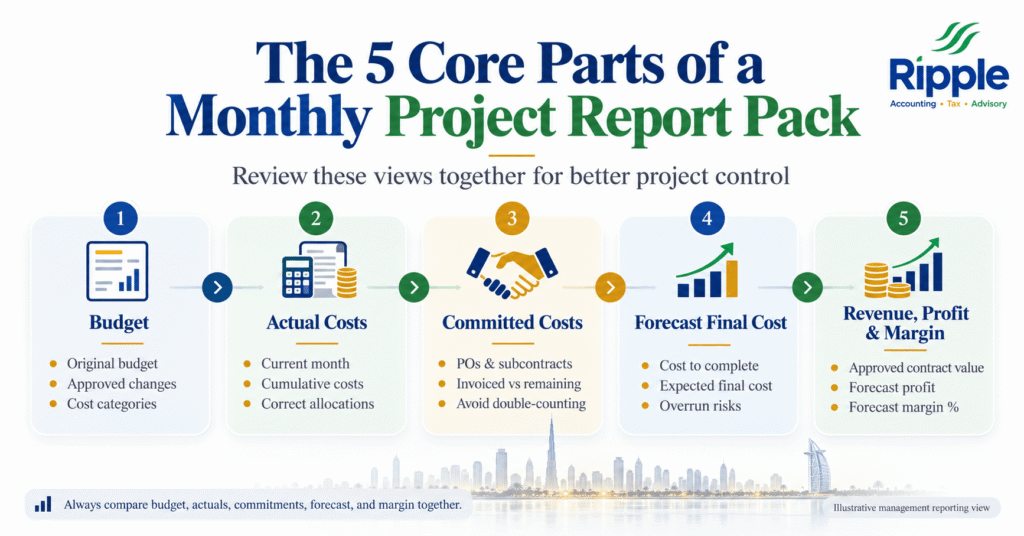
A practical report pack should present five connected views: budget, actuals, committed costs, forecast costs, and project margin. Each view has a different purpose, and the value comes from reviewing them together.
The budget is the baseline against which project performance is measured. It should show the approved cost allowance for each major work category and, where useful, each cost code.
Typical categories include:
The report should distinguish the original budget from approved changes. If the client approves additional work, the project budget and contract value may need to be updated in line with the company’s procedures.
Keeping a clear record of approved changes helps prevent teams from comparing actual spending with an outdated baseline.
What management should check: Has the budget been updated only for properly approved changes? Are cost categories detailed enough to identify the source of a variance?
Actual costs show the expenses recorded against the project up to the reporting date. These may include supplier invoices, payroll allocations, subcontractor invoices, equipment charges, and other costs supported by accounting records.
A report should show both the current month’s costs and cumulative costs from the start of the project.
For meaningful comparisons, actuals must be assigned to the correct project and cost category. Shared equipment, head-office expenses, and labour used across multiple sites should be allocated using a consistent and documented method.
The report should also identify missing documentation, unposted invoices, disputed charges, or costs recorded against the wrong job. Otherwise, the apparent project margin may be misleading.
What management should check: Are the accounts up to date? Have invoices and payroll costs been allocated to the correct project? Are there known costs that have not yet been recorded?
Committed costs represent obligations created by orders, subcontract agreements, or other authorised arrangements that have not yet been fully recognised as actual costs in the accounting records.
For example, a contractor may sign a subcontract worth AED 180,000. By month-end, the subcontractor has invoiced AED 70,000. Subject to the contract terms and any approved changes, the report may show AED 70,000 as actual costs and AED 110,000 as the remaining commitment.
This distinction matters because the outstanding AED 110,000 may not yet appear in the actual-cost total, but it still affects the project’s expected final cost.
The report should track, where relevant:
Care is needed to avoid double-counting. The remaining commitment should not be added again if it is already included in the forecast cost-to-complete figure.
What management should check: Are all active purchase orders and subcontract agreements included? Have cancelled orders been released? Are unapproved variations or expected claims identified separately?
The forecast is the report’s forward-looking component. It estimates what the contractor expects to spend to finish the project, using current information rather than relying only on the original budget.
A simple calculation is:
Forecast final cost = Actual costs to date + Forecast cost to complete
The forecast cost to complete should reflect the remaining work, outstanding commitments, expected labour and material requirements, equipment needs, and credible risks. It should be reviewed with the project manager and updated when conditions change.
For example, if actual costs are AED 600,000 and the latest estimate of remaining costs is AED 470,000, the forecast final cost is AED 1,070,000. If the current approved cost budget is AED 1 million, the project is forecast to exceed budget by AED 70,000.
The report should explain the major reasons for any projected overrun. These may include lower productivity, material price increases, rework, delays, or changes in project scope.
Forecasts should be realistic rather than deliberately optimistic. A cost that has not yet been invoiced does not disappear simply because it is absent from the ledger.
What management should check: Does the forecast reflect the work still to be completed? Are known risks included? Who reviewed and approved the latest estimate?
The final section translates the cost forecast into an estimate of project profitability.
At a basic management-reporting level:
Forecast project profit = Forecast project revenue − Forecast final cost
Forecast project margin (%) = Forecast project profit ÷ Forecast project revenue × 100
The revenue figure should be based on the contract value and approved changes, adjusted where necessary for the relevant revenue-recognition requirements. It should not automatically be treated as the amount invoiced or cash received.
For example, if forecast project revenue is AED 1.4 million and forecast final cost is AED 1.07 million, the projected profit is AED 330,000. The forecast margin is approximately 23.6%.
This is an illustrative calculation, not a substitute for the accounting treatment required for the specific contract. Where applicable, revenue recognition should be assessed under IFRS 15, Revenue from Contracts with Customers. The International Financial Reporting Standards Foundation explains the standard and its principles on recognising revenue in its official IFRS 15 overview.
What management should check: Is the revenue estimate supported by the contract and approved variations? Does the forecast include all expected costs? Has the margin changed materially since the previous report?
Consider a contractor working on a commercial fit-out project. The following figures are illustrative and demonstrate how the five reporting components fit together.
| Reporting item | Amount |
| Approved contract revenue | AED 1,400,000 |
| Approved project cost budget | AED 1,000,000 |
| Actual costs to date | AED 600,000 |
| Remaining commitments not included in actuals | AED 250,000 |
| Other forecast costs to complete | AED 220,000 |
| Forecast final cost | AED 1,070,000 |
| Forecast profit | AED 330,000 |
| Forecast profit margin | 23.6% |
In this example, the forecast final cost is AED 600,000 in actual costs plus AED 250,000 in remaining commitments and AED 220,000 in other forecast costs. The forecast therefore exceeds the approved cost budget by AED 70,000.
The report gives management more information than the actual-cost figure alone. Although only AED 600,000 has been recorded as actual costs, the project is not expected to finish within the original AED 1 million budget.
The next step is to investigate the forecast. For instance, are the additional costs caused by approved scope changes, lower-than-expected productivity, or procurement price increases? The answer will determine whether the contractor should revise its estimate, pursue a contractual variation, improve cost control, or take another action.
The finance team should also confirm that commitments and forecast costs are not overlapping. If part of the remaining subcontract value is already included in the forecast cost to complete, it must not be counted twice.
A monthly report should make important changes easy to identify. Alongside detailed cost schedules, contractors can include a concise set of indicators.
Budget variance = Forecast final cost − Approved cost budget
A positive result indicates a forecast overrun; a negative result indicates a forecast below budget. The report should show both the amount and percentage where useful.
Shows the expected profit as a percentage of forecast revenue. Comparing the current margin with the original estimate helps management see whether profitability is improving or deteriorating.
Shows how the estimate of remaining expenditure has changed since the previous reporting period. Significant movements should have a written explanation.
Highlights outstanding obligations and identifies whether remaining commitments are within the available budget. It should be read alongside actual costs and the forecast, not added to them indiscriminately.
Shows potential changes that may affect revenue or cost but have not yet been formally approved. These should be clearly separated from approved contract values and included in forecasts only according to the company’s documented assumptions and applicable accounting treatment.
Shows amounts invoiced, amounts collected, and overdue receivables. This is a useful companion to profitability reporting because a profitable job can still create cash-flow pressure.
Each KPI should have an owner, a reporting date, and a clear explanation of any significant exception. A dashboard full of figures is less useful if no one is responsible for acting on them.

A repeatable process improves consistency and makes reports easier to compare across projects.
Collect supplier invoices, payroll allocations, subcontractor statements, approved purchase orders, and relevant project records. Reconcile project-related costs to the accounting ledger and investigate unusual or missing entries.
Record approved changes to the contract value and cost budget. Keep proposed or disputed variations separate so that management can see what has been approved and what remains uncertain.
Compare recorded expenditure with purchase orders and subcontract agreements. Confirm which commitments remain open, which have been invoiced, and which have been cancelled or amended.
Work with project managers and procurement teams to estimate the cost of completing the outstanding scope. Include known risks and explain major changes from the previous forecast.
Update forecast revenue and final costs, calculate the projected profit and margin, and compare the results with the approved budget and previous month.
End the report with a short action list. For example, it may identify an overdue variation submission, an unexplained labour variance, a subcontract commitment requiring review, or a revised procurement plan.
Each action should have an owner and target date. This turns the report from a retrospective accounting document into a tool for project control.
Even a well-designed template can produce misleading results if the underlying data or process is weak.
Construction companies need financial reports that connect accounting records with project-level decisions. When project costs are recorded inconsistently, purchase orders are not tracked, or forecasts are not updated, management may struggle to understand the true financial position of each job.
Ripple Accounting, Tax & Advisory supports UAE businesses with accounting, bookkeeping, financial reporting, budgeting, cash-flow planning, and management reporting. These services can help a contractor organize financial information, monitor performance, and develop a more consistent monthly reporting process.
For construction businesses, the reporting process can be designed around the information management needs most: project budgets, actual expenditure, outstanding commitments, forecast costs, contract revenue, and expected margins. The precise scope depends on the records available, the company’s accounting systems, and the reporting requirements agreed with the client.
If your current reports show what has already been spent but do not explain what each project is likely to cost by completion, it may be time to review your reporting process.
Explore Ripple’s accounting and advisory services or discuss your requirements with the team to identify the reporting support that fits your business.
It should generally include the approved budget, actual costs to date, outstanding commitments, forecast cost to complete, forecast final cost, expected revenue, projected profit, and margin. It should also explain significant variances and list actions for management.
Actual costs are costs recorded as incurred under the company’s accounting procedures. Committed costs relate to obligations such as purchase orders and subcontract agreements that have not yet been fully recorded as actual costs. Tracking both helps contractors identify future spending exposure.
For a basic forecast, subtract the forecast final cost from forecast project revenue to estimate profit. Divide that profit by forecast revenue and multiply by 100 to calculate the margin percentage. The revenue and cost figures must be prepared consistently and in line with the applicable accounting requirements.
Monthly reporting is a practical minimum for many contractors because it supports regular financial review and forecasting. Projects with tight margins, fast-changing costs, or significant delivery risks may require more frequent monitoring.
The contractor may have incurred costs before billing the client, face delayed customer payments, or need to pay suppliers and subcontractors before receiving progress payments. Profitability reporting should therefore be reviewed alongside cash-flow forecasts, billing milestones, and receivables.
A useful monthly project profitability report does more than show how much a contractor has spent. It connects the approved budget with actual costs, remaining commitments, forecast expenditure, and expected margin. For UAE construction companies, this creates a clearer basis for identifying overruns, reviewing project performance, and making timely decisions. The key is to use consistent cost codes, reliable records, realistic forecasts, and clear responsibility for follow-up actions.
Disclaimer: This article provides general management-reporting information and is not accounting, tax, legal, or project-specific financial advice. Construction revenue recognition and cost accounting depend on the contract terms, facts, applicable accounting standards, and the company’s circumstances. Seek advice from a qualified professional where required.
Tell us a little about your business and our UAE tax experts will get back to you with clear, practical answers — no obligation.
 Corporate Tax
Are you unsure whether UAE Corporate Tax registration is mandatory for your business and how to complete the process? UAE Corporate Tax…
Read article Corporate Tax
Is your UAE Corporate Tax return filing deadline approaching, and are you sure your business is ready to file without errors or…
Read article Corporate Tax
How much does Corporate Tax return filing cost in UAE, and are you paying the right amount for your business? The UAE…
Read articlePage 2 of 58
Book a free consultation and get clear answers for your business.
0 Comments