Could a few missed finance checks each month turn into a much bigger compliance problem later?
For UAE SMEs, monthly finance compliance UAE is not only about filing tax returns when a deadline arrives. Regularly reviewing transactions, invoices, bank records, payroll, tax information and accounting balances can help identify errors before they become difficult or costly to fix.
A monthly finance compliance routine gives business owners a clearer view of their records while helping keep important documents ready for VAT, Corporate Tax and other financial obligations.
Let’s look at the key monthly finance compliance checks UAE SMEs should complete every month!
What Is Monthly Finance Compliance UAE?
Monthly Finance Compliance UAE
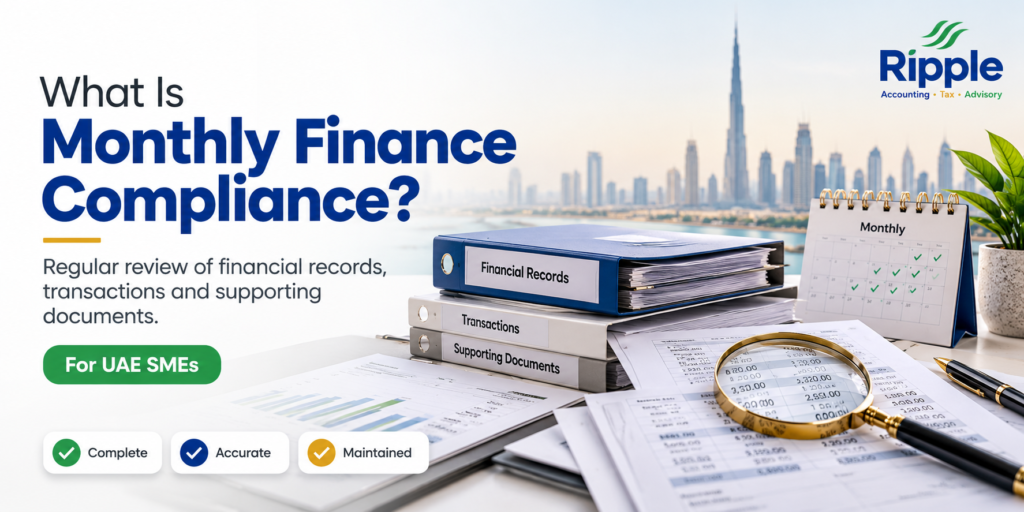
Monthly finance compliance means regularly reviewing a company’s financial records, transactions and supporting documents to make sure they are complete, accurate and properly maintained.
The exact checks will depend on the nature, size and tax status of the business. However, a practical monthly review can cover:
Sales and purchase transactions
Sales and purchase invoices
Bank and cash records
Accounts receivable and payable
VAT records, where applicable
Payroll and related records
Expenses and supporting documents
Fixed assets
Loans and liabilities
Corporate Tax records
Accounting reconciliations
Compliance deadlines and outstanding actions
This does not mean that every SME has identical monthly filing obligations. Instead, the objective is to maintain reliable financial records and identify issues early.
The UAE Ministry of Finance explains that businesses should understand the financial information and records they need to maintain for Corporate Tax purposes and regularly check official guidance for updates.
Why Should UAE SMEs Perform Monthly Finance Compliance Checks?
Leaving financial records unchecked until the end of the financial year can make errors harder to identify.
For example, a missing invoice may be difficult to locate several months later. An unreconciled bank transaction may affect reported balances. A duplicated expense may distort management reports, while an incorrect tax treatment may create additional work when preparing a tax return.
A monthly review helps businesses:
Detect accounting errors earlier
Keep financial records organised
Maintain supporting documentation
Identify unusual transactions
Monitor outstanding receivables and payables
Prepare for tax filing
Improve financial reporting
Reduce last-minute compliance pressure
It can also give SME owners better visibility into the financial position of their business.
UAE Monthly Finance Compliance Checklist for SMEs
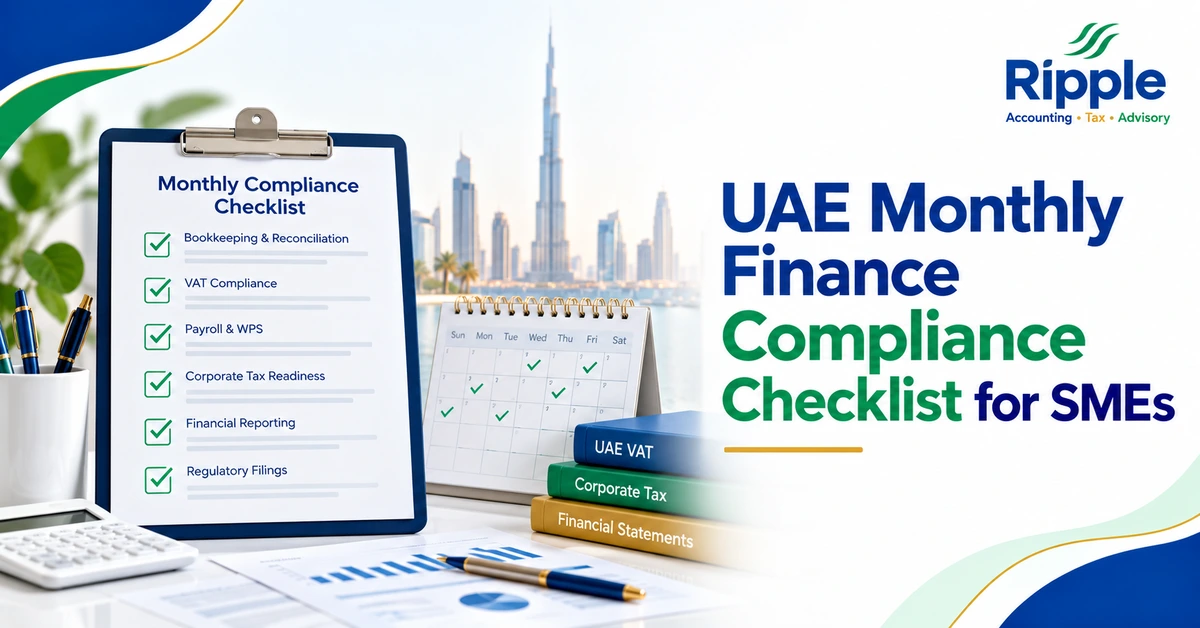
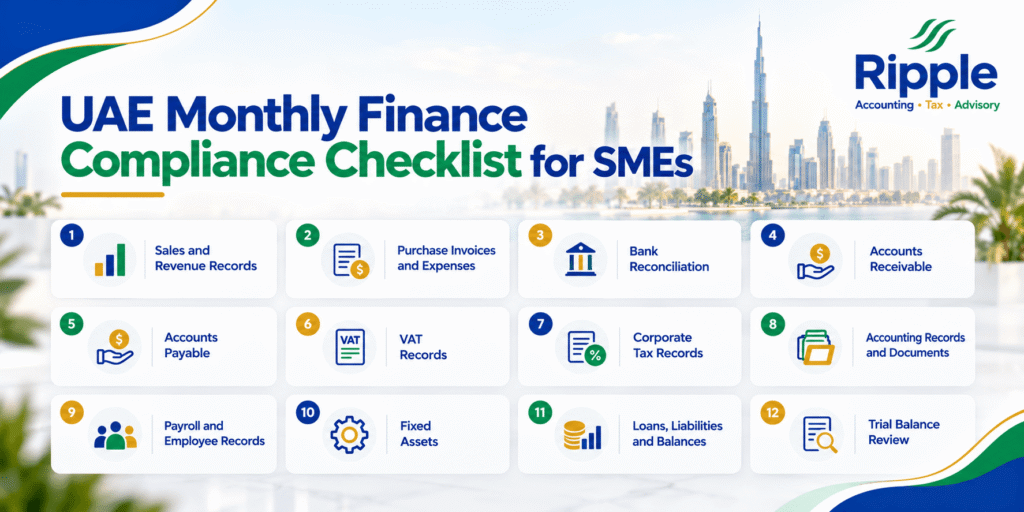
UAE Monthly Finance Compliance Checklist
The following checklist can be adapted according to your business activities, accounting system and tax obligations.
1. Review Sales and Revenue Records
Start by checking whether all sales made during the month have been properly recorded.
Review:
Sales invoices issued during the month
Credit notes and refunds
Customer receipts
Online and cash sales
Unrecorded or cancelled transactions
Revenue recorded in the accounting system
Compare sales records with available supporting documents and, where relevant, payment records.
The purpose is not simply to confirm how much the business sold. It is also to make sure the accounting records provide a reliable trail from the underlying transaction to the financial statements and, where applicable, tax reporting.
2. Check Purchase Invoices and Business Expenses
Review supplier invoices and expenses recorded during the month.
Check whether:
Supplier invoices are available
Expenses relate to business activities
Invoice details are complete
Transactions have been posted to the correct accounts
Credit notes have been recorded
Duplicate invoices have been removed
Supporting receipts are retained
Particular attention should be given to unusual, high-value or one-off expenses. For businesses registered for VAT, the supporting documentation should also be reviewed for appropriate VAT treatment before the relevant VAT return is prepared.
3. Reconcile Bank Accounts
Bank reconciliation should be one of the most important monthly finance checks. Compare the accounting records with bank statements and investigate differences such as:
Unrecorded bank charges
Outstanding deposits
Payments recorded twice
Missing receipts
Unidentified transfers
Timing differences
Incorrect transaction amounts
If a business operates several bank accounts, each account should be reconciled separately. A monthly bank reconciliation can also help identify transactions that require clarification before the accounting records are finalised.
4. Review Accounts Receivable
Check what customers owe the business at the end of the month.
Review:
Outstanding customer invoices
Overdue balances
Credit notes
Customer advances
Long-outstanding receivables
Unallocated customer payments
An aged receivables report can help management identify customers whose balances require follow-up. This review also supports cash-flow management because accounting profit does not necessarily mean that cash has already been collected.
5. Review Accounts Payable
The same principle applies to supplier balances.
Check:
Unpaid supplier invoices
Overdue payments
Supplier statements
Duplicate invoices
Unrecorded liabilities
Credit notes
Advances paid to suppliers
Keeping accounts payable records updated helps SMEs understand upcoming cash requirements and reduces the risk of overlooking supplier obligations.
6. Review VAT Records, If Applicable
VAT-registered businesses should regularly review VAT-related transactions rather than waiting until the VAT return is due.
Check:
Output VAT on sales
Input VAT on eligible purchases
VAT invoices
Credit notes
Zero-rated and exempt transactions
Imports, where applicable
VAT account balances
Differences between accounting records and VAT records
The Federal Tax Authority states that taxable persons must retain VAT invoices issued and received for a minimum of five years. For broader VAT record requirements, businesses should refer to the latest FTA guidance applicable to their circumstances.
7. Review Corporate Tax Records
Corporate Tax compliance should also be supported by regular accounting discipline. The starting point for calculating UAE Corporate Tax is generally the accounting income shown in the financial statements, followed by the relevant tax adjustments.
A monthly review can therefore help ensure that the underlying records are accurate.
Check:
Revenue records
Business expenses
Assets and disposals
Liabilities
Accounting adjustments
Related-party transactions, where relevant
Tax-sensitive expenses
Supporting documentation
The FTA has also emphasised that Taxable Persons must maintain records and documents supporting information reported in Corporate Tax returns.
8. Maintain Accounting Records and Supporting Documents
Good compliance depends on more than figures entered into accounting software. Businesses should maintain appropriate supporting records such as:
Bank statements
Sales and purchase invoices
Receipts
Contracts
Loan documents
Asset records
Supplier and customer records
Payroll records
Relevant business correspondence
The FTA’s Corporate Tax guidance identifies transaction records, assets, liabilities and stock records among the types of information businesses may need to maintain, depending on their circumstances.
For the latest requirements, businesses should also review FTA Decision No. 4 of 2026 on the Rules and Requirements for Maintaining the Information Contained in Accounting Records and Commercial Books, which was issued in June 2026 and published in August 2026.
9. Review Payroll and Employee-Related Records
Where the SME has employees, payroll records should also form part of the monthly finance review.
Check:
Salary calculations
Employee additions and exits
Allowances and deductions
Leave-related adjustments
Payroll journals
Salary payments
Supporting payroll documentation
Any applicable WPS requirements
Payroll information should be reconciled with the accounting records so that salary expenses and related liabilities are accurately reflected.
10. Review Fixed Assets
Businesses should periodically check their fixed asset records.
Review:
New assets purchased
Assets disposed of
Asset invoices
Asset locations or status
Depreciation entries
Asset register balances
This becomes particularly important where the business purchases equipment, vehicles, computers, machinery or other significant assets.
11. Check Loans, Liabilities and Other Balances
Review outstanding loans and other liabilities against available statements and supporting documents.
Check:
Loan balances
Interest charges
Repayments
Accrued expenses
Supplier balances
Employee-related liabilities
Other outstanding obligations
This can help prevent old or incorrect balances from remaining in the accounts indefinitely.
12. Review the Trial Balance
Once the monthly transactions have been recorded, review the trial balance. Look for unusual movements in:
Revenue
Cost of sales
Operating expenses
Receivables
Payables
Cash
Loans
Tax accounts
Fixed assets
Large or unexpected movements should be investigated before the month is closed.
A trial balance review is not necessarily a complete compliance review, but it can highlight areas requiring further investigation.
How to Make the Monthly Compliance Process Easier
A checklist works best when it becomes a repeatable process rather than an occasional exercise.
SMEs can consider using a simple monthly workflow:
Step 1: Collect invoices, receipts and statements.
Step 2: Record all transactions in the accounting system.
Step 3: Reconcile bank and other relevant accounts.
Step 4: Review receivables and payables.
Step 5: Check VAT and Corporate Tax-related records, where applicable.
Step 6: Review payroll and fixed assets.
Step 7: Investigate unusual or incomplete transactions.
Step 8: Review the trial balance.
Step 9: Save supporting documents systematically.
Step 10: Record outstanding compliance actions for the following month.
This approach makes it easier to see what has been completed and what still needs attention.
How Long Should UAE Businesses Keep Financial Records?
Record retention requirements depend on the type of record and the applicable legislation.
Under the UAE Tax Procedures framework, accounting records and commercial books generally need to be retained for specified periods, with additional retention requirements potentially applying in circumstances such as tax disputes or audits.
The rules have also been updated in 2026. The Ministry of Finance announced amendments to the Tax Procedures Executive Regulation that include changes affecting record retention in certain circumstances, including refund claims.
This is why businesses should avoid treating document retention as simply an end-of-year task. Financial documents should be organised throughout the year.
Common Monthly Finance Compliance Mistakes SMEs Should Avoid
Even businesses with accounting software can have compliance gaps. Some common issues include:
Recording transactions without supporting documents: An accounting entry without appropriate documentation can make it difficult to verify the transaction later.
Waiting until tax filing season: Trying to reconstruct several months of transactions immediately before a tax deadline increases the risk of errors.
Ignoring unreconciled balances: Old bank, customer or supplier differences should be investigated rather than repeatedly carried forward.
Mixing personal and business transactions: Business and personal spending should be appropriately separated and documented.
Keeping documents in scattered locations: Invoices and receipts stored across emails, phones and different folders can become difficult to retrieve when needed.
Assuming accounting software guarantees compliance: Accounting software can help organise records, but it does not automatically determine whether every transaction has been classified or treated correctly.
When Should an SME Consider a Compliance Review?
A monthly checklist is useful for routine monitoring, but a more detailed compliance review may be appropriate when:
Accounting records are incomplete
The business has recently changed accountants
There are unexplained balances
VAT records require reconciliation
Corporate Tax filing is approaching
The business has undergone significant growth
Several months of bookkeeping are outstanding
Management is unsure whether supporting documents are complete
The business has received a tax-related communication from the FTA
A professional review can help identify gaps before they become more difficult to resolve.
How Ripple Accounting, Tax & Advisory Can Help
Managing monthly finance compliance can become challenging when SME owners are also handling operations, customers, employees and business growth.
Ripple Accounting, Tax & Advisory can support businesses with accounting and compliance-focused reviews, including checking financial records, identifying inconsistencies and helping businesses maintain more organized financial information. If your SME has incomplete records, unreconciled balances or uncertainty around its monthly finance processes, contact Ripple Accounting, Tax & Advisory for a tailored compliance review.
1. What is a monthly finance compliance checklist for an SME?
It is a recurring list of financial and compliance checks performed each month. It can include transaction reviews, bank reconciliation, invoices, receivables, payables, tax records, payroll, fixed assets and supporting documentation.
2. Is monthly finance compliance legally required for every UAE SME?
Not every SME has the same monthly filing or review obligation. However, maintaining appropriate accounting records and supporting documents is important for businesses with tax obligations. The exact requirements depend on the business and applicable UAE legislation.
3. How often should UAE SMEs reconcile their bank accounts?
Monthly reconciliation is a practical minimum for many SMEs. Businesses with high transaction volumes may benefit from more frequent reconciliation.
4. How long should UAE SMEs keep accounting and tax records?
Record-retention periods depend on the applicable rules and type of record. Under the Tax Procedures framework, specified records are generally subject to minimum retention periods, with longer periods potentially applying in certain circumstances. Businesses should check the latest FTA and Ministry of Finance requirements.
5. Can an accounting compliance review be done before Corporate Tax filing?
Yes. Reviewing accounting records before Corporate Tax filing can help identify missing documents, unreconciled balances and other issues that may affect the information used to prepare the return.
Conclusion
Monthly finance compliance does not have to be complicated. For many UAE SMEs, a consistent routine covering transactions, invoices, bank reconciliations, receivables, payables, VAT records, Corporate Tax information, payroll and supporting documents can make financial management much easier. The exact requirements will depend on the business and its tax position, so SMEs should use the latest UAE legislation and FTA guidance when determining their obligations. The key is consistency: review financial records every month instead of waiting for a tax deadline or year-end closing process.
Disclaimer: This article provides general information about monthly finance compliance for UAE SMEs and is not legal, tax, accounting or financial advice. Compliance requirements can vary according to a business’s activities, legal structure, tax status and individual circumstances. UAE legislation and official guidance may change, so businesses should verify the latest requirements with the Federal Tax Authority, Ministry of Finance or a qualified professional before making compliance decisions.
Is your construction project still profitable after you account for actual spending, outstanding purchase orders, subcontractor commitments, and the cost of completing…
Could your business explain every employee’s salary payment, deduction, overtime amount, and leave adjustment if an employee or regulator asked for proof?…



0 Comments