Ethical Considerations in Tax Avoidance vs Tax Planning
Every individual and business wants to reduce its tax burden legally. Effective tax planning helps minimize taxes while remaining fully compliant with…
Read article
Are your business controls strong enough to prevent errors, fraud and compliance problems before they reach your financial statements?
For UAE SMEs, an internal controls review UAE can help identify weaknesses in financial processes, approvals, record keeping and access controls before they become larger problems. A structured review allows business owners to understand how transactions are authorized, recorded, reconciled and monitored. This practical checklist explains the key areas SMEs should review and how stronger internal controls can support reliable accounting, audit readiness and compliance.
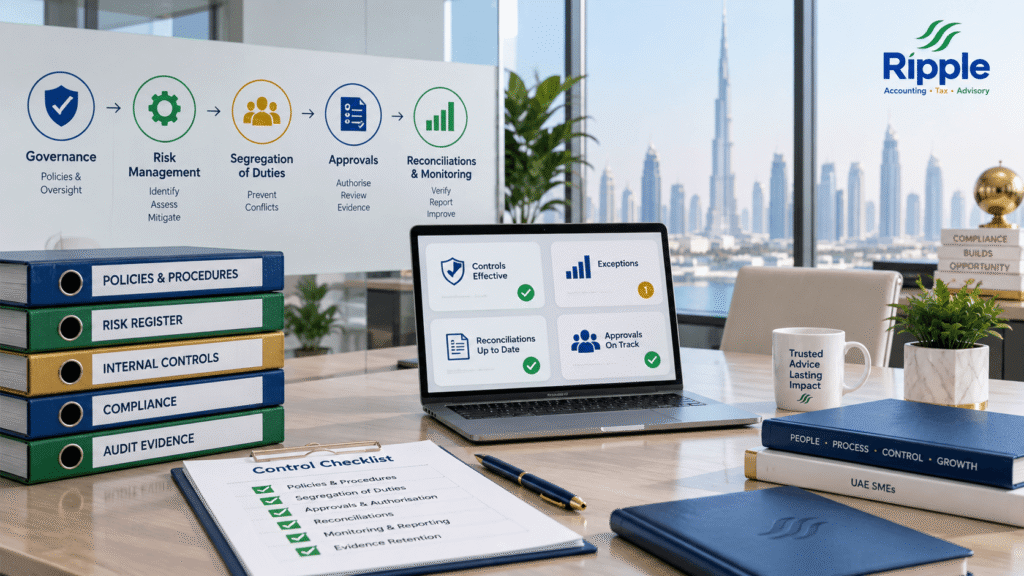
An internal controls review is a structured assessment of the processes and procedures a business uses to manage its financial and operational activities. The objective is not simply to find mistakes. It is to determine whether controls are properly designed and consistently followed.
For example, a business may have a rule requiring management approval before payments are made. The review should establish whether:
For SMEs, these controls are particularly important because a small finance team may mean that one employee handles several stages of a transaction.
Weak controls can lead to inaccurate financial records, duplicate payments, unauthorised transactions, missing documentation and difficulties during an audit. A review can help management identify these weaknesses before they affect financial reporting or regulatory compliance.
The UAE Federal Tax Authority (FTA) also requires businesses to maintain appropriate accounting records and supporting information. FTA Decision No. 4 of 2026 specifically sets rules and requirements for information maintained in accounting records and commercial books.
An internal controls review can therefore help SMEs determine whether their accounting processes are sufficiently organised to support accurate and complete records.
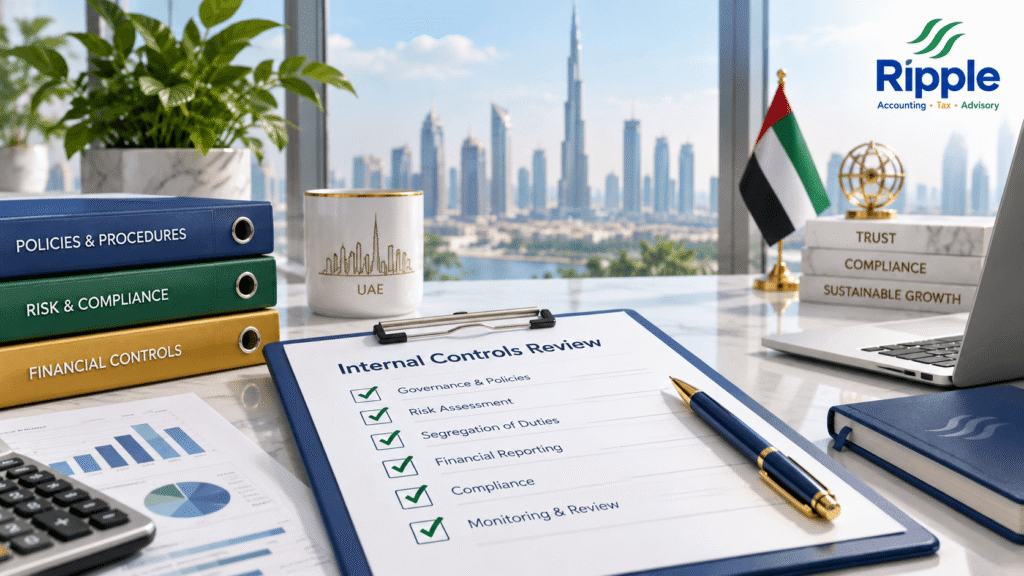
A practical internal control checklist UAE businesses can use should cover the following areas.
Start by checking who can access the accounting system, online banking platform and other financial applications. Access should be based on job responsibilities rather than convenience.
Check whether:
The FTA’s technical requirements for tax accounting software also highlight access controls and permissions as important controls for protecting accounting data.
Purchasing is an important area for an internal controls review UAE because weaknesses can result in unauthorised or duplicate payments.
SMEs should review whether there is a clear process for:
Where practical, different employees should be responsible for approving purchases, processing payments and reconciling bank transactions.
This separation reduces the risk that one person can initiate and complete an unauthorised transaction without detection.
Sales transactions should be supported by appropriate documentation and recorded accurately. Businesses should check whether:
Management should also review whether revenue recorded in the accounting system agrees with sales documentation and bank receipts.
Bank reconciliation is one of the most useful controls for identifying errors and unusual transactions. An SME should reconcile each business bank account regularly rather than waiting until year-end.
The review should check whether:
Bank reconciliation should not simply be treated as a bookkeeping task. It can provide management with an important independent check over cash movements.
Payroll should also be included in an SME’s internal control review. Businesses should establish controls over employee onboarding, salary changes, attendance information, deductions and termination payments.
Check whether:
Where payroll is subject to specific UAE regulatory requirements, businesses should also ensure their processes are consistent with applicable rules.
Businesses that hold inventory should assess whether physical stock and accounting records agree. An internal control checklist UAE SMEs can use for inventory should include:
Differences between physical inventory and accounting records should be investigated rather than simply adjusted without explanation.
Fixed assets such as machinery, vehicles, computers and equipment should be properly recorded and monitored. Review whether the business maintains:
Periodic physical verification can help identify assets that are missing, incorrectly recorded or no longer in use.
A strong control environment depends on complete supporting documentation. SMEs should check whether transactions can be traced from the accounting system back to their source documents.
For example, an expense should ideally have appropriate evidence such as an invoice, receipt, purchase approval or other relevant documentation.
The FTA has emphasised the importance of maintaining records and documents supporting information reported in Corporate Tax returns. Businesses should therefore review whether accounting records are complete, organised and supported by appropriate documentation.
Every SME should clearly define who can approve different types of transactions. For example, management may establish different approval levels for:
Approval limits should be documented and communicated to employees. A control is less effective if employees do not understand who has authority to approve a transaction.
Segregation of duties means dividing important responsibilities between different people where practical. For example, the person who creates a supplier should ideally not have unrestricted authority to approve and pay that supplier’s invoices.
Similarly, the employee preparing a bank reconciliation should not necessarily be the only person responsible for initiating payments.
SMEs may have limited staff, making complete segregation difficult. In such cases, management review and secondary approval can provide additional oversight.
Finding a control weakness is only the first step. Businesses should determine its potential impact and decide how it should be addressed. A simple review can classify findings as:
Each significant finding should have a clear action, responsible person and target completion date.
Some weaknesses occur repeatedly in growing businesses.
These may include:
These weaknesses do not necessarily mean that fraud or financial misstatement has occurred. However, they can increase the risk of errors and make problems more difficult to detect.
An internal controls review can be particularly useful before an external audit. Auditors may need to understand the company’s accounting processes, supporting documentation and relevant controls when performing their work. The UAE Ministry of Economy & Tourism maintains legislation governing the accounting and auditing profession, including Federal Decree Law No. 41 of 2023, which concerns the regulation of the accounting and auditing profession.
An internal review before an audit can help management identify documentation gaps, reconciliation issues and process weaknesses early. It should not, however, be treated as a replacement for an independent statutory audit where an audit is legally required.
Before completing the review, UAE SMEs can ask the following questions:
| Control Area | Key Question |
| System access | Do employees have only the access they need? |
| Purchases | Are purchases properly approved? |
| Payments | Are payments reviewed before release? |
| Sales | Are invoices complete and properly recorded? |
| Receivables | Are overdue balances regularly reviewed? |
| Bank accounts | Are bank accounts reconciled regularly? |
| Payroll | Are salary changes and payroll payments authorised? |
| Inventory | Are physical stocks periodically checked? |
| Fixed assets | Is there an updated asset register? |
| Accounting records | Are transactions supported by appropriate documents? |
| Approvals | Are approval limits clearly defined? |
| Segregation | Are incompatible duties separated where practical? |
| Management review | Are financial reports and unusual transactions reviewed? |
| Access changes | Are former employees removed from financial systems? |
This checklist can be adapted according to the size, industry and complexity of the business.
Ripple Accountants supports UAE businesses with practical accounting, audit, and compliance services. Its services include accounting and bookkeeping, financial reporting, budgeting and forecasting, account reconciliation, VAT registration and filing, Corporate Tax support, compliance reviews and audit support. Ripple can help businesses review their financial processes, identify potential control weaknesses and improve the organization of accounting records before an audit or compliance review.
If your business needs an internal controls review UAE, contact Ripple Accounting, Tax & Advisory to discuss your requirements and get tailored support for your business!
An internal controls review UAE is an assessment of a company’s financial and operational processes to identify weaknesses, risks and opportunities to improve controls. It can cover areas such as payments, accounting records, system access, payroll, inventory and bank reconciliation.
An internal controls review can help SMEs identify errors, weak approval procedures, documentation gaps and access risks before they lead to larger financial or compliance issues. It can also help businesses prepare their processes and records for an audit.
A practical checklist can include accounting system access, purchase approvals, payment controls, sales and receivables, bank reconciliation, payroll, inventory, fixed assets, accounting records, segregation of duties and management review.
Yes. Complete segregation of duties may not always be possible in a small business. However, management can introduce compensating controls such as secondary approval, regular management review, restricted system access and independent bank reconciliation reviews.
No. An internal controls review focuses on assessing and improving a company’s processes and controls. An external audit is an independent examination performed in accordance with applicable professional and regulatory requirements. An internal review can help a business prepare for an audit but does not replace an audit where one is required.
A strong internal control system helps UAE SMEs protect financial information, reduce errors, improve accountability and maintain reliable accounting records. Regular reviews can also help management identify weaknesses before they create larger financial, audit or compliance problems. Rather than treating internal controls as a one-time exercise, businesses should review key processes periodically as their employees, systems, suppliers and operations change.
Disclaimer: This article provides general information for UAE businesses and should not be considered legal, tax, accounting or audit advice. Regulatory requirements may vary according to the company’s legal structure, activities, location and circumstances. Businesses should review current UAE legislation and obtain professional advice for their specific situation.
Tell us a little about your business and our UAE tax experts will get back to you with clear, practical answers — no obligation.
 Corporate Tax
Every individual and business wants to reduce its tax burden legally. Effective tax planning helps minimize taxes while remaining fully compliant with…
Read article Corporate Tax
A Tax Residency Certificate (TRC) is an important document for businesses and individuals operating in the UAE. It proves that the certificate…
Read article Bookkeeping
Businesses today are expanding faster than ever, thanks to digital technology, online sales, and global markets. As operations grow, managing finances with…
Read articlePage 36 of 45
Book a free consultation and get clear answers for your business.
0 Comments