UAE Tax Residency Certificate Fees, Processing Time and Validity
How much does a UAE Tax Residency Certificate cost, how long does it take to obtain, and when does it expire? Understanding…
Read article
Could a transaction look completely normal in your accounting system and still be an AML red flag?
A transaction may appear normal in accounting records but still require closer review. Large payments, transfers involving several parties, or sudden changes in transaction patterns can be potential red flags, although they do not automatically indicate money laundering or financial crime.
Businesses should assess whether such activity is reasonable and consistent with the customer’s known profile. This makes DNFBP transaction monitoring UAE important for sectors exposed to money laundering risks. UAE DNFBPs are subject to the AML/CFT framework, with sector-specific guidance covering red flags and suspicious transaction reporting.
DNFBP stands for Designated Non-Financial Businesses and Professions. In the UAE, DNFBPs include certain non-financial businesses and professional activities that can be exposed to money laundering and other financial crime risks. Examples include:
The Ministry of Economy and Tourism provides specific AML resources for these sectors, including red-flag guidance for accountants and auditors, real estate businesses, precious-metal dealers, and corporate service providers. The reason these businesses receive particular attention is that their services, transactions, or assets may potentially be misused to move, conceal, or integrate illicit funds.
The UAE’s current AML framework includes Federal Decree-Law No. 10 of 2025 and its Executive Regulations under Cabinet Resolution No. 134 of 2025, which became effective on 14 December 2025.
Transaction monitoring means reviewing customer activity to identify transactions or patterns that appear unusual, inconsistent, or potentially suspicious based on what the business knows about the customer. In simple terms, it asks:
“Does this transaction make sense for this customer and their business?”
A business may consider factors such as:
These two AML terms are sometimes confused. Transaction monitoring looks at transaction activity and patterns to identify unusual behavior. Transaction screening is different. It involves checking relevant parties or transactions against applicable sanctions and other screening lists. A strong AML framework may require both, depending on the business’s activities and risk exposure.
Effective DNFBP AML compliance UAE processes help businesses identify unusual activity and respond appropriately before risks become harder to investigate.
Transaction monitoring can help a DNFBP:
The UAE Ministry of Economy and Tourism states that DNFBPs must promptly report suspicious transactions or attempted transactions when there are suspicions or reasonable grounds to suspect that funds or proceeds are related to a crime or intended for criminal purposes. It also says DNFBPs should maintain indicators for identifying possible suspicious transactions and have internal procedures for identification and reporting.
Importantly, transaction monitoring is not about assuming that every unusual transaction is illegal. The purpose is to identify activity that requires appropriate review.
A practical transaction monitoring process usually follows several stages.
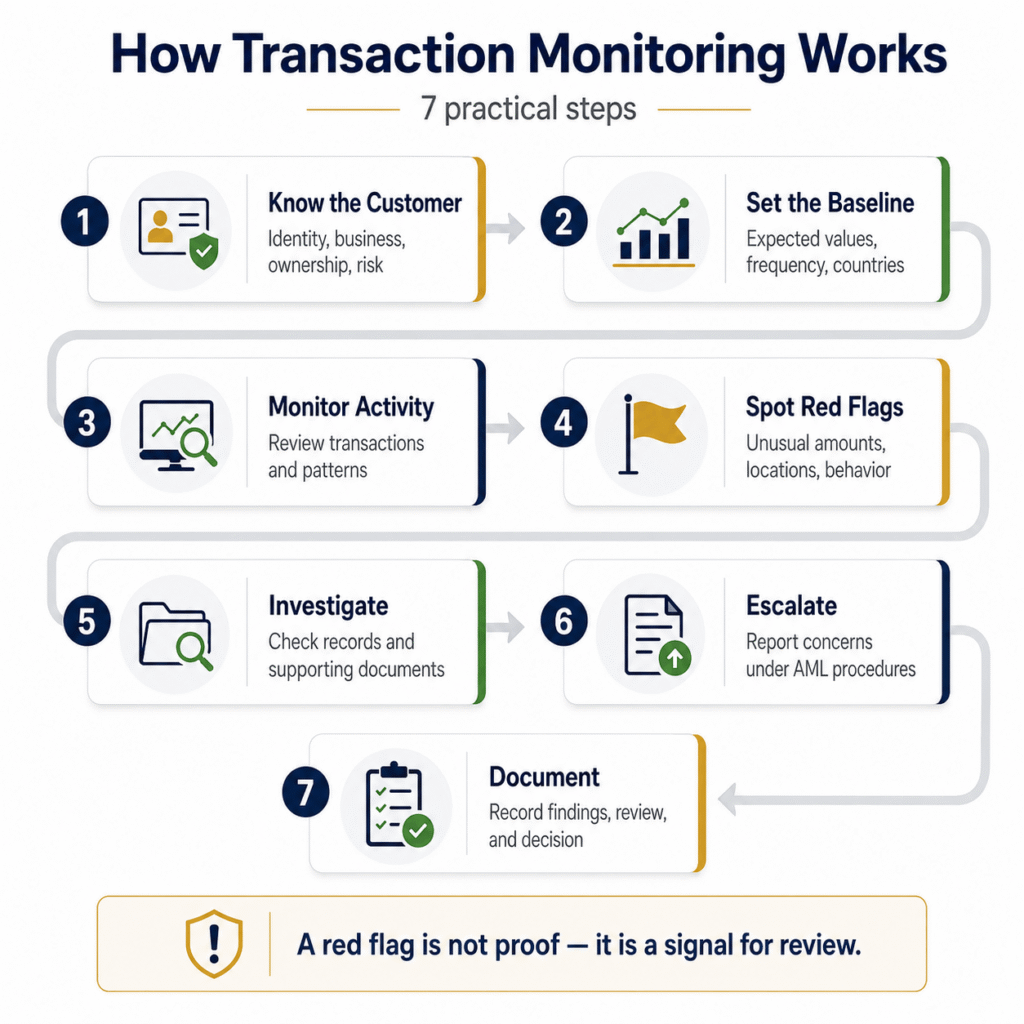
Before deciding whether something is unusual, the business needs to understand who the customer is. This may include reviewing:
Without this information, it is difficult to determine whether a transaction is genuinely unusual. For example, a large international payment may be completely normal for an import-export company but unusual for a small local business whose activities have historically been domestic.
The business should have a reasonable understanding of how the customer is expected to operate. Consider:
This creates a baseline against which future activity can be reviewed.
Transactions can then be reviewed for unusual amounts, patterns, counterparties, locations, or payment behavior. Monitoring may be manual or supported by technology.
An unusual transaction or pattern may trigger a review. However, a red flag is not proof of money laundering. It is an indicator that should be considered alongside the customer’s circumstances and other available information.
The business should review relevant information and supporting documents to understand the transaction.
If concerns remain after review, the matter may need to be escalated according to the organization’s AML procedures.
The business should record what was identified, what was reviewed, what explanation was obtained, and why a particular decision was reached.
Accounting records can provide valuable information during AML reviews. They may show patterns that are not obvious from a single transaction. The following transaction monitoring red flags should not automatically be treated as evidence of criminal activity. Instead, there are situations that may require additional questions or investigation.
A transaction that is significantly larger than the customer’s normal activity may deserve attention. For example, a business that normally processes payments of AED 20,000 suddenly records a transaction of AED 1 million. The amount alone does not make the transaction suspicious. The reviewer should ask:
One of the important AML red flags UAE businesses should understand is inconsistency between the customer’s known business and actual transaction activity. For example, a company described as a small local consulting business suddenly starts receiving substantial payments connected with unrelated international trading activity.
The reviewer should determine whether the customer’s business has changed, whether the activity is legitimate, and whether customer information needs updating.
Cash is not automatically suspicious. However, unusual cash activity can require closer review when it does not fit the customer’s normal business. Examples include:
The important question is whether the transaction has a reasonable and supported explanation.
A third-party payment occurs when someone other than the expected customer or counterparty makes a payment. For example, a customer owes a supplier AED 100,000, but the payment comes from an unrelated company. This does not automatically indicate wrongdoing. However, the relationship between the parties and the reason for the payment should be understood.
Another potential red flag is when funds enter and leave an account or transaction chain unusually quickly. Reviewers may examine:
Looking at the full transaction pattern is often more useful than looking at one payment in isolation.
A transaction involving multiple companies, intermediaries, jurisdictions, or ownership layers may require additional review when the structure has no clear commercial purpose. The key question is not simply:
“Is this transaction complicated?”
It is:
“Why does it need to be structured this way?”
A legitimate international transaction may naturally involve several parties. What matters is whether the structure can be reasonably explained and supported.
Changes in ownership are not inherently suspicious. However, unexplained or unusually frequent changes may require review, particularly when the business has difficulty identifying the ultimate beneficial owner.
Review:
Transactions involving jurisdictions identified as high-risk or subject to increased monitoring may require appropriate risk-based measures.
The UAE Ministry of Economy and Tourism publishes updates concerning high-risk countries and jurisdictions and related measures for DNFBPs.
This does not mean every transaction involving a particular country is suspicious. Geographic exposure is one factor that should be considered together with the customer’s profile and transaction circumstances.
Documentation problems can also create concerns.
Examples include:
A missing document does not automatically mean a transaction is suspicious. The business should determine whether the issue can be reasonably resolved.
Accounting teams may notice patterns such as:
Again, the pattern and context matter more than a single accounting entry.
| Red flag | What to review |
| Unusually large transaction | Customer profile and transaction purpose |
| Unexpected cash activity | Source and business rationale |
| Third-party payment | Relationship between parties |
| Complex transaction | Commercial or economic purpose |
| Geographic exposure | Applicable country and customer risk |
| Rapid movement of funds | Full transaction chain |
| Ownership changes | Beneficial ownership |
| Missing documents | Supporting evidence |
| Unusual invoices | Invoice and payment consistency |
| Activity inconsistent with profile | Expected vs. actual activity |
The presence of a red flag does not establish that a customer has committed a crime. The appropriate response is to review, investigate, and document the circumstances.
A clear AML review procedure helps staff respond consistently rather than making decisions based on assumptions.
Record the basic details:
Ask:
Depending on the transaction, documents may include:
The purpose is to understand the commercial reason for the transaction.
Where appropriate based on the customer’s risk and applicable requirements, the business should seek to understand where the funds came from and why the transaction is being made.
Do not always review an alert by itself.
Look for:
A single unusual payment may be easily explained. A repeated pattern may require more attention.
Consider the combined circumstances:
Depending on the outcome, the business may:
The appropriate decision should follow the DNFBP’s AML policies and applicable UAE requirements.
A reviewer should be able to understand:
What happened → What was investigated? → What evidence was reviewed → What decision was reached → Why
Good documentation is therefore an important part of the DNFBP AML requirements UAE.
Not every DNFBP needs the same technology.
Smaller businesses may use:
The process still needs to be structured and documented.
Larger or more complex businesses may use systems that identify:
Technology can improve efficiency, but automation does not replace human judgment. The UAE’s DNFBP guidance recognizes that monitoring can be manual or automated and should be appropriate to the business’s size, nature, complexity, and risk.
When an alert is generated, avoid jumping directly to a conclusion. Ask these questions:
The final assessment should consider all available information rather than relying on one red flag.
A useful transaction review record may include:
This documentation helps demonstrate that the business did not simply ignore an alert.
Not every unusual transaction requires external reporting. A useful way to understand the process is
Unusual → Reviewed → Explained → Close the review
or:
Unusual → Reviewed → Concerns remain → Escalate according to AML procedures
Escalation may be appropriate when:
The UAE’s current DNFBP guidance states that DNFBPs must promptly report suspicious transactions or attempted transactions when the applicable suspicion or reasonable grounds to suspect threshold is met.
Suspicious transaction or activity reporting is an important part of the UAE AML framework.
The UAE’s Financial Intelligence Unit (FIU) receives and analyzes suspicious transaction and activity reports. DNFBPs use the goAML system for relevant reporting. The Ministry of Economy and Tourism states that DNFBPs are required to register on goAML and use the system to submit STRs/SARs as applicable.
A report should not be treated as a declaration that the customer is guilty of a crime. Reporting is part of the AML framework for communicating concerns to the competent authority.
DNFBPs should also be careful about tipping off. In simple terms, this means improperly alerting a customer that a suspicious transaction/activity report or related investigation is being made.
Because reporting requirements and procedures can have serious legal consequences, businesses should follow their approved AML framework and obtain appropriate professional advice where necessary.
1. Treating Every Alert as Suspicious: An alert is a reason to investigate, not proof of criminal activity.
2. Looking Only at Transaction Value: A smaller transaction can also be unusual when considered as part of a wider pattern.
3. Ignoring Customer Context: A transaction should be assessed against the customer’s business and expected activity.
4. Reviewing Transactions in Isolation: Related transactions can reveal a pattern that one payment does not show.
5. Accepting Weak Explanations: An explanation should be supported by appropriate evidence where necessary.
6. Failing to Update Customer Information: Changes in business activity, ownership, or risk can affect how transactions should be assessed.
7. Poor Documentation: If a review is not documented, it can be difficult to demonstrate what happened and why a decision was reached.
8. Relying Completely on Software: Automated tools can identify patterns, but human review remains important.
9. Failing to Escalate Concerns: Unresolved concerns should follow the organization’s escalation process.
10. Treating AML as a One-Time Exercise: Ongoing monitoring is important because customers, businesses, and transaction patterns can change.
Accounting teams can play an important supporting role in AML compliance because they often work directly with financial records.
They may identify:
However, accounting staff should not be expected to independently decide that a customer is committing a crime. Their role is generally to identify relevant concerns, preserve supporting information, and escalate according to the organization’s AML procedures. This makes communication between accounting, compliance, and management particularly important.
Running a business in the UAE requires more than managing day-to-day operations. Companies also need to maintain accurate financial records, meet regulatory requirements, manage tax obligations, and build internal processes that support long-term growth.
Ripple Accountants supports UAE businesses with practical accounting, tax, compliance, and advisory services tailored to their operational needs. From bookkeeping and financial reporting to VAT, Corporate Tax, AML compliance support, and management advisory, Ripple helps businesses improve financial visibility and stay better prepared for regulatory requirements.
Contact us today to discuss your payment, reconciliation, and financial control requirements.
DNFBP transaction monitoring is the process of reviewing customer transactions and patterns to identify activity that may be unusual or inconsistent with the customer’s known profile and requires further assessment.
Relevant sectors include certain accounting and auditing businesses, real estate agents and brokers, dealers in precious metals and stones, and trust and company service providers. The exact scope depends on the applicable UAE legislation and the activities performed.
Examples can include unexplained transactions, unusual accounting entries, inconsistent invoices, unexplained third-party payments, unusual cash activity, and transactions that do not fit the customer’s known business profile.
No. An unusual transaction is an indicator that may require review. Its context, customer profile, supporting evidence, and overall pattern should be considered.
Monitoring should be appropriate to the customer’s and business’s risk profile and applicable AML requirements. Higher-risk relationships may require more frequent or enhanced monitoring.
Yes. Accounting and other technology systems can support monitoring, but businesses should ensure that their overall AML controls are appropriate to their risk and that alerts receive appropriate human review.
Effective DNFBP transaction monitoring UAE businesses can rely on is not about searching for one “suspicious” transaction and immediately assuming the worst. It is about understanding the customer, knowing what normal activity looks like, identifying meaningful changes, and reviewing transactions in context.
Accounting records can provide some of the earliest warning signs. Unusual payments, unexplained cash activity, third-party transactions, inconsistent invoices, complex structures, and unexpected changes in customer behavior may all deserve closer attention.
Disclaimer: This article is intended for general educational and informational purposes only. It does not constitute legal, tax, accounting, audit, or regulatory advice. UAE requirements can vary depending on the business structure, activity, location, tax status, and applicable regulatory framework. Businesses should obtain professional advice based on their specific circumstances.
Tell us a little about your business and our UAE tax experts will get back to you with clear, practical answers — no obligation.
 Corporate Tax
How much does a UAE Tax Residency Certificate cost, how long does it take to obtain, and when does it expire? Understanding…
Read article Corporate Tax
Are you planning to apply for a UAE Tax Residency Certificate but unsure which documents you need or whether you qualify? Understanding…
Read article Corporate Tax
Do you need a UAE Tax Residency Certificate for a local administrative requirement or to claim benefits under a double taxation agreement?…
Read articlePage 1 of 58
Book a free consultation and get clear answers for your business.
0 Comments