End-of-Service Gratuity Accounting and Payroll Records in UAE
Is your UAE business calculating end-of-service gratuity correctly when an employee leaves, but forgetting to track the amount building up during their…
Read article
Can your business recover input VAT on employee-related expenses?
The UAE Federal Tax Authority (FTA) has issued Decision No. 17 of 2026, setting out specific cases and conditions for recovering or deducting input VAT on certain goods and services provided to employees. The Decision was issued on 9 September 2026 and comes into effect from 1 October 2026.
The rules cover employee transportation, food and beverages, accommodation, temporary accommodation for new employees, mobile and internet services, and parking expenses.
Here is what UAE businesses should know before applying these rules to employee expenses.
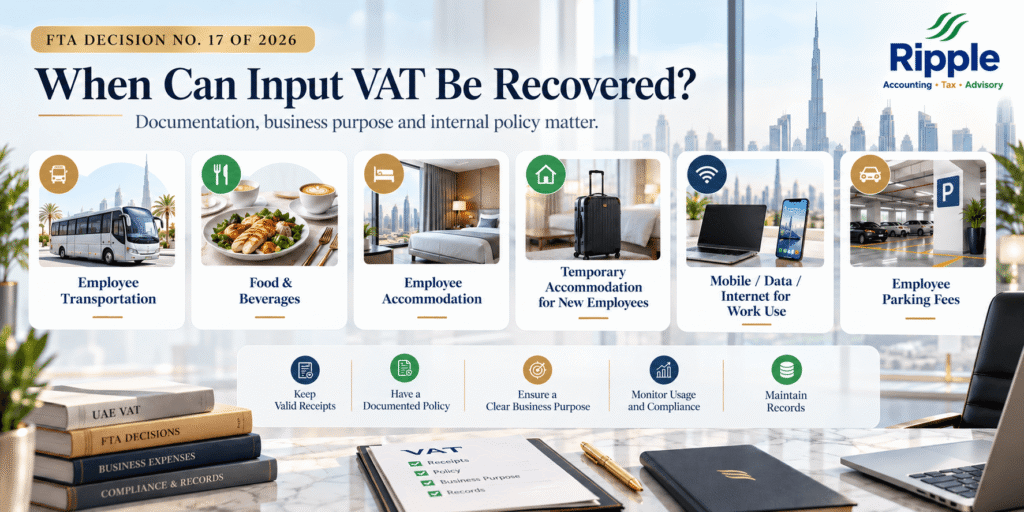
The Decision applies to taxable persons seeking to recover or deduct input VAT incurred on goods or services provided to employees free of charge, where there is a contractual obligation or documented policy to provide those goods or services.
Importantly, businesses should not assume that every employee-related expense qualifies for input VAT recovery. The expense must fall within one of the specified cases and meet the conditions applicable to that case.
Input VAT on employee transportation may be recoverable where the transportation is provided between the employee’s residence and workplace, to clients’ premises, or for another purpose directly connected with the employee’s job duties.
The service must not be used for the employee’s personal benefit. In addition, the employee must not have the option to receive a cash allowance or other financial compensation instead of the transportation service.
Businesses should therefore review whether their transportation arrangements and employee benefit policies meet these conditions.
The Decision also covers input VAT on food and beverages provided to employees, but the conditions are specific. The employee’s residence must be in a remote, distant or isolated area. Suitable facilities for preparing food must not be available at the residence or workplace, and there should be no nearby restaurants or facilities where employees can easily obtain food.
The provision of food and beverages must also be directly linked to the work period or residence period required because of the employee’s job. Employees must not be able to choose a cash allowance instead.
Input VAT on employee accommodation may qualify where the accommodation is required because of the operational needs of the business.
The conditions include:
This means businesses should review both the purpose of the accommodation and the supporting arrangements before claiming input VAT.
A separate rule applies to accommodation provided to new employees. Input VAT may be recoverable where the accommodation is temporary for a period of no more than 30 days and is appropriate for the employee’s job requirements and basic residency needs.
Businesses providing hotels, temporary housing or similar arrangements for new employees should therefore maintain records showing the period and purpose of the accommodation.
The Decision covers mobile phones, airtime, data packages and internet access provided to employees, including internet access from an employee’s residence through a modem or router. These goods and services must be necessary for the employee to perform job duties, including remote working or work-related communication outside normal working hours.
Any personal use must be incidental and insignificant. The employer must also have a documented internal policy explaining permitted use and the consequences of unauthorised use.
In addition, the employer must have reasonable monitoring mechanisms and maintain relevant records and justifications where unauthorised use occurs.
This makes internal policies and monitoring particularly important for businesses claiming input VAT on communication services.
Input VAT on employee parking expenses may qualify where the parking is incurred solely for business purposes and is directly related to job duties, business visits or related assignments. The employer must have a documented policy explaining when employees can be reimbursed for parking and the applicable approval mechanism.
Businesses must also retain evidence of payment, such as receipts showing the date, time, amount and VAT paid.
Businesses claiming input VAT on employee expenses should review their arrangements before the Decision takes effect.
A practical review can include:
The Decision becomes effective from 1 October 2026 following publication in the Official Gazette.
Reviewing employee expenses under the new VAT rules can require careful checking of supporting documents, internal policies and the conditions applicable to each expense category.
Ripple Accounting, Tax & Advisory can help UAE businesses review their employee-related expenses, accounting records and VAT treatment. Our support can include reviewing documentation, checking VAT recovery positions and identifying areas where additional records or internal controls may be needed.
Contact Ripple Accounting, Tax & Advisory for a tailored VAT compliance review and practical support with employee expense records and input VAT recovery.
FTA Decision No. 17 of 2026 provides specific conditions for input VAT recovery on six categories of employee-related expenses. Businesses should assess each expense against the applicable conditions rather than treating all employee benefits as automatically recoverable.
Reviewing contracts, internal policies, business purposes and supporting records before 1 October 2026 can help businesses identify areas that require attention before making future VAT recovery claims.
Disclaimer: This article is for general information only and should not be treated as tax, legal or accounting advice. The source document provided for this article is marked as an unofficial English translation. Businesses should refer to the official legislation and obtain professional advice before determining whether input VAT is recoverable in their specific circumstances.
Tell us a little about your business and our UAE tax experts will get back to you with clear, practical answers — no obligation.
 Audit
Is your UAE business calculating end-of-service gratuity correctly when an employee leaves, but forgetting to track the amount building up during their…
Read article Audit
Are you looking at your business numbers every month, or only checking them when cash gets tight or a major decision comes…
Read article VAT
Do you know the difference between the VAT your business charges customers and the VAT it pays on business expenses? Understanding input…
Read articlePage 16 of 59
Book a free consultation and get clear answers for your business.
0 Comments