Understanding Accounting Policies and Changes in Policies
Accounting policies are the foundation of accurate and consistent financial reporting. Every business, regardless of its size or industry, follows a set…
Read article
Are you a freelancer in the UAE who earns income from consulting, design, marketing, or other independent services? Do you know when your earnings make you liable for Corporate Tax registration?
Not every freelancer in the UAE automatically needs to register for Corporate Tax. The rules depend on the nature of the activity and the turnover generated from relevant business activities. Understanding these conditions helps freelancers distinguish personal income from business revenue, identify registration deadlines, and maintain appropriate financial records. This guide explains Corporate Tax freelancer UAE and natural persons, including the AED 1 million turnover threshold, registration requirements, taxable income, filing obligations, and practical examples.
The UAE Corporate Tax framework can apply to individuals who conduct a business or business activity in the country. Under the relevant rules, a natural person is generally subject to Corporate Tax when their total turnover from qualifying business activities exceeds AED 1 million in a Gregorian calendar year.
The Federal Tax Authority (FTA) confirms that natural persons whose qualifying business turnover does not exceed AED 1 million are not required to register for Corporate Tax on that basis. Salary, personal investment income, and real estate investment income are excluded from the relevant turnover calculation.
A natural person means an individual rather than a company or another legal entity.
For freelancers, this distinction matters because the rules are not based simply on whether someone receives money outside a traditional employment relationship.
For example, an independent marketing consultant who invoices clients for professional services may be conducting a business activity. However, an individual receiving a salary from an employer is not automatically subject to Corporate Tax on that salary.
Official guidance: FTA — Basis of Taxation for Natural Persons.
The AED 1 million threshold is one of the most important rules for freelancers and sole proprietors to understand.
It applies to the total turnover generated from qualifying business or business activities during a Gregorian calendar year, running from January to December.
It is not a threshold based on net profit, the amount remaining in a bank account, or the amount an individual withdraws for personal use.
Depending on the nature of the business, relevant turnover may include income generated from:
These are illustrative examples. Whether a particular activity qualifies as a business or business activity depends on the applicable rules and the facts of the case.
The FTA identifies the following income categories as excluded from the relevant natural-person turnover calculation:
The treatment of an income stream depends on its actual nature. For instance, income from personal investments should not automatically be treated as freelance business turnover, while a commercial activity involving property may require a different assessment.
The following examples illustrate how the AED 1 million turnover threshold works. They assume the income arises from relevant business activities conducted by a natural person and that no special circumstances change the analysis.
A freelance graphic designer earns AED 600,000 from qualifying business activities during the calendar year.
The turnover is below AED 1 million.
On these facts, the individual would generally not be required to register for UAE Corporate Tax solely on the basis of this freelance business turnover.
The freelancer should still maintain appropriate financial records and check whether other obligations, such as licensing or VAT requirements, apply.
A management consultant earns AED 1.2 million in turnover from qualifying business activities during the calendar year.
The turnover exceeds AED 1 million.
The consultant should assess the applicable Corporate Tax registration deadline, register with the FTA as required, and prepare to meet the relevant tax return and payment obligations.
The threshold is exceeded even if the consultant’s expenses are substantial and the final profit is considerably lower.
An individual receives AED 400,000 in employment salary and AED 800,000 in turnover from qualifying freelance business activities.
The salary is excluded from the AED 1 million business-turnover calculation. The relevant freelance turnover is AED 800,000, assuming the amounts are correctly classified and no other qualifying business turnover applies.
The individual would generally not be required to register solely on the basis of that freelance turnover.
This example shows why freelancers should classify different income streams correctly rather than combine all receipts into a single total.
For a resident natural person conducting a business or business activity in the UAE, the registration deadline is generally 31 March of the calendar year following the year in which qualifying turnover exceeds AED 1 million. The applicable rules and deadlines should always be checked against the individual’s circumstances.
For example:
| Calendar year | Qualifying business turnover | General position |
| 2025 | AED 850,000 | Below the threshold |
| 2026 | AED 1.1 million | Threshold exceeded |
| 31 March 2027 | — | General registration deadline for a resident natural person |
If the freelancer exceeds the threshold in 2026, they should generally apply for registration by 31 March 2027.
A non-resident natural person may be subject to different rules. Where the relevant business is conducted through a UAE permanent establishment and the threshold is exceeded, the applicable registration timeline may be three months from meeting the relevant conditions.
Freelancers should not wait until the end of the following year to check their registration position. Monitoring turnover throughout the year makes it easier to prepare the required documents and meet the applicable deadline.
Official source: FTA — Registration Timelines for Corporate Tax.
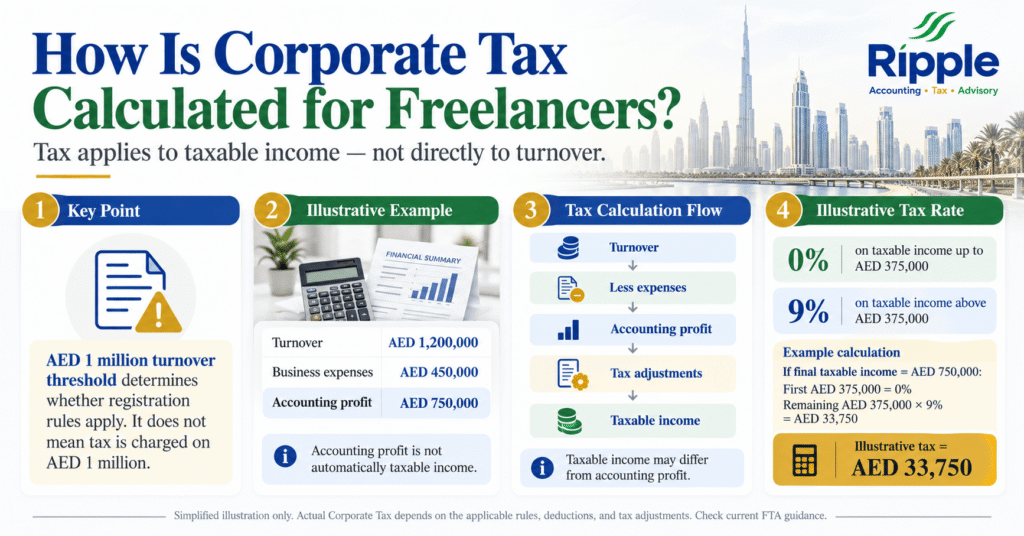
The AED 1 million turnover threshold determines whether the relevant natural person falls within the Corporate Tax registration rules. It does not mean that AED 1 million is the amount on which tax is automatically charged.
Once a freelancer is subject to Corporate Tax, the tax calculation generally begins with accounting income and applies the relevant adjustments required under UAE Corporate Tax legislation.
The final taxable income may differ from accounting profit because certain expenses, income items, and other adjustments are treated differently for tax purposes.
Consider a freelancer with the following annual figures:
| Financial item | Amount |
| Qualifying business turnover | AED 1,200,000 |
| Business expenses, before tax adjustments | AED 450,000 |
| Illustrative accounting profit | AED 750,000 |
The freelancer’s turnover exceeds AED 1 million, so the registration rules need to be considered.
However, the illustrative accounting profit of AED 750,000 is not automatically the final taxable income. The freelancer must determine which expenses are deductible and whether other tax adjustments apply.
For a taxable person subject to the standard UAE Corporate Tax regime, the general rates are:
The rates apply to taxable income, not directly to turnover. The applicable rules and any available relief must be considered before calculating the final liability.
For example, if a freelancer’s final taxable income is AED 750,000 and the standard rates apply, the illustrative calculation would be:
This is a simplified illustration, not a final tax assessment. The actual amount depends on the tax adjustments and rules applicable to the individual.
For more information, consult the FTA’s official Corporate Tax guidance.
Corporate Tax registration and business licensing are separate matters.
A freelancer may need a licence, permit, or other authorisation to conduct certain activities in the UAE, depending on the emirate, free zone, activity, and business arrangement.
The fact that a freelancer’s turnover is below AED 1 million does not automatically mean that the individual is exempt from licensing requirements.
Likewise, obtaining a freelance permit does not automatically remove the individual from the Corporate Tax framework if the relevant business turnover later exceeds the applicable threshold.
Freelancers should check the requirements of the relevant licensing authority and confirm whether their activity falls within the applicable Corporate Tax rules.
If a natural person is required to register and becomes subject to Corporate Tax, they must comply with the applicable filing obligations.
The general deadline for submitting a Corporate Tax return and paying any Corporate Tax due is nine months after the end of the relevant tax period.
For a natural person whose relevant tax period follows the calendar year, a return for the year ending 31 December 2026 would generally be due by 30 September 2027.
The deadline depends on the applicable tax period and rules. Freelancers should use their actual registration and tax-period details when confirming the filing date.
A freelancer should also distinguish between being below the threshold before registration and being an already registered person whose turnover later falls below AED 1 million. A reduction in turnover does not automatically cancel an existing registration. Deregistration conditions must be assessed separately.
Good bookkeeping helps freelancers monitor the turnover threshold, substantiate expenses, prepare financial statements, and meet their tax obligations.
Relevant records may include:
Maintain invoices, signed agreements, approved proposals, and supporting documents that explain the services delivered and the amounts charged.
These records help establish the source and nature of business income.
Retain supplier invoices, receipts, payment confirmations, and other evidence for expenses claimed in calculating taxable income.
An expense should not be treated as deductible merely because it was paid from a business account. Its treatment must meet the applicable tax requirements.
Keep bank statements, payment gateway reports, and transaction records that allow income and expenses to be reconciled.
Separate personal transactions from business transactions where possible to reduce errors and simplify reviews.
Maintain a year-to-date turnover report that combines relevant income from all qualifying business activities.
A freelancer who works for several clients should not assess the threshold using only the income from one client or platform.
Registered natural persons should maintain records supporting their Corporate Tax returns and financial statements. The FTA’s guidance states that relevant records and documents should generally be kept for seven years following the end of the applicable tax period.
Freelancers should verify the current requirements and retain any additional documents required under other applicable rules.
Understanding Corporate Tax rules can be challenging for freelancers who manage their own client contracts, invoices, expenses, and tax records.
Ripple Accounting, Tax & Advisory can support UAE businesses and eligible individuals with accounting and Corporate Tax processes, depending on the services required and the client’s circumstances.
Support may include:
If you are a freelancer or sole proprietor approaching the AED 1 million turnover threshold, a review of your records can help clarify the next steps and identify any applicable obligations.
Contact Ripple Accounting, Tax & Advisory to discuss your Corporate Tax requirements and obtain support suited to your business circumstances.
Explore Ripple’s Corporate Tax Services
No. A natural person conducting a business or business activity is generally required to register when qualifying business turnover exceeds AED 1 million in a Gregorian calendar year. The individual’s activities and circumstances should be assessed against the applicable rules.
It is based on qualifying business turnover, not net profit. Business expenses do not reduce the turnover figure used to test the threshold.
No. Salary is excluded from the relevant natural-person turnover calculation. Personal investment income and real estate investment income are also excluded under the applicable rules.
The general deadline is 31 March of the calendar year following the year in which qualifying turnover exceeds AED 1 million. Different timelines may apply to non-resident natural persons, so the relevant FTA rules should be checked.
Maintaining organised records is good practice regardless of turnover. Freelancers may also have licensing, VAT, contractual, or other obligations that should be assessed separately from Corporate Tax registration.
Corporate Tax for UAE freelancers depends on the nature of the business activity and the turnover generated from qualifying business activities. The AED 1 million threshold is a key registration test, but it should not be confused with taxable profit or the amount of tax payable. By tracking turnover, maintaining supporting documents, understanding registration deadlines, and reviewing the applicable rules, freelancers can approach their tax obligations with greater confidence.
Need help reviewing your freelance business records? Contact Ripple Accounting, Tax & Advisory for support with bookkeeping, financial reporting, and Corporate Tax compliance.
Disclaimer: This article provides general information and does not constitute legal, accounting, or tax advice. The appropriate treatment depends on the individual’s activities, tax status, licensing arrangements, and current UAE legislation. Confirm your position with the Federal Tax Authority or a qualified UAE tax adviser before making compliance decisions.
Tell us a little about your business and our UAE tax experts will get back to you with clear, practical answers — no obligation.
 Compliance
Accounting policies are the foundation of accurate and consistent financial reporting. Every business, regardless of its size or industry, follows a set…
Read article Corporate Tax
Small Business Relief UAE is a Corporate Tax relief designed to reduce the compliance burden for eligible small businesses while supporting entrepreneurship…
Read article Compliance
Businesses operating in the UAE must stay updated with changes to tax compliance requirements and administrative penalties. As the UAE tax system…
Read articlePage 47 of 59
Book a free consultation and get clear answers for your business.
0 Comments