UAE Tax Residency Certificate Fees, Processing Time and Validity
How much does a UAE Tax Residency Certificate cost, how long does it take to obtain, and when does it expire? Understanding…
Read article
Is your UAE clinic generating revenue but still struggling with delayed insurance payments, rejected claims, growing patient balances, or unclear accounts receivable?
For a healthcare provider, generating revenue does not end when a doctor completes a consultation or procedure. The revenue must move through a series of financial and administrative stages before it becomes collected cash. A missing insurance authorization, incorrect medical code, incomplete documentation, rejected claim, incorrect payment posting, or delayed patient follow-up can interrupt that process.
Let’s get started learning more about clinic revenue cycle management UAE!
Clinic Revenue cycle management in the UAE must operate within the country’s healthcare regulatory and insurance framework. The applicable requirements can differ depending on where the clinic operates. Healthcare providers may need to deal with authorities and systems, including:
For example, Dubai’s eClaimLink provides standardized claims-related resources, including coding and data requirements for healthcare providers and payers.
MOHAP’s e-Claims Post Office similarly facilitates electronic exchange between providers and payers, including eligibility, authorization, and claims transactions. This environment means that a clinic’s financial team cannot treat billing as an isolated accounting task.
The quality of information collected at reception can affect whether a claim is paid. The quality of clinical documentation can affect coding. Coding can affect claim adjudication. The payer response affects accounts receivable, and payment posting ultimately affects the accounting records. Revenue cycle management connects all of these stages.
A well-designed revenue cycle begins before treatment and ends only when the clinic has correctly collected and reconciled the amount due.
The first stage is accurate patient registration. The clinic should capture relevant information such as:
This is the foundation of patient billing UAE processes.
Insurance eligibility should be verified before treatment whenever possible. Relying solely on the information printed on an insurance card can expose the clinic to avoidable financial risk.
Example: A patient visits a specialist and provides an insurance card. The receptionist assumes the policy is active. The clinic provides treatment worth AED 1,500. Later, the insurer rejects the claim because the policy was inactive or the clinic was outside the relevant network.
The medical service was delivered successfully, but the clinic may now have difficulty recovering the expected amount. A proper eligibility process could have identified the issue before treatment.
Certain healthcare services may require prior approval from the insurer. A clinic should therefore identify procedures that require pre-authorization and establish responsibility for obtaining approval.
The workflow should include:
Documentation is equally important. A service can be medically appropriate but still encounter reimbursement difficulties if the documentation does not adequately support the diagnosis, treatment, or procedure being billed.
Example: A clinic performs a procedure for AED 2,000, but the insurer’s authorization approves a specific service or amount under particular conditions.
If the clinic does not check the authorisation before treatment, it may later discover that the submitted claim does not correspond with the approved service. Strong RCM controls connect clinical documentation, authorization, and billing.
After treatment, the clinic must accurately record the services provided. This is where medical billing UAE depends heavily on complete documentation and accurate coding.
Potential errors include:
Dubai’s eClaimLink provides standardized resources for healthcare claims, including CPT and HCPCS-related data.
Imagine a physician performs three billable services, but the billing system records only two. The resulting claim may contain no obvious technical error. However, the clinic has still lost revenue because one service was never billed.
This is revenue leakage. Effective RCM therefore compares:
Services provided → Services documented → Charges captured → Claims submitted → Payments received
Any unexplained gap deserves investigation.
Once charges have been captured and reviewed, claims are submitted to the relevant payer or claims platform. This is a central stage in health insurance claims UAE workflows. The payer may:
Electronic claims infrastructure has become an important part of UAE healthcare administration. Dubai’s eClaimLink supports standardized claims processes, while MOHAP’s e-Claims Post Office supports electronic exchanges between providers and payers.
The objective should therefore not be simply to submit claims quickly. The goal is to submit clean, accurate, and complete claims the first time.
When an insurer makes a payment, the revenue cycle is not finished. The payment must be correctly posted to the relevant patient and claim accounts and reconciled against the payer’s remittance information.
The clinic should identify:
Example: A clinic submits a claim for AED 1,000. The insurer pays AED 750. AED 150 is assigned to the patient, and AED 100 is a contractual adjustment.
The records should therefore reflect:
| Item | Amount |
| Original claim | AED 1,000 |
| Insurance payment | AED 750 |
| Patient responsibility | AED 150 |
| Contractual adjustment | AED 100 |
If the AED 100 contractual adjustment is incorrectly treated as money still owed by the patient, the clinic’s receivables will be overstated.
This is why healthcare accounts receivable UAE management requires accurate payment posting and reconciliation rather than simply tracking unpaid invoices.
Claim denials can significantly affect cash flow. Common causes include:
However, effective denial management is not simply about appealing rejected claims.
Clinics should identify the root cause of recurring denials.
Example: Suppose a clinic receives 100 claim denials during a month, and 40 relate to missing authorization.
The immediate reaction might be to assign employees to appeal the 40 claims. A better approach is to ask why authorizations are repeatedly being missed.
Perhaps:
Fixing the underlying process can prevent future denials.
Insurance does not necessarily cover the entire cost of treatment. Patients may have financial responsibility through:
This makes patient billing UAE an important component of the revenue cycle. Patients should receive clear and understandable statements showing:
Example: A patient’s total treatment is AED 1,500. The insurer pays AED 1,200, leaving AED 300 as patient responsibility.
The clinic should clearly communicate why the patient owes AED 300 rather than simply issuing a collection request with no explanation. Clear billing can reduce disputes and improve collection efficiency.
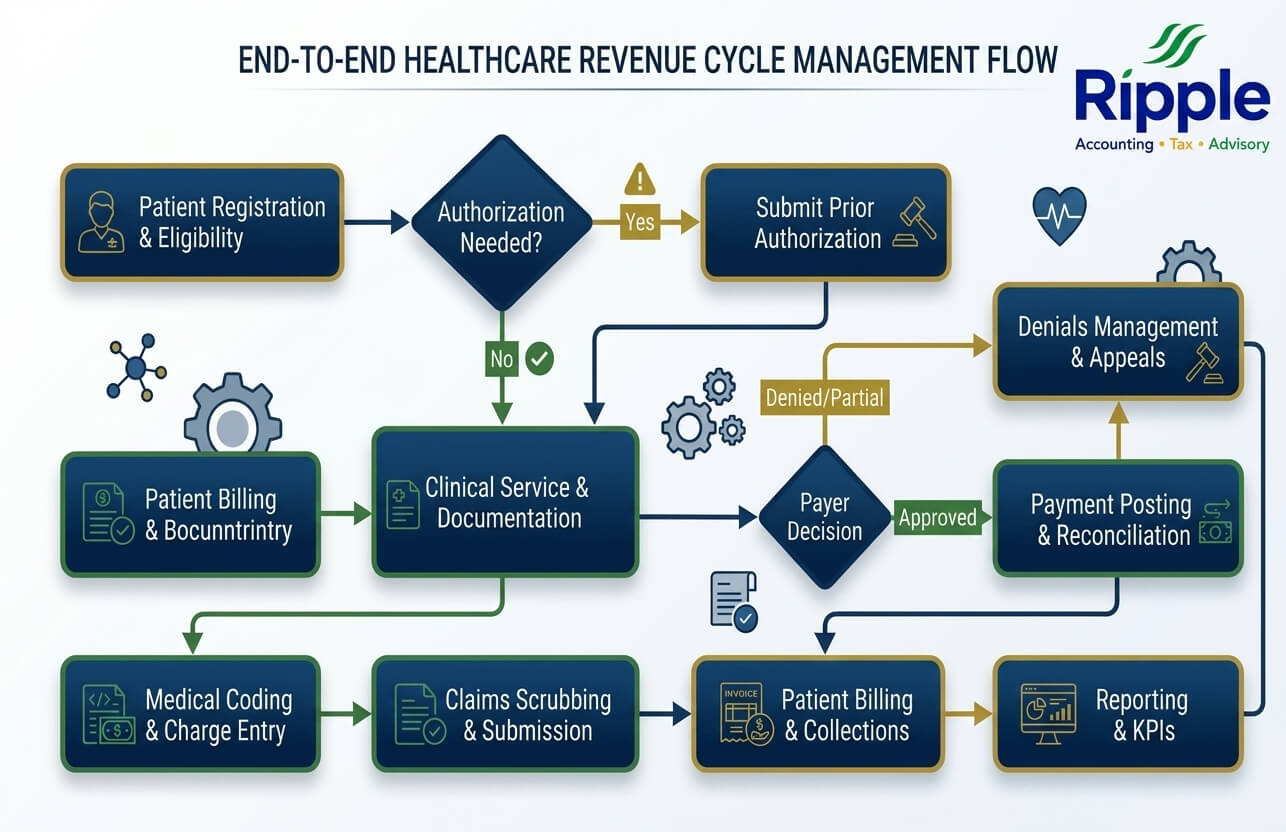
Medical billing and collections UAE should therefore operate as connected processes. Billing creates the receivable; collections convert that receivable into cash.
Revenue leakage does not always come from major accounting errors. It can happen through small process failures repeated hundreds of times. Common leakage points include:
A clinic may work with several insurers and third-party administrators, each with different processes, contracts, and requirements. A useful payer management system should maintain information such as:
| Payer information | Purpose |
| Payer/TPA | Identify responsible organisation |
| Network status | Confirm coverage |
| Authorization requirements | Prevent avoidable denials |
| Contract rates | Reconcile expected payments |
| Claim requirements | Improve clean-claim rate |
| Filing timelines | Prevent delayed submissions |
| Denial codes | Identify recurring issues |
| Payment terms | Support cash-flow planning |
This makes medical claims management UAE more systematic. It also reduces reliance on individual employees remembering different payer requirements.
Healthcare businesses should also consider VAT when designing their accounting processes.
The UAE VAT framework provides for zero-rating of certain qualifying healthcare services, subject to the conditions set out in the legislation. The Federal Tax Authority identifies qualifying healthcare among zero-rated supplies.
The Executive Regulation provides conditions relating to healthcare services, including supplies made by qualifying licensed healthcare providers or professionals and services relating to the well-being of a human being.
However, a clinic should not assume that every item appearing on a healthcare invoice automatically receives the same VAT treatment.
Example: A clinic may generate revenue from:
Each revenue stream should be reviewed according to the applicable VAT rules. The accounting system should therefore be capable of distinguishing between relevant VAT categories.
This is especially important for clinics with mixed supplies, because incorrect classification can affect both VAT reporting and input VAT recovery.
A clinic cannot improve what it does not measure. Management should monitor a focused group of revenue-cycle KPIs.
Clean Claim Rate:
Denial Rate
Days in Accounts Receivable
Aging of Receivables
Collection Rate
Payment Posting Time
Technology can improve revenue cycle performance, but software alone cannot correct a poorly designed process. A suitable clinic billing or practice-management system should ideally support:
The strongest environment is one where clinical, billing, and accounting systems communicate with each other.
For example:
Electronic Medical Record → Billing → Claims → Payer Response → Payment Posting → Accounting → Management Reporting
If these systems operate independently, employees may repeatedly enter the same information, increasing the possibility of discrepancies. Internal controls should complement technology. Clinics should establish:
Ripple Accountant can help UAE clinics strengthen the financial side of their revenue cycle by connecting medical billing information, receivables, collections, and accounting records.
The objective is not simply to prepare financial statements after transactions have occurred. The objective is to provide management with better visibility over the complete revenue process.
Support can include:
To avail our services, pick up your phone and contact us; our team will guide you completely!
Clinic revenue cycle management is the complete financial process through which a healthcare provider converts services into collected revenue. It includes registration, insurance verification, authorization, coding, billing, claims, payment posting, denial management, patient collections, and accounts receivable.
Medical billing primarily deals with creating and submitting bills and insurance claims. Revenue cycle management is broader, covering the complete financial journey from patient registration through final collection and reconciliation.
Insurance verification confirms whether a patient’s policy is active and whether the clinic and proposed service are covered under the applicable arrangements. Identifying problems before treatment can reduce avoidable claim denials.
Common causes include eligibility issues, missing authorisation, incorrect coding, incomplete documentation, duplicate claims, non-covered services, and incorrect patient information.
Clinics can improve AR by submitting clean claims, posting payments promptly, following up on denials, monitoring aged balances, and maintaining effective patient collection procedures.
Important indicators include clean claim rate, denial rate, days in accounts receivable, collection rate, payment posting time, and aged receivables.
Effective Clinic Revenue Cycle Management UAE is far more than submitting insurance claims. It is a connected process beginning with patient registration and ending at accounting reconciliation. A weakness at any stage can affect the clinic’s cash flow.
A registration error can cause a claim rejection. A missing authorization can result in non-payment. An incorrect code can delay reimbursement. An unrecorded payment can overstate receivables. Poor patient follow-up can leave legitimate balances outstanding for months. For this reason, successful healthcare revenue cycle management UAE requires collaboration between clinical staff, reception teams, billing specialists, insurance teams, and finance professionals.
Disclaimer: This article provides general information for educational purposes only and does not constitute legal, tax, accounting, financial, or professional advice. Rules, regulations, and requirements may vary depending on the specific circumstances, industry, location, and applicable laws. Readers should verify the latest requirements with the relevant authorities and consult a qualified professional before making any business, financial, tax, or compliance decisions.
Tell us a little about your business and our UAE tax experts will get back to you with clear, practical answers — no obligation.
 Corporate Tax
How much does a UAE Tax Residency Certificate cost, how long does it take to obtain, and when does it expire? Understanding…
Read article Corporate Tax
Are you planning to apply for a UAE Tax Residency Certificate but unsure which documents you need or whether you qualify? Understanding…
Read article Corporate Tax
Do you need a UAE Tax Residency Certificate for a local administrative requirement or to claim benefits under a double taxation agreement?…
Read articlePage 1 of 58
Book a free consultation and get clear answers for your business.
0 Comments